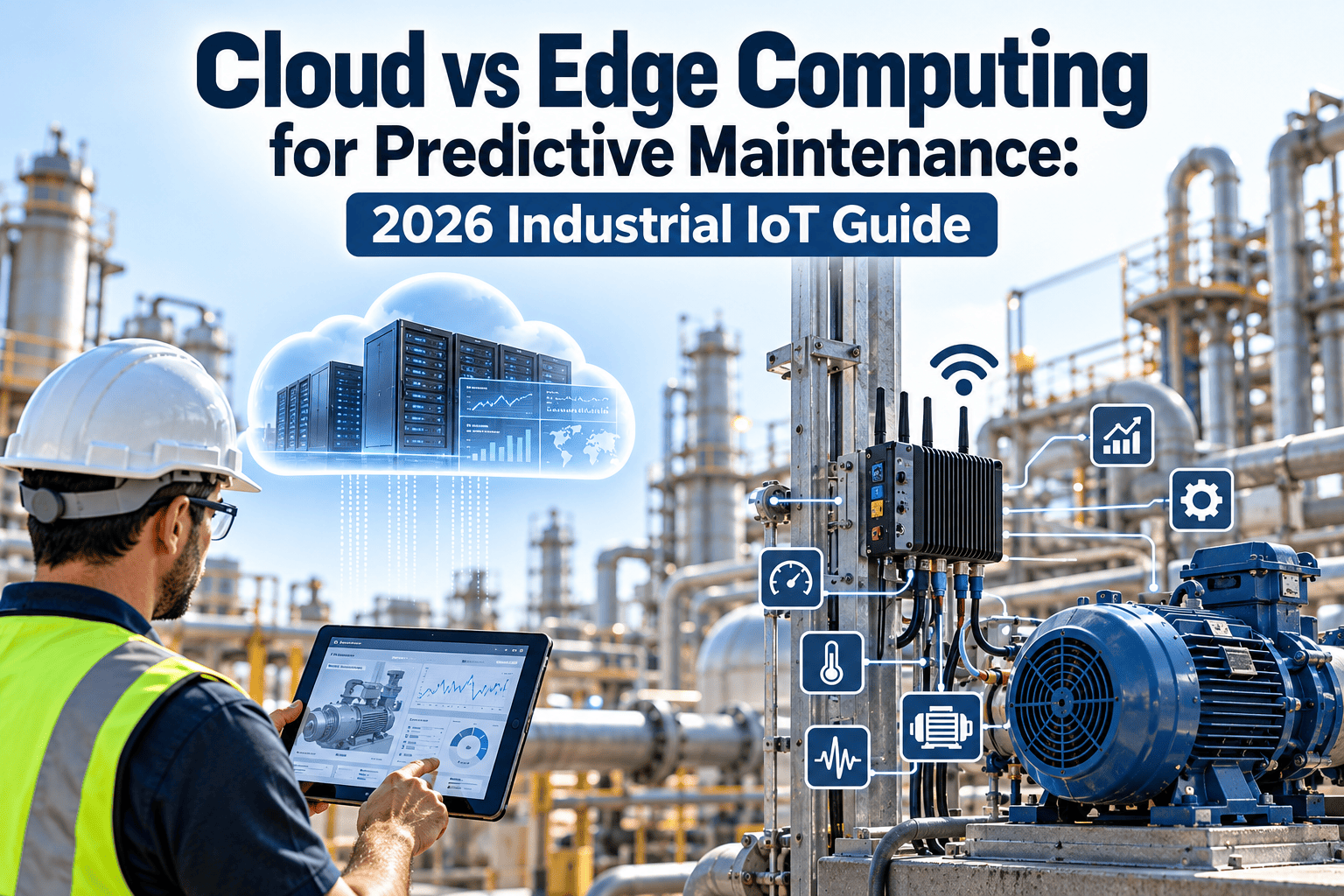
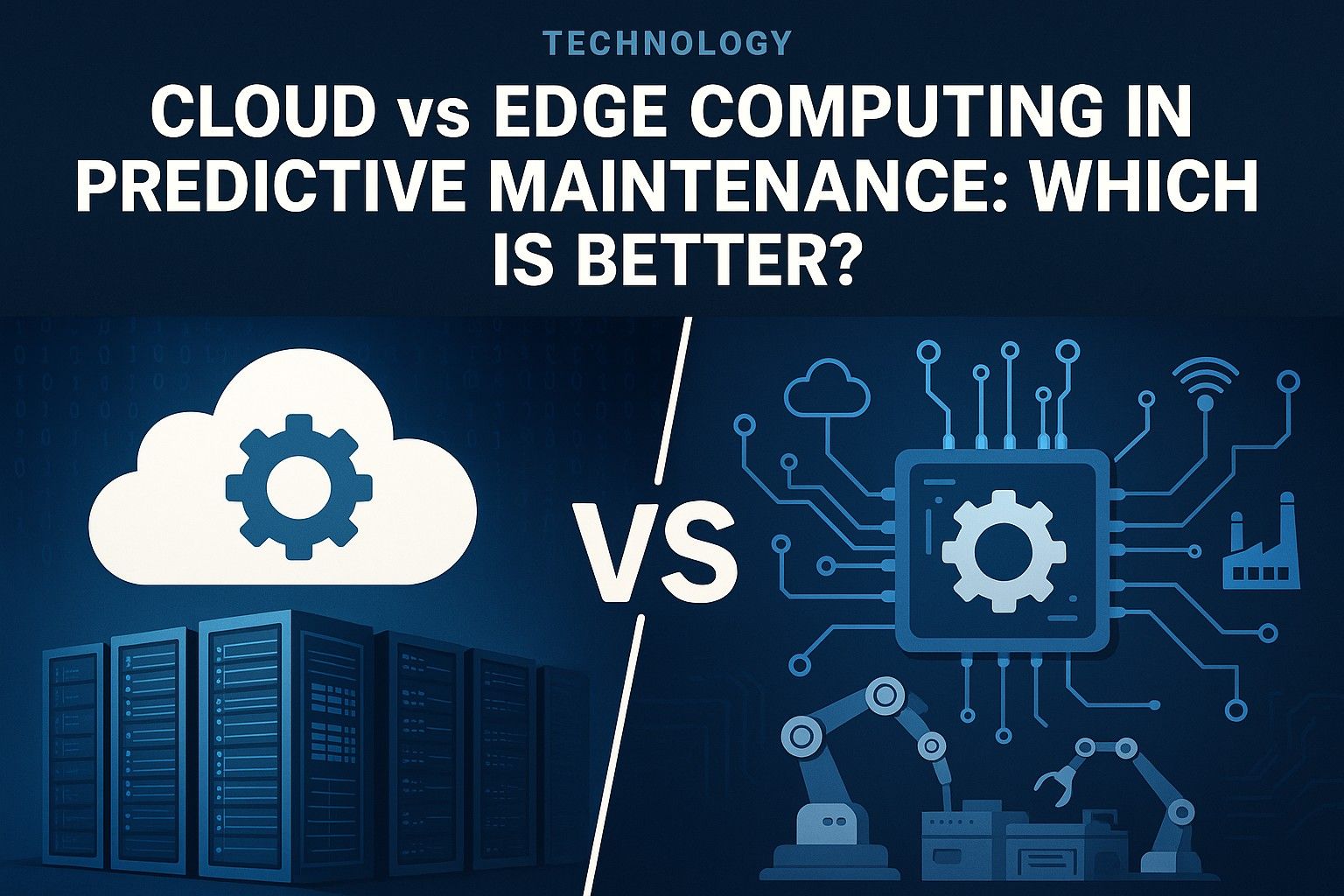
A bearing at 50,000 RPM doesn't wait for your cloud server to respond. By the time sensor data travels to a remote data center and a prediction returns — 200 milliseconds later — the bearing has completed 166 additional rotations. In that window, micro-damage becomes catastrophic failure. Edge AI eliminates this gap entirely by processing sensor data directly on the factory floor, detecting anomalies in under 10 milliseconds, and triggering protective actions before damage occurs. This isn't incremental improvement — it's the difference between a $500 planned bearing replacement and a $200,000 emergency shutdown. Manufacturers using edge-based predictive maintenance report up to 40% reductions in unplanned downtime and 30% lower maintenance costs. Schedule a demo to see edge AI detecting equipment anomalies in real time.
UPCOMING OXMAINT EVENT
AI Predictive Maintenance: Eliminate Downtime Before It Starts
Join OxMaint's expert-led session covering how AI-native predictive maintenance — including real-time anomaly detection, sensor-to-work-order automation, and CMMS-driven reliability — transforms your maintenance strategy from reactive to predictive.
✓ Live AI anomaly detection walkthrough
✓ Q&A with OxMaint's maintenance AI specialists
✓ Real-world breakdown prevention case studies
✓ Actionable predictive maintenance roadmap you can use immediately
<10ms
Edge Detection Speed
Anomalies detected in milliseconds — 50× faster than cloud round-trip
25%
Fewer Equipment Failures
Documented reduction from Siemens and GE edge AI deployments
15%
OEE Improvement
Overall equipment effectiveness boost from edge predictive maintenance
30%
Lower Maint. Costs
Maintenance cost reduction with on-device AI monitoring
Why Milliseconds Matter: The Speed Gap That Destroys Equipment
In industrial environments, the time between detecting an anomaly and taking action determines whether you get a planned repair or a catastrophic failure. Cloud AI adds 50–500ms of network latency. For high-speed rotating equipment, safety interlocks, and precision production lines, that delay is the difference between saving and destroying the asset.
Edge AI Path
Sensor
→
Local Gateway
→
AI Inference
→
Action
Total: 1–10ms
Cloud AI Path
Sensor
→
Gateway
→
Internet
→
Data Center
→
Return
→
Action
Total: 50–500ms
At 50,000 RPM, a 200ms cloud delay = 166 rotations of undetected damage. At 600 units/min packaging speed, a 1-second delay = 10 defective products shipped.
What Edge AI Detects — And How Fast
Edge AI doesn't just monitor one parameter — it fuses multiple sensor streams simultaneously to build a real-time behavioral model of each asset. When any parameter deviates from the learned baseline, the system detects it in milliseconds and classifies the anomaly type, severity, and projected time-to-failure.
Vibration Analysis
Detects: Bearing wear, misalignment, imbalance, looseness, gear mesh faults
Detection: <5ms
Warning window: 14–60 days before failure
Temperature Monitoring
Detects: Overheating bearings, lubrication failure, electrical faults, insulation breakdown
Detection: <10ms
Warning window: 7–30 days before failure
Current / Power Draw
Detects: Motor degradation, load anomalies, winding faults, energy waste from friction
Detection: <2ms
Warning window: 10–45 days before failure
Acoustic / Ultrasonic
Detects: Compressed air leaks, steam trap failures, electrical arcing, early-stage bearing defects
Detection: <8ms
Warning window: 7–21 days before failure
Pressure Monitoring
Detects: Hydraulic leaks, valve failures, blockages, pump degradation, system integrity loss
Detection: <5ms
Warning window: 3–14 days before failure
Machine Vision (CV)
Detects: Surface defects, alignment drift, wear patterns, contamination, assembly errors
Detection: <15ms
100% inspection at full line speed — zero escapes
Your Machines Are Generating Millions of Data Points Per Hour. Are You Listening? OxMaint fuses vibration, temperature, current, and pressure data at the edge — detecting failure signatures weeks before breakdown.
Start Free Trial
Schedule a Demo
From Signal to Saved: The Real-Time Detection Journey
Edge AI transforms raw sensor noise into a prevented failure in four automated steps — all happening within your facility, in under 60 seconds from anomaly to work order, with zero cloud dependency.
01
Sense (<1ms)
IoT sensors stream vibration, temperature, current, and acoustic data to local edge gateways at kilohertz frequency — capturing micro-patterns invisible at lower sampling rates.
02
Analyze (<10ms)
ML models on NPU-equipped edge hardware compare live readings against equipment-specific baselines. Anomaly classified by type, severity, and confidence score.
03
Decide (<50ms)
Critical anomalies trigger immediate protective actions — safety shutdowns, load reductions, or operator alerts — without waiting for human review or cloud response.
04
Act (<60s)
CMMS auto-generates a predictive work order with diagnosed failure mode, asset context, parts list, and recommended repair window — all within your secure local network.
5 Factory Scenarios Where Edge AI Is Non-Negotiable
For some industrial scenarios, cloud-based AI simply cannot respond fast enough. These five use cases require on-device intelligence — and they represent the highest-value applications of edge AI in manufacturing today.
Requirement: 5–20ms response to prevent catastrophic failure at 50,000 RPM. Cloud latency of 200ms = 166 unprotected rotations.
Edge AI action: Local AI detects bearing resonance change and triggers emergency stop before vibration reaches destructive threshold — verified by functional safety hardware (IEC 61508).
Requirement: Inspect every unit at 600+/min line speed. A 1-second cloud delay = 10 uninspected products shipped.
Edge AI action: On-camera vision models detect microscopic defects in <15ms, rejecting defective units in real time. 100% inspection coverage at full line speed.
Requirement: Millisecond path adjustments as conditions change. Cloud latency causes collisions, dropped parts, or safety zone violations.
Edge AI action: Local AI monitors torque, position, and force sensors on each joint — detecting anomalies that predict servo failure or mechanical wear before the arm misbehaves.
Requirement: Continuous monitoring at oil fields, mines, and distributed facilities where internet is unreliable or nonexistent.
Edge AI action: Fully autonomous monitoring — detects, alerts, and logs 24/7 regardless of connectivity. Syncs insights when connection returns.
What Makes Industrial Edge AI Different from Consumer Edge
Factory-floor edge AI faces requirements that consumer devices never encounter. Industrial edge hardware must survive extreme environments, process high-frequency sensor data continuously, and meet functional safety certifications that consumer products don't require.
Rugged Hardware
Fanless, DIN-rail mountable, operating -40°C to +70°C. Dust, vibration, moisture resistant. Designed for 24/7 factory-floor deployment with 10+ year lifecycles.
NPU Acceleration
Neural Processing Units deliver 150+ TOPS locally — running complex ML inference at 10–20× lower power than GPUs. Purpose-built for continuous on-device AI workloads.
Safety Certification
IEC 61508 / ISO 26262 functional safety. Dedicated safety island processors ensure hardware-level separation between AI and safety-critical control loops.
Protocol Support
OPC-UA, Modbus, MQTT, EtherNet/IP, PROFINET. Connects to legacy PLCs (1980s–present) and modern sensors through industrial-grade I/O connectors.
Your Equipment Fails in Milliseconds. Your AI Should Be Faster.
OxMaint puts AI intelligence directly on the factory floor — detecting failure signatures in under 10ms, generating predictive work orders in under 60 seconds, and keeping every production hour protected.
Frequently Asked Questions
What's the actual latency difference between edge and cloud AI in a factory?
Edge AI delivers 1–10ms detection-to-action response because data never leaves the local network. Cloud AI adds 50–500ms due to the sensor → internet → data center → response return path. For a bearing running at 50,000 RPM, a 200ms cloud delay means 166 additional rotations of undetected damage. For a packaging line at 600 units/minute, a 1-second cloud delay means 10 defective products shipped. Edge AI eliminates this gap entirely.
Start free and experience real-time edge detection on your equipment.
Can edge AI work with my existing legacy equipment?
Yes. Edge gateways connect to legacy PLCs, SCADA systems, and even machines from the 1960s–1980s using standard industrial protocols — OPC-UA, Modbus, MQTT, and serial converters. Non-invasive sensors (clamp-on vibration, external temperature probes, magnetic current sensors) retrofit to virtually any equipment without modifying wiring. The edge hardware normalizes data from any source into AI-ready formats.
How accurate is edge AI compared to cloud-based models?
Edge AI runs small, task-specific models optimized for specific equipment types — achieving 99.5%+ accuracy on known failure modes. Industrial models require higher accuracy than consumer AI (99.5% vs. 95%). The key advantage: edge models are trained on your equipment's specific operating patterns, not generic global datasets. Cloud handles the heavy training; edge handles the fast, accurate inference. By month 12, prediction accuracy typically exceeds 92% on your specific equipment.
Book a demo to see accuracy benchmarks on real industrial equipment.
What edge hardware do I need to get started?
Modern industrial edge gateways are compact (DIN-rail mountable), fanless, and built for factory environments — operating from -40°C to +70°C with dust, vibration, and moisture resistance. NPU-equipped gateways cost $2,000–$10,000 per node, each covering 5–10 monitored assets. They consume 10–20× less power than GPU-based solutions. OxMaint provides recommended hardware specifications matched to your sensor count and asset types.
Does edge AI replace cloud analytics or work alongside it?
Edge AI handles real-time detection, safety actions, and local work order generation. Cloud analytics (optional) handles fleet-wide pattern analysis, model retraining, and cross-plant benchmarking. Most manufacturers deploy a hybrid architecture where edge handles the millisecond decisions and cloud handles the big-picture intelligence. OxMaint supports both — edge-first with optional cloud sync. Your raw sensor data never leaves your facility.
Start free with edge AI and add cloud analytics when you're ready to scale.