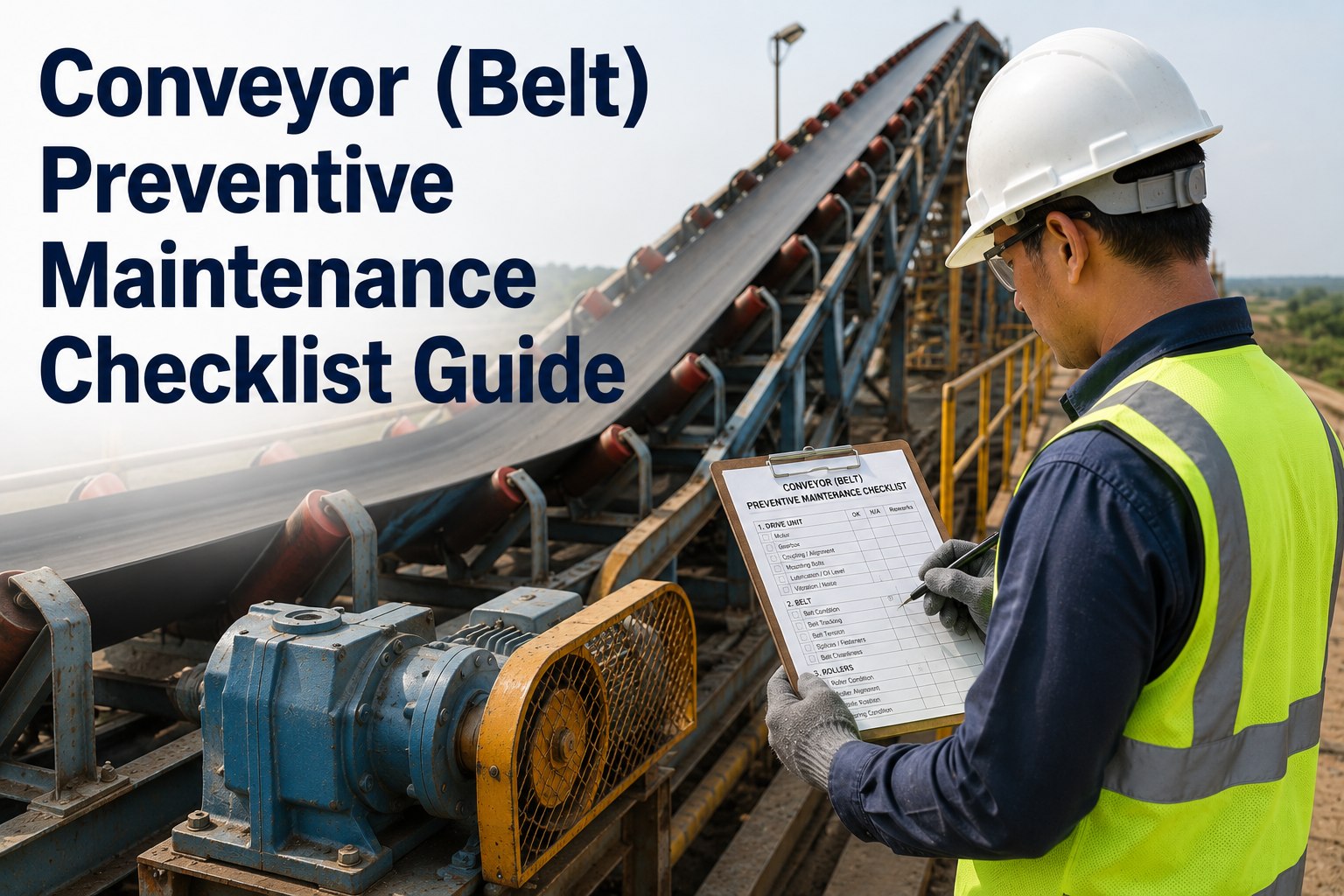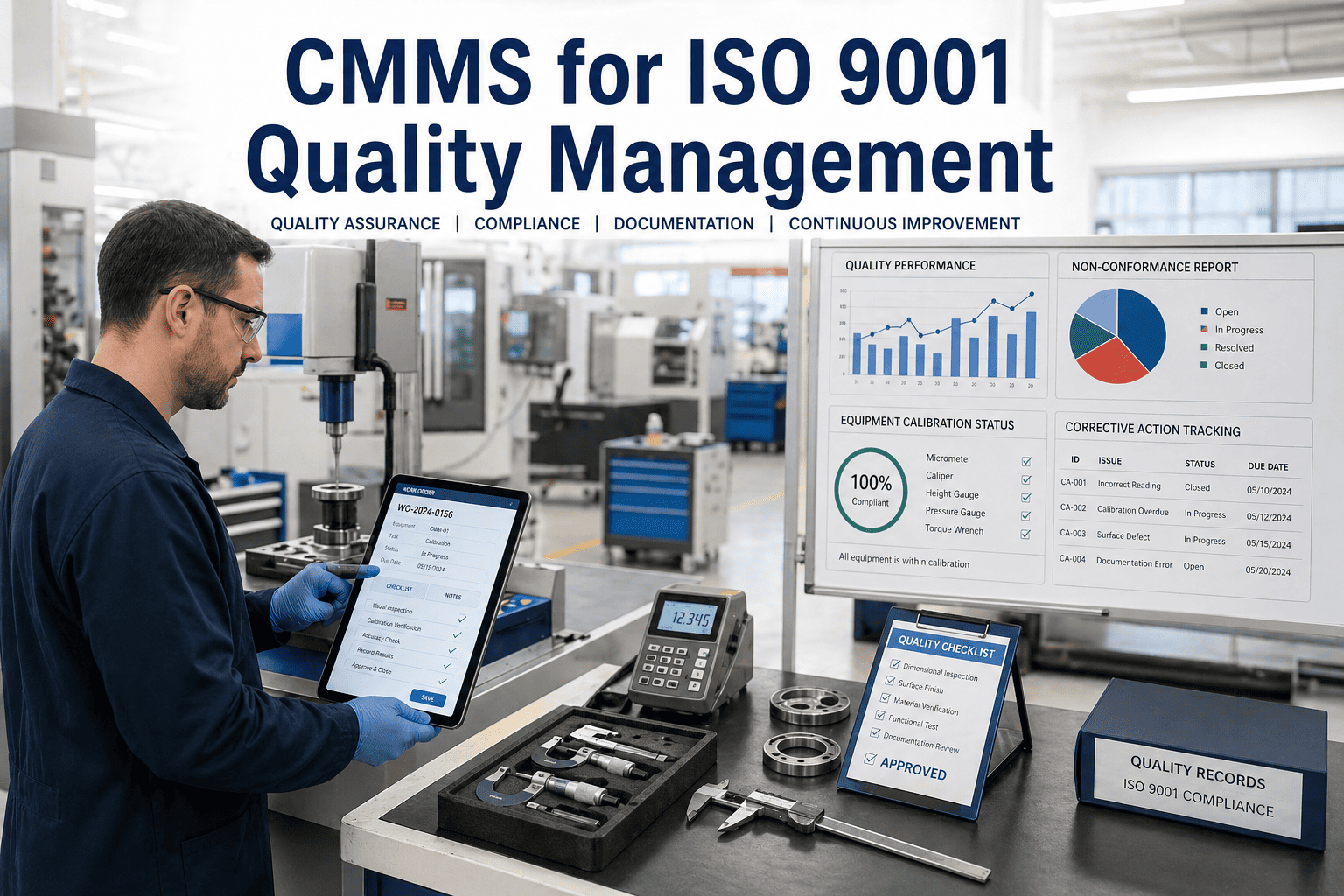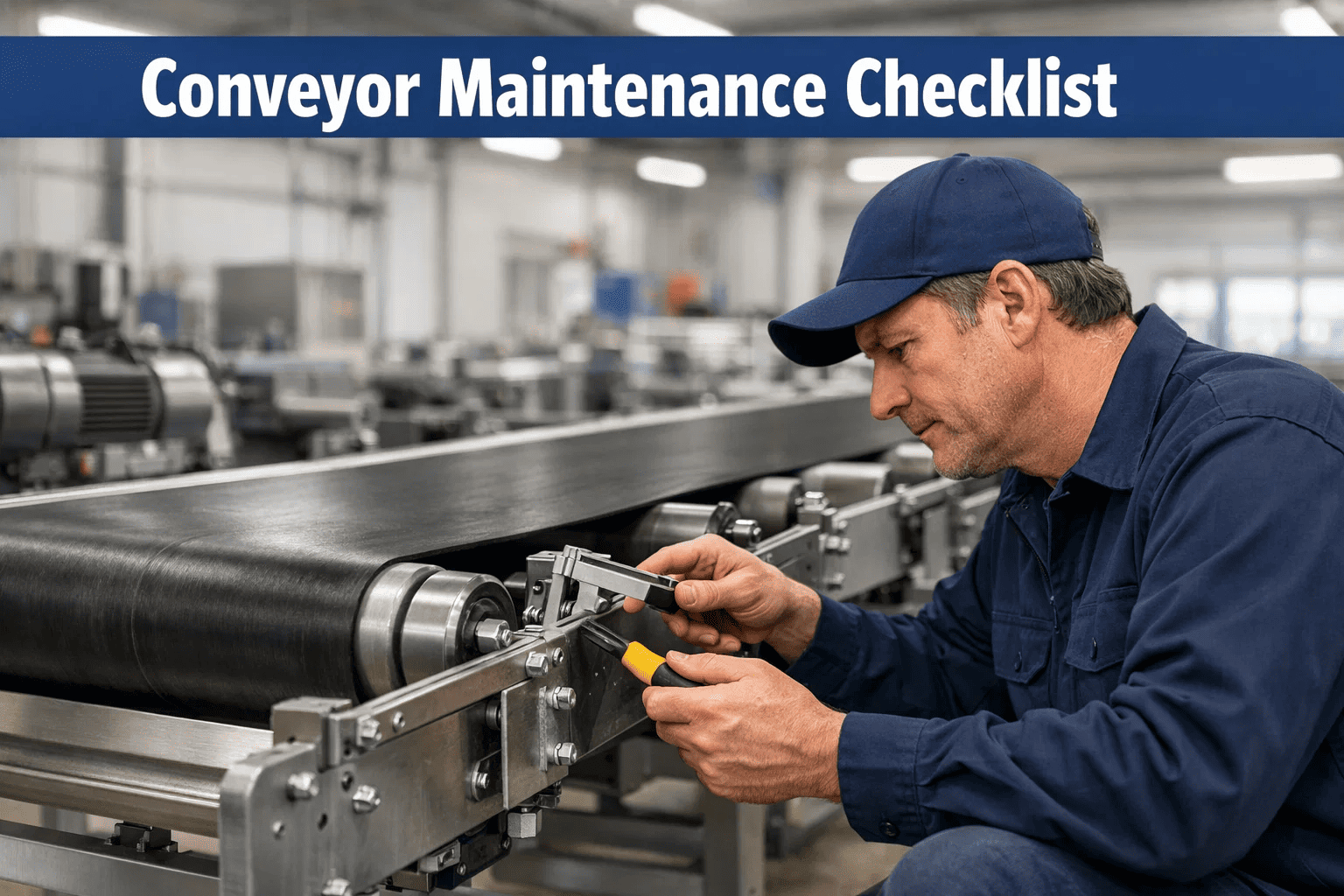
A stopped conveyor is a stopped plant — and in most manufacturing facilities, the conveyor system is the single most interconnected asset on site, with a failure on one section cascading downstream through 6 to 14 dependent operations. Roughly 29% of all unplanned manufacturing downtime traces back to conveyor systems that were either missed during inspection or inspected inconsistently across shifts. A proper conveyor maintenance checklist isn't paperwork — it's a structured defense against the small deviations (belt mistracking by 3mm, roller rotation irregularity, one loose impact idler) that compound into catastrophic events. Want a pre-built checklist library that adapts to your specific conveyor configuration? start a free trial or book a demo and we'll import your conveyor registry in under an hour.
The Conveyor Checklist That Prevents 90% of Manufacturing Line Stoppages
Daily, weekly, monthly, and quarterly inspection tasks covering belt tracking, roller condition, drive components, alignment, lubrication, and safety — structured as executable checklists with CMMS scheduling and mobile completion built in.
12% of failures
18% of failures
32% of failures
14% of failures
9% of failures
15% of failures
300+ conveyor inspection tasks mapped to asset type, duty class, and compliance standard
Import your conveyor list, select your belt type (troughed, flat, cleated, modular, roller), and OxMaint generates a full PM schedule with daily, weekly, monthly, and quarterly checklists preloaded. Each task includes inspection criteria, pass/fail thresholds, and photo capture — structured for CMMS execution from day one.
The Four-Tier Checklist Structure Every Conveyor Needs
The most common mistake in conveyor maintenance is collapsing all inspection work into a single monthly PM. Different failure modes develop on different timescales — belt mistracking shows up within days, bearing wear over weeks, and structural fatigue over months. A proper checklist program runs on four tiers with different inspection depth, and OxMaint's PM engine schedules all four tiers automatically.
Shift-Start Walk-Through
- Visual belt tracking — center ±10mm
- Unusual noise from drive or idlers
- Belt tears, splice damage, material spillage
- Emergency pull-cord and guard integrity
- Lubrication reservoir levels visible
- Motor/gearbox external leak check
Running Inspection
- Idler rotation — all idlers spinning freely
- Belt tension verification
- Drive coupling condition
- Skirt rubber and impact bar wear
- Discharge chute build-up or blockage
- Scraper blade contact and wear
Shutdown Inspection
- Pulley lagging condition and wear
- Bearing temperature trend review
- Gearbox oil analysis sample
- Belt alignment precision measurement
- Take-up travel inspection
- Structural bolt torque spot-check
Deep Overhaul
- Complete idler replacement audit
- Belt thickness / cover wear measurement
- Pulley shaft alignment (laser)
- Drive coupling replacement schedule
- Guard, interlock, and E-stop function test
- Structural weld and frame inspection
The Complete Conveyor Daily Inspection Checklist
This is the exact daily checklist OxMaint ships with out of the box for belt conveyors — customizable per asset, executable from a mobile device with photo capture and pass/fail logging. Each item takes 30–45 seconds and the complete walk-through runs under 5 minutes per conveyor section.
Why Paper Checklists Fail — And Digital Checklists Don't
Most manufacturing plants already have conveyor checklists in some form. The problem is the format. Paper clipboards, binder logs, and spreadsheet trackers all fail in the same four predictable ways — and each failure mode costs real uptime. Here's what plants see when they migrate to CMMS-driven digital checklists.
Paper Never Triggers a Work Order
A technician notes "idler #12 dragging" on a paper form that ends up in a filing cabinet. Nobody schedules the replacement. Three weeks later the idler seizes and damages the belt. OxMaint fix: failed checklist items auto-generate corrective WOs with asset tag, criticality, and recommended parts attached.
No Way to Verify Completion
"Pencil-whipping" — signing off the form without actually walking the conveyor — is the documented cause of 18% of skipped-inspection failures. OxMaint fix: each checklist item requires a timestamped location-verified photo or scan, making skipped steps visible in real time.
No Historical Trend Data
Paper checklists don't produce trend lines. A gearbox oil leak that was noted as "minor" for 14 straight weeks looks minor each time — but the trend shows progressive failure. OxMaint fix: every checklist response feeds asset history, surfacing gradual deterioration that any single inspection would miss.
Compliance Audit Nightmare
OSHA 1910.212, NFPA guarding standards, and corporate safety audits require inspection records to be retrievable on demand. Paper records take hours or days to compile. OxMaint fix: every inspection, photo, signature, and corrective action is exportable as a PDF audit package in under 90 seconds.
How OxMaint Turns Your Checklist Into an Uptime Engine
A checklist is only valuable if it drives action. OxMaint's preventive maintenance engine ties every checklist item to the full CMMS workflow — scheduling, mobile execution, auto-WO generation on fails, trend tracking, and compliance reporting — so your team spends less time inspecting and more time fixing the right things. Ready to see it on your conveyor registry? start a free trial and import your first conveyor list in minutes.
Automated PM Scheduling
Daily, weekly, monthly, quarterly checklists spin up on schedule. Technicians see them on their mobile device at shift start — no manual dispatching.
Mobile-First Execution
Checklists run on any phone or tablet, online or offline. Photo capture, voice notes, QR asset scanning, and digital signatures built in.
Trend Analytics Per Asset
Every response feeds an asset history. Supervisors see degrading conditions (gradual bearing temp rise, progressive idler failures) before anyone notices on the floor.
Auto-Generated Work Orders
A failed checklist item becomes a corrective WO with failure details, photo evidence, recommended parts, and priority score pre-populated.
Multi-Site Portfolio View
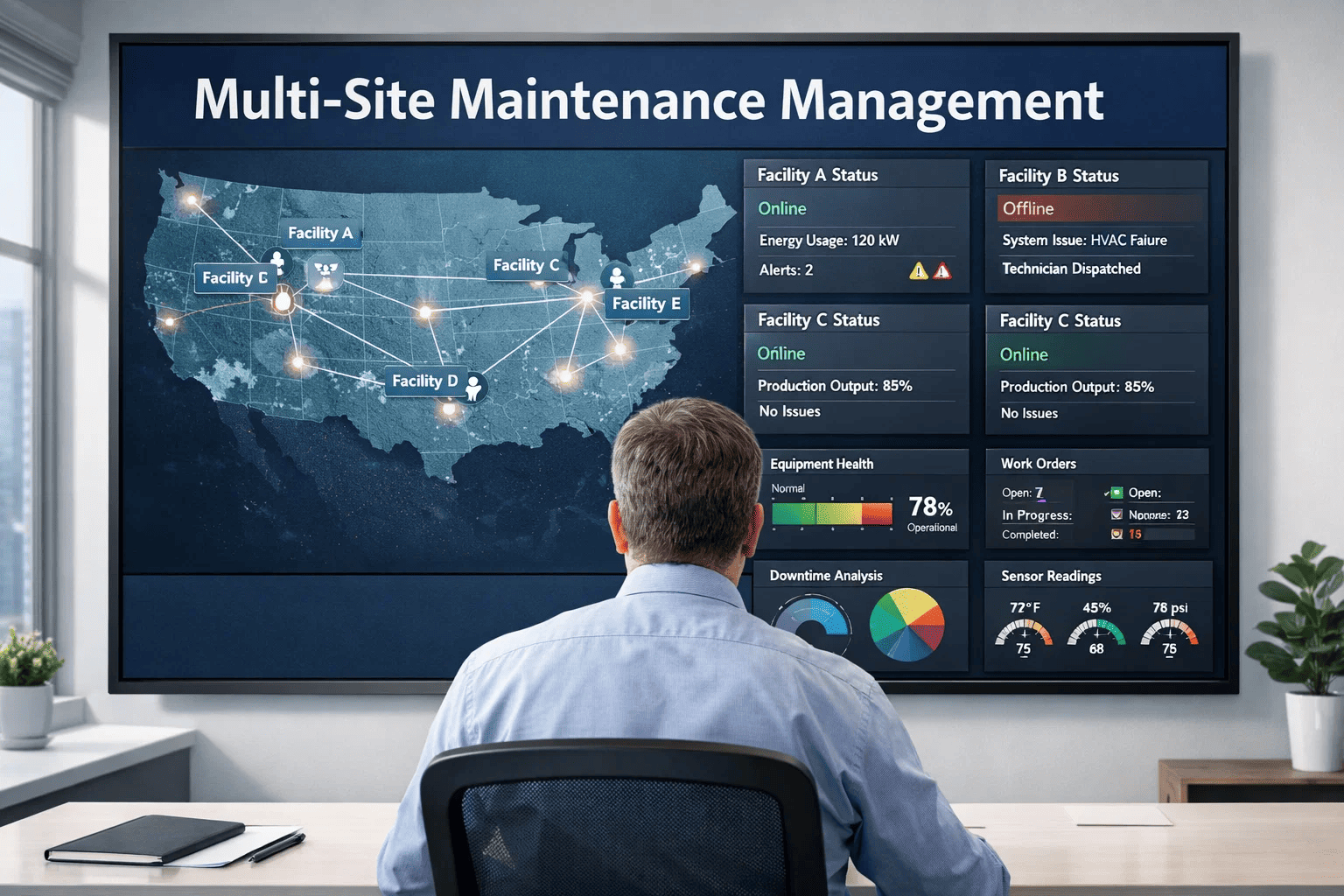
For operators running conveyors across multiple plants, the dashboard shows checklist compliance, overdue items, and trending failures at portfolio level.
One-Click Audit Reports
OSHA, NFPA, and corporate safety audits receive a complete inspection history — checklists, photos, corrective WOs, and sign-offs — as a PDF package.
Before & After: Paper Checklists vs. OxMaint-Driven Conveyor PM
Real numbers from a mid-sized food manufacturing plant with 18 conveyor sections across two production lines, measured before and 9 months after OxMaint rollout.
| Metric | Paper / Spreadsheet | OxMaint Digital Checklist | Impact |
|---|---|---|---|
| Daily checklist completion rate | 62% | 96% | +34 pts |
| Items that auto-trigger a WO | 0% | 100% | Full closure |
| Conveyor unplanned downtime / month | 24 hrs | 6 hrs | −75% |
| Idler / bearing failures before detection | 11/quarter | 2/quarter | −82% |
| Belt splice catastrophic failures | 4/year | 0/year | Eliminated |
| Audit prep time (OSHA / corporate) | 22 hrs | 45 min | −97% |
| Average days from finding to fix | 18 days | 3 days | −83% |
| Annual conveyor MRO spend | $348K | $214K | −$134K |
ROI Summary — OxMaint Conveyor Programs
Performance results pulled from OxMaint customer reviews across manufacturing plants running 10+ conveyor sections, measured 9–12 months after digital checklist rollout.
Frequently Asked Questions
Can OxMaint handle different conveyor types — belt, roller, chain, modular — with a single checklist system?
Yes. OxMaint ships with six conveyor-type templates — troughed belt, flat belt, cleated belt, modular belt, powered roller, and chain — each with its own tiered daily/weekly/monthly/quarterly checklist structure. Templates are fully customizable, so plants with unusual configurations (bucket elevators, screw conveyors, overhead trolley) can adapt existing templates or build new ones. All conveyor types share the same CMMS workflow for failed items, WO generation, and audit reporting.
How do technicians complete checklists when they're working in areas without internet connectivity?
The OxMaint mobile app runs full offline mode for checklist execution. Technicians download their assigned inspections at shift start, complete them anywhere (underground, outdoor, within a Faraday-cage facility), and the app syncs automatically when connectivity is restored. Photos, signatures, and pass/fail data are all stored locally during the offline period and pushed to the cloud the moment network is available. No data loss, no duplicate entries, no rework.
Do these checklists satisfy OSHA, NFPA, and corporate audit requirements out of the box?
The shipped templates are built against OSHA 1910.212 (machinery guarding), OSHA 1910.147 (lockout/tagout), NFPA 652 (combustible dust where applicable), and general conveyor safety standards from CEMA. Each checklist item references the applicable standard, and the audit export generates a compliance-ready PDF package with timestamps, photos, sign-offs, and corrective action history. Customers in regulated industries (food, pharma, UK/EU safety) typically need only minor customization for site-specific procedures.
How long does it take to get a complete conveyor PM program live with OxMaint?
The typical onboarding timeline for a plant with 10–30 conveyor sections is 10–14 days from contract to live PM execution. Day 1–3 covers asset import and hierarchy setup, Day 4–7 covers checklist template configuration and customization, Day 8–10 covers technician training on the mobile app, and Day 11–14 runs a pilot on 2–3 conveyors before broader rollout. Customers with existing digital asset registries can often accelerate this to under a week.
Replace Paper Clipboards with a Checklist System That Actually Prevents Downtime.
OxMaint ships with ready-to-execute conveyor checklists, automates PM scheduling across daily/weekly/monthly/quarterly tiers, turns failed inspections into work orders with one tap, and produces audit-ready compliance reports in 90 seconds. Manufacturing customers cut conveyor downtime by 75% and saved $134K/year on average within 9 months of go-live.