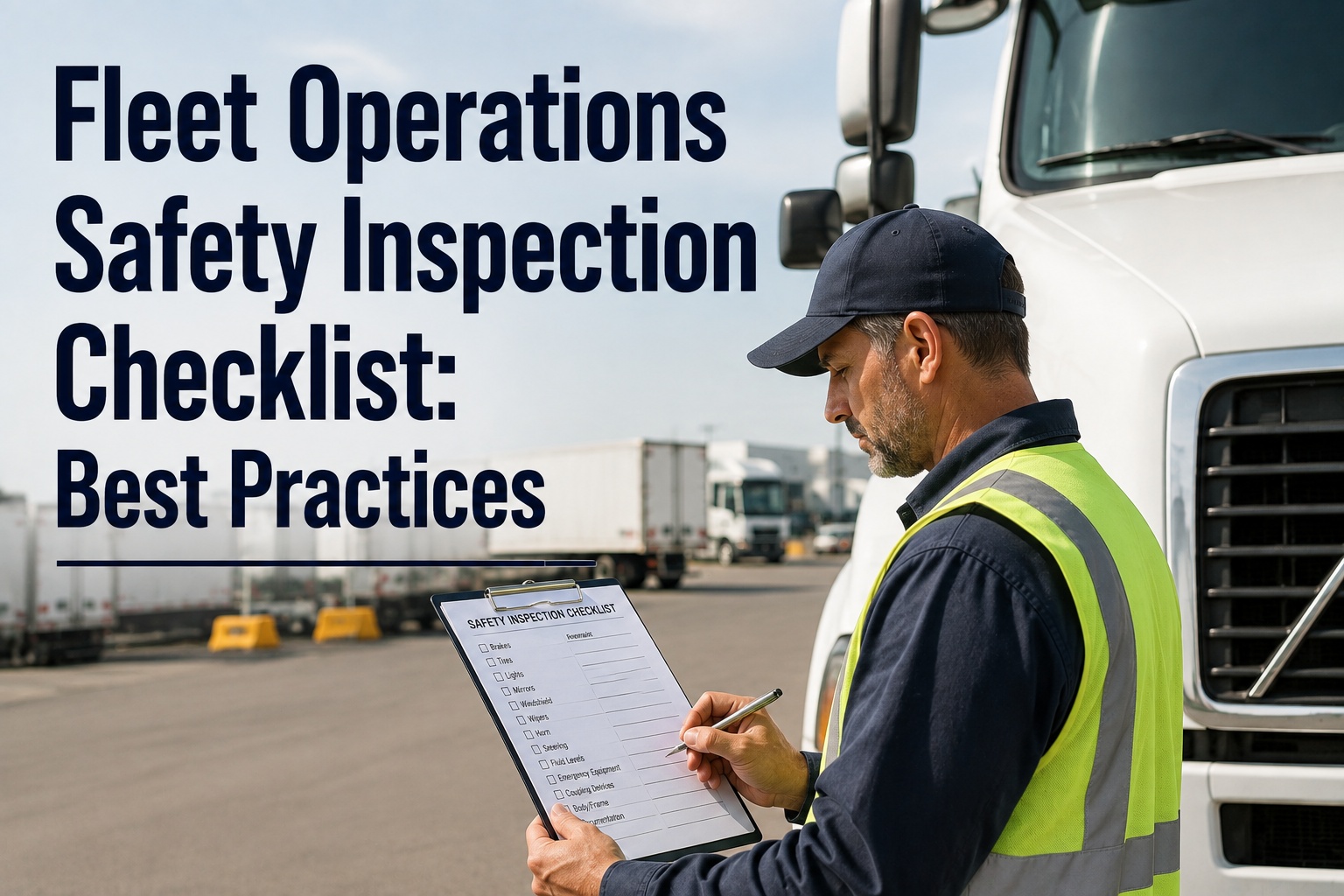
A fleet operations safety inspection checklist is the difference between a fleet that passes an FMCSA or OSHA audit on demand and one that scrambles for paperwork the week before — and the checklist itself is the single biggest variable. For US commercial fleets, a defensible fleet operations safety inspection checklist must cover pre-trip and post-trip DVIRs, brake and tire systems, lighting, load securement, driver qualification files, and documented corrective actions, all aligned to FMCSA Part 396 and OSHA recordkeeping expectations. This guide walks through every requirement with clear pass/fail criteria, mandatory documentation points, and the corrective-action workflow auditors expect to see. It also shows how OxMaint's digital fleet operations safety inspection checklist turns paper forms into audit-ready records with photo evidence, e-signatures, and asset-linked history — Start Free Trial to digitize your first inspection today.
Is Your Fleet Operations Safety Inspection Checklist Audit-Ready — or Just a Clipboard Habit?
Roadside inspectors placed over 2.4 million vehicles out of service in recent CVSA data cycles, and roughly 1 in 5 inspected trucks still fails. The fleets that pass share one trait: a digital fleet operations safety inspection checklist with photo evidence, e-signatures, and closed-loop corrective actions.
- Pre-trip & post-trip DVIR items with pass/fail criteria
- Mandatory photo evidence + e-signature capture
- Auto-generated corrective work orders on any fail
- Audit-ready records linked to every asset, instantly retrievable
What a Failed Fleet Compliance Audit Actually Costs
A single out-of-service order costs $1,000–$5,000 in fines, towing, and lost revenue per event — and a pattern of violations can push a carrier's CSA score into intervention thresholds that trigger a full FMCSA fleet audit. Here is the math most fleet managers underestimate.
Worked example: a 45-truck regional carrier running paper DVIRs failed a CDL fleet audit when 11 inspection forms were missing signatures and 4 brake-defect reports had no documented repair. The result: $28,500 in fines, a conditional safety rating, and 6 weeks of remediation. After switching to OxMaint's digital fleet operations safety inspection checklist — where a failed item cannot be closed without a corrective work order, photo, and e-signature — the same carrier passed its next audit with zero recordkeeping findings and cut inspection admin time by 70%.
Fleet Operations Safety Inspection Checklist Requirements: The 6 Inspection Zones
A complete commercial fleet inspection covers six zones, each with explicit pass/fail criteria. Anything marked "Fail" must trigger a documented corrective action before the vehicle returns to service — that closed loop is what separates a compliant program from a liability.
Brake System
- Service brake pedal reserve & fade test
- Air pressure build-up: 85→100 psi within 45 sec
- Air leak rate: ≤3 psi/min (single) / ≤4 psi/min (combo)
- Parking brake holds on grade
- ABS warning lamp cycles correctly
Tires, Wheels & Rims
- Tread depth: ≥4/32" steer, ≥2/32" drive/trailer
- No exposed cord, bulges, or sidewall cuts
- Inflation within OEM spec (±5 psi)
- No cracked rims, missing lugs, or rust trails
Lighting & Electrical
- Head, tail, brake, turn, marker lamps all functional
- Reflectors & conspicuity tape intact
- Battery secure, no corrosion or frayed wiring
- Warning devices: 3 triangles or flares aboard
Steering & Suspension
- Steering lash ≤10° (power) on 20" wheel
- No cracked/broken leaf springs or air-bag leaks
- Shock absorbers secure, no fluid seepage
- No loose or missing U-bolts
Coupling & Load Securement
- Fifth wheel locked, jaws fully engaged
- Safety chains/cables attached & rated
- Cargo securement: 1 tiedown per 10 ft + WLL ≥50% load
- Doors, tarps, and liftgates operate & latch
Cab, Fluids & Documentation
- Wipers, washers, horn, mirrors, defroster functional
- No active leaks: fuel, oil, coolant, DEF
- Fire extinguisher charged & mounted
- Registration, insurance, annual inspection cert aboard
Fleet Operations Safety Inspection Checklist Template: Frequency & Documentation Matrix
Auditors don't just check that inspections happened — they check that each inspection type occurred at the required interval with the required evidence. Use this matrix as your fleet operations safety inspection checklist template baseline.
| Inspection Type | Frequency | Governing Rule | Required Evidence | Retention |
|---|---|---|---|---|
| Pre-trip DVIR | Every shift, before dispatch | FMCSA §396.11 / §392.7 | Driver e-signature, item checklist, defect photos | 90 days |
| Post-trip DVIR | End of each driving day | FMCSA §396.11 | Defect report + mechanic certification of repair | 90 days |
| Corrective action on defect | Before vehicle returns to service | FMCSA §396.11(c) | Work order, parts used, technician sign-off | 1 year (with vehicle file) |
| Periodic / PM inspection | Mileage or time-based (e.g. every 10K mi / 90 days) | OEM + fleet policy | Multi-point checklist, measurements, photos | Life of asset |
| Annual DOT inspection | Every 12 months | FMCSA §396.17 | Qualified inspector report + decal/cert | 14 months |
| Driver qualification file review | Annual + on hire | FMCSA §391 | CDL, medical cert, MVR, drug test records | Duration + 3 years |
How to Pass an FMCSA or OSHA Fleet Audit: The 4-Step Corrective-Action Workflow
Auditors follow the evidence trail from defect detection to verified repair. Fleets that fail almost always break one of these four links — usually link three, documented repair verification.
Detect & document the defect
Driver flags a failed item on the digital checklist with a mandatory photo and note. Timestamp, GPS, and asset ID attach automatically — no illegible handwriting, no lost forms.
Auto-generate the corrective work order
The failed item instantly creates a prioritized work order assigned to a technician. Safety-critical defects (brakes, tires, steering) block dispatch until closed — enforced by the system, not by memory.
Verify the repair with evidence
Technician records parts used, labor time, and after-repair photos, then e-signs. The DVIR and work order link permanently to the vehicle's asset history — the exact chain §396.11(c) demands.
Prove it in seconds, not weeks
When an auditor requests records, filter by asset, date range, or defect type and export a complete, time-stamped trail. What took 8–14 hours of filing-cabinet archaeology becomes a 2-minute report.
Digital Fleet Operations Safety Inspection Checklist Software: What OxMaint Does Differently
OxMaint is an AI-powered CMMS + EAM platform that turns your fleet operations safety inspection checklist from a paper ritual into an enforced, audit-proof workflow — with measurable outcomes.
Mandatory mobile checklists
Drivers complete zone-by-zone inspections on any phone — failed items require a photo and note before submission. Outcome: 100% form completeness, zero missing signatures.
Closed-loop corrective work orders
Any failed check auto-creates a work order, assigns it, and blocks vehicle dispatch until a technician e-signs the verified repair. Outcome: zero unrepaired defects slip back onto the road.
Asset-linked audit trail
Every DVIR, PM, annual inspection, and repair lives on the vehicle's permanent record with timestamps and e-signatures. Outcome: audit prep drops from weeks to under 5 minutes per asset.
Compliance analytics & alerts
Dashboards flag expiring annual inspections, repeat-defect vehicles, and overdue corrective actions before they become violations. Outcome: fleets report 30–50% fewer roadside defects within 6 months.
See OxMaint Run Your Fleet Inspection Workflow — Book a 30-Minute Demo
We'll load one of your vehicles and show the full loop: mobile checklist → failed item → corrective work order → audit-ready record. Bring your toughest compliance question.
Fleet Operations Safety Inspection Checklist: FAQs
What should a fleet operations safety inspection checklist include?
At minimum: brakes, tires/wheels, lighting, steering/suspension, coupling and load securement, and cab/fluids/documentation — each with explicit pass/fail criteria, a photo requirement for failures, and a linked corrective-action step. Align items to FMCSA §396.11 and your OEM service schedules.
How long must fleet inspection records be kept for an FMCSA fleet audit?
DVIRs must be retained for 90 days, annual inspection reports for 14 months, and maintenance/repair records for 1 year (plus 6 months after a vehicle leaves your control). Digital storage in OxMaint meets these rules and makes any record retrievable in seconds.
Is a digital fleet operations safety inspection checklist legally acceptable?
Yes — FMCSA explicitly permits electronic DVIRs and records provided they capture the required information and signatures. E-signatures, timestamps, and photo evidence actually strengthen your position versus paper. Start Free Trial to see a compliant digital form in minutes.
What triggers an FMCSA compliance review or fleet audit?
Common triggers: CSA scores above intervention thresholds (especially Vehicle Maintenance and Unsafe Driving BASICs), a serious crash, a complaint, or a pattern of roadside out-of-service violations. Fleets with documented, closed-loop inspections resolve reviews far faster.
How do I switch from paper DVIRs to a digital system without disrupting drivers?
Roll out vehicle-by-vehicle over 2–4 weeks: mirror your existing paper form in the app, run a 30-minute driver training, and keep paper as backup for the first week. Most fleets see full adoption within 10 working days — Book a Demo and we'll map your exact migration plan.
Make Every Inspection Audit-Proof — Starting With Your Next Shift
Digitize your fleet operations safety inspection checklist in OxMaint today: mandatory checks, photo evidence, e-signatures, and a corrective-action trail auditors can't poke holes in.
Free 14-day trial · No credit card · Set up your first checklist in under 10 minutes