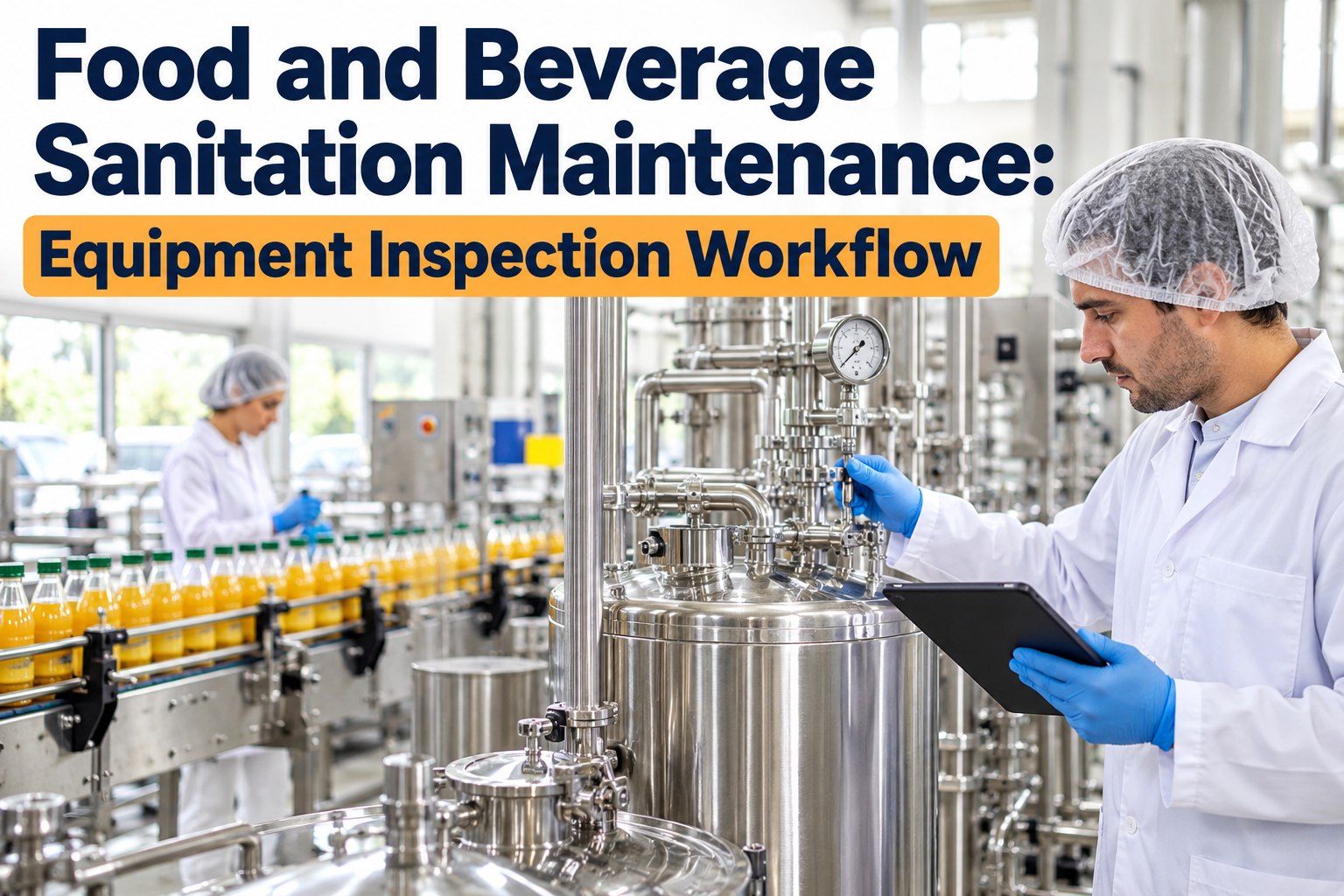
A frozen food processing plant failed an unannounced FDA inspection because three pieces of evidence were missing: the sanitation log for a packaging line conveyor belt showed a 6-day gap, a CIP (Clean-in-Place) cycle on a pasteurizer had no documented verification temperature, and the PM record for a blast freezer compressor referenced "completed" with no technician signature, no readings, and no timestamp. The FDA issued a Warning Letter — publicly posted, visible to every retailer and distributor — citing inadequate maintenance records under 21 CFR 117 (Current Good Manufacturing Practice). The plant spent $340,000 on remediation, lost two major retail contracts during the 90-day corrective period, and the facilities director was replaced. Every item on that Warning Letter was a documentation failure, not a maintenance failure. The equipment had been maintained. The records did not prove it. Food and beverage manufacturing maintenance is inseparable from food safety compliance — and a CMMS that does not generate FDA-ready documentation at point of work is a regulatory liability. Schedule a demo to see FDA-compliant maintenance documentation running on food manufacturing data.
The FDA Compliance Framework for Food Manufacturing Maintenance
Food and beverage plants operate under the most documentation-intensive maintenance requirements in any industry. FDA, USDA, OSHA, and state health departments impose simultaneous requirements — and a single Warning Letter can cost more than the entire annual maintenance budget. Sign up free to see FDA compliance tagging on every maintenance work order from day one.
Six Equipment Categories Unique to Food Manufacturing
OxMaint generates FDA-ready maintenance documentation at point of work — not reconstructed before an audit.
Timestamped, signed, photo-verified compliance records from every maintenance action.
The Food Manufacturing PM Workflow: Five Steps with FDA Documentation
Every PM on food-contact equipment must produce a record that answers five questions an FDA inspector will ask: what was done, who did it, when, what were the verification readings, and what corrective action was taken for any deviation. Book a demo to see the food manufacturing PM workflow with built-in FDA documentation.
The CMMS integrates production schedules so maintenance windows align with sanitation cycles. Equipment PM is scheduled after CIP completion — never during production. Sanitation verification (temperature, concentration, contact time) is a mandatory checklist step before any mechanical PM begins.
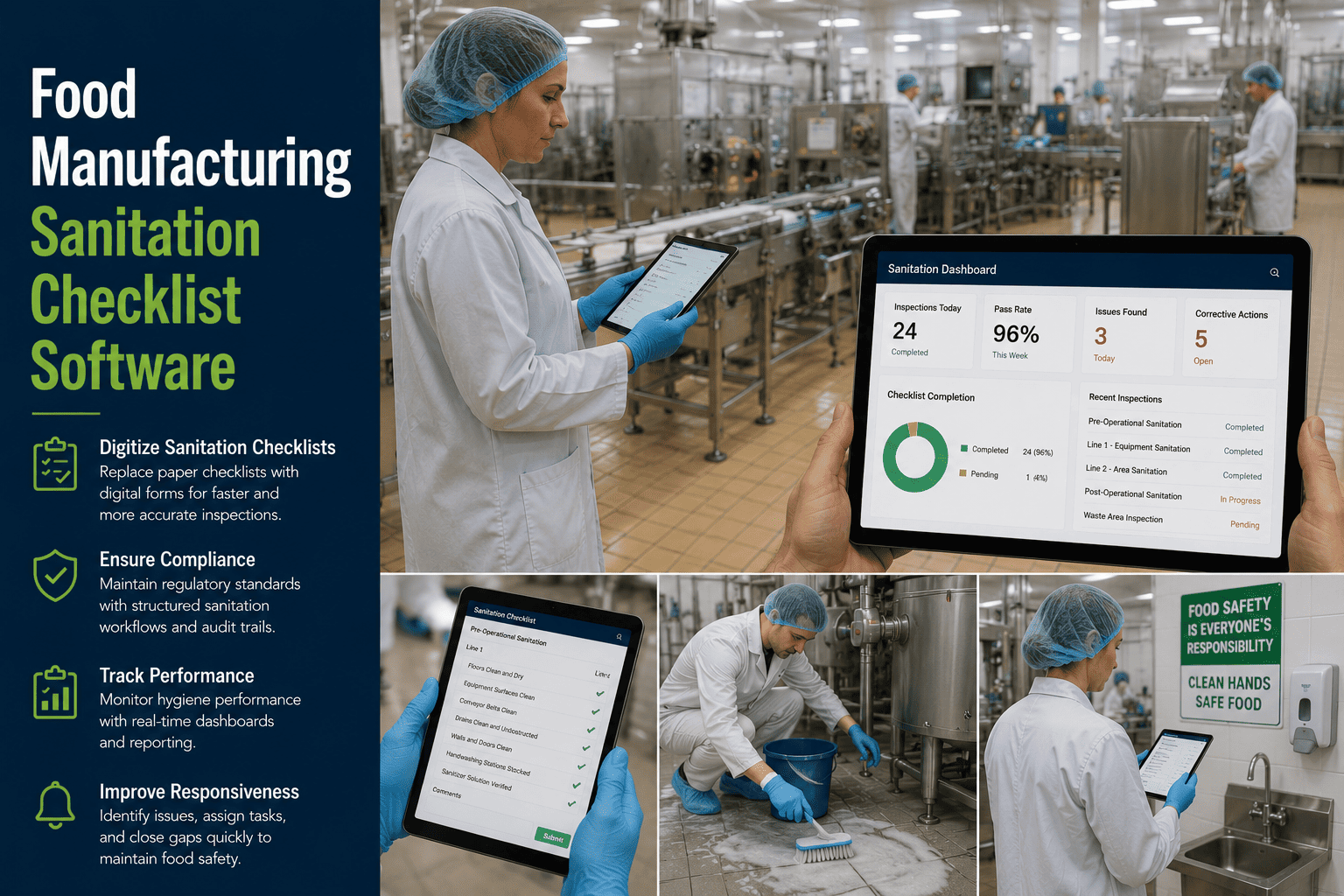
Technicians follow digital checklists with quantitative pass/fail criteria for every food-safety inspection point. CCP-linked equipment requires calibration readings entered directly into the work order. Food-grade lubricant verification, gasket condition checks, and surface contamination inspections are mandatory checklist items — not optional notes.
Any checklist item that fails its pass/fail threshold auto-generates a corrective action work order linked to the parent PM. Deviations on CCP-linked equipment trigger immediate escalation to the food safety team. The corrective action record — required by HACCP and FSMA — is created automatically, not assembled after the fact.
Maintenance chemicals (lubricants, cleaners, sanitizers) used during PM are logged against the work order with NSF/H1 food-grade certification verification. Allergen changeover maintenance — line teardown, cleaning, and verification between allergen-containing products — follows a dedicated protocol with swab test documentation.
Completed PM records — checklist, readings, photos, chemical logs, corrective actions, technician credentials — finalize as tamper-proof compliance records. This is the exact document an FDA inspector reviews. It is generated from the technician's workflow, not assembled from memory before an audit.
Financial Impact for Food and Beverage Manufacturers
60-Day Deployment for Food Manufacturing
HACCP integration: Link CCP verification to equipment maintenance status — ensuring production cannot proceed on equipment with overdue PM.
Audit reports: One-click report templates for FDA, SQF, BRC, and customer audits.
KPI dashboards: OEE, sanitation compliance, and food safety dashboards for leadership.
By week 8, every food-contact asset has verified maintenance and sanitation records, and every audit generates a complete report in one click. Start your free trial and have food-contact equipment documented within the first week.
Every Sanitation Cycle Documented. Every CCP Verified. Every Audit Ready.
OxMaint ensures every food-contact asset receives the right maintenance, at the right interval, documented to FDA standards — so every inspector finds compliance, every production run starts on verified equipment, and every audit is a demonstration of food safety excellence.
Frequently Asked Questions
Does OxMaint handle both sanitation and mechanical maintenance?
Yes — and this integration is critical. Food plants need sanitation and mechanical PM on the same platform because they are operationally linked: mechanical PM on food-contact equipment must occur after verified sanitation, and sanitation schedules must account for equipment maintenance windows. OxMaint manages both with enforced sequencing rules.
How does the CMMS connect to our HACCP plan?
CCP-linked equipment is tagged in the asset registry. Every PM on tagged equipment includes mandatory CCP verification steps — calibration readings, temperature checks, and corrective action documentation when deviations occur. The CMMS generates the HACCP maintenance records that auditors require without separate documentation. Book a demo to see HACCP-linked maintenance workflows.
Can the system track food-grade chemical compliance?
Every maintenance chemical — lubricants, cleaners, sanitizers — is logged in the system with NSF registration category (H1, H2, H3), lot number, and expiration date. When a technician uses a chemical during PM, it is recorded against the work order. If a non-food-grade chemical is selected for food-contact equipment, the system flags the violation before application.
What happens when a CIP cycle fails verification?
Failed CIP verification auto-generates a corrective action work order, escalates to the food safety team, and blocks mechanical PM from proceeding on the affected equipment until re-sanitation is completed and verified. The entire sequence — failure, corrective action, re-verification — is documented as a single compliance record.
What is the realistic ROI for a food manufacturing plant?
ROI is immediate from recall prevention alone — a single avoided recall ($500K–$10M) exceeds years of platform cost. Additional value: $800K+ in downtime reduction, $200K+ in audit remediation avoidance, $350K+ in labor productivity, and $150K+ in product loss prevention. A mid-size food plant documents $2M+ in annual value. Platform starts free.