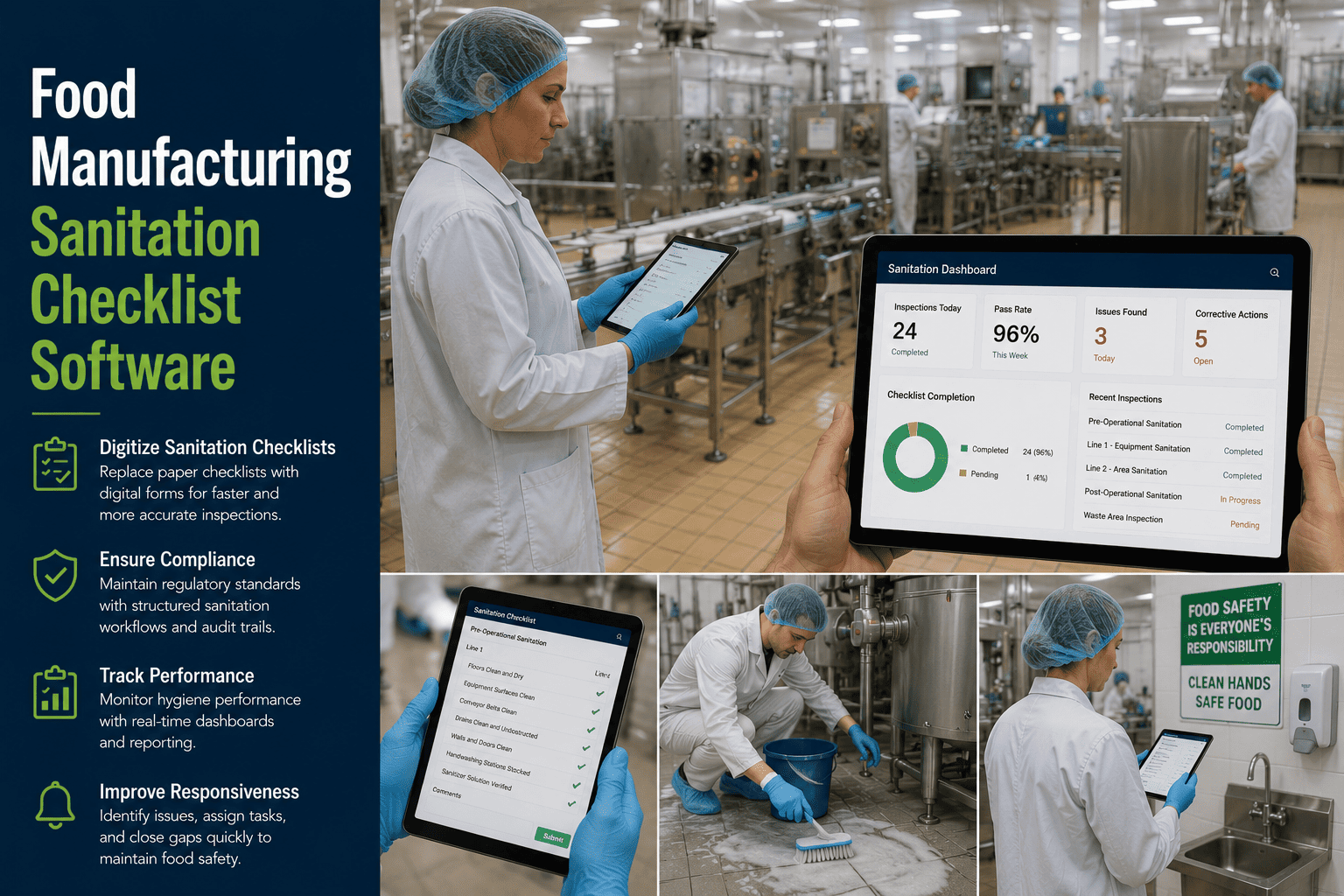
In a food or beverage plant, sanitation and maintenance are the same job wearing two hats. A worn gasket isn't just a maintenance ticket — it's a harborage point where bacteria hide from the sanitation crew. A pitted weld isn't just corrosion — it's a spot CIP can't reach. When equipment inspection and sanitation run as separate programs, the gaps between them are exactly where contamination and downtime live. This guide lays out a unified equipment inspection workflow for sanitation-critical assets, and shows how OXMAINT AI ties inspection, preventive work and asset records into one auditable system. See it on your line with a live demo.
Food & Beverage · Sanitation Maintenance · Equipment Inspection · 2026
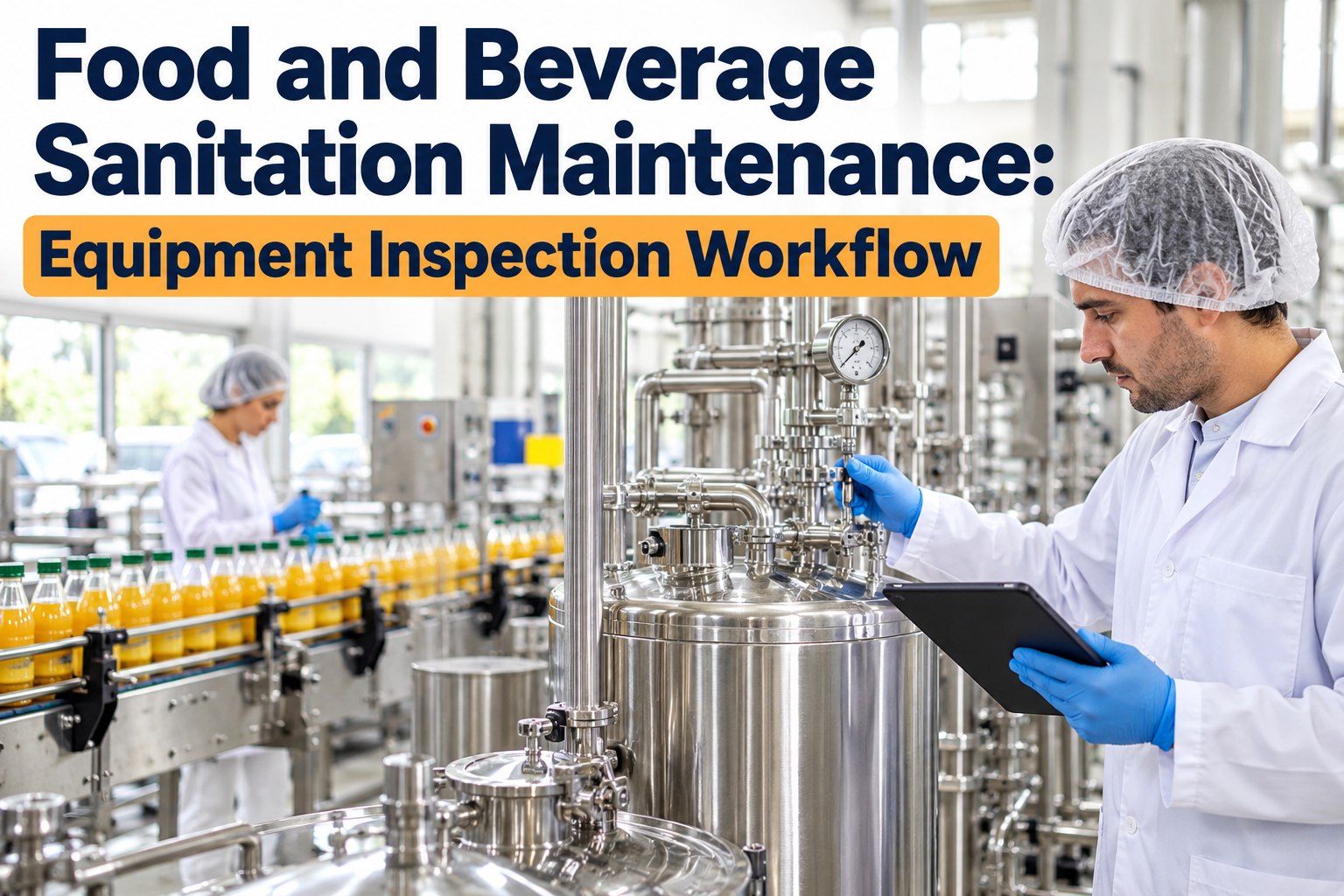
Food & Beverage Sanitation Maintenance: Equipment Inspection Workflow
Sanitation and maintenance fail in the gaps between them — the worn seal that becomes a harborage point, the pitted surface CIP can't clean. OXMAINT AI runs equipment inspection, preventive work and asset history as one workflow, so a sanitation risk becomes a tracked work order, not an audit finding.
Inspect the asset
→
Flag the risk
→
Work order
→
Verified & recorded
Sanitation & maintenance, unified
Inspections tied to each asset
Sanitation risks become work orders
Full history for HACCP & audits
Pre-op sign-off on record
Why Maintenance Is a Food-Safety Function
Every maintenance defect on a food-contact surface is a potential contamination pathway. Treating inspection as a reliability task alone misses half its purpose — the same check that protects uptime protects the product. These four are where the two jobs are really one. Start free and connect inspection to food-safety risk in OXMAINT.
Worn Seals & Gaskets
Cracked or lifting gaskets create niches that shelter bacteria from cleaning chemicals — a maintenance wear item and a harborage point at once.
Pitting & Rough Welds
Corroded or poorly finished stainless holds soil that CIP can't flush — a surface defect the inspection must catch before sanitation fails on it.
Lubricant Migration
The wrong lubricant, or too much of it, migrates toward product zones. Food-grade spec and application are a maintenance-controlled food-safety point.
Standing Water & Drainage
Blocked drains and pooling water breed Listeria. Drainage upkeep sits squarely between the maintenance and sanitation teams.
The Sanitation-Critical Asset Zones
Not every asset carries the same food-safety weight. A workflow that treats a floor scrubber like a filler wastes effort where it matters least. Zone your assets by contact risk first — it's what decides inspection depth and frequency. Book a demo to see assets zoned by contact risk.
Zone 1 · Highest
Food-Contact Surfaces
Fillers, conveyors, mixers, slicers, product piping — anything the product touches. Inspection is most frequent and most detailed here.
Zone 2 · High
Adjacent Surfaces
Equipment framing, guards and housings near the product stream — splash and transfer risk make these a close second.
Zone 3 · Medium
Room & Environment
Drains, floors, walls, overhead structures and HVAC in the production area — the environmental reservoir sanitation has to control.
Zone 4 · Support
Non-Production Areas
Warehousing, docks, utilities and exterior — lower direct risk, but the pathways pests and traffic use to reach the higher zones.
The Inspection Workflow — Around the Production Cycle
Sanitation inspection isn't one event; it's a rhythm that wraps the production run. Each stage has a distinct job, and skipping any one leaves a blind spot the others can't cover. This is the cycle OXMAINT AI schedules and records, stage by stage. Sign up free and put the full cycle on schedule.
01
Post-Production Teardown Check
As the line comes down, inspect for the wear that the run exposed — loosened fasteners, worn seals, product build-up in dead legs — and log it before cleaning starts.
02
Cleaning & CIP Verification
During and after cleaning, verify CIP coverage, chemical concentration and contact time, and confirm hard-to-reach surfaces were actually reached.
03
Pre-Operational Inspection
Before the line restarts, the sign-off inspection: surfaces visually clean, equipment reassembled correctly, no lubricant or debris in product zones. Nothing runs until this passes.
04
In-Run Monitoring
During production, watch the conditions that drift — leaks, temperature, unusual wear — so a developing risk is caught mid-run, not at next teardown.
05
Periodic Deep Inspection
On a scheduled cadence, disassemble and inspect what daily checks can't reach — internal surfaces, bearings, valve seats — the PM layer beneath the daily rhythm.
The Finding Only Counts If It Becomes an Action.
A sanitarian who spots a lifting gasket on a pre-op walk has done their job — but the risk isn't closed until someone replaces it, verifies it, and records the whole chain for the auditor. Paper checklists and separate systems are where that chain breaks. OXMAINT AI turns the inspection finding into a work order against the specific asset, tracks it to a verified close, and keeps the record HACCP-ready.
From Inspection Finding to Verified Close
This is the chain that separates a compliant plant from an exposed one — every finding traceable from the moment it's spotted to the moment it's verified fixed. Break a link and it's an audit finding waiting to happen. Here's the loop OXMAINT AI keeps intact. Book a demo to walk this chain on your own assets.
1
Capture
Inspector logs the finding against the specific asset and zone, with a photo — on mobile, at the machine.
→
2
Prioritize
Risk is ranked by zone — a Zone 1 food-contact defect outranks a Zone 4 cosmetic one automatically.
→
3
Work Order
A work order goes to the crew with the food-grade part and correct procedure attached.
→
4
Verify
The fix is confirmed — re-clean, re-inspect, and a pre-op sign-off before the asset returns to service.
→
5
Record
The full chain stays on the asset's history — the traceable evidence a HACCP or GFSI audit asks for.
What Every Sanitation Inspection Record Should Capture
A finding scribbled on a clipboard can't be trended, prioritized or produced at audit. Structured capture is what turns inspection into an asset you can act on. These are the fields that make a sanitation inspection record complete. Sign up free and structure your inspection records.
01
Asset & zone — the specific equipment and its contact-risk zone
02
Inspection type — pre-op, teardown, CIP verification, deep PM
03
Finding & severity — what was seen and how serious, with a photo
04
Inspector & timestamp — who checked and when, attributable
05
Corrective action — the work order raised and its priority
06
Verification — re-inspection result and pre-op sign-off
Where OXMAINT AI Fits: One System, Sanitation to Audit
The gap between sanitation and maintenance closes when both run on one record. OXMAINT AI is the CMMS layer that unifies inspection, preventive work and asset history — so a risk spotted at pre-op becomes a tracked, verified, audit-ready fix. Here's what your team gets. Sign up free and get your sanitation assets on record.
Zoned Asset Register
Every asset tagged by contact-risk zone, so inspection depth and frequency match the food-safety weight of the equipment.
Mobile Pre-Op Inspections
Sanitarians run structured checklists from a phone at the machine — findings and photos captured on the spot, not typed up later.
Risk-Ranked Work Orders
A finding becomes a work order prioritized by zone, with the food-grade part and correct procedure attached.
Verification & Sign-Off
Re-inspection and pre-op sign-off close the loop, so no asset returns to service until the fix is confirmed.
Condition-Based PM
Deep-inspection and PM scheduled by run-hours or condition, so the layer beneath the daily rhythm never lapses.
Audit-Ready History
The full finding-to-fix chain on every asset — the traceable evidence a HACCP, GFSI or regulatory audit asks for, on demand.
"
Our sanitation crew and our maintenance team were running on two different systems that never talked. A sanitarian would flag a worn seal on the pre-op sheet, maintenance would fix it eventually, and at audit we couldn't connect the finding to the repair. Once both ran on OXMAINT, a pre-op finding became a work order against that exact filler, closed with a verification and sign-off. Our last audit, the inspector asked for a piece of equipment's sanitation-maintenance history and we had the whole chain on screen — that had never happened before.
Plant Sanitation & Maintenance Lead · Food Processing Facility
Frequently Asked Questions
Why should sanitation and maintenance share one workflow?
Because their failure points overlap. A worn gasket, a pitted weld, migrating lubricant or a blocked drain is both a maintenance defect and a contamination risk. When the two teams run on separate systems, findings fall into the gap between them — the same gap where audits find problems. One shared record closes it.
What is a pre-operational inspection?
It's the sign-off check before a line restarts after cleaning: surfaces visually clean, equipment reassembled correctly, no lubricant or debris in product zones. Nothing runs until it passes. Capturing that sign-off against the specific asset is what makes it defensible at audit rather than just a box ticked on paper.
How should we prioritize equipment inspections?
By contact-risk zone. Food-contact surfaces (Zone 1) get the most frequent and detailed inspection, adjacent surfaces (Zone 2) next, then the room environment (Zone 3) and support areas (Zone 4). Zoning ensures inspection effort lands where food-safety risk is highest instead of being spread evenly.
How does this support a HACCP or GFSI audit?
Audits ask you to prove that risks were identified and corrected. A unified workflow keeps the full chain — finding, work order, repair, verification, sign-off — on each asset's history, so you can produce the traceable evidence on demand instead of assembling it from paper checklists and separate maintenance logs.
How does OXMAINT connect inspection to maintenance?
It captures the inspection finding against the specific asset and zone, turns it into a risk-ranked work order with the food-grade part and procedure attached, tracks it to a verified close with pre-op sign-off, and keeps the whole chain on the asset's record — one system from the sanitarian's walk to the auditor's request.
Close the Gap Between Sanitation and Maintenance.
Run equipment inspection, preventive work and asset history as one workflow — so a sanitation risk becomes a tracked, verified, audit-ready fix instead of a finding on the wall. Start free — no credit card, unlimited users.