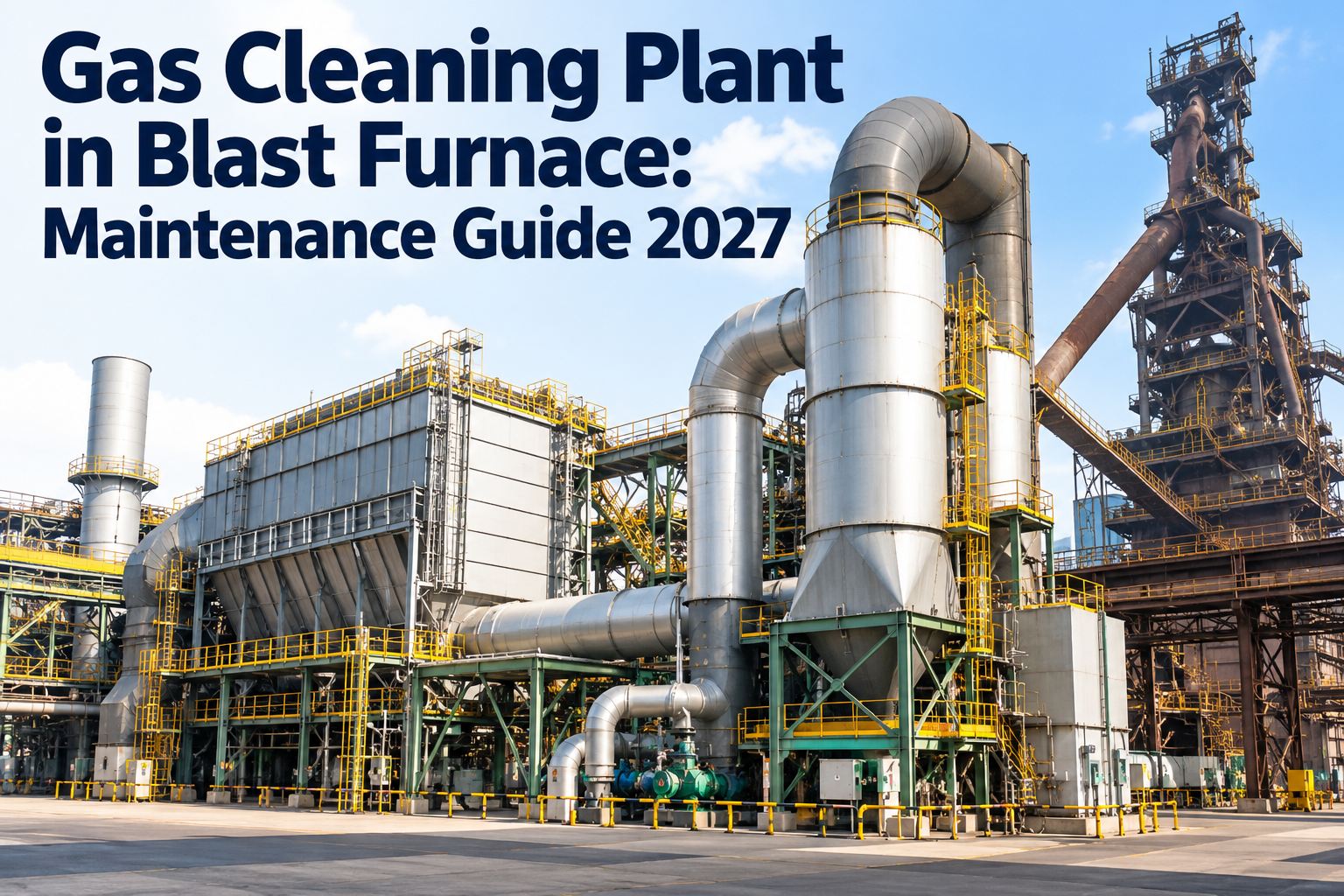
Blast furnace gas is a fuel and a hazard in the same breath — around a fifth of it is carbon monoxide, and the gas cleaning plant is what stands between a dusty, toxic top gas and clean fuel the stoves and boilers can actually burn. When a scrubber nozzle blocks, a demister floods or a septum valve sticks, dust carries through, top pressure wanders and the furnace itself feels it. This guide walks the gas-cleaning train equipment by equipment, the maintenance each piece needs, and the carbon-monoxide safety that governs every job — and how to run the whole plant in OXMAINT AI, or book a demo of GCP maintenance tracking.
GAS CLEANING PLANT · BLAST FURNACE · MAINTENANCE GUIDE · 2027
Gas Cleaning Plant in Blast Furnace: Maintenance Guide 2027
Raw top gas leaves the furnace at 20–30 grams of dust per cubic metre and must reach the network at single-digit milligrams — so every asset on the cleaning train has to stay maintained. OXMAINT AI is the AI-powered CMMS that puts each one on a maintenance clock, ties every carbon-monoxide job to a permit and lock-out, and turns a sensor baseline into a work order before clean gas turns dirty.
Dust Catcher
Scrubber
Septum Valve
Demister
Pumps & Water
20–30 g
dust per cubic metre in raw top gas, before any cleaning
≤ 3 mg
target dust per cubic metre in the clean gas sent to the network
~20%+
carbon monoxide in BF gas — colourless, odourless and the reason every job is a permit job
>99%
dust the wet scrubbing stage must remove after the dry catcher
Follow the Gas: the Cleaning Train
Maintenance makes sense when you follow the gas: coarse dust out dry, fine dust out wet, pressure let down, last droplets stripped — each stage a different asset with its own failure mode. OXMAINT AI, our AI-powered maintenance management software, holds the whole train as one connected asset register. Start free and build your GCP asset register in OXMAINT AI.
1
Dust Catcher / Cyclone
Dry primary cleaning — gravity or centrifugal force drops coarse dust above 10 microns.
DRY · COARSE
→
2
Venturi Scrubber
Wet secondary cleaning — atomised water captures fine and sub-micron dust, over 99% removed.
WET · FINE
→
3
Septum Valve
Pressure let-down and top-pressure control, holding the furnace top steady.
PRESSURE
→
4
Demister / Separator
Strips entrained water droplets so the clean gas leaves dry enough for the network.
DRY-OUT
Underneath it all runs the water circuit — scrubber pumps, recycle lines, clarifier-thickener and cooling tower — the dirtiest, most deposition-prone part of the plant and the one most teams under-maintain.
Each Asset, Its Job, Its Maintenance
Maintenance lives at the asset level, and so does OXMAINT AI. Here is what each major piece does, where it fails, and the preventive work that keeps it honest — each set up as its own asset, with PM triggered by heat count, tonnage or campaign age, not the calendar alone.
Drops coarse dust dry so it can be recycled low in zinc and lead through the sinter plant.
Watch: refractory and lining wear, dust bridging in the cone, discharge-valve seizure, cyclone internal erosion from high circumferential velocity.
PM: lining and wear-plate inspection on campaign meters, dust-discharge cycle and level-sensor checks, hopper emptying before bridging, cone and downcomer condition survey.
Atomises water into the throat so droplets collide with fine dust and wash it out of the gas.
Watch: throat and nozzle erosion, nozzle blockage and scaling, movable-cone drift, uneven spray pattern, loss of pressure differential.
PM: nozzle flow and spray-pattern checks, throat wear measurement, cone-actuator stroke test, scrubbing-water pressure verification against baseline.
Lets gas pressure down and trims top pressure, so burden descent and gas flow stay stable.
Watch: seat and trim erosion from throttling dusty wet gas, sticking or sluggish response, actuator and positioner drift, seal leakage.
PM: stroke and response test, positioner calibration, seat-leak check, actuator service, trim inspection at campaign intervals.
04Demister / Mist Eliminator
Removes carried-over water droplets so the gas leaving the plant is dry enough for the network.
Watch: pad or vane fouling and scaling, flooding, re-entrainment, differential-pressure rise, corrosion.
PM: differential-pressure trend, wash-down and cleaning schedule, pad/vane inspection, drain and seal checks.
05Scrubber Pumps & Water Circuit
Moves recycle and make-up water through scrubber, clarifier-thickener and cooling tower.
Watch: impeller and seal wear from abrasive slurry, scale and iron-oxide deposition in lines and nozzles, bearing vibration, clarifier underperformance.
PM: vibration and bearing-temperature baselines, seal and impeller inspection, line de-scaling, water-chemistry monitoring, thickener checks.
Cools the gas to cut moisture and gas volume before it enters the distribution network.
Watch: spray-nozzle scaling, internal deposition, packing or tray fouling, temperature creep at outlet.
PM: outlet-temperature trend, nozzle and internal inspection, cleaning cadence, water-side condition checks.
In OXMAINT AI you set those PMs on the meters that drive wear — heats, tonnes and campaign age — so each task fires when the equipment has earned it, not on a fixed date. Book a demo and see meter-based PM scheduling in OXMAINT AI.
Three Maintenance Triggers, Not One
The best GCP programmes do not lean on one trigger — they run three in parallel. OXMAINT AI holds all three against the same asset: scheduled work, condition alerts and the safety sign-off.
Preventive
By Heat, Tonnage & Campaign
OXMAINT AI ties lining surveys, nozzle checks and valve services to heats, tonnes or campaign age — because a dust catcher wears by what passes through it, not by how many days have elapsed.
Predictive
By Sensor Baseline
Scrubber pressure differential, demister differential pressure, pump vibration and gas temperature each hold a normal band. OXMAINT AI watches them against baseline and raises a work order on drift, before dust carries through.
Safety
By Permit & Lock-Out
No job on a gas-carrying asset starts without a permit, gas isolation and lock-out/tag-out. OXMAINT AI wraps each work order in that permit and LOTO record, so the safety step is part of the task, not a separate paper trail.
Non-NegotiableCarbon Monoxide Governs Every Job
Blast furnace gas is roughly one-fifth carbon monoxide — colourless, odourless and dangerous at low concentration. A weeping flange, a sticking bleeder or a blocked pressure tapping is not just a dust problem; it can be a gas release. No GCP maintenance task is a maintenance task first — it is a gas-safety task. OXMAINT AI builds that discipline into the work order itself, so none of the four controls below is left to memory.
!Permit to work — every job on a gas-carrying asset opens with a permit that records the isolation and the people on it.
!Gas isolation & LOTO — positive isolation, lock-out and tag-out before any line is broken or valve is opened.
!Isolation leak test — verify valve seat tightness through the plant leak-test method before a line is released for work.
!CO monitoring — personal and area gas detection active for the duration, with a standby and rescue plan in place.
From Sensor Baseline to Work Order
Predictive maintenance here is just reading the instruments you already have against a known-good band — exactly what OXMAINT AI does. Set each baseline once and the software turns a drift into a work order before the clean-gas spec slips.
Signal
Normal
Drift Means
Auto Action
Scrubber pressure differential
Steady band
Falling: throat wear or nozzle blockage, cleaning dropping off
Raise scrubber inspection WO
Demister differential pressure
Low, stable
Rising: pad fouling or flooding, re-entrainment risk
Raise demister wash/clean WO
Pump vibration & bearing temp
Baseline signature
Climbing: impeller, seal or bearing wear from slurry
Raise pump service WO
Clean-gas outlet temperature
Within target
Creeping up: cooling-tower scaling, moisture to network
Raise cooling-tower WO
Dust-hopper level
Cycling normally
High/stuck: discharge valve or bridging in the catcher
Raise discharge-system WO
This grid scrolls sideways on a phone. Each row is a baseline you set once; OXMAINT AI watches the band and opens the work order itself.
Where GCP Maintenance Goes Wrong
A gas cleaning plant rarely fails all at once — it degrades quietly until the clean-gas number slips. These are the gaps that let it happen, and every one is a gap OXMAINT AI is built to close.
×
Calendar-Only PM
Lining and nozzle work set by date, not by heats or tonnage, so wear outruns the schedule.
×
Ignored Water Circuit
Pumps, lines and clarifier left out of the PM plan until a seal fails or scale chokes a nozzle.
×
Baselines Never Set
Pressure-differential and vibration readings taken but never trended, so drift is invisible until failure.
×
Job Before Permit
A quick fix on a gas-carrying line without isolation, LOTO and a leak test — the one shortcut that kills.
×
Paper Records
Inspections and permits scattered across files, impossible to audit or trend across a campaign.
×
No Spare Strategy
High-wear nozzles, cones and seals not stocked, so a known-worn part means an unplanned stop.
Clean Gas Is a Maintenance Outcome.
The single-digit milligram number at the plant outlet is not an accident of design — it is the result of a dust catcher that is not bridging, a scrubber whose nozzles still spray, a demister that is not flooding and pumps that still move water. OXMAINT AI keeps every one of those on a clock, a baseline and a permit.
How OXMAINT AI Runs the Gas Cleaning Plant
OXMAINT AI holds the whole cleaning train — every asset, PM meter, permit and sensor baseline — on one platform, so a drift becomes a work order and the work order becomes an auditable record. Start free and bring your GCP assets onto OXMAINT AI.
Asset Register
Dust catcher, scrubber, septum valve, demister, pumps and cooling tower each with history, drawings and spares in one place.
Meter-Based PM
Preventive tasks triggered by heats, tonnage and campaign age — not just the calendar — so wear and PM stay in step.
Predictive Alerts
Pressure differential, vibration and temperature watched against baselines, with auto work orders on drift.
Permits & LOTO
Every gas-side job carries its permit, isolation and lock-out/tag-out record, so safety is built into the work order.
Spares & Inventory
High-wear nozzles, cones, seals and pad sections stocked and linked to the assets that consume them.
Audit & Trend
Every inspection, permit and failure trended across the campaign, ready for audit and for the next rebuild plan.
EXPERT REVIEW
Written for ironmaking, utilities and maintenance teams running blast furnace gas cleaning plants. The equipment, dust loadings and clean-gas figures here are general industry references — your real targets, intervals and isolation procedures come from your plant's design basis and local regulations. Carbon-monoxide handling, confined-space entry and permit-to-work are safety-critical and governed by your site's statutory procedures; nothing here replaces them. OXMAINT AI registers the assets, schedules the work, carries the permit record and tracks the baselines — it is not a gas-detection or top-pressure control system, or a substitute for your gas-safety authority.
Frequently Asked Questions
What is a gas cleaning plant in a blast furnace?
It is the plant that cleans the dust-laden top gas leaving the blast furnace so it can be used as fuel. Raw top gas carries roughly 20–30 grams of dust per cubic metre; the cleaning plant removes the coarse dust dry in a dust catcher or cyclone, then the fine dust wet in a venturi scrubber, controls the pressure, and strips water in a demister — delivering clean gas at single-digit milligrams per cubic metre.
Start free and map your gas cleaning plant in OXMAINT AI.
What does a septum valve do, and why does it need maintenance?
The septum valve lets the high gas pressure down and helps control the furnace top pressure, keeping burden descent and gas flow stable. Because it throttles dusty, wet gas, its seat and trim erode, its actuator and positioner drift, and it can begin to stick — so it needs stroke and response testing, positioner calibration, seat-leak checks and trim inspection at campaign intervals. A faulty valve disturbs the furnace itself, not just the gas line.
How is the demister maintained in a gas cleaning plant?
The demister, or mist eliminator, strips carried-over water droplets so the gas leaves dry. Its pads or vanes foul and scale over time, which shows up as a rising differential pressure across it; left alone it floods and re-entrains water into the clean gas. Maintenance means trending that differential pressure, washing and cleaning on schedule, inspecting the pad or vane element, and keeping the drains and seals clear.
Why is carbon monoxide the central safety concern?
Blast furnace gas is around one-fifth carbon monoxide, which is colourless, odourless and dangerous at low concentration, so a leak gives no warning. That is why every maintenance job on a gas-carrying asset opens with a permit, positive gas isolation and lock-out/tag-out, a seat-tightness leak test before the line is released, and active CO monitoring with a rescue plan. The safety procedure comes before the maintenance task, every time.
How does a CMMS like OXMAINT AI help run a gas cleaning plant?
A CMMS puts every GCP asset on a maintenance clock keyed to heats, tonnage and campaign age, watches sensor baselines like scrubber pressure differential and pump vibration to raise work orders on drift, and ties each gas-side job to its permit and lock-out record. It keeps inspections, permits and failures in one auditable, trendable history instead of scattered files.
Book a demo and see GCP maintenance run end to end in OXMAINT AI.
Keep the Gas Clean and the Crew Safe.
Run your gas cleaning plant on OXMAINT AI: every asset registered, PM set by heats and tonnage, baselines watched for drift, and every carbon-monoxide job wrapped in a permit and lock-out — so clean gas stays clean and no job starts unsafe.