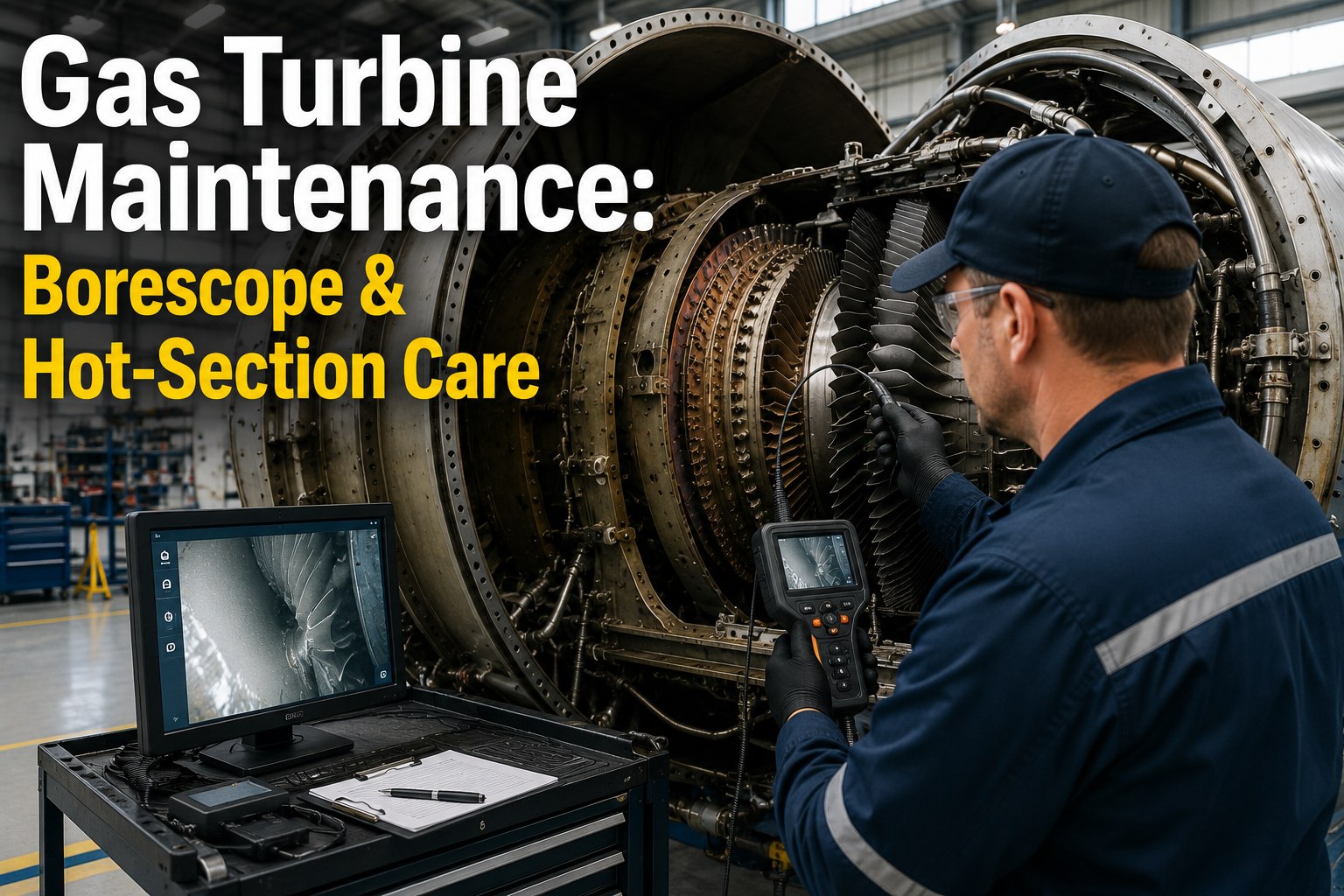
For every combined cycle plant, the gas turbine hot-section inspection is the single highest-leverage maintenance event on the calendar — a single missed combustion-can crack or tip-rub finding can cascade into a $2–4M major overhaul years ahead of schedule. OEM intervals for combustion (CI), hot-section (HSI), and major inspections (MI) are built around fired hours and starts, but defensible compliance demands far more than a calendar reminder: it requires borescope findings tied to work orders, trended clearances, and an audit trail that survives OEM warranty reviews. OxMaint gives gas turbine O&M teams the scheduling, documentation, and CMMS integration to run that cycle without spreadsheets, missed hours, or tribal knowledge. Start your Start Free Trial to see how inspection-led reliability actually works.
GAS TURBINE INSPECTION COMPLIANCE
Are your fired-hour inspection windows tracked in a spreadsheet — or in a defensible system?
A single 9FA-class machine runs roughly 8,000 fired hours between combustion inspections. One missed borescope finding in the transition piece or stage-1 nozzle can pull a $3.8M major inspection forward by 18 months — and void OEM warranty coverage in the process.
THE INSPECTION CYCLE, DECODED
Three OEM intervals that govern every fired hour
Heavy-duty gas turbines operate on a layered inspection architecture defined by OEM firing-hour and start-cycle limits. Skipping or delaying any tier doesn't just risk availability — it breaches the warranty terms that protect your rotor, casing, and hot-gas-path components.
Combustion Inspection
Borescope and hands-on check of combustion cans, transition pieces, fuel nozzles, liners, and cross-flame tubes. Typical outage window: 7–12 days. Catching liner cracking or nozzle coking here prevents hot-gas-path escalation.
- Combustor liners & transition pieces
- Fuel nozzle flow & pattern
- Flame detector & ignition
- Cross-fire tube integrity
Hot-Section Inspection
Stage-1 and stage-2 nozzle and blade evaluation, tip-clearance measurement, and shroud-segment condition. This is the highest-value inspection tier — findings here directly drive the major-inspection scope and rotor-life decisions.
- Stage-1 & 2 nozzle condition
- Blade tip clearance & rub
- Shroud segments & honeycomb
- TBC coating distress mapping
Major Inspection
Full casing open, rotor removal, all stages inspected and re-bladed as needed. A 9FA major runs 28–42 days and $2.5–4.2M in parts and labor. Scope is dictated almost entirely by the preceding two HSI cycles.
- Rotor inspection & NDE
- Casing bore & alignment
- Bearing & seal renewal
- Full hot-gas-path re-blade
BORESCOPE PROTOCOL
The borescope findings that actually move the overhaul date
Not every borescope observation is equal. The four finding categories below are the ones OEM reliability engineers weight when they extend — or pull forward — your next inspection interval. Document each one with photo, clock position, and clearance measurement, and trend it across CI cycles.
| Finding category | Where it appears | Severity threshold | Action if breached |
|---|---|---|---|
| TBC coating spallation | Stage-1 blade & nozzle surfaces | > 20% chord coverage | Pull HSI forward 2,000–4,000 hrs |
| Tip rub / clearance loss | Stage-1 & 2 rotor blades | > 0.040 in. growth | Scrape & re-tip at next CI |
| Combustor liner cracking | Combustion cans, axial joints | Through-wall or > 50 mm length | Replace liner within 1,000 hrs |
| Transition piece distress | TP aft frame & seal | Seal-groove wear > OEM limit | Replace TP before next CI |
| Nozzle partition bow | Stage-1 nozzle segments | Bow > 0.060 in. per partition | Nozzle reseat or replacement |
WORKED EXAMPLE
A 2×1 7FA plant, 12,000 fired hours, and the $1.1M finding nobody expected
Consider a 2×1 combined-cycle site running two 7FA machines at baseload — roughly 8,200 fired hours per year per unit. At the second CI, the borescope crew flagged stage-1 nozzle partition bow at 0.072 in., well above the 0.060 in. OEM limit. Because the finding was tied to a work order and trended against the prior CI baseline in OxMaint, the reliability team could prove the bow was a 14-month acceleration — not a sudden failure.
$1.85M
Forced HSI pulled forward 6,000 hours, emergency parts premium of 22%, and a 9-day availability loss while a spare nozzle set was sourced on the spot market.
$720K
Planned HSI at the next outage window, parts ordered at standard lead time, and a warranty claim supported by 14 months of trended borescope evidence — saving roughly $1.1M in avoided premium and lost generation.
INSPECTION READINESS CHECKLIST
What a defensible gas turbine inspection record looks like
OEM warranty audits and insurer reviews increasingly demand a digital, time-stamped inspection trail. The checklist below is the minimum record set a modern O&M team should maintain for every CI, HSI, and MI cycle — and exactly what OxMaint captures automatically as findings are logged.
Fired-hour & start tracking
Live fired-hour counter per unit, with CI/HSI/MI due dates calculated automatically against OEM baselines and any fleet-specific extensions.
Borescope finding register
Every observation tagged by stage, clock position, component, and severity — with photos, video clips, and clearance measurements attached to the record.
Findings-to-work-order flow
Each actionable finding auto-generates a work order with parts, labor estimate, and recommended outage window — no re-keying, no lost sticky notes.
Cross-cycle trending
TBC distress, tip clearance, and nozzle bow tracked across CI cycles so the reliability engineer can see the slope of degradation, not just a snapshot.
OEM warranty evidence pack
A one-click export of inspection history, finding photos, and trending charts in a format OEM field engineers accept for warranty claim support.
Outage scope build
Open findings roll up into the next outage scope automatically, with parts lead-time warnings flagged 180 days before the planned outage window.
PROTECT THE OVERHAUL CYCLE
Turn your next borescope finding into a planned outage — not a forced one
OxMaint schedules every CI, HSI, and MI by fired hours, ties findings to work orders, and gives you the warranty-grade audit trail OEMs accept.
FREQUENTLY ASKED
Gas turbine inspection & hot-section care, answered
How does OxMaint calculate when a combustion, hot-section, or major inspection is due?
Each gas turbine unit is configured with its OEM interval table — typically 8,000 / 24,000 / 48,000 fired hours for heavy-duty machines — plus start-cycle limits. OxMaint reads the live fired-hour and start counters from your PI or DCS historian, calculates remaining hours to each interval, and surfaces due dates on the maintenance dashboard with 180-day and 90-day warnings. Extensions granted by your OEM reliability engineer are logged as overrides with a reason code, so the audit trail stays intact.
Can borescope findings be tied directly to a work order?
Yes. Every borescope observation logged in OxMaint — tagged by stage, clock position, component, and severity — can be converted into a work order in one click. The work order inherits the finding's photo, clearance measurement, and recommended action, and is routed to the outage planner. Open findings roll up into the next outage scope automatically, so nothing is lost between the inspection and the work face. Start Free Trial to see the findings-to-work-order flow.
What happens if an inspection window is missed or delayed?
OxMaint flags any interval breach in red on the compliance dashboard and forces a recorded deviation reason — typically a fired-hour overrun, parts availability delay, or grid dispatch constraint. The deviation is timestamped and attributable, which matters because OEM warranty terms and most plant insurance policies tie coverage to documented inspection compliance. A silent miss is the costliest scenario; a tracked, justified deviation is usually survivable.
Does OxMaint integrate with our existing CMMS and historian?
OxMaint connects to industry-standard historians (OSIsoft PI, PHD, IP21) for fired-hour and start-count ingestion, and to major CMMS platforms including Maximo, SAP PM, and Infor EAM for work-order synchronization. The integration is bidirectional: inspection findings create work orders in your CMMS, and work-order completion updates the OxMaint inspection record so both systems stay current without double entry.
How long does it take to roll out OxMaint for a multi-unit gas turbine fleet?
A typical 2×1 or 3×1 combined-cycle site is live in 3–4 weeks: week one for unit configuration and OEM interval loading, week two for historian and CMMS integration, week three for borescope template and finding-severity setup, and week four for O&M team training. Book a Book a Demo and we'll walk through your fleet's specific interval table and integration points.
RUN THE INSPECTION CYCLE RIGHT
Stop trusting spreadsheets with a $3.8M major inspection
Schedule every CI, HSI, and MI by fired hours. Tie borescope findings to work orders. Build the audit trail OEMs accept. OxMaint does all three — and your rotor life depends on it.
Free 14-day trial · No credit card