A 62-year-old lead mechanic retired on Friday. By Monday morning, 34 years of institutional knowledge about the plant's most temperamental equipment was gone — the exact sequence to restart the #3 boiler after a flame-out, the trick to aligning the packaging line's registration system that no manual documents, the specific torque pattern on the reactor vessel head bolts that prevents the persistent gasket leak. His replacement, a competent technician with 8 years of experience at another facility, spent the next 6 months rediscovering through trial and error what the retired mechanic knew intuitively. During those 6 months, mean time to repair on the equipment the retired mechanic had maintained increased 45%, emergency callouts doubled, and the plant spent $340,000 in avoidable rework, extended downtime, and contractor support that would have been unnecessary if the departing knowledge had been captured. Generative AI for maintenance documentation does not replace the retiring mechanic. It interviews the mechanic before retirement — extracting procedural knowledge through conversational prompts, converting spoken expertise into structured SOPs, and building a searchable knowledge base that makes 34 years of experience available to every technician on every shift permanently. Schedule a demo to see generative AI creating maintenance documentation from technician knowledge in real time.
Every retirement, every resignation, every shift change loses maintenance knowledge that took years to build. Generative AI captures it before it walks out the door.
The Knowledge Crisis in Industrial Maintenance
The maintenance industry faces a converging crisis: the workforce that knows how to fix things is retiring faster than new workers can be trained. 40% of the skilled maintenance workforce will retire within the next 5 years. The average age of an industrial maintenance technician is 48. Each departure takes 15–30 years of undocumented procedural knowledge — the "tribal knowledge" that lives in heads, not manuals. Sign up free and start capturing institutional maintenance knowledge with generative AI today.
Six Generative AI Capabilities for Maintenance Documentation
Generative AI transforms maintenance documentation from a manual writing task into an automated knowledge extraction and content generation pipeline. Each capability addresses a specific documentation gap that has persisted because the effort to document exceeded the bandwidth of maintenance teams already consumed by repairs.
- AI interviews technicians in natural conversation — "Walk me through how you restart the #3 boiler after a flame-out"
- Spoken responses are transcribed, structured, and converted into step-by-step procedures automatically
- Follow-up questions probe for safety warnings, common mistakes, and conditional steps the technician might skip
- 30 minutes of conversation produces a complete SOP that manual writing would take 4–8 hours to create
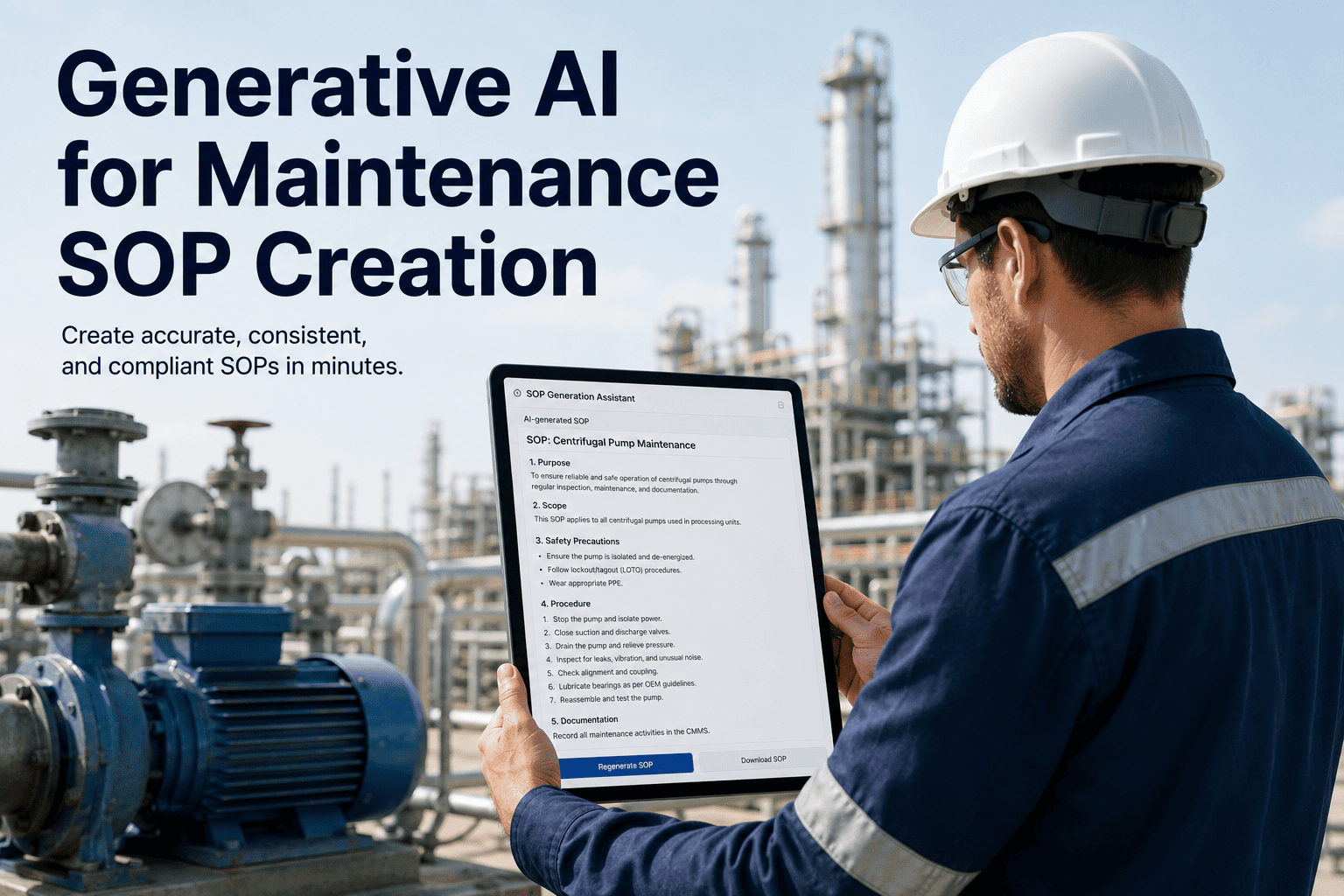
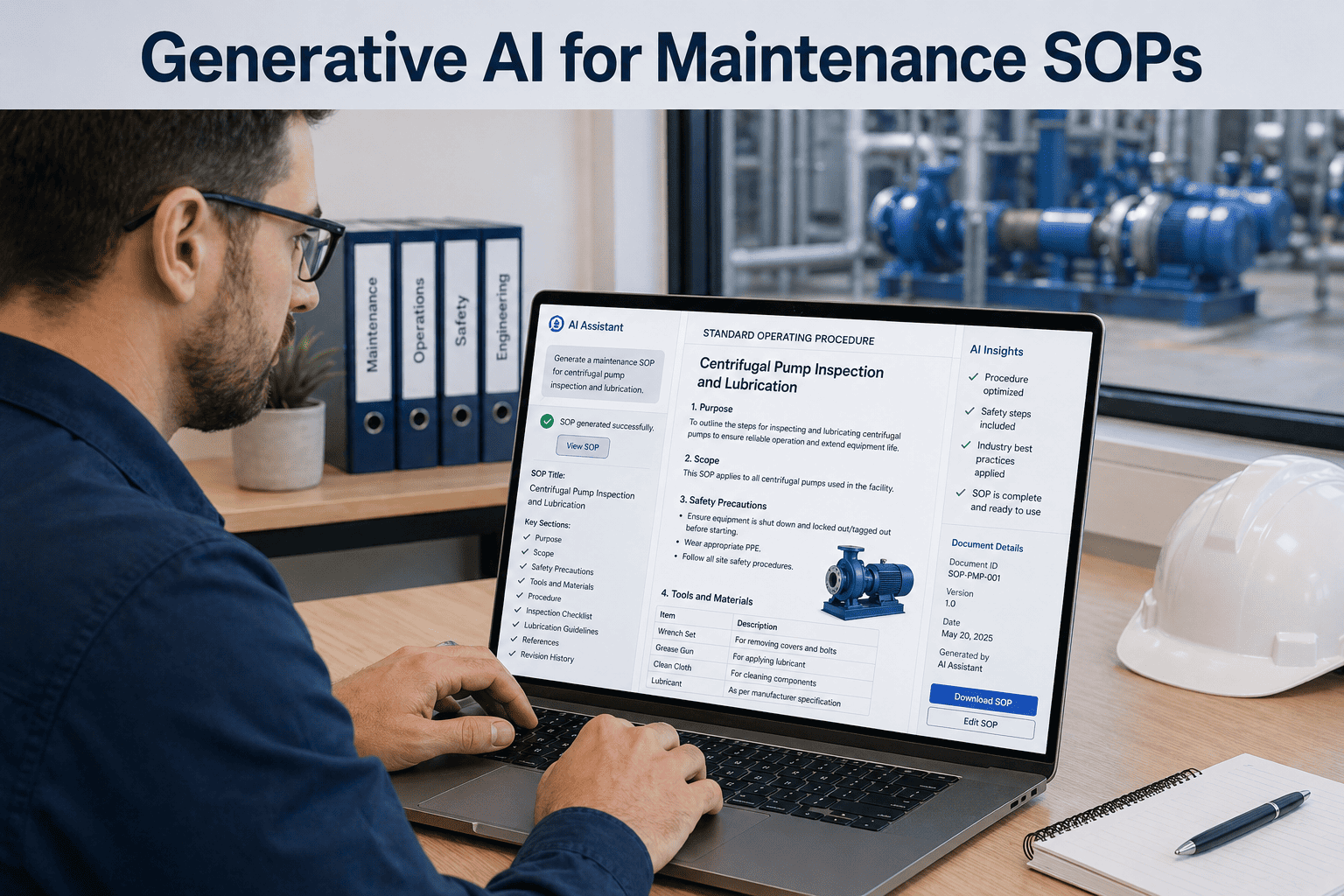
- AI generates complete standard operating procedures from work order history, repair notes, and parts usage data
- Analyzes the last 50 instances of a repair type to identify the consensus procedure, common variations, and failure points
- Outputs formatted SOPs with numbered steps, safety callouts, required tools, parts lists, and estimated duration
- Procedures update automatically when new repair data reveals improved methods or additional steps
- AI builds decision-tree troubleshooting guides from historical failure data and repair outcomes
- "Symptom → Diagnostic Step → Probable Cause → Fix" pathways generated from actual repair success rates
- Guides prioritize diagnostic steps by probability — most likely cause tested first, rarest cause tested last
- New failure modes auto-add to existing guides as technicians document novel problems and solutions
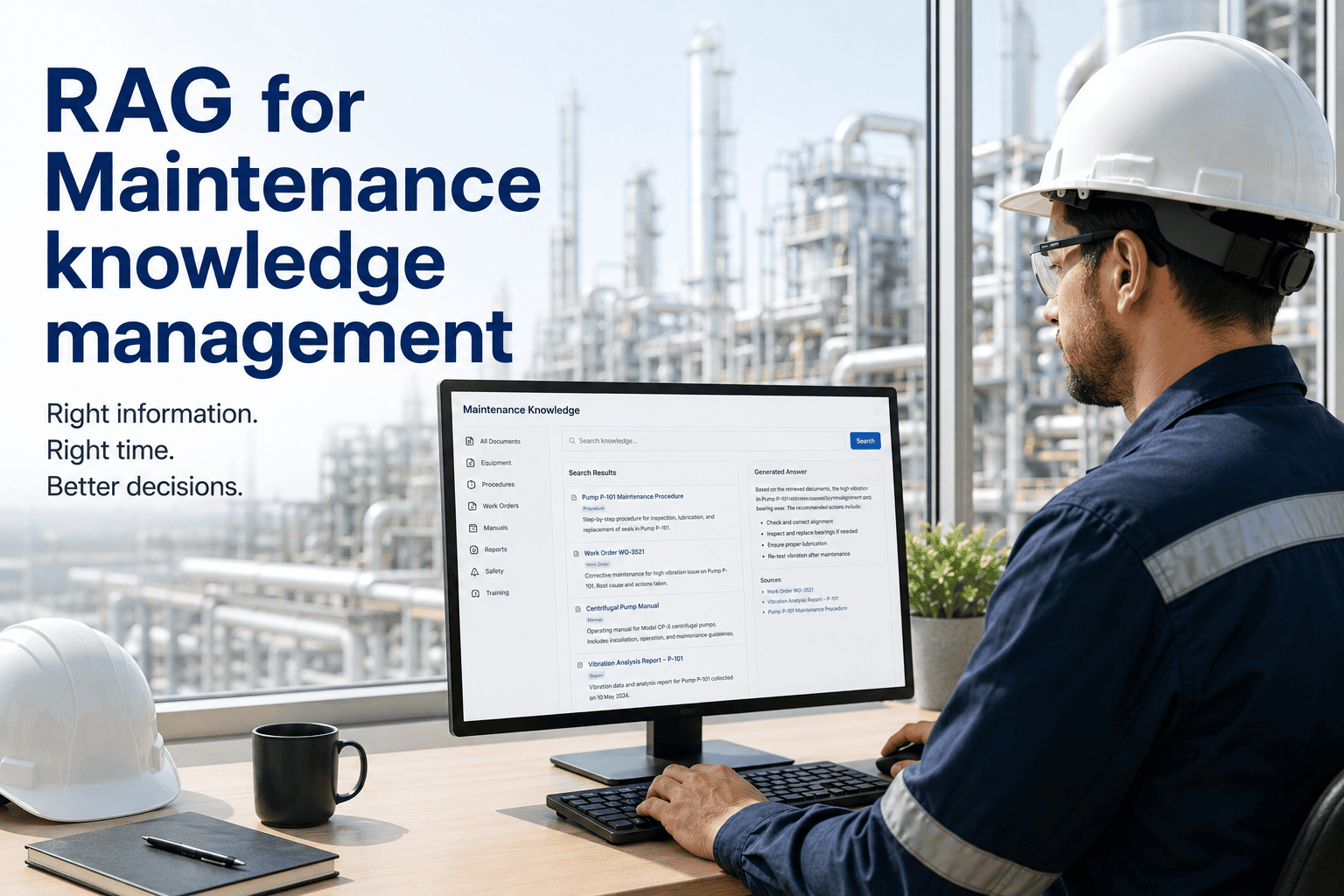
- AI generates and maintains a searchable knowledge base article for every asset in the CMMS
- Each article includes: operating parameters, common failures, repair procedures, parts cross-references, and tips
- Articles auto-update from new work order data — a novel repair documented today appears in the wiki tomorrow
- Technicians search by symptom, asset name, or plain-language question — "Why does Pump 7 cavitate at low flow?"
- AI converts SOPs and troubleshooting guides into training modules with knowledge checks and skill assessments
- Difficulty level adapts to the learner — apprentice receives detailed explanations, journeyman gets concise procedures
- Photo and video integration from completed work orders provides real-world visual examples for each procedure
- Training content updates automatically when procedures change — no manual curriculum revision required
- AI translates all generated documentation into any required language while preserving technical accuracy
- Maintenance-specific terminology handled correctly — not generic translation but industry-aware localization
- A procedure captured in English from a retiring mechanic is available in Spanish, French, and Mandarin within hours
- Critical for multinational operations and diverse maintenance workforces on the same site
How Generative AI Transforms Work Order Data Into Knowledge
Your CMMS already contains thousands of work orders with repair descriptions, parts used, time spent, and technician notes. Generative AI mines this data to extract patterns that no individual technician would notice — and converts those patterns into documentation that benefits the entire team.
| Data Source in CMMS | What AI Extracts | Documentation Output | Value Created |
|---|---|---|---|
| Repair Work Orders | Most common failure modes, effective repair sequences, average repair duration | Auto-generated SOPs ranked by frequency and success rate | New technicians follow proven procedures from day one |
| Technician Notes | Tips, warnings, workarounds, and contextual knowledge buried in free-text fields | Knowledge base articles with searchable tips and "watch out for" callouts | Tribal knowledge preserved even after technicians depart |
| Parts Usage History | Which parts are actually used vs. what manuals recommend, cross-reference alternatives | Updated parts lists and cross-reference tables per repair type | Eliminates wrong-part orders and reduces parts room confusion |
| Failure Patterns | Recurring symptoms, seasonal failure trends, equipment-specific quirks | Troubleshooting guides with probability-ranked diagnostic trees | First-time fix rate improves 20–35% from guided diagnostics |
| Inspection Reports | Condition progression, degradation rates, intervention effectiveness | Condition assessment standards and replacement timing guides | Capital planning decisions backed by documented condition data |
Your CMMS already holds years of maintenance intelligence trapped in unstructured work order text. Generative AI extracts it, structures it, and makes it searchable.
Before and After: Documentation Quality Transformation
- SOPs written manually — 4–8 hours per procedure, rarely updated
- Tribal knowledge lives in senior technicians' heads — lost at retirement
- Troubleshooting is trial-and-error for new technicians
- Work order notes are cryptic: "replaced seal, runs good now"
- Training materials are photocopied OEM manuals from 2008
- Knowledge base does not exist or is a neglected SharePoint site
- Multilingual documentation requires manual translation budget
- New hire onboarding takes 6–12 months to achieve competency
- SOPs auto-generated from work order data — updated continuously
- Conversational AI interviews extract knowledge before departures
- Probability-ranked troubleshooting guides from actual repair data
- AI enriches sparse notes into detailed procedural descriptions
- Training modules auto-generated from current SOPs with assessments
- Searchable wiki updated nightly from every completed work order
- Instant translation into any required language with technical accuracy
- New hire onboarding reduced to 3–4 months with guided procedures
Business Impact: What Generative AI Documentation Delivers
60-Day Deployment Roadmap
Generative AI documentation deploys incrementally — start with your highest-risk knowledge gaps (senior technicians approaching retirement) and expand to full knowledge base automation. Start your free trial and begin capturing institutional knowledge this week.
Identify critical knowledge held by 3–5 senior technicians approaching retirement or holding unique expertise
Conversational AI captures procedural knowledge in 30-minute sessions — producing draft SOPs overnight
AI mines existing work order history to auto-populate knowledge base articles for every critical asset
Every completed work order enriches the knowledge base — documentation improves automatically forever
Audit and Compliance: AI-Generated Documentation Standards
- Every SOP includes version history, author attribution, and data sources
- Procedures auto-update when repair data reveals improved methods
- Compliance-tagged procedures link to OSHA, EPA, NFPA, and industry standards
- Audit trail shows when procedures were created, modified, and accessed
- Training completion records prove technicians accessed current procedures
- Multilingual versions maintain identical technical content across languages
- SOPs written once and never updated — procedures reflect 2018 equipment configuration
- No record of who wrote procedures or what data informed them
- Compliance linkage is manual and incomplete — auditors find gaps
- No audit trail showing whether technicians accessed procedures before repairs
- Training materials are disconnected from actual repair procedures
- Translated documents may not reflect current English-language procedures
OxMaint's generative AI captures institutional knowledge through conversational interviews, auto-generates SOPs from work order data, builds searchable troubleshooting guides from repair history, and maintains a living knowledge base that grows smarter with every completed work order. Stop losing expertise to retirement. Start preserving it today.