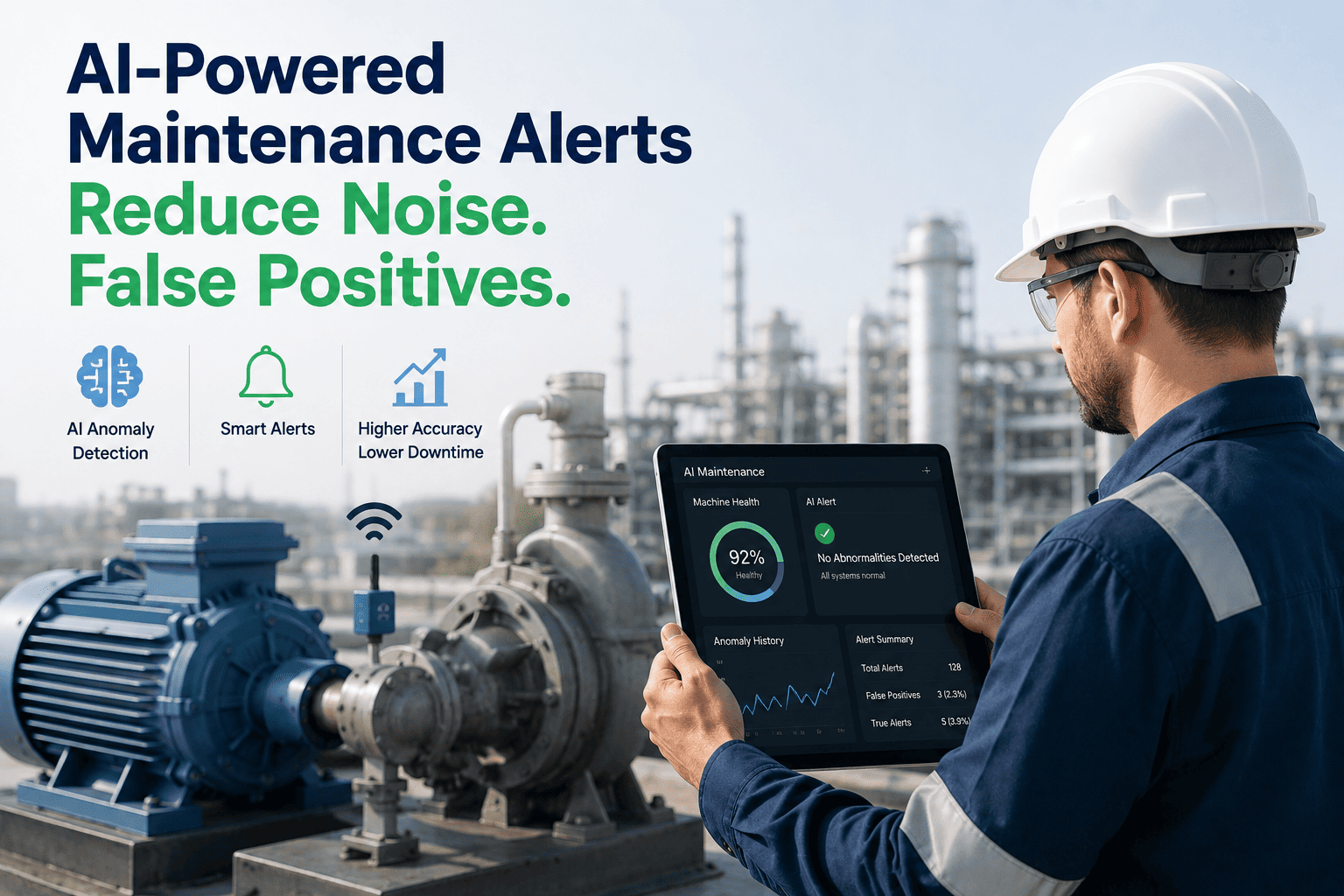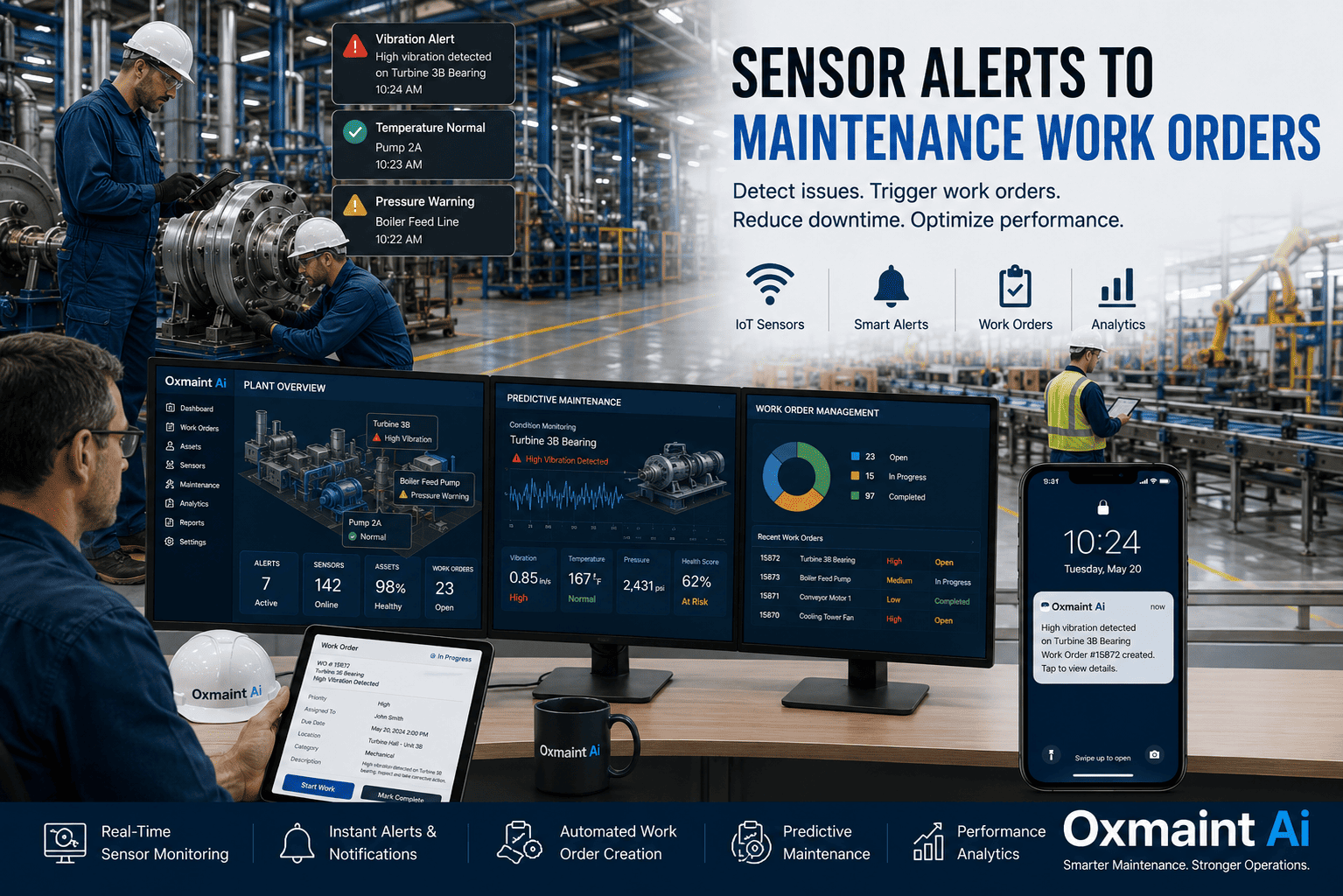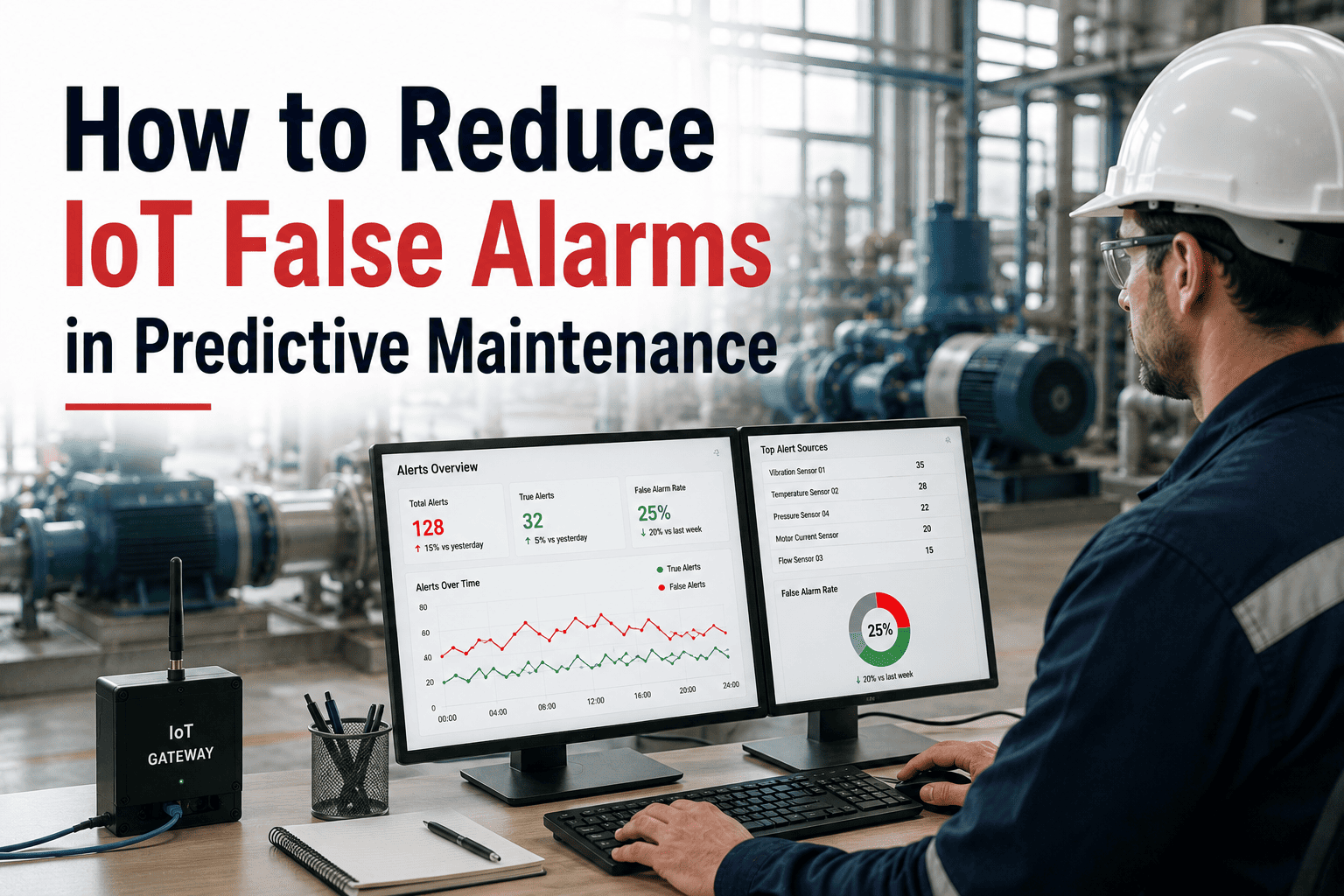
IoT false alarms are the primary reason predictive maintenance programs fail — not hardware failures, not data quality, not budget. When a maintenance team receives hundreds of low-signal alerts daily, two things happen within weeks: technicians start ignoring notifications entirely, or they respond to every alert with equal urgency regardless of actual risk. Both outcomes are dangerous. The first means real failures go undetected. The second means your highest-paid technicians spend their days chasing phantom faults on stable equipment. Reducing IoT false alarms in predictive maintenance is not a tuning exercise you do once at deployment — it is an ongoing configuration discipline that determines whether your sensor investment delivers 35% maintenance cost reduction or a decommissioned monitoring system collecting dust by month four. OxMaint's predictive maintenance platform structures alerts around asset criticality, baseline operating conditions, and maintenance history — so technicians receive signals that mean something, not raw threshold crossings that require expert interpretation before anyone commits to a response.
How to Reduce IoT False Alarms in Predictive Maintenance Systems
The practical guide to eliminating alert fatigue — smarter threshold configuration, baseline-relative alerting, three-tier alert logic, and the CMMS workflow that turns sensor signals into maintenance actions your team trusts.
Why IoT False Alarms Happen — and Why They're a Configuration Problem
A flat threshold alarm on a vibration metric carries no information about whether the asset was running at full load, ramping up from a cold start, or operating in high ambient heat when the reading was taken. The same vibration level that signals a developing fault on a lightly-loaded motor at steady state is completely normal for a heavily-loaded motor during ramp-up. When a CMMS applies the same threshold to both situations without context, one generates a valid maintenance signal and the other generates a false alarm — and there is no way to tell them apart at the point of notification.
Alert fatigue is not a sensor problem. It is a configuration problem. The fix requires four things: baseline establishment before threshold activation, asset-specific thresholds rather than plant-wide settings, three-tier alert logic that separates observation from action, and multi-sensor correlation that requires multiple independent signals before generating a work order. OxMaint's work order management module applies all four automatically once threshold rules are configured per asset — book a demo to see the alert configuration workflow.
8 Root Causes of IoT False Alarms in Predictive Maintenance
Setting thresholds at 80% of the alert limit before establishing what "normal" looks like for each specific asset. The same machine running different production grades generates different vibration levels — both normal, both alerting under fixed thresholds.
One threshold that triggers one work order, no matter what. Every crossing — genuine failure signal, transient process variation, sensor noise — produces the same urgency response. Three-tier logic (Advisory / Warning / Critical) maps alert severity to proportional response.
Alerting on a single data point above threshold rather than requiring sustained breach over a time window (e.g., above limit for 15+ consecutive minutes). A single spike from process variation triggers an alert; a genuine developing fault holds above threshold for hours.
Applying the same threshold during motor startup (high transient vibration expected), steady-state operation, and shutdown. Operating state context is the single largest source of false positives in vibration and current monitoring programs.
Generating a work order from one sensor breach without corroboration from other sensor types. A vibration anomaly alone is 78% reliable. The same vibration anomaly confirmed by temperature rise and increased amp draw is 92% reliable. Multi-sensor confirmation before work order generation eliminates a significant portion of false dispatches.
Treating a Tier 1 production-critical compressor and a Tier 3 auxiliary exhaust fan identically in alert logic. Both assets may breach the same threshold, but only one has production-stopping consequences. Alert thresholds and escalation rules must reflect asset criticality tier.
An elevated vibration reading on a pump rebuilt 30 days ago carries different weight than the same reading on a pump last serviced 18 months ago. CMMS-integrated alert logic that checks maintenance history before escalating reduces false urgent dispatches on recently-serviced assets.
Initial threshold settings are estimates. Real asset behavior under real operating conditions differs from manufacturer specs. A threshold tuning review at 30, 60, and 90 days after deployment — closing loop on false alarms vs. genuine alerts — is the difference between a program that matures and one that stays noisy indefinitely.
The Cost of Alert Fatigue — 4 Operational Consequences
When technicians receive 200+ alerts daily and have been conditioned to treat most as false, genuine warning signals are missed or deprioritized. The most dangerous outcome of alert fatigue is not that teams respond to everything — it is that eventually they respond to nothing, and the failure that sensor was supposed to catch causes exactly the unplanned downtime the program was designed to prevent.
A 3-person maintenance team receiving 50 false alert dispatches per week spends an average of 27 hours weekly investigating non-issues — time that could be spent on planned maintenance that actually extends asset life and reduces emergency spend. False alarms don't just waste time; they actively crowd out the work that prevents failures.
IoT monitoring programs abandoned within 6 months of launch almost universally cite the same reason: "too many false alarms, team stopped trusting the system." The hardware investment, configuration time, and organizational change required to restart a disbanded program is 3–5x the cost of tuning the existing one correctly from the start.
When alert acknowledgment rates drop (because the team is ignoring notifications), compliance audit trails show alert-response gaps that regulators flag as inadequate monitoring. Paradoxically, too many alerts produces worse compliance posture than well-tuned, fewer alerts with 100% response documentation.
How OxMaint Reduces False Alarms — Built-In
OxMaint establishes an asset-specific operating baseline during a configurable run-in period (typically 2–4 weeks) before activating alert rules. Thresholds are set relative to that baseline — flagging statistical deviation from normal rather than absolute values. This single change reduces false alarms by 40–60% versus fixed thresholds on the same sensor data.
Advisory: anomaly logged, monitoring frequency increased, no dispatch. Warning: scheduled maintenance work order generated for the next available window. Critical: immediate work order, mobile alert to nearest certified technician, supervisor notification. Each tier maps to a proportional response — technicians never receive an urgent alert for a non-urgent condition.
OxMaint's alert engine requires either sustained breach (above threshold for a configurable time window) or a defined rate-of-change (e.g., vibration rising 0.05 in/s per hour) before escalating to Warning or Critical. Single-point spikes from process variation, startup transients, or sensor noise do not trigger work orders.
OxMaint's AI requires corroboration from multiple sensor types before generating a Critical alert. A vibration anomaly on a motor that is not accompanied by temperature rise or increased amp draw escalates to Advisory only. The same anomaly confirmed by two additional sensor channels escalates immediately. This correlation layer eliminates the majority of single-sensor false positives. Explore OxMaint's AI automation.
Every alert is evaluated against the asset's last service event, parts replaced, and known failure modes. An asset serviced within the last 30 days showing early anomaly signs receives a lower escalation priority than the same anomaly on an asset approaching its historical mean-time-between-failures. History context is automatic — no manual configuration required once work orders are closed in the system.
OxMaint's analytics dashboard tracks alert accuracy over time — what percentage of alerts led to confirmed maintenance findings vs. false dispatches. This data drives threshold tuning reviews at 30, 60, and 90 days, systematically improving signal quality as the program matures without requiring manual data analysis.
Alert Configuration: Before vs. After Tuning
| Factor | Untuned System | Properly Configured System |
|---|---|---|
| Threshold basis | Fixed absolute — same for all assets | Baseline-relative — asset-specific deviation |
| Alert levels | Binary: alert / no alert | Three-tier: Advisory / Warning / Critical |
| Trigger logic | Single data point above threshold | Sustained breach + rate-of-change confirmation |
| Sensor correlation | Single sensor decides alert | Multi-sensor corroboration required for Critical |
| Context awareness | None — reading vs. threshold only | Criticality + maintenance history + operating state |
| Daily alert volume | 200–500+ notifications | 10–30 actionable signals |
| Team response rate | Declining — fatigue sets in | Near 100% — every alert is meaningful |
| False dispatch rate | 60–80% of dispatches | <15% with mature multi-sensor correlation |
ROI of Getting Alerts Right
Use the OxMaint ROI Calculator to model the labor and downtime cost savings from alert tuning, or book a demo to see the three-tier alert configuration workflow live.
Frequently Asked Questions
What is the most effective single change to reduce IoT false alarms?
How many alerts per day should a well-configured predictive maintenance system generate?
How long does it take to tune alert thresholds in OxMaint?
Can OxMaint reduce alert volume from an existing noisy IoT deployment?
Reduce IoT False Alarms — Build a System Your Team Trusts
OxMaint's predictive maintenance platform applies baseline-relative thresholds, three-tier alert logic, multi-sensor correlation, and maintenance history context automatically — so your team receives 10–30 actionable signals per day instead of hundreds of noise notifications. 94% AI accuracy. 62% less downtime. Free to start.
Trusted by 1,000+ facilities · Live in days, not months