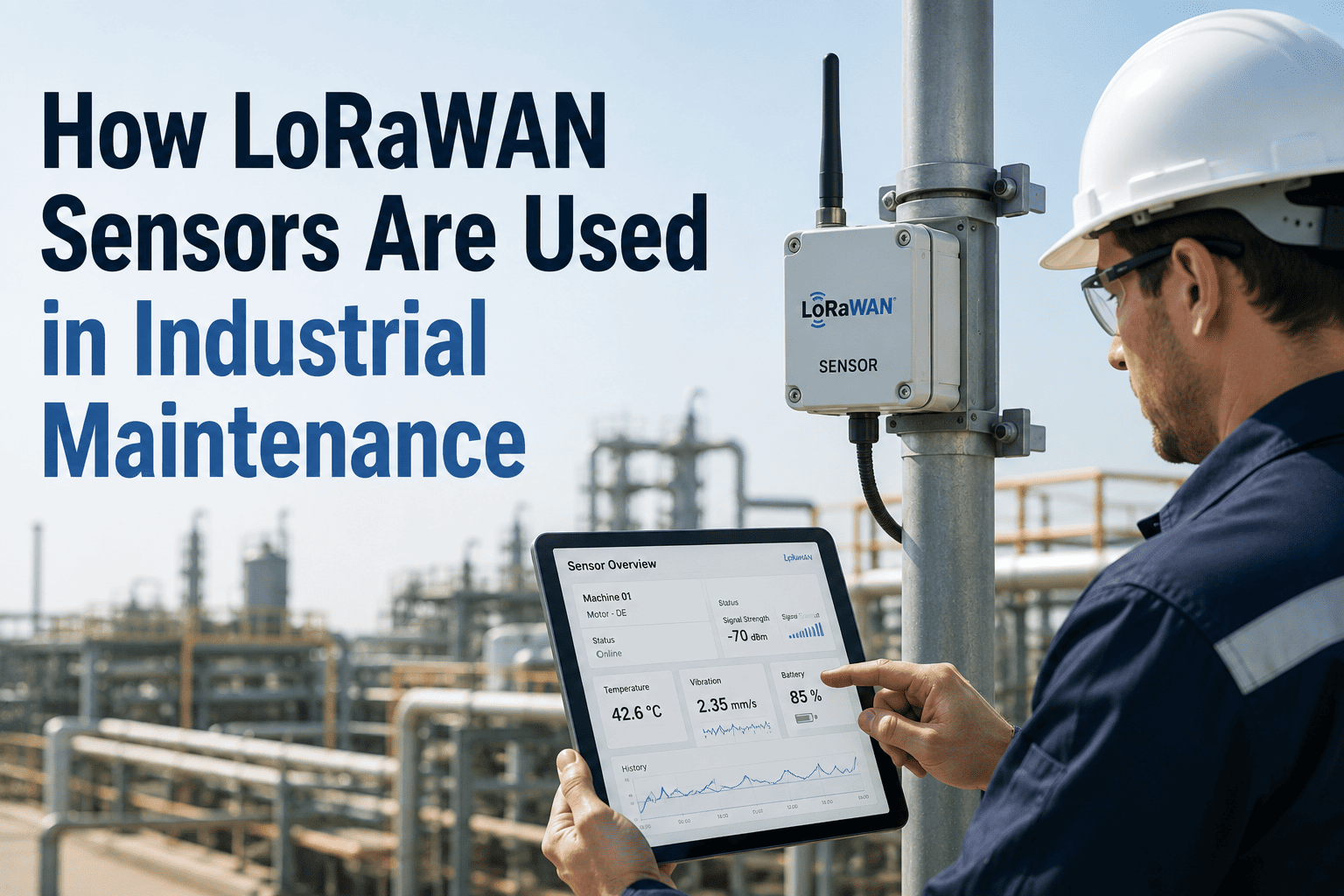
LoRaWAN sensors are solving the single most common infrastructure barrier to industrial IoT adoption: the facilities where sensor connectivity is most valuable are exactly the ones where installing it is hardest. Large manufacturing plants, outdoor tank farms, remote pump stations, multi-building campuses — environments with dead zones, structural interference, and high cable-run costs that make Wi-Fi and wired networks prohibitively expensive. LoRaWAN (Long Range Wide Area Network) solves this by transmitting small sensor data packets up to 10–15 km on a single battery charge that lasts 5–10 years, using license-free spectrum at a fraction of cellular costs. With over 350 million LoRaWAN devices now connected globally, the technology has moved decisively from pilot to production — and plants that deploy it for predictive maintenance monitoring consistently report 30% or more reduction in unplanned downtime from vibration and temperature monitoring of critical rotating equipment.
LoRaWAN Sensors for Industrial Maintenance: Benefits, Setup & Use Cases
How LoRaWAN enables long-range, low-power condition monitoring across facilities where Wi-Fi and wired sensors can't reach — and how to connect it to your CMMS for automatic work order generation.
What Is LoRaWAN and Why Does It Matter for Industrial Maintenance?
LoRaWAN is a low-power wide-area network (LPWAN) protocol that transmits small data packets over long distances using license-free radio spectrum. In industrial maintenance terms, it means a single gateway device placed at a facility can receive sensor data from vibration monitors, temperature probes, and pressure sensors deployed anywhere on site — through concrete walls, across outdoor distances, and in RF-noisy environments — without wiring, without Wi-Fi infrastructure, and without the per-device cellular data costs of 4G/5G solutions.
The tradeoff is bandwidth: LoRaWAN transmits very small payloads (typically 10–50 bytes) at low frequency (every few minutes to hourly). This is perfectly suited for condition monitoring — vibration RMS, temperature readings, pressure values, and alarm flags are small data points that don't require continuous high-bandwidth streaming. For assets where you need millisecond-resolution data, Wi-Fi or wired connections are more appropriate. For the majority of industrial condition monitoring use cases, LoRaWAN delivers everything needed at a fraction of the infrastructure cost. Book a demo to see LoRaWAN sensor data feeding OxMaint predictive work orders live.
LoRaWAN vs. Other Industrial IoT Connectivity — At a Glance
| Factor | LoRaWAN | Wi-Fi | 4G / Cellular | Wired (Ethernet) |
|---|---|---|---|---|
| Range | 10–15 km outdoor / 1–2 km indoor | 50–150 m | Carrier coverage dependent | 100 m per segment |
| Battery life | 5–10 years | Months (high power draw) | 1–3 years | N/A — wired power |
| Install cost | Very low — 1 gateway, wireless sensors | Medium — multiple APs required | Low hardware, high ongoing cost | High — cable runs, conduit |
| Ongoing data cost | None — license-free spectrum | None (local) | Monthly SIM fees per device | None |
| Bandwidth | Low — small payloads only | High — suitable for streaming | Medium–high | Very high |
| Best use case | Condition monitoring, periodic readings | High-frequency data, AI vision cameras | Remote sites without local network | Mission-critical, high-precision |
Pain Points LoRaWAN Resolves for Maintenance Teams
Outdoor compressor yards, rooftop HVAC units, basement pump rooms, distant storage tanks — these are exactly the assets most likely to fail without warning and least likely to be covered by existing Wi-Fi infrastructure. LoRaWAN reaches them all from a single centrally-placed gateway.
Running cable to 40 sensor points across an existing plant can cost $50,000–$150,000 in conduit, cabling, and licensed electrical labor. LoRaWAN eliminates this entirely. Sensors mount in minutes, gateway installation takes hours, and total infrastructure cost is typically under $5,000 for a medium-sized facility.
With 5–10 year battery life, a 50-sensor LoRaWAN deployment requires fewer than 10 battery replacements per year on average — manageable without a dedicated team. By comparison, Wi-Fi IoT sensors typically need battery service every 6–18 months, creating a significant maintenance burden as deployments scale. OxMaint's PM scheduler tracks sensor battery status and auto-generates replacement work orders before a sensor goes offline.
LoRaWAN is an open standard — any certified sensor from any manufacturer works with any certified gateway. You are not locked into proprietary hardware ecosystems. Mix vibration sensors from one vendor, temperature probes from another, and level sensors from a third — all reporting to the same gateway and the same CMMS via standard protocols. Book a demo to see OxMaint's LoRaWAN-connected asset monitoring in action.
How OxMaint Connects to LoRaWAN Sensors
LoRaWAN-certified vibration, temperature, pressure, or current sensors are mounted directly on the asset — no wiring required. Most sensors activate via QR scan or NFC tap and begin transmitting immediately. OxMaint supports sensors from all major LoRaWAN-certified manufacturers.
The LoRaWAN gateway (one device covering the full facility) receives sensor transmissions and forwards them via MQTT or HTTP to OxMaint's cloud. Gateway placement takes under an hour. OxMaint's integration layer handles protocol translation — no custom middleware needed.
Each sensor is linked to a specific asset record in OxMaint — so every reading, threshold breach, and work order attaches to the right equipment with its full service history, parts inventory, and maintenance cost data already populated.
Set three-tier thresholds (Advisory / Warning / Critical) per sensor per asset. When a threshold is breached, OxMaint generates a prioritized work order automatically, assigns it to the nearest certified technician via mobile app, and logs the event to the asset's history — closing the loop from sensor signal to maintenance action without manual intervention.
LoRaWAN Maintenance Use Cases by Industry
Vibration + temperature monitoring on motors, pumps, and conveyors across large production floors. LoRaWAN reaches assets in RF-noisy environments where Wi-Fi is unreliable. OxMaint for manufacturing connects LoRaWAN sensor data to production-line uptime analytics.
Rooftop HVAC units, basement chillers, cooling towers, and remote AHUs — all unreachable by Wi-Fi but covered by a single LoRaWAN gateway. Temperature and vibration monitoring prevents the HVAC failures that cause comfort complaints and compliance violations. Explore OxMaint for facilities.
Refrigeration compressor health monitoring, cold-chain temperature compliance, and processing equipment vibration monitoring — all with LoRaWAN's ability to penetrate the thick stainless steel walls and RF interference typical of food processing environments. OxMaint for food manufacturing.
Remote pump stations, distributed transformer monitoring, and outdoor substation equipment — LoRaWAN's 10–15 km outdoor range covers geographically dispersed infrastructure that would require prohibitive cellular or fiber costs to monitor conventionally.
ROI & Results
Calculate your specific ROI at the OxMaint ROI Calculator, or book a demo and we'll walk through a LoRaWAN deployment plan for your facility.
Frequently Asked Questions
How many LoRaWAN gateways does a typical industrial facility need?
Is LoRaWAN secure enough for industrial operational technology (OT) environments?
How frequently do LoRaWAN sensors transmit data — is it frequent enough for maintenance monitoring?
Can LoRaWAN sensors work alongside existing Wi-Fi or wired sensors in OxMaint?
Connect LoRaWAN Sensors to Your CMMS — No Wiring Required
OxMaint connects LoRaWAN, Wi-Fi, and wired sensors to automatic, AI-prioritized work orders — covering your entire facility from a single platform, regardless of connectivity infrastructure. 5–10 year battery life. Open standard hardware. Free to start.
Trusted by 1,000+ facilities · Live in days, not months