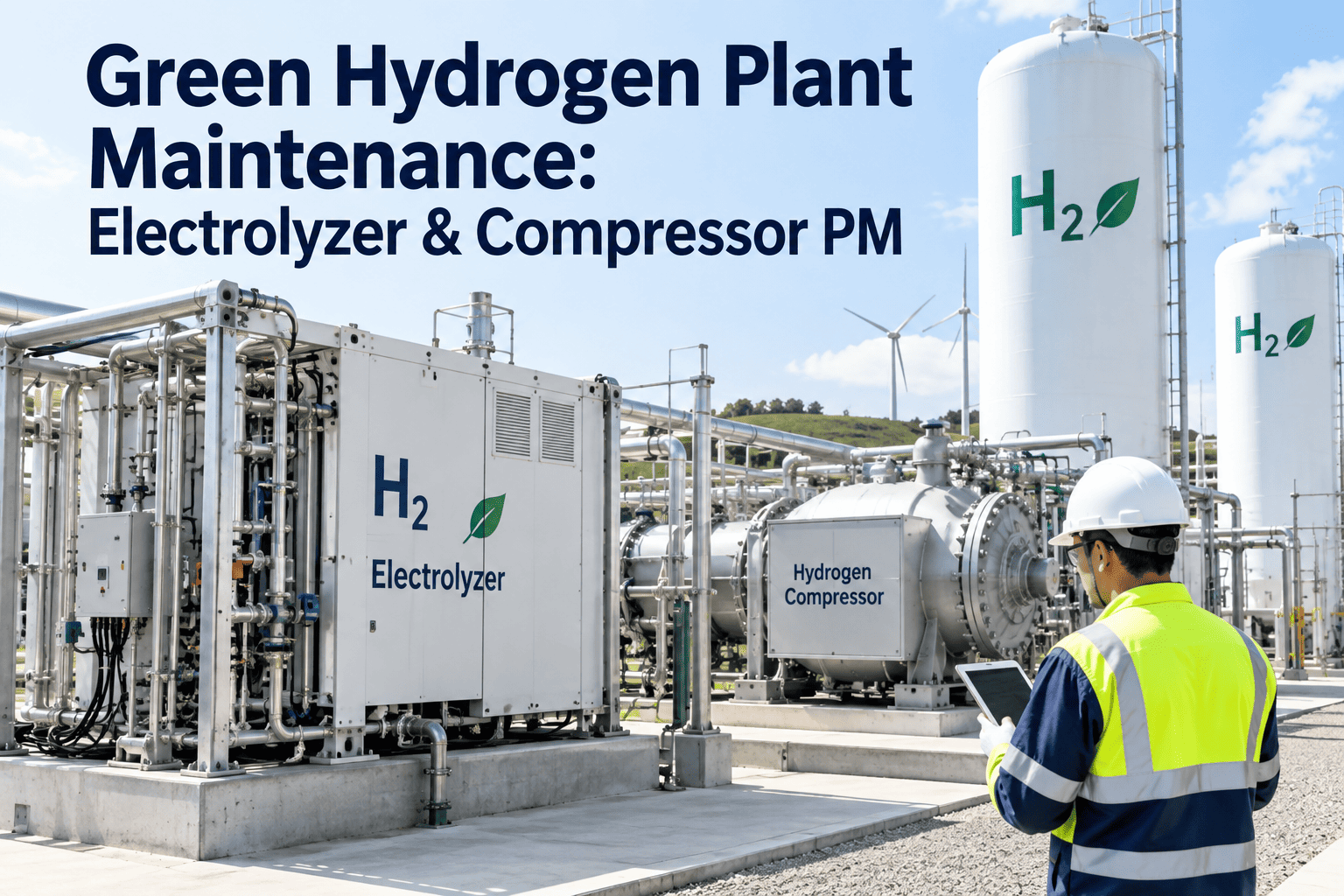
A green hydrogen plant fails in slow motion. The stack doesn't stop — it drifts, needing 2%, then 5%, then 15% more power to produce the same kg of H₂. By the time the operations team notices the extra megawatt, the plant has been losing money for months. The maintenance strategy that catches this is different from anything in a conventional gas plant — cell-voltage watching, deionised water chemistry, membrane thinning trends and compressor lube-oil filtration all sit on the same asset record. This guide walks the model using OXMAINT AI, the AI-powered CMMS for green hydrogen operations.
Green Hydrogen Plant Maintenance: Electrolyser, Compressor, and Storage.
OXMAINT AI, the AI-powered CMMS/maintenance management software, connects the full hydrogen plant workflow on one platform — cell-voltage telemetry and water-chemistry logs in, degradation defects raised and prioritised, work orders assigned to stack, BoP or compressor techs, and preventive & predictive PM cadence tuned per asset class.
Why Green Hydrogen Maintenance Is Its Own Discipline
Hydrogen plants combine electrochemistry, compression, cryogenics, gas handling and utilities — with a load profile that follows the grid, not the operator. The maintenance problem is a moving target that a conventional gas-plant CMMS handles poorly. OXMAINT AI carries the electrolyzer as a first-class asset class. Sign up free and configure your first electrolyzer stack in OXMAINT AI.
PEM vs Alkaline — Two Stacks, Two Maintenance Regimes
The two dominant electrolyzer technologies fail differently, so they need different PM regimes. OXMAINT AI ships templates for both — pick per asset, or run a mixed fleet on one platform. Book a demo to see the PEM and alkaline templates.
- MEA (membrane electrode assembly) thinning and pinhole risk
- Platinum / iridium catalyst poisoning from feed-water metals
- Bubble-induced water starvation at high current density
- Fast dynamic response — suits cycling renewable loads
- Typical operation: 50–80°C, up to 30 bar; ~1–3 A/cm²
- Diaphragm/separator degradation and gas crossover risk
- Nickel electrode passivation and shunt-current corrosion
- Lye circulation, concentration and temperature control
- Slower dynamic response — best on stable baseload
- Commercial baseline — long field history at industrial scale
The 4-Domain Asset Map
A green hydrogen plant isn't one system — it's four interlocked ones. OXMAINT AI carries each domain with its own hierarchy, PM template and skill routing. Start free and map your plant into the 4-domain model.
The Stack Degradation Curve — What the Ledger Actually Tracks
Stack aging is measurable, plottable and predictable. OXMAINT AI holds cell voltage, current density and specific energy consumption as trend series per stack — the drift shows up long before the alarm does. OEM stack-replacement typically triggers around a 20% voltage rise vs start-of-life. Book a demo to see the degradation curve view.
Catch the Drift. Book the Refurb. Skip the Megawatt.
OXMAINT AI turns cell-voltage trends into scheduled maintenance decisions — refurbishment windows are planned around the grid, not forced by a failure.
The Compressor PM Regime
Downstream of the stack, H₂ compression is the second-biggest reliability lever. Compressor types have different PM profiles — OXMAINT AI ships templates for each. Sign up free and configure your compressor fleet in OXMAINT AI.
The Predictive PM Cadence Library
A working hydrogen plant runs on a nested cadence — continuous telemetry, daily walkdowns, monthly checks, quarterly PMs, annual overhauls. OXMAINT AI ships the cadence as a default template per domain. Book a demo to see the cadence library live.
| Cadence | Task | Domain | Signal / Method |
|---|---|---|---|
| CONT | Cell voltage, current density, specific energy | Stack | Telemetry trend vs SoL baseline |
| DAILY | DI water conductivity + KOH concentration | BoP | Inline sensor + grab sample |
| DAILY | Compressor vibration + discharge temp | Compression | Vibration IoT + PT100 trend |
| WEEKLY | Gas-liquid separator drain + level check | BoP | Sight-glass + drain log |
| WEEKLY | H₂ leak survey — flanges, valves, dispensers | Storage | Portable H₂ detector sweep |
| MONTHLY | Compressor lube-oil sample + filter dP | Compression | Lab oil analysis + trend |
| MONTHLY | Rectifier / PSU thermography + connections | BoP | IR imaging + torque check |
| QUARTERLY | Stack polarisation curve + resistance test | Stack | EIS or offline sweep |
| QUARTERLY | De-oxo + dryer media condition | BoP | Bed sample + moisture spec |
| ANNUAL | Compressor major service + valve rebuild | Compression | OEM SOP |
| ANNUAL | Pressure vessel + PRD inspection | Storage | Per applicable pressure code |
The Signal-to-Refurb Workflow
Every degradation signal walks the same rails — measured, trended, alerted, decided, actioned. OXMAINT AI moves it end-to-end so a drifting stack becomes a booked refurb, not a Monday-morning surprise. Start free and route your first degradation alert in OXMAINT AI.
What OXMAINT AI Gives a Hydrogen Plant Team
Purpose-built for the electrochemistry-plus-plant reality — one platform behind the stacks, the BoP, the compressors and the storage yard. Start free and load your hydrogen plant into OXMAINT AI.
The pain wasn't the stacks — it was the fact that nobody in maintenance owned the drift. Voltage crept up quietly for months, and we only saw it in the electricity bill. When the CMMS started plotting cell voltage on the same screen as PM and WOs, the conversation changed. Refurbs got booked in advance, aligned with the cheap-power windows. That's when the plant became a real business.
Frequently Asked Questions
Stack. BoP. Compressor. Storage. One Platform.
Move your green hydrogen operation onto OXMAINT AI — chemistry-specific PM, degradation trend ledger, compressor type templates and a refurb-booking engine that answers the grid, not just the calendar.