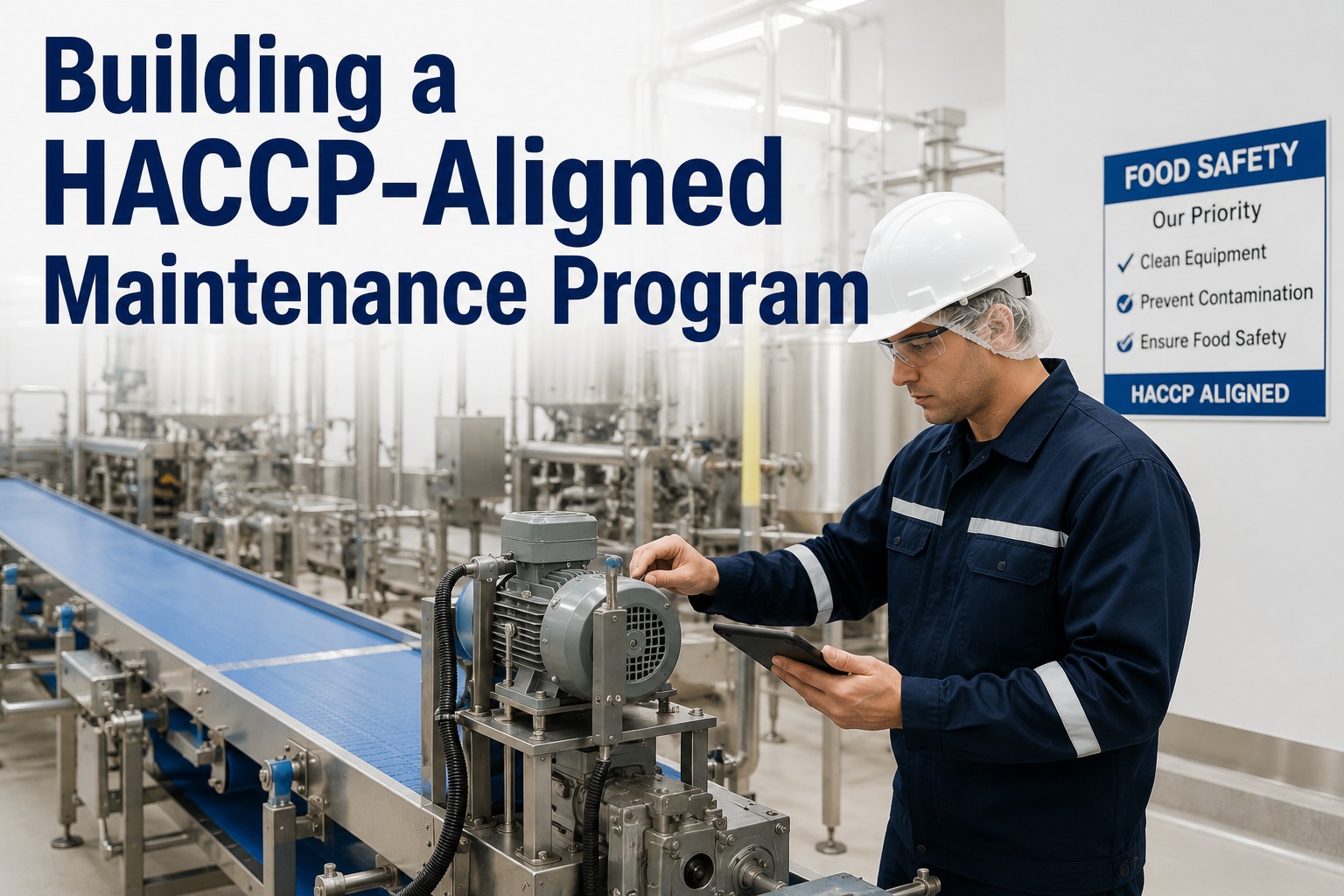
Maintenance is a prerequisite program under HACCP, meaning every work order, calibration record, and preventive maintenance task on critical food-contact equipment directly supports your food safety plan. A HACCP-aligned maintenance program transforms your CMMS from a simple repair-tracking tool into defensible food safety infrastructure that survives FSMA, BRC, and customer audits with confidence. Plants that structure maintenance this way routinely cut unplanned downtime 30–50% while eliminating the paper trails that trigger audit findings. OxMaint helps food manufacturing teams build exactly this structure — CCP-supporting PM flagging, calibration integration, and sanitation coordination — so your maintenance records are always audit-ready. Start Free Trial to see how fast you can align your program.
HACCP Maintenance Compliance
Is your maintenance program defensible under a food safety audit — or just a paper trail?
Over 60% of food manufacturing audit findings trace back to incomplete preventive maintenance records, missing calibration logs, or undocumented sanitation-equipment downtime. Your CMMS should be the evidence — not the gap.
The Compliance Gap
Why HACCP maintenance is a prerequisite program — not just "equipment upkeep"
Under HACCP and FSMA's preventive controls rule, maintenance is formally classified as a prerequisite program (PRP). That means auditors don't just check whether your line ran — they check whether the metal detector was calibrated before the shift, whether the freezer compressor PM was completed on schedule, and whether the conveyor lubricant was food-grade. If those records can't be produced in minutes, you have a critical deficiency.
A food safety maintenance program isn't built with spreadsheets and clipboards. It requires a structured system where every asset tied to a Critical Control Point has a flagged PM schedule, every calibration is logged with traceable serial numbers, and every sanitation-equipment downtime event is coordinated with production so there are no gaps in the cleaning record. When a HACCP plan says "monitor metal detector every 2 hours," the maintenance program must guarantee that the detector is functioning, calibrated, and repairable within that window — with documentation to prove it.
Audit-Ready Checklist
HACCP maintenance program checklist: what auditors expect to see
Whether you're facing an SQF, BRCGS, FSSC 22000, or FDA FSMA inspection, the maintenance documentation expectations overlap by 90%+. Use this checklist to gauge your readiness.
Every asset supporting a Critical Control Point — metal detectors, magnets, sifters, temperature probes, scales — has a preventive maintenance schedule flagged in the CMMS with a direct reference to the HACCP plan CCP number.
Calibration intervals are automated, not memory-based. Each record links to the instrument serial number, the calibration standard used, the technician who performed it, and the pass/fail result — retrievable in under 60 seconds.
Maintenance downtime is scheduled around CIP/COP cycles so sanitation teams never find equipment disassembled mid-clean or, worse, reassembled without a post-sanitation inspection sign-off.
Every unplanned breakdown on a CCP asset generates an automatic corrective action record — root cause, parts replaced, food-safety impact assessment, and revalidation of the CCP before production resumes.
Inventory system flags food-grade lubricants, NSF-certified gaskets, and FDA-compliant belts. Non-food-grade parts cannot be issued to a production-line work order without an override log.
A single report pulls every PM completion, calibration log, and corrective action for any date range and any asset group — formatted the way auditors expect, not assembled manually the night before.
Build the Program
How to build a HACCP-aligned maintenance program in 5 phases
A food manufacturing plant with 180 production assets can move from spreadsheet-based maintenance to a fully HACCP-aligned CMMS program in 6–10 weeks. Here's the phased approach that works.
Asset–CCP Cross-Reference
Map every asset in your facility to the corresponding HACCP plan CCPs. Flag CCP-supporting equipment (metal detectors, magnets, sifters, temperature controls, scales, pressurized vessels) so they carry a visible compliance tag in the CMMS. A 180-asset plant typically identifies 25–40 CCP-supporting assets.
PM Schedule Alignment
Build preventive maintenance schedules for every flagged asset. PM intervals must match or exceed the frequency stated in the HACCP plan — if the plan says "verify metal detector every 2 hours," the CMMS schedules a verification task every 2 hours with a sign-off requirement. No exceptions, no manual reminders.
Calibration & Sanitation Integration
Automate calibration schedules for all food-safety instruments. Coordinate maintenance windows with the sanitation schedule so CIP cycles, equipment disassembly, and post-clean inspections happen in the right sequence — not in conflict.
Corrective Action Workflows
Configure the CMMS so any failure on a CCP asset auto-generates a corrective action record: root-cause field, food-safety impact assessment, parts used, and a mandatory revalidation step before the line restarts. This is what auditors look for first.
Audit-Ready Reporting & Mock Audit
Build one-click reports that pull PM completions, calibration logs, and corrective actions by date range and asset group. Run a mock audit — ask a maintenance tech to produce the last 90 days of metal-detector calibration records. If it takes more than 2 minutes, the system isn't ready.
Audit Gaps vs. Audit-Ready
Reactive maintenance vs. HACCP-aligned CMMS: what auditors actually find
The difference between a reactive maintenance program and a HACCP-aligned one isn't just operational — it's the difference between passing an audit and receiving a critical non-conformance that costs you customers.
| Audit Criterion | Reactive / Spreadsheet Maintenance | HACCP-Aligned CMMS (OxMaint) |
|---|---|---|
| CCP asset PM completion records | Paper logs in file cabinets; 15–20% missing or illegible | 100% digital, time-stamped, technician-signed; 0% missing |
| Calibration traceability | Sticker on instrument; standard used often undocumented | Full chain: serial number, standard, technician, result, date |
| Corrective action documentation | Verbal handoff; documented days later if at all | Auto-generated at failure; mandatory fields before line restart |
| Report retrieval time for auditor | 2–4 hours of manual file searching per request | Under 60 seconds via one-click filtered report |
| Sanitation–maintenance coordination | Conflicting schedules; equipment torn down mid-CIP | Shared calendar; maintenance windows locked to CIP cycles |
| Spare parts food-grade status | Bin labels; wrong parts issued ~5% of the time | System-enforced; non-food-grade parts blocked on production WOs |
| Audit outcome | Avg. 2–4 non-conformances per cycle; repeat findings common | Zero maintenance-related non-conformances; first-time pass rate 95%+ |
How OxMaint Helps
How OxMaint turns your CMMS into food safety infrastructure
OxMaint isn't just a work-order tool with a food-industry label. It's built to map directly to your HACCP plan's prerequisite program requirements — so every maintenance action generates audit-grade evidence automatically.
CCP-Supporting PM Flagging
Tag any asset as CCP-supporting and OxMaint links it directly to your HACCP plan's CCP number. PM schedules auto-enforce the frequency in your plan, and missed PMs escalate to the maintenance manager within hours — not at the next audit.
Outcome: 100% PM completion on CCP assets, zero "missed verification" findings.
Calibration Management Integration
Automated calibration scheduling for every food-safety instrument — thermometers, pH meters, metal detectors, scales, pressure gauges. Each record captures serial number, standard, technician, result, and digital signature, retrievable by any filter in seconds.
Outcome: Calibration report retrieval drops from 3 hours to under 60 seconds.
Sanitation Coordination Module
Maintenance windows are scheduled against the CIP/COP calendar so disassembly, repair, and reassembly never conflict with sanitation cycles. Post-sanitation inspections are work-order tasks with mandatory sign-off before production restarts.
Outcome: Eliminate sanitation–maintenance scheduling conflicts that cause 8–12 hours of lost production per month.
One-Click Audit Reporting
Generate a complete maintenance evidence package — PM completions, calibration logs, corrective actions, spare-parts traceability — for any date range, any asset group, any CCP. Formatted for SQF, BRCGS, FSSC 22000, and FDA FSMA reviewers.
Outcome: Audit prep time drops from 2 weeks to 2 hours; first-time audit pass rate exceeds 95%.
Worked Example
A 180-asset dairy plant spending $42K/yr on audit prep — and what changed
A mid-size dairy processor with 180 production assets was spending roughly $42,000 annually on audit preparation — 2 weeks of QA and maintenance manager time pulling paper records, plus $10K in recurring non-conformance remediation costs. After implementing OxMaint's HACCP-aligned CMMS, the plant tagged 32 CCP-supporting assets, automated calibration schedules for 48 instruments, and built one-click audit reports. Result: audit prep time dropped to under 4 hours, the plant achieved zero maintenance-related non-conformances on its next BRCGS audit, and unplanned downtime on the pasteurizer line fell 34% because CCP-flagged PMs were never skipped again. Payback period: under 4 months.
See OxMaint on your assets — book a 30-min demo
Walk through a HACCP-aligned maintenance setup with our team. We'll show you how CCP flagging, calibration integration, and one-click audit reporting work on assets like yours — in 30 minutes.
FAQ
HACCP maintenance program: common questions
Is maintenance a prerequisite program under HACCP?
Yes. Under HACCP and FSMA's preventive controls rule, maintenance and sanitation are formally classified as prerequisite programs (PRPs). This means your maintenance program must be documented, scheduled, verifiable, and directly supportive of every Critical Control Point in your food safety plan — not just "keeping machines running." Auditors will ask to see the evidence.
What maintenance records does a food safety auditor expect to see?
Auditors expect preventive maintenance completion logs for all CCP-supporting assets, calibration records with full traceability (serial number, standard, technician, result), corrective action documentation for any equipment failure affecting a CCP, spare-parts food-grade verification, and sanitation–maintenance coordination records. These must be retrievable in minutes, not days. Book a demo to see how OxMaint structures these records for instant retrieval.
How does a CMMS support HACCP compliance in food manufacturing?
A food safety CMMS like OxMaint supports HACCP compliance by automating PM schedules on CCP assets, enforcing calibration intervals, generating corrective action records at point of failure, coordinating maintenance with sanitation cycles, and producing one-click audit reports. The system transforms maintenance from a paper-based obligation into defensible, real-time food safety evidence that auditors can verify on the spot.
How long does it take to implement a HACCP-aligned maintenance program?
A food manufacturing plant with 150–250 production assets can typically implement a HACCP-aligned CMMS program in 6–10 weeks. The phased approach includes asset–CCP cross-referencing (weeks 1–2), PM schedule alignment (weeks 3–4), calibration and sanitation integration (weeks 5–6), corrective action workflow setup (weeks 7–8), and audit-ready reporting with a mock audit (weeks 9–10). Plants migrating from spreadsheets see payback in under 4 months.
Can OxMaint integrate with our existing HACCP plan and food safety software?
Yes. OxMaint is designed to map directly to your existing HACCP plan's CCP numbers, prerequisite program structure, and audit framework (SQF, BRCGS, FSSC 22000, FDA FSMA). You can tag assets by CCP, link PM schedules to plan frequencies, and export maintenance evidence in formats your QA team and auditors already use. Start a free trial or talk to our team about your specific HACCP plan structure.
Make your maintenance program audit-proof
Join the food manufacturing plants that cut unplanned downtime 30–50% and pass food safety audits with zero maintenance-related non-conformances. OxMaint gives you the CCP flagging, calibration tracking, and one-click reporting that auditors — and your QA team — will thank you for.
Free 14-day trial · No credit card