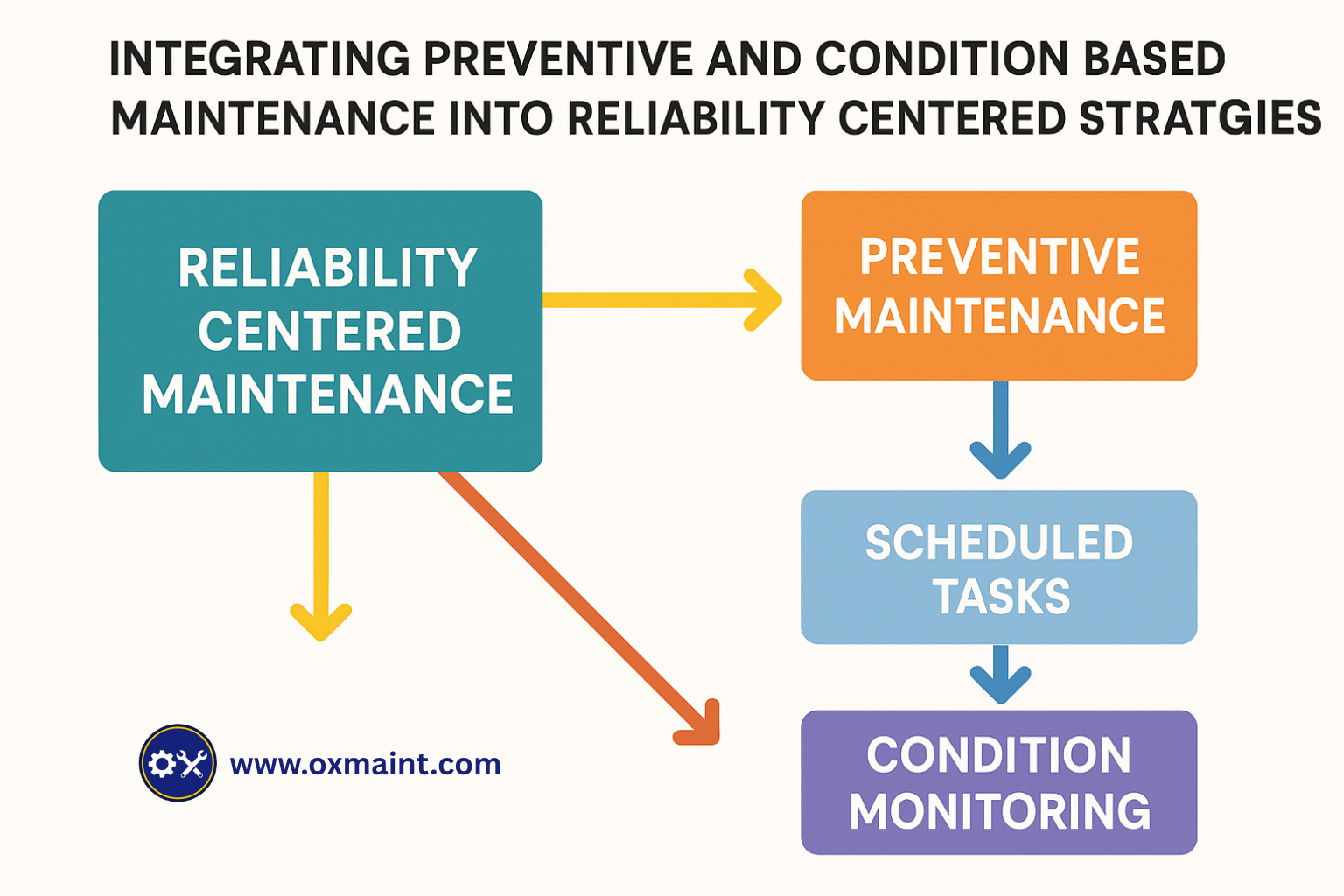
Reliability centered maintenance in healthcare facilities is the difference between a maintenance operation that reacts to equipment breakdowns and one that engineers them out — a distinction that directly impacts patient safety, regulatory compliance, and operating budgets. This complete RCM guide for healthcare facilities walks through the seven classic RCM questions, shows you how to identify the top failure modes on critical medical assets, and helps you choose the right maintenance strategy for each one. OxMaint's AI-powered CMMS is built for teams putting RCM into practice, with asset hierarchies that mirror your facility, failure-mode libraries linked to work orders, and analytics that prove your reliability program is cutting downtime. Start Free Trial to see how fast you can launch your first RCM pilot.
What if your most critical medical equipment simply never failed unexpectedly?
Reliability centered maintenance in healthcare facilities shifts your team from reactive firefighting to engineered prevention — reducing unplanned downtime by up to 50% and extending the life of high-value diagnostic, sterilization, and HVAC assets.
A 600-bed hospital typically loses $1.2M+ annually to unplanned equipment downtime — from cancelled surgeries to spoiled pharmaceuticals and emergency repair premiums. RCM flips that cost curve.
How to Build a Healthcare Facilities Reliability Program from the Ground Up
Every successful RCM implementation in healthcare facilities starts with the same seven questions — a framework codified in SAE JA1011. Answering them systematically for each critical asset ensures your maintenance strategy is driven by data, not guesswork.
Define Asset Functions
What is the asset supposed to do? Document the primary and secondary functions of critical equipment like MRI machines, HVAC chillers, and sterilizers — including performance standards.
Identify Functional Failures
In what ways can the asset fail to perform each function? Distinguish between complete failure and degraded performance that compromises patient care or compliance.
Determine Failure Modes
What causes each functional failure? Build a failure-mode library tied to each asset — from bearing wear in air handlers to coolant degradation in CT scanners.
Describe Failure Effects
What happens when the failure occurs? Document symptoms, safety risks, regulatory exposure, and the operational impact on clinical services and patient throughput.
Assess Failure Consequences
Does the failure matter? Categorize each by safety, operational, and economic impact — prioritizing failures that threaten patient safety or Joint Commission compliance.
Select Maintenance Tasks
What proactive task prevents or detects the failure? Choose from condition-based monitoring, time-based PM, failure-finding, run-to-failure, or redesign.
Group & Optimize
Bundle tasks into efficient PM packages. OxMaint lets you trigger these automatically based on runtime hours, calendar intervals, or sensor thresholds.
Choosing the Right Healthcare Facilities Maintenance Strategy for Each Failure Mode
Not every asset warrants the same approach. RCM in healthcare facilities means matching the strategy to the failure mode's consequence and detection window — balancing cost, safety, and feasibility.
| Strategy | When to Use | Healthcare Asset Examples | Typical Cost Impact |
|---|---|---|---|
| Run-to-Failure | Low-criticality assets where failure has no patient-safety impact and replacement is cheaper than prevention. | Desktop computers, non-critical lighting, waiting-room monitors | Lowest PM cost; highest emergency repair cost |
| Time-Based PM | Failures show a clear age-related pattern; components have predictable wear curves. | Sterilizer gasket replacements, HVAC filter changes, generator load tests | 15–25% lower lifecycle cost vs. reactive |
| Condition-Based Monitoring | Failure develops gradually and can be detected before functional failure; high-consequence assets. | MRI chillers (vibration), medical gas compressors (temp/pressure), UPS batteries | 30–50% downtime reduction |
| Redesign / Modification | Recurring failure mode with no effective preventive task; safety or compliance risk. | Upgrading sterilizer controls, replacing failure-prone pump seals with upgraded material | High upfront; eliminates repeat cost |
How OxMaint Turns RCM Theory into Measurable Downtime Reduction
Implementing reliability centered maintenance in healthcare facilities fails without the right tooling — spreadsheets and paper work orders simply cannot handle multi-asset failure-mode tracking, sensor-driven triggers, and audit-ready reporting. OxMaint was built for exactly this.
Asset Hierarchies That Mirror Your Facility
Map every building, floor, department, and piece of medical equipment in a parent-child hierarchy. Roll up maintenance costs and failure data from individual infusion pumps up to entire clinical departments — giving facility directors the visibility they have never had before.
Outcome: Full asset register compliance in days, not monthsFailure-Mode Libraries Linked to Work Orders
Every completed work order captures failure mode, cause, and remedy against the asset record — building a living FMEA database. Over time, OxMaint's analytics surface the highest-frequency and highest-cost failure modes automatically.
Outcome: Cut repeat failures 40% with data-driven PM optimizationRuntime & Sensor-Based PM Triggers
Stop relying on calendar-only PMs. OxMaint triggers preventive maintenance on runtime hours, cycle counts, or sensor thresholds — so a chiller gets serviced when vibration data says it needs it, not when a calendar says it might.
Outcome: 25% fewer unnecessary PMs, zero missed critical onesAudit-Ready Reliability Reports
Generate MTBF, MTTR, OEE, and downtime-by-asset reports in one click. OxMaint maintains a complete, timestamped maintenance history for every asset — proving compliance with Joint Commission, DNV, and FDA requirements during inspections.
Outcome: Audit prep time cut from weeks to hoursRCM Implementation in Healthcare Facilities: A 6-Month Timeline
A healthcare facilities RCM pilot project should target 10–20% of your most critical assets first — proving ROI before scaling. Here is a proven timeline that gets results in weeks, not years.
Select Critical Assets & Build Hierarchy
Identify the top 15–25 critical assets using a risk-based matrix (criticality x failure frequency). Build the asset hierarchy in OxMaint and import existing maintenance history. Target: HVAC chillers, emergency generators, sterilizers, and medical gas systems.
Conduct FMEA & Map Failure Modes
Facilitate RCM analysis sessions with technicians and clinical engineering. Document functions, functional failures, failure modes, and effects for each asset. OxMaint stores these directly on the asset record for ongoing reference.
Select Tasks & Build PM Packages
For each failure mode, choose the right strategy: condition-based, time-based, failure-finding, or RTF. Build PM templates in OxMaint with checklists, parts lists, and estimated labor hours. Assign triggers based on interval or runtime.
Execute & Monitor
Launch the new PM schedule. Track work order completion rates, mean time between failures, and unplanned downtime events. Expect the first signs of improvement within 4–6 weeks as condition-based tasks catch incipient failures.
Measure Impact & Refine
Pull a 90-day performance report from OxMaint. Compare MTBF, MTTR, and downtime hours against the pre-RCM baseline. Refine PM frequencies — if a task finds nothing after 3 cycles, extend the interval; if failures still occur, shorten it.
Scale to Plant-Wide Reliability Program
Present pilot results to leadership and expand to the next 30% of assets. A typical healthcare facility achieves full RCM coverage on critical assets within 18–24 months, reducing unplanned downtime 30–50% and cutting total maintenance cost 15–20%.
The Cost of Inaction vs. the ROI of RCM in Healthcare Facilities
Consider a 400-bed regional medical center with 1,800 tracked assets spending $680K annually on maintenance. Without RCM, 62% of work orders are reactive. Here is what happens when they implement OxMaint-powered RCM on their top 200 critical assets.
"We launched our RCM pilot on 22 critical HVAC and sterilizer assets using OxMaint. Within four months, unplanned downtime on those assets dropped 44% and our emergency repair spend was cut nearly in half. The audit trail alone justified the switch."
Ready to see OxMaint on your critical healthcare assets?
Book a 30-minute demo and we will walk you through a live RCM dashboard — asset hierarchies, failure-mode tracking, and downtime analytics built specifically for healthcare facilities maintenance teams.
Healthcare Facilities RCM: Your Top Questions Answered
What is reliability centered maintenance in healthcare facilities?
RCM in healthcare facilities is a structured methodology that identifies the most appropriate maintenance strategy for each critical asset by analyzing its functions, failure modes, and operational consequences. Instead of treating every piece of medical equipment the same, RCM matches the strategy — whether condition monitoring, time-based PM, or run-to-failure — to the specific failure pattern and patient-safety risk. The result is fewer unplanned breakdowns, lower total maintenance cost, and stronger compliance with regulatory standards like Joint Commission and DNV.
How long does it take to implement RCM in a healthcare facility?
A focused RCM pilot project on 15–25 critical assets typically takes 3–6 months from analysis to measurable results. Full plant-wide implementation across hundreds of assets usually spans 18–24 months. The key is starting small with your highest-risk equipment — such as HVAC chillers, emergency power systems, and sterilizers — proving the ROI, then scaling. You can Start Free Trial of OxMaint to build your asset hierarchy and launch your first RCM analysis in days.
What are the biggest benefits of RCM for healthcare facilities maintenance?
The primary RCM benefits for healthcare facilities include 30–50% reduction in unplanned downtime, 15–20% lower total maintenance cost, extended asset life for high-value diagnostic and clinical equipment, improved patient safety through fewer equipment-caused service interruptions, and audit-ready maintenance documentation. RCM also shifts maintenance teams from reactive firefighting to planned, scheduled work — improving technician utilization and reducing overtime spend.
Which healthcare assets should be prioritized for RCM analysis first?
Start with assets that have the highest combination of criticality and failure frequency. In healthcare facilities, this typically means HVAC chillers and air handlers (which affect infection control and surgical suites), emergency generators and UPS systems, medical gas compressors, sterilization equipment, and high-value diagnostic imaging machines like MRI and CT scanners. A risk-based criticality matrix — plotting patient-safety impact against failure frequency — helps prioritize the top 10–20% of assets for your first RCM pilot.
How does OxMaint support RCM implementation in healthcare facilities?
OxMaint provides the digital infrastructure RCM requires: multi-level asset hierarchies that mirror your facility, failure-mode libraries linked directly to work orders, PM triggers based on runtime hours or sensor data rather than just calendars, and one-click reliability reports including MTBF, MTTR, and downtime-by-asset. The platform also maintains a complete timestamped maintenance history for every asset, giving you the audit trail Joint Commission and DNV inspectors expect. To see it on your own assets, Book a Demo with our team.
Stop reacting to failures. Start engineering them out.
Join the healthcare facilities using OxMaint to cut unplanned downtime, extend asset life, and prove maintenance ROI — all from one AI-powered CMMS platform.
Free 14-day trial · No credit card