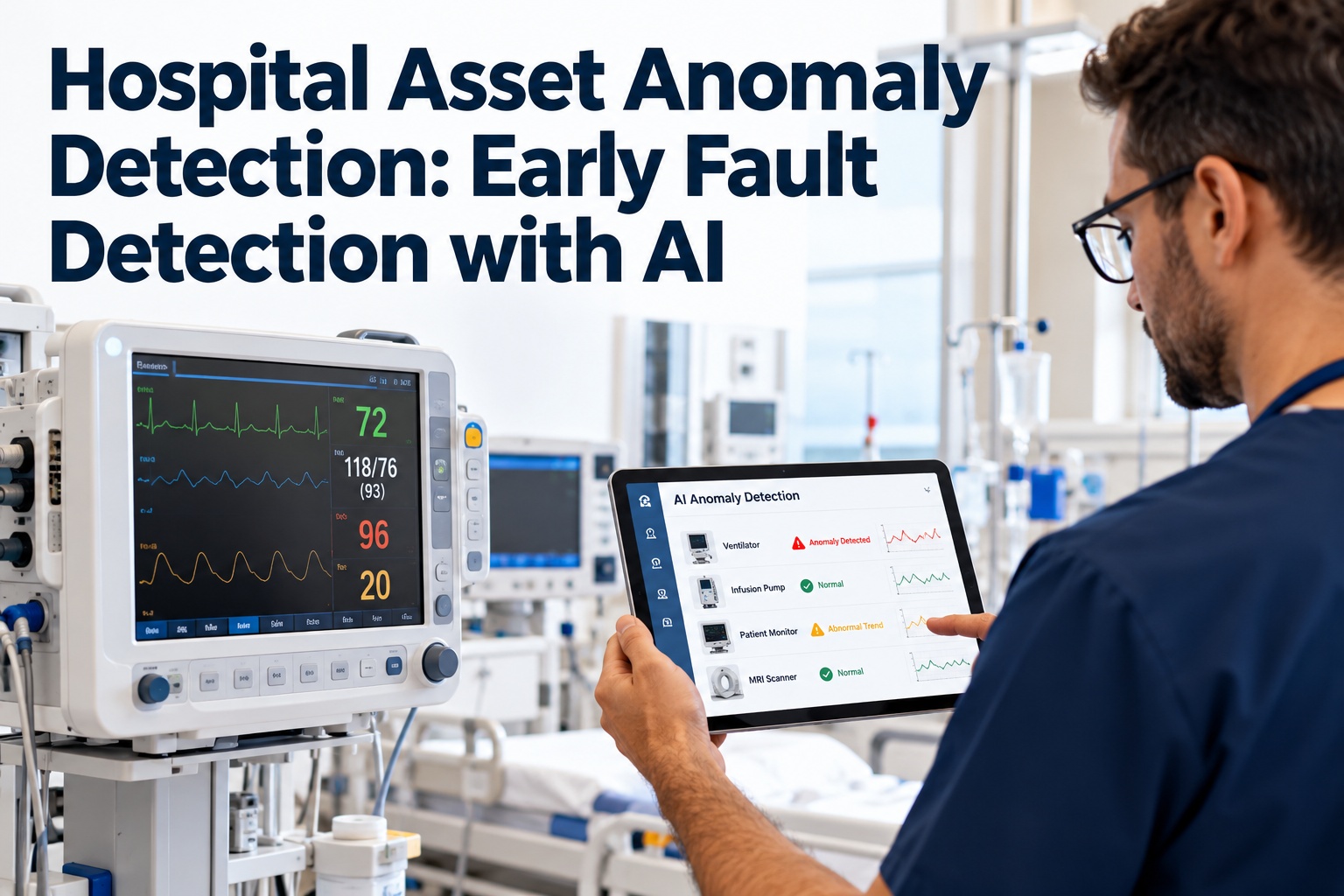
Most hospital equipment doesn't fail all at once. A chiller compressor draws a little mor current each week. A vacuum pump takes slightly longer to reach pressure. A sterilizer cycle drifts a few minutes. Each reading is still "within limits," so nothing alarms, and then one day the unit trips during a procedure schedule. Anomaly detection is the practice of learning what normal looks like for each asset and flagging the drift early, while there's still time to plan the repair. This article explains how it works, which signals matter, and what it takes to turn an early warning into an actual work order. OxMaint AI maintenance management software connects sensor data and AI alerts to the maintenance workflow.
Hospital Asset Anomaly Detection: Early Fault Detection with AI
Learn how AI spots the quiet signs of equipment trouble long before a fixed alarm limit trips, which hospital assets benefit most, and how to turn each early warning into a planned, tracked repair.
Why Fixed Alarm Limits Arrive Too Late
A fixed limit answers one question: has this value crossed a line? Anomaly detection asks a better one: is this asset behaving differently from how it normally behaves? The chart below shows the same degrading signal under both approaches. It is illustrative, not real data. Start free and bring your asset data into one place.
Three Kinds of Anomaly Worth Catching
Different faults show up in different ways, and good models look for all three. Book a demo to see how alerts are classified.
Which Hospital Assets and Signals to Watch
Start where failure hurts most: patient safety, high repair lead times, and costly downtime. Available signals depend on the equipment and your sensors, so treat this as a starting map. Start free and register your critical assets.
| Asset | Signals to watch | Early sign of trouble |
|---|---|---|
| Chillers & air handlers | Current, vibration, temperatures, pressures | Rising energy draw or vibration at the same load |
| Medical gas & vacuum systems | Pressure, run time, compressor cycles | Longer run times to hold pressure |
| Emergency generators & UPS | Battery condition, start behavior, temperatures | Weakening battery or slower start response |
| Sterilizers & autoclaves | Cycle time, temperature, pressure | Cycle duration creeping up |
| Imaging cooling systems | Coolant temperature, flow, compressor behavior | Temperature swings or more frequent cycling |
| Pumps, motors, and fans | Vibration, current, bearing temperature | Vibration rising before failure noise appears |
An Early Warning Is Worthless Without a Next Step.
The value of anomaly detection is in what happens after the flag. OxMaint AI can turn an alert into an assigned work order tied to the asset, so the early signal ends in a planned repair and a record, not an unread notification.
From Sensor Reading to Planned Repair
Five stages connect the data to the fix. Book a demo to walk through the full pipeline.
A Realistic View: What It Can and Can't Do
AI anomaly detection is powerful, but it works best with realistic expectations. Start free and begin with your most critical assets.
- Spots slow drift that fixed limits miss
- Prioritizes which assets need attention first
- Gives technicians earlier, more specific starting points
- Improves as asset history accumulates
- Needs good data and a baseline period to learn
- Alerts must be reviewed and confirmed by technicians
- False positives need tuning, especially early on
- It supports, but doesn't replace, preventive maintenance and clinical engineering judgment
Getting Started in Four Steps
How OxMaint AI Supports Early Fault Detection
OxMaint AI sits on top of your maintenance workflow, so early signals land where work gets done. Start free and connect your first asset.
Frequently Asked Questions
Catch the Fault While It's Still a Plan, Not a Panic.
Register your critical assets, connect the data, and turn early warnings into assigned work orders with OxMaint AI.