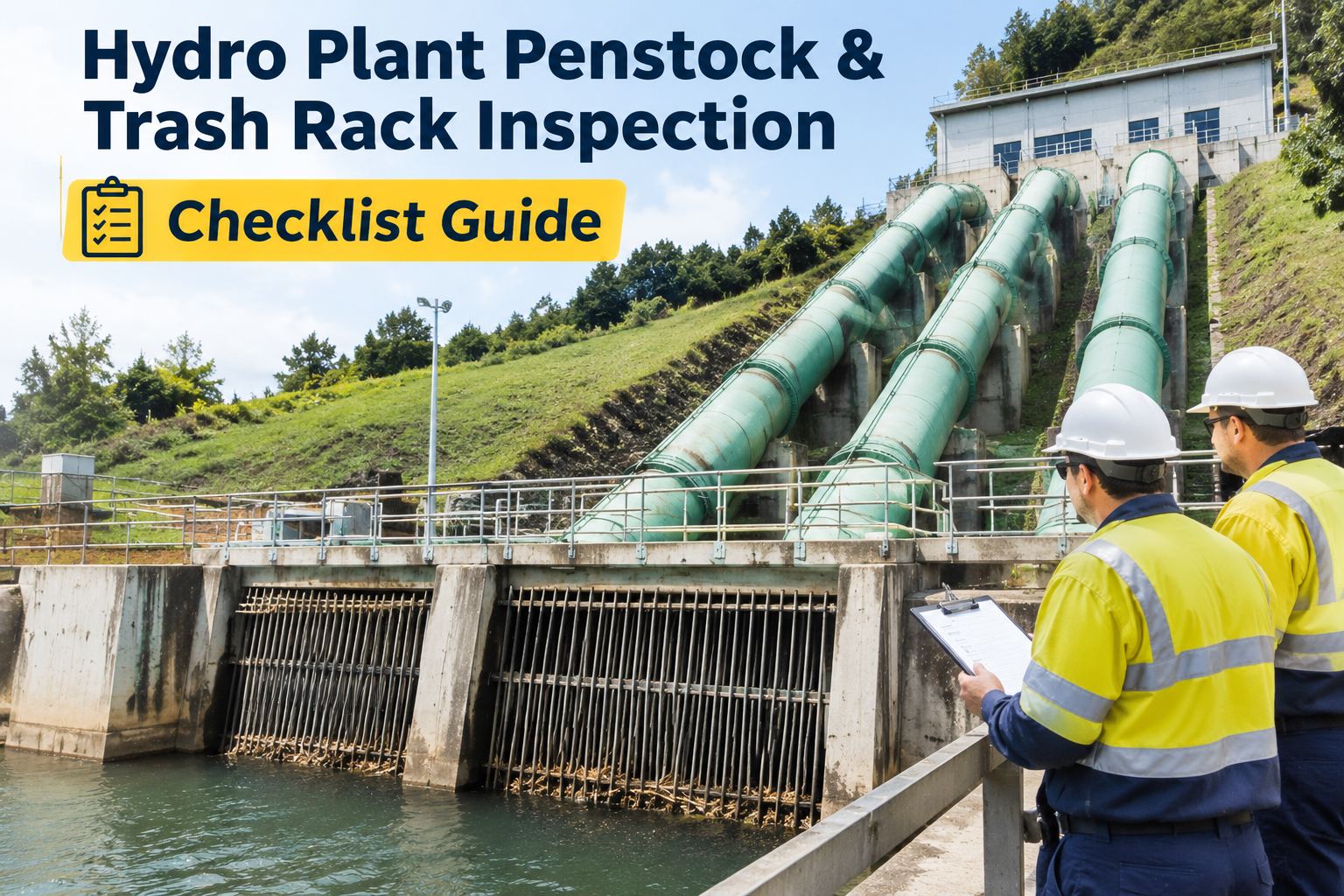
In a hydro plant, the waterway is a pressure vessel you can walk through and a penstock failure is one of the most dangerous events on the site. The trash rack is its first line of defence, the intake gate its shut-off, and the penstock shell the thing standing between high-head water and the powerhouse. This checklist covers the inspection points that keep those assets sound and compliant, and shows how OxMaint AI hydro maintenance software tracks the cadence, the thickness readings and the repairs. Book a demo to see it on your plant.
HYDRO POWER · WATER CONVEYANCE · INSPECTION CHECKLIST
Hydro Plant Penstock & Trash Rack Inspection Checklist
Follow the water from reservoir to runner. Each stage of the conveyance has its own failure modes, inspection methods and compliance stakes — and OxMaint AI holds the whole route on a defensible, schedule-driven maintenance plan.
01
Intake & Trash RackDebris barrier, head loss, raking
↓
02
Intake Gate & HoistShut-off, seals, spindle, limit switches
↓
03
Penstock & Surge TankShell, coatings, joints, anchors
↓
04
Turbine InletClean water, full head, no debris
Why the Waterway Is Its Own Discipline
Turbine and generator PM gets the attention, but the water passages carry the catastrophic risk. A penstock loses wall thickness to corrosion year after year, joints seep, and a clogged trash rack quietly steals head and strains its own structure. Because penstock integrity falls under FERC dam-safety oversight, these inspections are not optional housekeeping — a missed cycle is both a safety and a compliance exposure.
THE TRASH RACK RULE
Clean It Before Differential Head Does the Damage
The trash rack is the single most important debris control device at the intake — and it is designed to yield before its support structure if it ever fully clogs. A blocked rack builds differential head across the bars; let it run and you lose generation to head loss, then risk the rack itself. Clean on a schedule, or trigger raking on a differential-head sensor.
1
Clear — low differential head, full flow, rack carrying normal debris load.
2
Loading — debris building, head loss climbing, generation starting to dip.
3
Critical — high differential head, rack stressed toward its yield design limit.
4
Act — rake, inspect bars, and log the event against the intake asset.
The Penstock & Trash Rack Checklist
Work each group below; the frequency chip is the baseline interval, tightened by condition and your FERC-approved program. Internal penstock items need the unit dewatered and a confined-space plan — never enter a penstock outside your site's safety procedure.
D Daily
W Weekly
M Monthly
Q Quarterly
O Outage
How the Hard Items Get Inspected
Much of this checklist needs more than a flashlight. These are the methods behind the deeper penstock and intake points.
Visual (Dewatered)
Drain the unit and enter under a confined-space plan to inspect interior surfaces, coatings and joints directly.
Ultrasonic Thickness
UT — including crawler-mounted automated scans — maps remaining wall thickness across the shell and welds.
Laser & 3D Scan
Laser and 3D profilometry capture out-of-roundness and corrosion loss at high data density.
ROV / Diver
Remote vehicles and divers inspect intakes, gates and racks underwater when full dewatering isn't practical.
What Goes Wrong in the Waterway
These are the failure modes the checklist exists to catch. Raise any from the field in OxMaint AI and it becomes a ranked work order against the exact asset.
!
Wall Thinning
Corrosion and abrasion reducing shell thickness toward the minimum allowable — the headline penstock risk.
!
Coating Breakdown
Lining delamination and blistering that expose steel and accelerate interior corrosion.
!
Joint Seepage
Leaks at expansion, riveted or welded joints signalling movement, wear or packing failure.
!
Rack Blockage
Debris load driving differential head, stealing generation and stressing the rack structure.
!
Gate Corrosion
Corroded leaves, seals and spindles that block a clean shut-off when you need to dewater.
!
Concrete Voids
Gaps opening between pipe and encasement, leaving the shell unsupported and exposed.
A Penstock Survey Is Only Worth the Trend It Builds.
One wall-thickness reading tells you little; the same grid point tracked across outages tells you when to reline or replace. OxMaint AI keeps every reading, coating report and repair tied to the asset, so the waterway's condition is a trend line — and your FERC file is a filter away.
How OxMaint AI Runs Hydro Waterway PM
OxMaint AI is the AI-powered hydro maintenance software that carries the waterway from a field inspection to a closed, recorded work order — with inspection cadence, thickness trending and compliance history built in. Book a demo and see a penstock inspection cadence on one screen.
Inspection Cadence
Daily rack and leak rounds, periodic gate PM, and outage penstock surveys — each on its own schedule, nothing missed.
Wall-Thickness Trending
Log UT readings per grid point and watch each trend toward the minimum allowable, so reline and replace are planned, not reactive.
Gate & Hoist PM
Seal, spindle, limit-switch and painting tasks scheduled so the gate is ready to shut off when an outage calls for it.
Rack-Cleaning Triggers
Raise raking on schedule or a differential-head reading, and log each event against the intake asset.
Field Squawk to Work Order
Operators raise a leak or a damaged bar with a photo; it becomes a ranked work order routed to the right crew.
Compliance-Ready History
Every inspection, reading and repair kept per asset — the defensible record a FERC dam-safety review expects.
EXPERT REVIEW
Written for hydro plant O&M, civil and dam-safety teams responsible for penstocks, intakes and water conveyances. The tasks, methods and intervals here are a general framework drawn from standard hydropower practice and references such as the USBR penstock inspection guidance — your authoritative program comes from your FERC-approved inspection plan, the penstock and gate OEM and design documents, and your dam-safety engineer, who set the minimum allowable thickness, intervals and acceptance criteria. Penstock entry is dewatered, confined-space, permit-controlled work. OxMaint AI structures and records the inspection, PM and work order workflow; it does not replace your FERC program, your engineering analysis, or your dam-safety authority.
Frequently Asked Questions
How often should a penstock be inspected?
Internal penstock inspections are typically tied to planned outages and your FERC-approved schedule, with routine external walks, leak checks and trash-rack work carried out far more frequently. The deeper survey — wall-thickness mapping, coating assessment, joint and anchor checks — needs the unit dewatered, so it is planned around generation and dam-safety requirements rather than a fixed calendar alone.
Start free and put your penstock cadence on a schedule in OxMaint AI.
Why is trash rack maintenance so important?
The trash rack is the first barrier protecting the intake, gates, penstock and turbine from debris. A clogged rack builds differential head that steals generation through head loss and, if ignored, can stress the rack toward its yield design limit. Cleaning on schedule — or on a differential-head sensor — protects both output and the structure itself.
Book a demo and route rack cleaning on head readings in OxMaint AI.
How is penstock wall thickness measured?
Mainly by ultrasonic testing, often with crawler-mounted automated scanners that map thickness across the shell and welds, backed by laser or 3D profilometry for out-of-roundness and corrosion loss. The value is in trending: the same grid points read across outages show the rate of loss and when a section approaches its minimum allowable thickness.
Start free and trend thickness readings per grid point in OxMaint AI.
Can the waterway be inspected without dewatering?
Parts of it, yes. Remotely operated vehicles and divers inspect intakes, gates, seal plates and trash racks underwater, which is useful when full dewatering is costly or disruptive. Internal penstock shell and coating assessment, though, generally still needs the unit drained so inspectors can access the surfaces directly under a confined-space plan.
Book a demo and log underwater and dewatered inspections together in OxMaint AI.
How does a CMMS help with FERC compliance?
Penstocks and dams sit under FERC dam-safety oversight, which expects a documented, defensible inspection and maintenance record. OxMaint AI keeps every inspection, thickness reading, coating report and repair tied to the specific asset, so when a review asks for the waterway's history it is a filter away rather than a search through binders. The program and acceptance criteria stay with your dam-safety engineer.
Start free and build a compliance-ready waterway record in OxMaint AI.
Keep the Head Clean and the Penstock Sound.
Put trash-rack cleaning, gate PM, leak rounds and penstock surveys on schedule in OxMaint AI hydro maintenance software — raised from the field, ranked, trended across outages, and recorded for dam safety. One platform that protects the generation and the people below the penstock.