A sticking main stop valve or a sluggish control valve doesn't announce itself on a vibration trend — it shows up during a trip event, when the valve either closes in time or it doesn't. Steam turbine valve maintenance is its own discipline, separate from blade and bearing PM, because these valves are your last line of overspeed protection and the first thing an auditor asks about. If your valve PM history lives in a spreadsheet nobody trusts, start a free OxMaint trial or book a 30-minute demo to see how trigger-based valve tracking works in practice.
Steam Turbine Valve Maintenance: A Power Plant Guide to PM, Testing and Compliance
Main stop, control, intercept and bypass valves each fail differently, test differently and carry different regulatory weight. Here's how to run each one as a tracked, auditable maintenance program — not a line item that gets deferred every outage.
Why do turbine valves need their own maintenance program?
Because a turbine valve is a safety device first and a flow device second. Your bearings and blades degrade gradually and give you condition signals — vibration, temperatures, oil debris. Valves sit still for months, then must move once, fast, under the worst possible conditions. That duty cycle creates failure modes that standard rotating-equipment PM never touches: stem binding from oxide growth, seat leakage from wire drawing, sluggish response from galled bushings, and servomotor issues that only appear under a full-stroke demand.
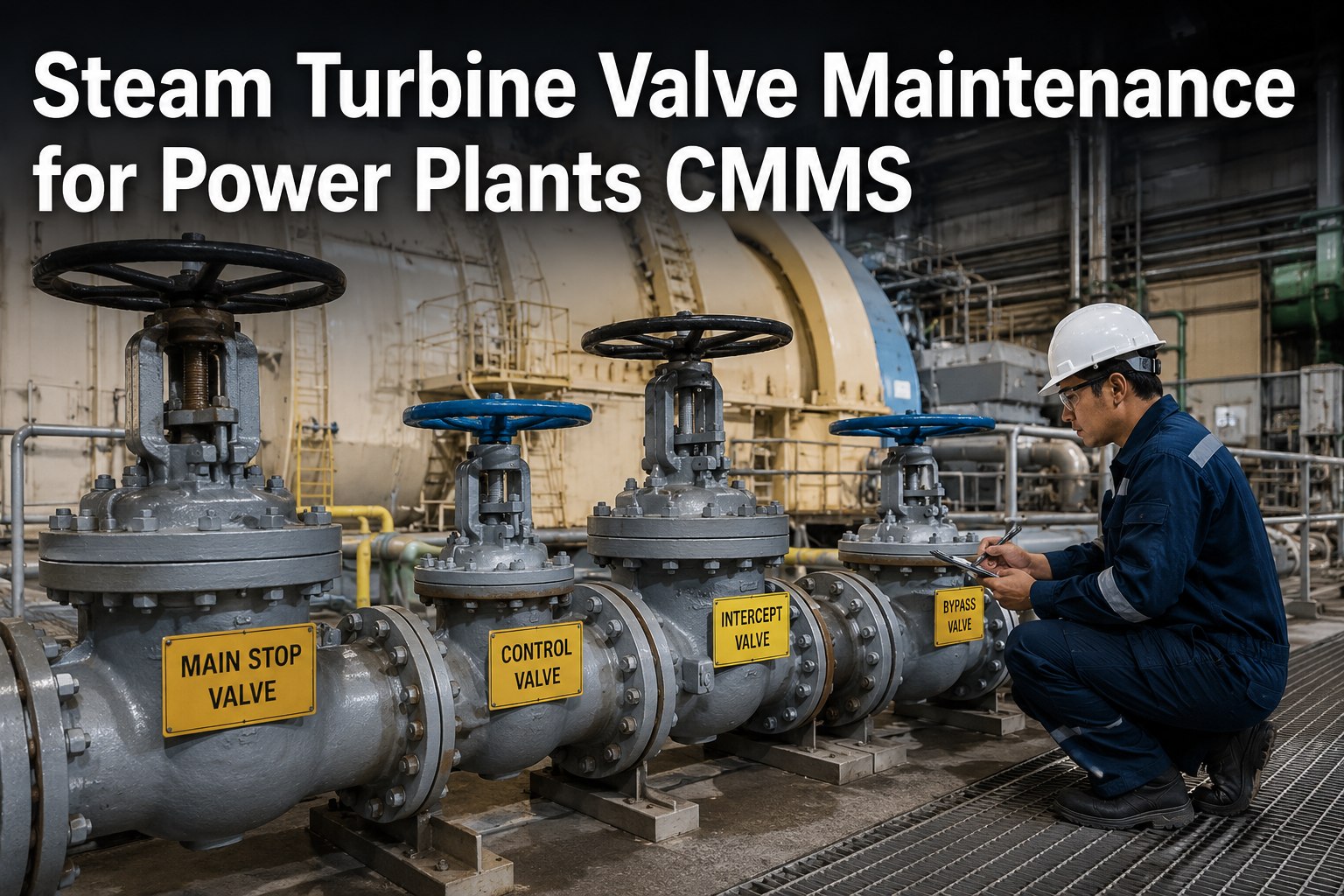
The four valve classes carry different stakes:
- Main stop valves (MSV): the final overspeed trip barrier. A failure to close on demand is a catastrophic-event scenario, which is why trip testing is a compliance item, not a preference.
- Control (governor) valves: modulate constantly, so they wear — stems, bushings, seats — and their friction directly affects load response and valve positioning accuracy.
- Intercept and reheat stop valves: protect against overspeed from energy stored in the reheat circuit after the HP valves close. Often neglected because they cycle less.
- Bypass valves: erode and leak from throttling duty; a passing bypass valve costs heat rate every day and can mask itself as a condenser or attemperation problem.
Treating all four as "turbine valves — inspect at outage" is how plants end up with a sticky intercept valve discovered during a NERC or insurer-mandated overspeed test. Each class needs its own task list, interval and pass criteria.
What does main stop valve PM and seat inspection actually involve?
Main stop valve maintenance splits into online testing and outage overhaul, and you need both. Online, the standard practice is a partial-stroke (typically 10–20% travel) exercise test — monthly is common across the industry, with some fleets running weekly on units with known stem-friction history. The test proves the valve isn't stuck without taking load off the unit. Log the stroke time and any abnormal hydraulic pressure behavior every time; a slowing trend is your early warning.
At outage, the work is hands-on:
- Internal inspection: check the seat and plug for erosion, wire drawing and steam-cutting. Even minor seat damage becomes a leak path that worsens fast under throttled flow.
- Stem and bushing measurement: record stem diameter and bushing clearances against OEM tolerances. Oxide scale buildup on the stem is the classic cause of a valve that tested fine cold but binds hot.
- Seat leak test: blue-check or lap the seat and verify contact pattern; on critical valves, a pressure or vacuum-box leak test confirms closure integrity.
- Actuator and trip linkage: inspect the servomotor, pilot valve, dump valve and trip oil circuit. Fast closure depends on the whole chain, not just the valve body.
- Full-stroke timing test: on reassembly, measure closure time against the OEM spec — typically a fraction of a second on trip demand — and record it as your baseline for the next cycle.
The decision rule is simple: if closure time or stem friction has drifted since last overhaul, find the cause now. "It still closed" is not a pass criterion for a device whose only job is closing.
How do you keep control valve stems and bushings from becoming your next forced outage?
Control valves are the wear items of the group because they throttle continuously. The two failure modes that matter most are rising stem friction and seat leakage. Rising friction shows up first as hunting or deadband in valve positioning — the governor calls for a move, the valve overshoots or lags, and load control gets sloppy. Left alone, friction becomes binding, and binding on a control valve during a trip event is an overspeed contributor.
A practical control valve PM program looks like this:
- Trend valve position vs. demand signal through your DCS historian. A growing gap between commanded and actual position is friction developing — catch it months before the outage.
- Exercise valves through full travel during planned load swings where the unit design allows it, and note any sticking points in the stroke.
- At outage, measure stem-to-bushing clearance and inspect for galling and oxide scale. Steam oxidation on stems operating at high temperature is progressive — if clearances are at the tight end of OEM tolerance, dress or replace now rather than next cycle.
- Inspect seats and plugs for throttling erosion. A control valve that passes steam when closed costs heat rate continuously and erodes faster the longer it leaks — a self-accelerating problem.
- Check servomotor and positioner calibration after any valve work; a mechanically perfect valve with a sloppy positioner still hunts.
Here's the objection worth naming: "We don't have condition monitoring on valves — we just overhaul them at major outages." That's fair for plants without instrumentation, but you almost certainly already have the data. Valve demand vs. actual position, hydraulic pressure during stroke tests, and closure times are all condition indicators — they just need somewhere to live and someone reviewing the trend. That's a CMMS workflow, not a sensor purchase.
How should intercept valve testing be run — and what counts as a pass?
Intercept valves protect against the energy stored in the reheater and crossover piping. When the HP stop and control valves close on a trip, steam trapped in the reheat circuit can still drive the turbine into overspeed unless the intercept and reheat stop valves close too. Because they rarely move in normal operation, they're prime candidates for sticking — and the failure only reveals itself during the worst possible moment.
| Test | Typical Cadence | Pass Criterion | What Failure Tells You |
|---|---|---|---|
| Partial-stroke exercise (online) | Monthly (some fleets weekly) | Valve moves smoothly through test travel; no abnormal hydraulic pressure; returns to full open | Stem friction, oxide binding, or servomotor degradation developing |
| Full-stroke closure test (online, per OEM/unit design) | Quarterly to annually, load permitting | Full closure within OEM-specified time; unit remains stable | Trip circuit, dump valve or actuator response problems |
| Closure time measurement (outage) | Every major outage | Within OEM spec — typically well under 1 second on trip demand | Degraded spring, hydraulic restriction, or mechanical drag |
| Internal inspection (outage) | Per OEM interval or on test-trend deterioration | Seat contact verified; stem/bushing clearances in tolerance; no erosion | Leakage path or mechanical wear requiring rework |
The critical discipline is trending, not just testing. A valve that closes in spec but takes measurably longer each quarter is telling you something. Record stroke times, test pressures and any operator observations against the asset record every single test — that's what turns a compliance checkbox into a predictive tool.
What are you looking for in a bypass valve inspection?
Erosion and leakage, in that order. Bypass valves live a hard life: when they operate, they're throttling high-energy steam across a large pressure drop, which is exactly the duty that wire-draws seats and erodes plugs. When they're closed, any seat damage from the last operation becomes a continuous leak — steam you're paying to make, dumping straight to the condenser.
Inspection priorities at outage:
- Seat and plug surfaces: look for wire drawing (the thin, threaded erosion grooves that indicate a leak path under pressure) and cavitation-style damage on the plug. Minor damage can often be lapped out; deep cutting means replacement or weld repair.
- Leak-by evidence while running: a downstream pipe temperature that stays elevated with the valve commanded closed is the classic field indicator. Log it as a work order, not a mental note.
- Stem packing and actuator: bypass valves cycle under thermal transients; check packing condition and actuator response, especially on valves used for startup duty.
- Attemperation interface: spray water control problems downstream of the bypass valve often get blamed on the valve itself. Verify both before condemning either.
Decision rule: if a bypass valve shows measurable leak-by, repair it at the next available window rather than waiting for the planned major. The heat-rate penalty of a passing valve accumulates every operating day, and the erosion accelerates as the leak path grows — the repair only gets bigger.
How do you document valve testing so a trip-protection audit goes smoothly?
Auditors — whether internal, insurer, NERC-related for applicable units, or corporate engineering — ask the same three questions: what was tested, when, and what were the results against pass criteria. If answering that means digging through a supervisor's notebook and three versions of a spreadsheet, you have an exposure problem regardless of how good the actual maintenance is.
An auditable valve compliance record has five elements for every valve, every test:
- Asset identity: valve tag, type, serial number, OEM, and which protection function it serves (primary overspeed, reheat protection, bypass).
- Task definition: the procedure used, revision, and the pass/fail criteria applied — not just "tested OK."
- Measured results: stroke times, pressures, clearances, leak-test outcomes — numbers, not adjectives.
- Trigger basis: why the work happened — calendar interval, cycle count, condition trend, or post-event — and when the next occurrence is due.
- Sign-off trail: who performed it, who reviewed it, and any follow-up work orders raised from findings.
This is where a CMMS earns its keep. In OxMaint, each valve carries its own PM schedule with trigger-based work orders — monthly partial-stroke tests fire automatically, outage overhaul tasks attach to the same asset record, and every measured result lands in one searchable history. When the auditor asks for three years of intercept valve test records, you filter by asset and export, instead of reconstructing history from memory.
What can you do this week to tighten your valve program?
Three concrete actions, none of which require a purchase:
- Pull the last 12 months of valve test records for your main stop and intercept valves. Can you produce closure times and pass criteria for every test within ten minutes? If not, that's your gap.
- Check where your test intervals came from — the OEM manual, an insurer requirement, or habit. If it's habit, compare against OEM recommendations and adjust with engineering sign-off.
- Walk the DCS trends for control valve demand vs. actual position over the last quarter. Any growing deadband or hunting is a work order today, not an outage surprise next year.
Then put the program where it can actually run: valve-by-valve PM schedules, test intervals, pass criteria and compliance records for every steam turbine valve type, managed as trigger-based, auditable work in OxMaint — replacing the scattered spreadsheets that make every audit a scramble.
Frequently asked questions
How often should main stop valves be full-stroke tested?
It depends on OEM guidance, unit design and insurer requirements — monthly partial-stroke testing is common online practice, with full-stroke closure testing typically done quarterly to annually where load conditions allow, and always verified at overhaul. Whatever interval you adopt, document the basis for it and trend the results; an unexplained interval is an audit finding waiting to happen.
What's the difference between a partial-stroke and full-stroke valve test?
A partial-stroke test moves the valve a small percentage of travel — typically 10–20% — proving it isn't stuck without significantly affecting load. A full-stroke test drives the valve completely closed, verifying the entire trip chain including closure time. Partial-stroke tests catch binding early and run frequently; full-stroke tests prove the protection function end-to-end but require suitable unit conditions.
Can we extend valve overhaul intervals if test results look good?
Sometimes — but only with evidence. A defensible interval extension needs documented trend data: stable closure times, clean internal inspections, stem clearances well within tolerance, and no leak-by history. Present that package to your OEM, insurer or corporate engineering for sign-off. Extending intervals based on "it's been fine" without records is how plants end up explaining a stuck valve after an event.
What records do auditors typically request for turbine trip protection?
Expect requests for test procedures and revisions, test dates and results against pass criteria, closure-time measurements, maintenance and overhaul history for each trip-related valve, and corrective actions from any failed or degraded tests. Auditors also look for evidence that overdue tests get escalated, not silently skipped. A CMMS with per-asset history and automatic work-order triggers answers all of these from one screen.
Our crew won't log test results consistently — how do we fix that?
Make logging part of the work order itself, not a separate task. When the monthly partial-stroke test fires as a work order with fields for stroke time, pressure and observations, completing the record is completing the job. Keep the form short — three to five fields — and mobile-friendly so it's filled in at the valve, not reconstructed at a desk later.
Run every steam turbine valve on a schedule you can prove
Stop valves, control valves, intercept valves, bypass valves — each with its own PM tasks, test intervals, pass criteria and audit trail, all in one system. OxMaint replaces the spreadsheet tangle with trigger-based work orders and per-asset compliance records your next auditor can actually read.