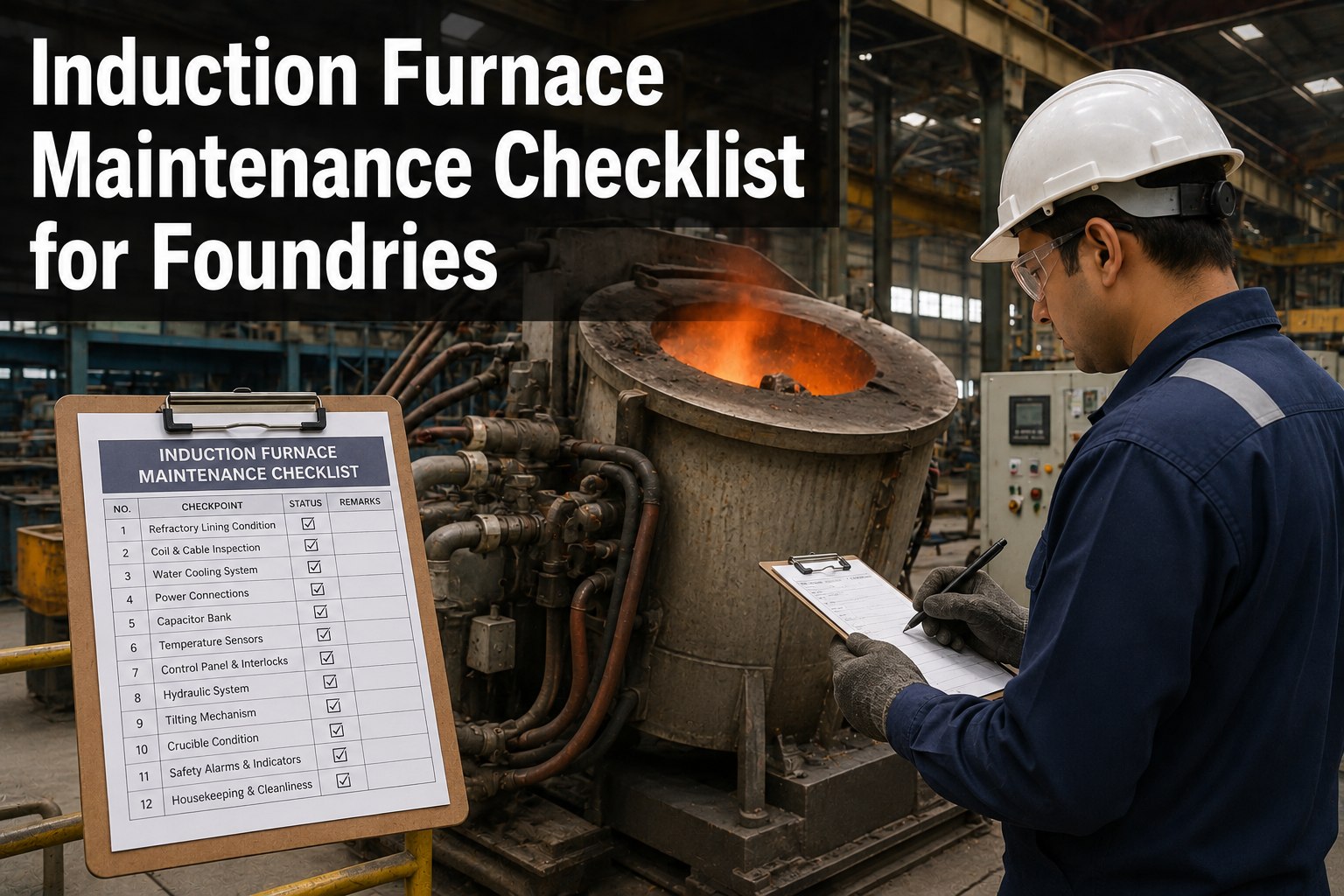
Induction melting furnaces are the beating heart of modern foundries and mini-mills, and an unplanned coil, lining, or power-supply failure can idle a melt line for 18 to 72 hours at a cost of $8,000 to $40,000 per day in lost throughput and emergency refractory work. The vast majority of these events are preventable through disciplined preventive maintenance across four critical systems: the induction coil, the refractory lining, the cooling loop, and the power supply. OxMaint maintenance management software gives foundry teams structured PM checklists, lining-thickness tracking, and cooling-system service schedules that make furnace availability defensible campaign after campaign — and you can Start Free Trial to deploy the full checklist library in under a day.
INDUCTION FURNACE MAINTENANCE CHECKLIST
Four systems. One disciplined routine. Zero unplanned melt downtime.
A practical, campaign-tested PM checklist covering coil inspection, lining thickness tracking, cooling-system service, and power-supply monitoring — engineered for foundries and mini-mills that cannot afford a mid-heat failure.
THE COST OF INACTION
One failed lining can erase a quarter of foundry margin
When a 5-ton coreless induction furnace goes down mid-heat, the cascading cost is rarely just the refractory — it is the lost melt schedule, the de-scheduled pours, the cold ingots, and the emergency crew call-in.
WORKED EXAMPLE · 5-TON FURNACE
A steel foundry running two 5-ton coreless furnaces was averaging 4.5 unplanned lining-related stoppages per year, each costing roughly $26,000 in lost melt, refractory, and re-scheduling. By moving from a reactive "run-to-failure" posture to a campaign-based PM checklist tracked in OxMaint — including weekly lining thickness measurement, daily cooling-water ΔT logging, and monthly coil Meggar testing — unplanned stoppages dropped to 1.3 per year within 14 months, recovering over $83,000 in annual margin.
DAILY · WEEKLY · CAMPAIGN-END
Tiered inspection checklist for induction melt lines
Foundry PM is most defensible when it is tiered: operators own the daily walkaround, maintenance techs own the weekly deep check, and reliability engineering owns the campaign-end teardown. Each tier below maps directly to an OxMaint checklist template.
Pre-shift walkaround
- Inspect coil cooling-water inlet/outlet temperatures and confirm ΔT ≤ 8°C
- Verify flow-rate gauges read within furnace OEM spec (typically 2–4 m³/hr per coil)
- Check hydraulically operated tilt for smooth motion and leak-free cylinder seals
- Visually inspect crucible rim and slag line for spalling, erosion, or metal build-up
- Listen for abnormal hum or buzz that could indicate loose coil clamps or turn shorts
- Confirm ground-fault indicator and interlock panel show green / no alarms
Mechanical & electrical deep check
- Meggar-test coil ground insulation; log MΩ value and trend against prior weeks
- Measure lining thickness at 8 fixed points; flag any reading ≤ 65% of installed thickness
- Test cooling-water conductivity (≤ 50 µS/cm) and pH (7.0–8.5) at the closed-loop tap
- Torque coil clamps and bus-bar connections to OEM spec; log hot-spot IR readings
- Inspect capacitor bank for bulged cans, oil seepage, or degraded fuse indicators
- Clean spray-coil cooling-air filters and confirm cabinet exhaust fans are running
Lining removal & teardown
- Photograph and document lining wear map; compare to predicted erosion model
- Inspect coil copper for arcing marks, oxidation, or turn-to-turn insulation degradation
- Replace inter-turn insulation strips where wear is visible or thickness is below spec
- Perform high-potential (Hi-Pot) test on coil-to-ground at 1.5× operating voltage
- Re-certify slip-ring and tilting-lug bolts using calibrated torque wrench
- Update OxMaint campaign counter and trigger next lining-install work order
SYSTEM-BY-SYSTEM DEEP DIVE
Critical thresholds and inspection intervals for each furnace subsystem
The table below consolidates industry benchmarks for the four highest-risk induction furnace subsystems. Use these values to set alarm thresholds in OxMaint; a reading outside the limit should auto-trigger a corrective work order.
| Subsystem | Key Parameter | Inspection Interval | Action Limit | Failure Mode Prevented |
|---|---|---|---|---|
| Induction coil | Ground insulation resistance | Weekly (operating) | < 100 MΩ | Turn-to-ground short, coil burnout |
| Induction coil | Coil joint resistance | Weekly | > 15 µΩ above baseline | Hot joint, arcing, water leak |
| Refractory lining | Lining thickness at reference points | Weekly (after heat 20) | ≤ 65% of installed thickness | Lining breach, molten metal run-out |
| Refractory lining | Campaign heats elapsed | Per heat | ≥ 90% of OEM campaign life | End-of-life failure during melt |
| Cooling system | Coil-water inlet-to-outlet ΔT | Continuous / per shift | > 8°C rise or sudden 2°C shift | Insulation breakdown, coil overheating |
| Cooling system | Water conductivity | Weekly | > 50 µS/cm | Electrolytic corrosion, ground fault |
| Power supply | Capacitor capacitance drift | Monthly | ±5% of nameplate | Power-factor collapse, inverter trip |
| Power supply | Thyristor / IGBT junction temp | Continuous | > 85°C or ΔT > 15°C vs. baseline | Semiconductor failure, converter trip |
LINING RELIABILITY FORMULA
Predict remaining lining life from thickness, campaign heats, and wear rate
Rather than waiting for the OEM campaign number, a simple wear-rate model lets maintenance teams forecast the safe remaining heats with each weekly thickness reading — and schedule the reline during a planned outage, not a Friday-night emergency.
REMAINING-LIFE MODEL
Hremaining = (Tcurrent − Tretire) ÷ Ravg
Log weekly thickness at 8 fixed points
Mount a laser distance gauge to a fixed bracket and measure the same azimuths every week. Consistency of measurement location is more important than absolute precision — the trend is what flags acceleration.
Compute the rolling 20-heat wear rate
Discard the first 15 heats after sinter (run-in wear is non-linear). Use heats 15–35 to establish the steady-state wear rate, then update the rolling average each subsequent week.
Auto-trigger the reline work order
Set OxMaint to auto-create a lining-replacement work order when Hremaining drops below 25 heats — enough lead time to schedule the reline, stage refractory, and brief the crew during a planned outage.
DEPLOY THE CHECKLIST IN UNDER A DAY
Stop running induction furnaces to failure. Start running them to plan.
OxMaint ships with pre-built coil, lining, cooling, and power-supply PM templates tuned for coreless and channel induction furnaces — assign them to assets, set the intervals, and your first audit-ready campaign is live by shift change.
FREQUENTLY ASKED QUESTIONS
Foundry-specific answers on induction furnace PM
How often should induction coil insulation resistance be Meggar-tested?
Under normal operation, a 1,000V Meggar test should be performed weekly and the value trended — not just recorded. Any reading below 100 MΩ, or a 30% drop week-over-week, is an immediate precursor to a ground fault and should trigger a coil inspection and re-test after drying. For furnaces running aggressive melting schedules (≥ 18 hours/day), twice-weekly testing is advisable, and a full Hi-Pot test at 1.5× operating voltage should be performed at every campaign-end teardown.
What is the single most common cause of unplanned induction furnace downtime?
Cooling-system degradation is the root cause in roughly one-third of unplanned events — not the lining itself, but a fouled heat exchanger, drifting conductivity, or a partially blocked cooling channel that lets coil water ΔT creep up until ground insulation breaks down. Daily ΔT logging and weekly water-quality checks catch this drift weeks before a trip. You can deploy the full cooling-system checklist from OxMaint's template library — Start Free Trial to access it today.
When should a refractory lining be retired instead of patched?
Retire the lining when minimum measured thickness at any reference point drops to 65% of the installed thickness, when the weekly wear rate accelerates by more than 40% versus the rolling 20-heat average, or when visible metal penetration appears at the back-up layer during inspection. Patching is acceptable only for cosmetic rim or spout repairs — never for the working lining in the erosion zone. Pushing past these limits is the leading cause of molten-metal run-out events.
Can OxMaint track multiple furnaces with different campaign lengths simultaneously?
Yes. Each furnace is modeled as an asset with its own PM schedule, campaign counter, and thickness-reading log. A foundry running a 5-ton coreless furnace on 90-heat campaigns alongside a 12-ton channel furnace on 600-heat campaigns sees both schedules on a single dashboard, with auto-triggered reline work orders timed to each unit's wear-rate model. Book a walkthrough at Book a Demo to see multi-furnace scheduling configured live.
What power-supply parameters matter most for preventing inverter trips?
Three readings predict most inverter failures: capacitor capacitance drift beyond ±5% of nameplate (flagging end-of-life cans), thyristor or IGBT junction temperatures exceeding 85°C (flagging cooling-jacket fouling or load imbalance), and harmonic distortion on the incoming line rising more than 20% above baseline (flagging filter degradation). Trend these monthly and alarm on any single-point deviation — the inverter will rarely fail without one of these moving first.
READY TO HARDEN YOUR MELT LINE?
Make furnace availability defensible — campaign after campaign.
Join the foundries and mini-mills using OxMaint to run structured PM on every coil, lining, cooling loop, and power supply in the plant. Your first checklist is live in under a day.
Free 14-day trial · No credit card