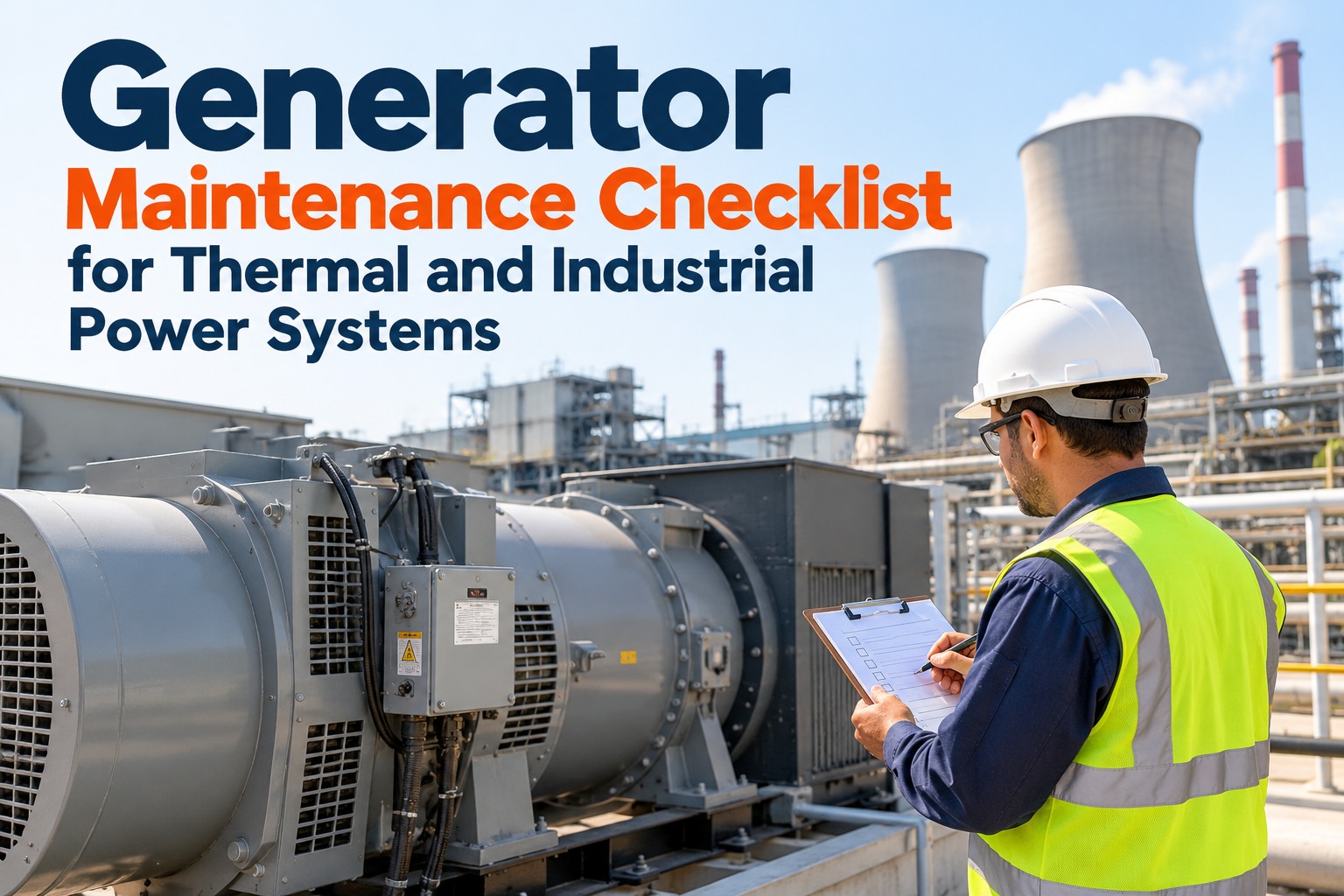
A generator rarely fails cheaply — a shorted rotor turn, a loose stator wedge, a hydrogen seal leak or a bearing starved of oil can take a unit offline for weeks and a repair into seven figures. Most of it is catchable on a disciplined inspection routine, if the right test runs at the right interval and the trend is watched year over year. This guide is a complete generator maintenance checklist by subsystem, with the test standards and frequencies, and shows how OXMAINT AI, the AI-powered power-plant CMMS, schedules each task and trends every reading.
Power Generation · Thermal & Industrial · Generator Maintenance Checklist · 2026
Generator Maintenance Checklist for Thermal & Industrial Power Systems
A shorted turn, a weeping hydrogen seal, a stator reading that drifted and nobody trended — that's how a generator becomes a forced outage. OXMAINT AI, the AI-powered CMMS and maintenance management software, runs the full inspection routine by subsystem, schedules every test at its interval, trends each result against last year, and raises the work order when a reading crosses its limit.
1Stator
·
2Rotor
·
3Cooling
·
4Excitation
·
5Bearings
WHERE FAILURES ORIGINATE
Stator insulation45%
Rotor winding & core20%
Excitation / AVR15%
Cooling circuit12%
Bearings & seals8%
5
subsystems the inspection routine covers
PI ≥ 2.0
polarization index acceptance for Class F windings
≥ 97%
hydrogen purity target for H₂-cooled units
5 tiers
frequencies from daily online to major overhaul
How to Read This Checklist
Each subsystem below lists its core checks with the governing standard, the acceptance value where one applies, and how often it runs. Values are typical industry references — always follow the OEM and the unit's own test history, since trend matters more than any single reading. OXMAINT AI stores each result against the asset so the year-over-year comparison is automatic. Book a demo to see subsystem tracking in OXMAINT AI.
1Stator
Insulation resistance & polarization index (IEEE 43) — PI ≥ 2.0 for Class F; flag a 25% year-on-year declineAnnual
Partial discharge survey (IEEE 1434) — alert above ~5,000 pC on bars rated ≥ 13.8 kVSemi-annual
Wedge tightness & end-winding vibration — tap test / fiber-optic, acceptance under ~30% looseness per slot3–5 yr
Dielectric absorption & DC leakage, stator core loop testOverhaul
2Rotor
Rotor winding IR & PI (IEEE 43) — IR above ~100 MΩ, PI ≥ 2.0Annual
Field ground-fault detection — alarm around < 1 kΩ, trip around < 100 ΩContinuous
Retaining-ring NDE (UT + dye penetrant) — no crack indications of concern8–10 yr
Air-gap measurement — within about ±10% of nominal; high-speed balance to ISO 1940-1 G 2.5 after a rewindOverhaul
3Hydrogen / Cooling
Hydrogen purity & dew point — purity around ≥ 97%, dew point roughly ≤ −10°C; purge below thresholdOnline
Seal-oil differential pressure — held about 0.3–0.5 bar above casing pressureContinuous
H₂ leak / makeup volume tracked daily; investigate a sustained riseDaily
Stator cooling water — conductivity under ~0.5 µS/cm, flow and inlet/outlet ΔT per barOnline
4Excitation & AVR
Slip-ring and brush inspection — wear, seating, collector-ring cleanlinessMonthly
Field-current drift trended against baselineOnline
Voltage regulator (AVR) functional check and responseAnnual
Exciter cooling-air filter conditionMonthly
5Bearings & Lubrication
Shaft & bearing vibration spectra, torsional vibrationOnline
Bearing temperature trend against baselineOnline
Bearing oil level and oil sample / film analysisMonthly
Bearing insulation resistance (shaft-current protection)Annual
6Protection & Operational
Protection relay calibration and functional testAnnual
Over-speed trip testAnnual
Governor and motor-operated valve functional checksAnnual
Alarm and event log reviewMonthly
A Single Reading Means Little. The Trend Means Everything.
A stator IR that's fine today but down 25% from last year is the warning — and it only shows if every result is captured against the asset and compared over the years. OXMAINT AI auto-trends each IR, PI, PD and vibration reading and flags the drift before it becomes a fault.
The Frequency Tiers
Generator maintenance runs on nested cycles — continuous monitoring underneath, stepping up to the once-a-decade major overhaul. Each tier has its own scope, and OXMAINT AI schedules them so none quietly lapses. Book a demo to automate the cycles in OXMAINT AI.
Daily / online
Continuous condition monitoring — bearing vibration, stator temperature, H₂ purity, seal-oil differential, field ground fault, partial discharge — with DCS/SCADA data ingested against baselines.
Monthly
Visual and operational checks — bearing oil and sampling, slip-ring and brush inspection, collector-ring cleanliness, exciter air filter, hydrogen dryer desiccant, alarm-log review.
Annual
Stator and rotor IR/PI, bearing insulation resistance, over-speed trip test, governor and valve checks, protection-relay calibration — all trended against previous years.
3–6 yr
Minor inspection by boroscope through the ports — wedge condition, end-winding support ties, fan-blade integrity, gas baffles, retaining-ring surfaces.
8–12 yr
Major overhaul on a full outage — rotor removal, EL-CID inter-turn short test, retaining-ring NDE, wedge mapping, stator core loop test, re-wedging, high-speed balance, reassembly.
From Check to Documented Record
A checklist only protects the unit if its results live where they can be trended and acted on. OXMAINT AI turns each inspection into a stored, comparable record and a work order when needed. Start free and document the routine in OXMAINT AI.
◉
Auto-Trended Readings
Every IR, PI, PD and vibration result trends on the asset profile, so a year-on-year decline surfaces on its own.
◉
Threshold-Based Alerts
A reading crossing its limit — a PD level, an H₂ makeup rise — raises a prioritized work order automatically.
◉
DCS / SCADA Ingestion
Real-time tags stream in and are evaluated against baseline, generating condition-based work orders without a manual round.
◉
Overhaul Templates
Pre-loaded major-overhaul checklists with hundreds of steps, labor-hour estimates and spare-parts lists, ready for the outage.
◉
Permanent Asset History
Test results, photos, repairs and running hours kept against the generator for audit and ISO 55000 compliance.
◉
Early-Warning Prediction
Trended IR decay, PD patterns and vibration spectra analyzed to forecast remaining useful life weeks in advance.
“
Our generator program was a binder of test sheets that only got compared when something had already gone wrong. The stator insulation had actually been trending down for two years before a near-miss made us look. Putting every IR, PI and PD reading on the asset profile, with the annual tests scheduled and the online tags trended, means the drift now raises a flag on its own — and the overhaul templates turned our last outage from a scramble into a plan.
Electrical & Generator Reliability Engineer · Thermal Power Plant
Frequently Asked Questions
What subsystems does generator maintenance cover?
Five core subsystems plus protection: the stator, the rotor, the hydrogen or water cooling system, the excitation and AVR, and the bearings and lubrication — with protection relays and operational trips alongside. Stator insulation and the rotor carry the largest share of failures, so they carry the most of the checklist.
Book a demo to see the routine in OXMAINT AI.
What is the polarization index and what's acceptable?
PI is the ratio of 10-minute to 1-minute insulation resistance, measured per IEEE 43. For Class F systems above 1 kV, a PI of 2.0 or higher is the usual acceptance — and a 25% fall year over year signals moisture or contamination even if the absolute value still passes.
How is a hydrogen-cooled generator monitored?
Continuously: hydrogen purity (target around 97% or higher) and dew point, seal-oil differential pressure held roughly 0.3–0.5 bar above casing pressure, and daily makeup-volume tracking — a sustained rise in makeup points to a seal, flange or cooler leak and should trigger an inspection.
How often is a major generator overhaul?
Typically every 8–12 years on a full outage — rotor removal, EL-CID inter-turn short test, retaining-ring NDE, wedge mapping, stator core loop test, re-wedging and high-speed balance — with a lighter boroscope inspection every 3–6 years in between.
Why does a CMMS matter for generator checks?
Because the value is in the trend, not the single sheet. A CMMS stores every reading against the asset, compares it year over year, raises a work order when a limit is crossed, and holds overhaul templates and full history — so drift is caught early and an audit is a search, not a reconstruction.
Start free and trend your generator in OXMAINT AI.
Keep the Generator on the Routine, Not the Repair Bill.
Run generator maintenance on the OXMAINT AI maintenance management software — the full subsystem checklist with standards and intervals, nested frequency tiers from online to major overhaul, auto-trended test readings, and overhaul templates ready for the outage. Catch the drift on the checklist, not after the breakdown.