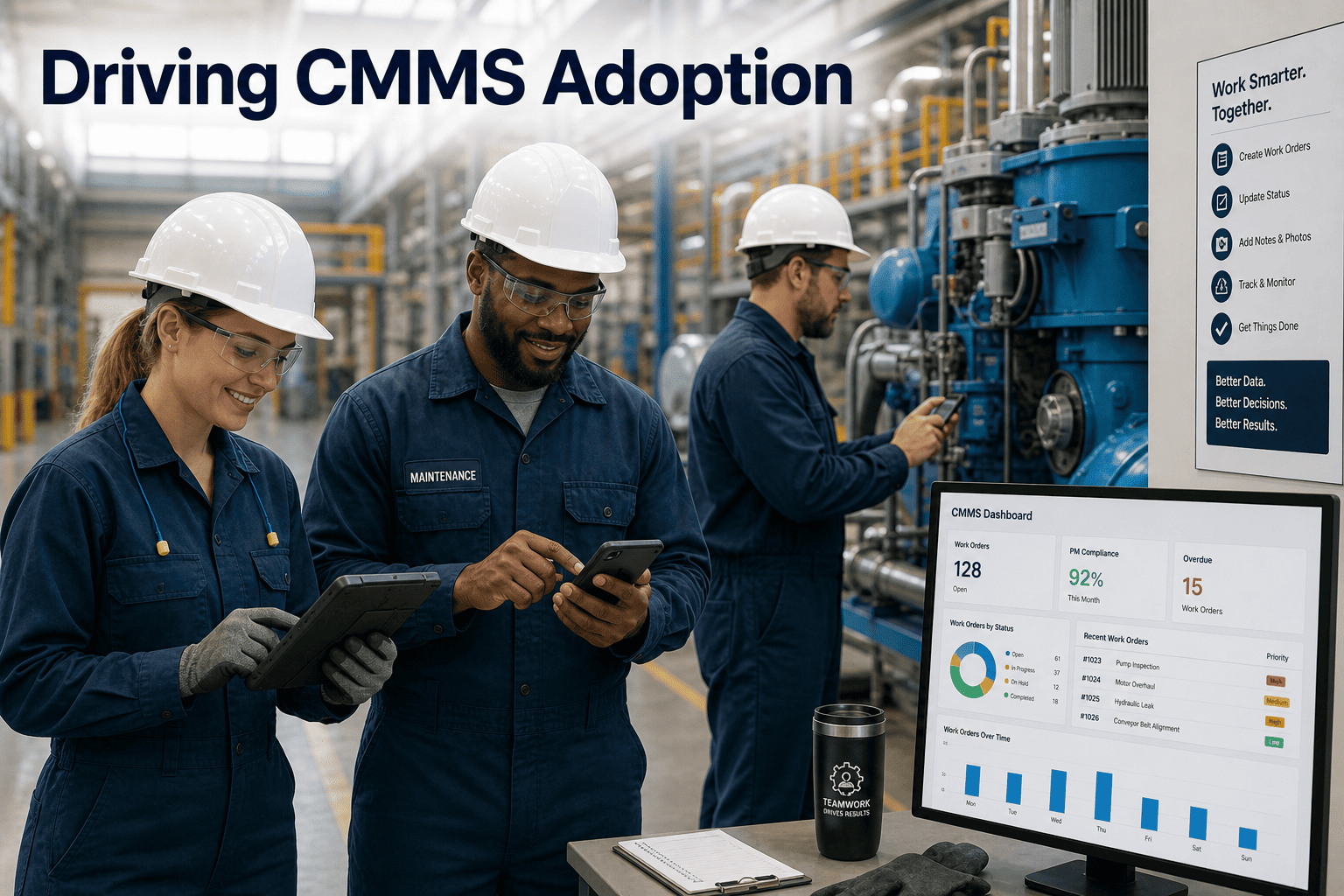
The software works. The workflows are configured. The training session ran. And still, three months after go-live, 60% of work orders are being logged on paper and technicians are asking if the CMMS is "mandatory." CMMS adoption is a change management problem disguised as a technology problem — and the organizations that treat it as the former succeed at rates three to five times higher than those that treat it as the latter. This guide gives you the frameworks, the sequence, and the concrete tactics that turn a CMMS rollout into a daily operating habit. Start a free trial with Oxmaint and see how mobile-first workflows make daily adoption the path of least resistance for your technicians.
Change management starts with the right tool
See how Oxmaint's mobile-first design makes daily adoption the path of least resistance
Technicians logging work in under 60 seconds. No friction. No paper fallback. Habits form fast.
of CMMS systems see utilization drop below 50% within 6 months of go-live
Gartner, 2024
3–5×
Higher ROI for organizations with structured change management vs. ad-hoc rollouts
Prosci Change Management Report, 2024
72%
of technician resistance to CMMS stems from UI complexity, not job security concerns
Aberdeen Group, 2025
90 days
Critical window — adoption habits formed in first 90 days determine long-term utilization
Maintenance Technology, 2025
What Is CMMS Change Management — And Why It's Not a Training Problem
Change management for a CMMS adoption is the structured process of shifting how an entire maintenance organization thinks, communicates, and executes its daily work — with the CMMS as the operational system of record. It is not a one-time training event. It is not a communication email from IT. It is a 6–12 month behavioral change program that requires executive sponsorship, role-specific enablement, feedback loops, and accountability metrics. Organizations that confuse "training completed" with "adoption achieved" find themselves 6 months post-launch with a $50,000 software subscription and a team still running on spreadsheets. Book a demo and walk through how Oxmaint's design reduces the change management burden before a single training session is delivered.
The Change Management Framework — 6 Core Concepts
01
Stakeholder Mapping
Identify every role that touches the CMMS — technicians, supervisors, planners, finance, and leadership. Map each group's concerns, incentives, and current habits. Different adoption strategies apply to each segment.
02
Sponsor Visibility
Executive sponsors must be visibly active — attending review meetings, referencing CMMS data in decisions, and recognizing teams that hit adoption milestones. Invisible sponsors equal optional software.
03
Resistance Management
Resistance is information, not obstruction. Surface it early through interviews and shadowing sessions. The technician who resists most loudly often has the most legitimate workflow concern — fix that concern and you win the floor.
04
Role-Based Enablement
One training program for all roles fails everyone. Technicians need mobile work order workflows. Supervisors need scheduling and dispatch views. Managers need PM compliance dashboards. Each role gets its own training track.
05
Behavioral Reinforcement
Adoption requires reinforcement loops, not just initial training. Weekly supervisor check-ins on system use, public PM compliance scoreboards, and manager recognition of consistent CMMS use all reinforce the new behavior.
06
Continuous Feedback Cycles
30-day, 60-day, and 90-day structured feedback collection from technicians identifies friction points before they become abandonment triggers. Make it easy to flag workflow problems and visibly fix them within days.
Where CMMS Adoption Breaks Down — The Resistance Points
Desktop-Only or Poor Mobile UX
Technicians work on equipment, not at desks. A CMMS that requires desktop login or delivers a clunky mobile experience creates friction at the exact moment work gets done. Friction at the point of logging means logs don't happen.
No Champion on the Floor
Without a respected senior technician visibly using and advocating for the CMMS, peer pressure runs the opposite direction. The informal floor leader who dismisses the system as "management overhead" shapes the behavior of the entire crew.
No Visible Win in the First 30 Days
If technicians see no tangible benefit in the first month — no time saved, no emergency avoided, no process improved — the system becomes bureaucratic overhead in their mental model. Early wins must be engineered and publicized.
Adoption Treated as a One-Time Event
Adoption is not achieved at go-live. It is a sustained rate — daily active use, consistent work order logging, PM completion before deadline. Treating go-live as the finish line is the single most common cause of post-launch utilization collapse.
Workflows Not Mapped Pre-Launch
Configuring the CMMS without first mapping your actual work order flow, PM schedule structure, and approval chains creates a system that technically works but doesn't fit how your team operates — driving workarounds and shadow systems.
Metrics Not Tied to Manager Performance
When CMMS adoption KPIs don't appear in supervisor performance reviews or departmental scorecards, middle management has no structural incentive to drive daily use on their team. Adoption becomes someone else's problem.
How Oxmaint Solves CMMS Adoption Challenges
Mobile-First Work Order Design
Work orders are designed for phone-first completion — scan an asset QR code, log the work, close the ticket. Under 60 seconds for a standard completion log. Low friction at the point of work is the adoption multiplier no training can replicate.
OEE Dashboards for Visible Wins
Real-time OEE dashboards give managers and technicians immediate visibility into how PM compliance translates to uptime. When the system visibly prevents a breakdown, the adoption conversation is over — proof beats persuasion.
Portfolio Reporting for Executive Buy-In
Leadership dashboards show PM compliance, work order backlog, and asset condition scores across all sites. Executives who see the data in their weekly review stay actively engaged — which keeps the adoption mandate visible and funded.
GMP-Compliant Inspections Built In
For regulated industries, compliance inspection templates give technicians a concrete, mandatory reason to use the CMMS — not just a suggested one. Regulatory necessity is the strongest adoption driver in pharma, food, and utilities.
Ad-Hoc Rollout vs. Structured Change Management
Adoption Factor
Ad-Hoc Rollout (No Change Management)
Structured Change Management Program
Utilization at 6 months
20–40% of intended users active daily
75–90% active daily with reinforcement program
Technician resistance
Unaddressed — builds into resentment and workarounds
Surfaced, logged, and resolved within 2-week cycles
Training model
One-size-fits-all session at go-live
Role-based tracks with 90-day reinforcement calendar
Executive engagement
Approves budget, disengages post-launch
Reviews adoption KPIs monthly, visible in team communications
First visible win
Not engineered — may never appear
Planned within first 30 days; shared with full team
New-hire onboarding
Informal — learns from colleagues who don't use the system
Structured CMMS module in new-hire orientation
12-month ROI realization
Below forecast; leadership questions the investment
On or above forecast; adoption data supports expansion
ROI of Getting Adoption Right — The Numbers
5×
ROI difference between high and low adoption implementations
Same software, same price — adoption quality determines the financial outcome (Prosci, 2024)
28%
Average PM compliance improvement with structured training reinforcement
vs. one-time training programs at same organizations — Aberdeen Group, 2025
$210K
Average annual savings per plant at 85% PM compliance
Planned early wins in the first month are the strongest predictor of 12-month adoption rates
Frequently Asked Questions
How do you get resistant technicians to use the CMMS consistently?
Address the root cause of resistance, not the symptom. Resistance is almost always about workflow friction — the system takes longer than the old way, the mobile experience is poor, or the technician doesn't see what's in it for them. Fix the friction first. Then identify the most skeptical respected senior technician and make them a co-designer of the workflow. When the floor skeptic becomes a CMMS advocate, the rest of the team follows within weeks. Punitive approaches — "you must use the system or face consequences" — produce compliance theater, not adoption.
What is the most important metric to track for CMMS adoption?
Daily active users as a percentage of licensed users is the single most actionable adoption metric in the first 90 days. Below 60% daily active usage in week four is a red flag that requires immediate intervention — usually a workflow friction audit and supervisor coaching. After 90 days, transition the primary metric to PM compliance rate: what percentage of scheduled preventive maintenance tasks are completed before the due date. High PM compliance correlates directly with all the downstream outcomes that justify the CMMS investment.
How long should the change management program run?
Structured change management should run for 12 months post-launch, not 30 days. Month 1–3: active reinforcement, friction resolution, and early win engineering. Month 4–6: habit solidification, supervisor coaching, and new-hire integration into the onboarding program. Month 7–12: transition from change management to operational standard — CMMS metrics appear in regular performance reviews and stop being treated as a special program. Beyond 12 months, the system either runs as standard operating procedure or it doesn't run at all.
What role should supervisors play in CMMS adoption?
Supervisors are the single most powerful adoption lever — more impactful than training programs, vendor support, or executive mandates. A supervisor who opens the CMMS in team meetings, references PM compliance data in daily huddles, and provides immediate positive feedback when technicians complete work orders on-time shapes team behavior within 2–3 weeks. Conversely, a supervisor who treats the CMMS as an IT requirement and never uses its data actively undermines adoption regardless of what training has been delivered. Supervisor coaching is the highest-ROI investment in a change management program.
Mobile-First · Fast Adoption · No Change Management Tax
Drive CMMS Adoption That Sticks — Starting Week One
Oxmaint's mobile-first design eliminates the friction that kills adoption before your change management program even gets started. Technicians are logging work orders within days, not months. Start a free trial with your real asset structure, or book a demo and we'll map the adoption plan specifically to your team size, site count, and current workflow.