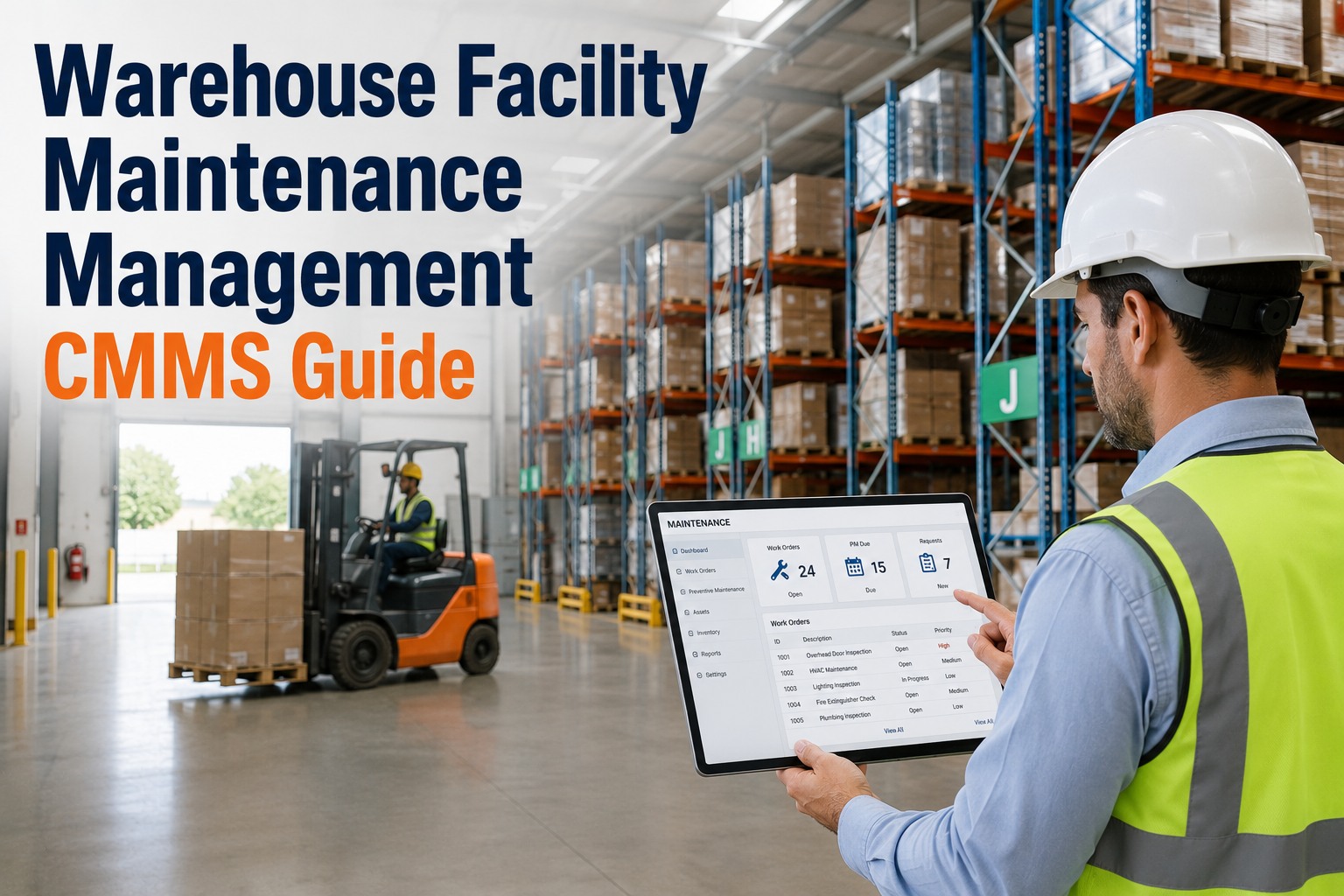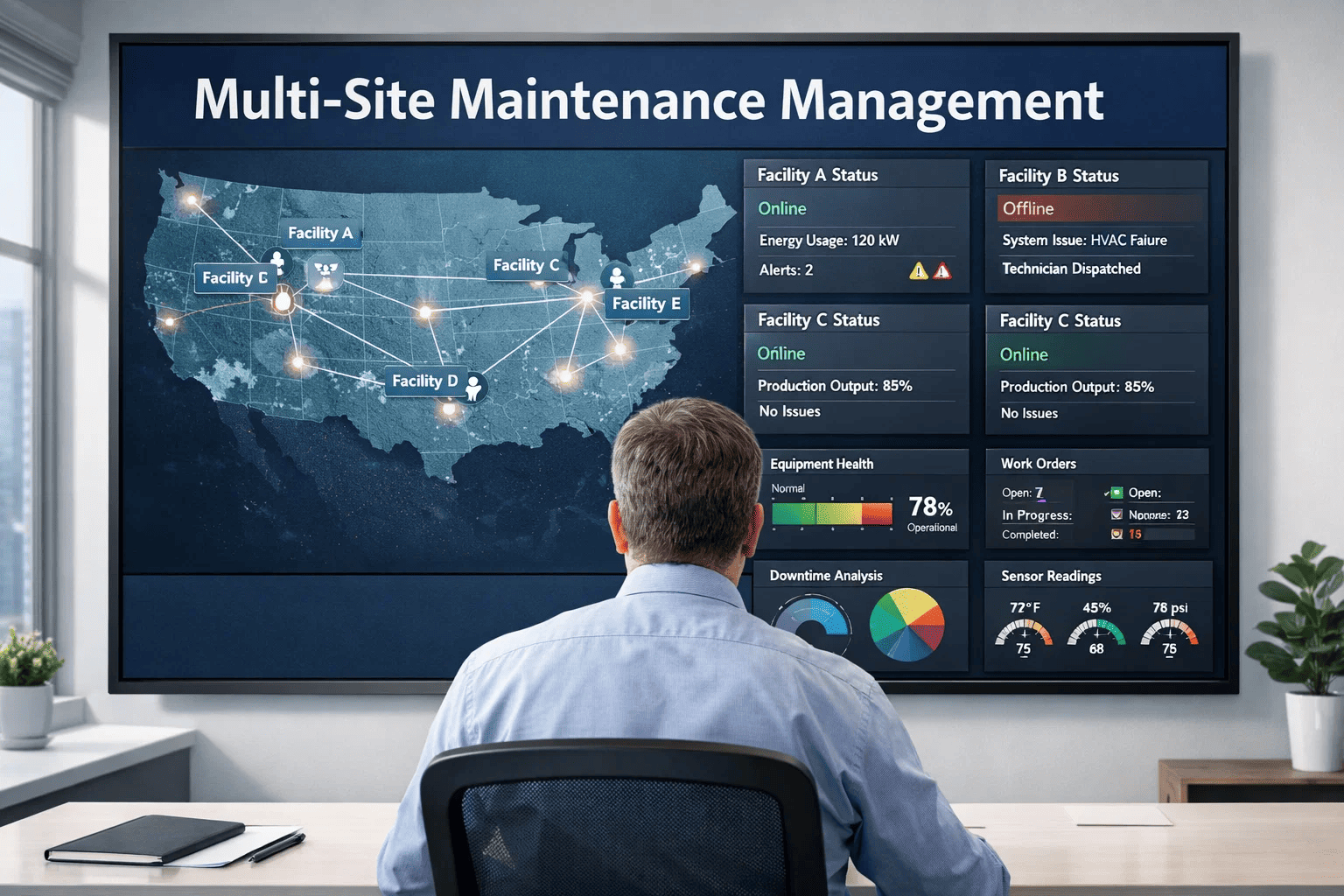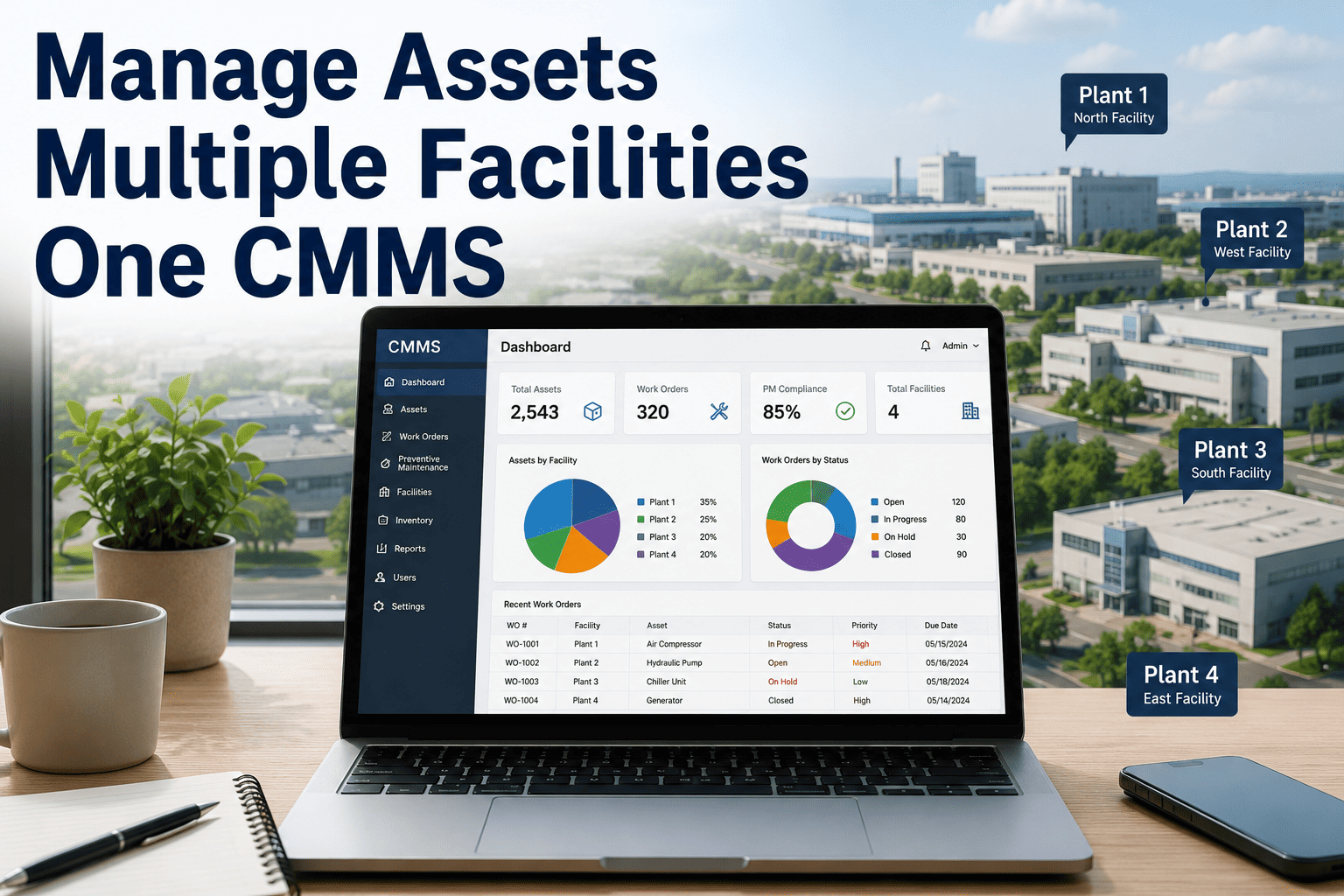
Multi-site asset management breaks down fast when each facility runs its own spreadsheets, separate CMMS instances, or paper-based records — and the true cost of that fragmentation is a 23% higher maintenance spend per asset compared to organizations running a centralized CMMS across all locations. If you manage assets across multiple facilities, you need one platform that gives every site its own operational view while giving leadership a single source of truth.
See how much untracked reactive maintenance cost you can eliminate across every site — in 30 minutes.
- Real-time AI asset monitoring across all locations
- Centralized work orders with site-level visibility
- Automated PM scheduling for every facility, one calendar
Trusted by teams managing 10,000+ assets across 9+ industries · Live in days, not months
Managing assets across multiple facilities in one CMMS
Multi-site asset management in a CMMS is the practice of tracking, scheduling, and reporting on all physical assets — equipment, machinery, infrastructure — across every location from a single platform, with role-based access that preserves site-level autonomy without creating data silos. Each facility gets its own view. Leadership gets the consolidated picture.
When facilities run separate systems, the cost compounds invisibly. Parts get over-ordered at one site and stocked out at another. A failure mode that hit Site A six months ago happens again at Site B because no one shared the data. Compliance audits require manual assembly of records across disconnected sources. A centralized asset management platform eliminates all three failure patterns at once.
The architecture that works is a single database with a site hierarchy — not separate CMMS instances loosely connected. This distinction matters. Loosely federated instances still create reconciliation lag, inconsistent taxonomies, and blind spots in cross-site analytics. True centralization means one asset register, one PM library, one work order workflow — with site-level filters applied at the user layer, not the data layer. See how Oxmaint structures this for multi-site operations.
The 8 building blocks of multi-site asset management
A structured tree — enterprise › region › site › system › asset. Every record lives in the hierarchy so cross-site filters, reports, and comparisons work without manual assembly.
One master database for all assets across all locations. Asset specs, age, maintenance history, and criticality sit in one place — searchable from any site or the corporate level.
Site technicians see their assets. Site managers see their facility. Regional managers see their cluster. Executives see everything. No workarounds, no information leakage between competing sites.
PM schedules built once and pushed to equivalent assets at every site. When OEM frequencies are updated, the change propagates everywhere. No manual replication across 12 spreadsheets.
See stock levels at every site in real time. Transfer parts from a site with surplus before placing a new PO. Auto-reorder thresholds apply platform-wide, not per-location.
Audit trails for OSHA, ISO, GMP, and local regulations roll up automatically. One-click compliance report across all facilities replaces days of manual record assembly.
Compare MTBF, PM compliance rate, reactive-to-planned ratio, and cost per asset across locations on the same dashboard. Identify your best-performing site and replicate the practice.
When work orders come in from 8 sites simultaneously, AI ranks them by criticality, asset risk, and labor availability — not by which site manager emailed first. Resources go where they matter most.
4 ways fragmented multi-site management costs you money
Without cross-site visibility, Site A over-orders bearings it can't store while Site B is on emergency backorder for the same part. Studies show multi-site orgs without centralized inventory carry 18–28% more stock than needed. See how centralized parts management fixes this.
When compliance tracking is siloed by location, a missed inspection at one site doesn't trigger a platform-wide alert. By the time a corporate audit surfaces it, the paperwork gap is months old. Centralized inspection management closes this without adding headcount.
If Site A has 91% PM compliance and Site B has 54%, you can only fix Site B if you know the gap exists. Siloed systems make this comparison a manual quarterly exercise instead of a live dashboard metric every manager checks on Monday morning.
A motor failure root-caused at your plant in Texas carries the exact fix for the same motor model at your plant in Ohio — but only if both sites are on the same system. Siloed CMMS means the same failure, the same downtime, and the same repair cost happen twice. Predictive maintenance on a shared platform prevents both events.
6 Oxmaint capabilities built for multi-facility operations
Build your full site tree in Oxmaint — enterprise, region, site, system, equipment. Every work order, PM, and inspection auto-inherits its place in the hierarchy. Explore asset management.
QR-scan creates a work order at any site. AI routes it to the nearest certified tech, regardless of which facility they're based at. Priority queues visible across all locations simultaneously. See smart work orders.
Configure a PM schedule once, deploy to every equivalent asset across all sites. Site-specific frequency overrides are permitted without breaking the master template. Preventive maintenance details.
NVIDIA-powered cameras at any site feed into the same AI detection engine — 99.2% accuracy on cracks, corrosion, leaks, thermal anomalies. Alerts and auto-generated work orders land in the same queue. AI Vision Camera details.
One inventory register across all sites. When a part goes below threshold at Site B, the system checks Site A before triggering a PO. Reduce carrying cost, cut emergency freight. Parts and inventory module.
Compare PM compliance, OEE, MTBF, and cost per asset across every site on a single screen. Export an enterprise-wide compliance report in under 60 seconds. Analytics and reporting.
Multi-facility management: fragmented tools vs one CMMS
| Capability | Fragmented (site-by-site) | Centralized in Oxmaint |
|---|---|---|
| Asset register | Separate spreadsheets or instances per site | One register, hierarchy enforced, always current |
| PM scheduling | Each site manages its own calendar | Shared library, site overrides allowed, one view |
| Work order routing | Manual, per-site queue, no cross-site routing | AI-routed to nearest certified tech, any site |
| Parts inventory | Over-ordered at some sites, stocked out at others | Cross-site visibility, auto-transfer before new PO |
| Compliance reporting | Manual assembly, days before a corporate audit | On-demand, cross-site, audit-ready in 60 seconds |
| Failure intelligence | Failure at Site A never reaches Site B | Same failure mode detected platform-wide, proactively |
| Leadership visibility | Monthly reports compiled manually, always stale | Live dashboard, drill from enterprise to asset level |
| Benchmarking | Not possible without painful manual reconciliation | One-click comparison of every site on every KPI |
What multi-site centralization actually delivers
Teams that consolidate to one CMMS typically recover the platform cost in under 4 months through inventory savings and downtime reduction alone — run the ROI calculator for your facilities, or book a demo to see it mapped to your asset count.
Common questions about managing assets across multiple facilities
Can a single CMMS really handle multiple facilities with different asset types and compliance requirements?
How do you prevent one site's data from being visible to technicians at a competing site?
What is the typical implementation timeline for a multi-site CMMS rollout?
How does centralized multi-site CMMS help with budget planning and CapEx decisions?
One CMMS. Every Site. Full Visibility.
Multi-site asset management doesn't have to mean 12 spreadsheets, three CMMS logins, and a monthly report that's already three weeks old by the time it lands. Oxmaint centralizes every asset, work order, PM, and inventory record across all your facilities — with site-level views for your teams and a live enterprise dashboard for leadership.
- AI-powered monitoring at every site, one alert queue
- Cross-site parts visibility — cut carrying cost before the next PO
- Compliance reports for all facilities in under 60 seconds
Trusted by 1,000+ teams managing assets across multiple facilities · Live in days, not months