Municipal public works equipment maintenance is the systematic process of inspecting, servicing, and documenting every critical asset a city depends on — from street sweepers and snow plows to water pumps and traffic signal controllers — using a standardized checklist procedure that prevents breakdowns and proves compliance. For US public works departments managing hundreds of assets across multiple divisions, a paper-based or memory-driven PM program is a liability: missed inspections become missed failures, and missed failures become emergency repairs that cost 3–9x more than planned maintenance. This complete municipal public works equipment maintenance checklist guide lays out every checkpoint your technicians should touch on every visit — mechanical, electrical, lubrication, safety, and documentation — aligned to OEM intervals and FMCSA/DOT compliance standards. Whether you're a 12-person DPW crew or a multi-site county operation, Start Free Trial with OxMaint to turn this checklist into auto-generated PM work orders, mobile execution with photo capture, and audit-ready records that satisfy any city equipment audit or state inspection.
Is your DPW still running preventive maintenance from a photocopied form and a clipboard?
Cities that digitize their municipal PM program cut unplanned downtime by 30–50% and reduce emergency repair costs by up to 40%. This guide gives you the complete checklist template — and shows you how OxMaint automates it.
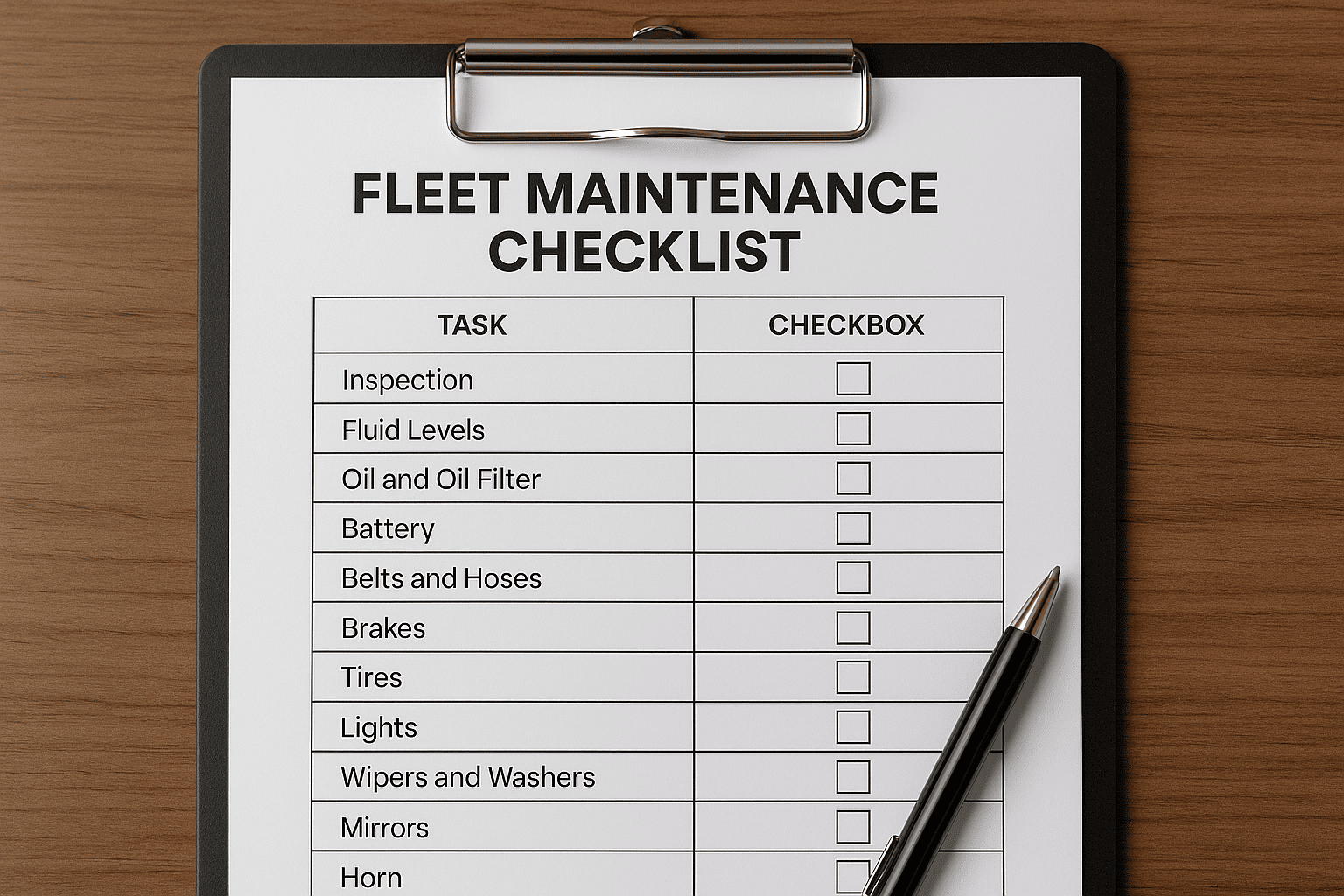
Municipal Public Works Equipment Maintenance Checklist: What to Inspect on Every Visit
A defensible municipal public works equipment maintenance checklist covers six inspection tiers. Miss any one and you risk a roadside breakdown, a failed state inspection, or a liability claim. Here is every checkpoint, organized by system.
Mechanical & Structural
- Frame, welds, and mounting bolts — cracks, corrosion, torque
- Hydraulic hoses, fittings, and cylinders — leaks, chafing, pressure test
- Belts, chains, and drive components — tension, wear, alignment
- Blades, buckets, and cutting edges — wear vs. OEM discard threshold
- Suspension, steering linkage, and axle seals — play, leaks, damage
Engine & Powertrain
- Oil level and condition — change at OEM interval (typically 250–500 hrs)
- Coolant level, concentration, and hose condition
- Fuel system — filters, water separator, tank venting
- Air intake and filter restriction indicator
- Transmission fluid — level, color, shift quality
- Exhaust system and DPF regeneration status
Electrical & Controls
- Battery voltage, terminals, and hold-down hardware
- Charging system output — alternator voltage under load
- All lighting: head, tail, brake, turn, strobe, work lights
- Wiring harnesses — chafing, corrosion, connector integrity
- Gauges, warning lights, and onboard diagnostics — verify function
Lubrication & Fluids
- Grease all zerk fittings per OEM lubrication chart
- Gear oil in differentials, final drives, and PTO gearboxes
- Hydraulic fluid level and contamination check
- Def/DEF fluid level and quality (diesel emissions systems)
- Windshield washer and any seasonal fluid top-offs
Safety & Compliance
- Brake system — pad/shoe thickness, air pressure, parking brake hold
- Tire condition — tread depth ≥4/32" steer, 2/32" drive (FMCSA minimum)
- Backup alarms, cameras, and proximity sensors — function test
- Fire extinguisher — charge, inspection tag current
- Seat belts, mirrors, and operator restraint systems
- Decals, placards, and load-rating labels — legible and present
Documentation & Sign-Off
- Record hour meter / odometer reading
- Note all deficiencies found with photo evidence
- Flag items needing follow-up work order vs. immediate removal from service
- Technician e-signature and date/time stamp
- Supervisor review and closure confirmation
Municipal Fleet PM Schedule: How Often Should You Service Each Asset Class?
OEM intervals vary, but most US municipalities follow a tiered PM schedule based on hours, miles, or calendar time. The table below shows a defensible baseline for common public works asset classes — adjust to your OEM manual and duty cycle.
| Asset Class | PM-A (Basic Inspection) | PM-B (Full Service) | PM-C (Annual / Seasonal) | Key Compliance Standard |
|---|---|---|---|---|
| Dump Trucks & Plow Trucks | Every 250 hrs / 5K mi | Every 500 hrs / 10K mi | Pre-winter & pre-summer | FMCSA 396.3, DOT annual inspection |
| Street Sweepers | Every 100 hrs | Every 300 hrs | Gutter broom & water system overhaul | OEM wear-part thresholds |
| Backhoes & Loaders | Every 250 hrs | Every 500 hrs | Hydraulic system flush & test | OSHA 1926.601, OEM service manual |
| Water / Sewer Pumps | Monthly visual + vibration | Quarterly lubrication & alignment | Annual rebuild / seal replacement | AWWA G200, state environmental regs |
| Mowers & Grounds Equipment | Every 50 hrs | Every 200 hrs | Blade balance, deck inspection, winterization | ANSI B71.4, OEM safety standards |
| Traffic Signal Controllers | Quarterly function test | Semi-annual battery & cabinet check | Annual full conflict-monitor calibration | MUTCD, NEMA TS-2, state DOT specs |
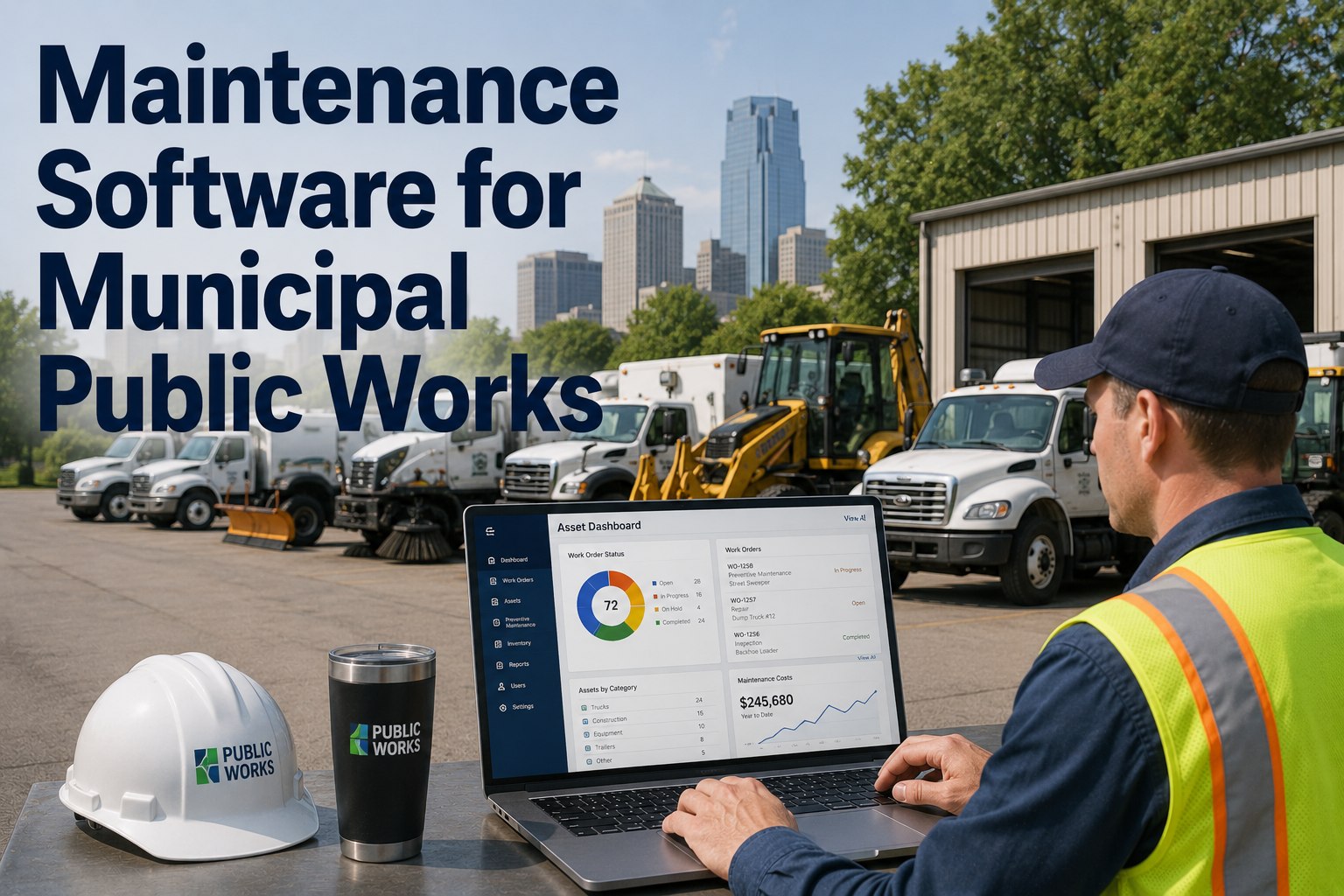
OxMaint's PM scheduler auto-generates work orders at every interval above — by hours, miles, or calendar — so no asset ever falls through the cracks. Technicians get the checklist on their phone, complete it with mandatory fields and photos, and e-sign. The record is logged against the asset permanently.
What Happens When a Municipal PM Program Fails: Real Numbers
A mid-size city running 120 fleet assets without a structured preventive maintenance program typically spends 60–70% of its maintenance budget on reactive repairs. Here is what that looks like in practice.
A city public works department with 180 assets — 90 fleet vehicles, 40 stationary pumps, 30 pieces of grounds equipment, and 20 traffic signal cabinets — was spending $68,000/year on emergency repairs alone. Their PM program was a shared spreadsheet and a whiteboard. Technicians "remembered" to grease fittings. Oil changes happened when someone noticed the sticker. Brake inspections were done when a driver complained.
After implementing OxMaint's municipal public works equipment maintenance checklist as a digital PM program — auto-scheduled work orders, mobile checklists with photo capture, and e-signature sign-off — the results in the first 12 months:
How OxMaint Turns This Checklist Into a Self-Running Municipal PM Program
The checklist above is only useful if it actually gets done — on time, every time, with proof. OxMaint's CMMS platform automates the entire cycle so your team spends time turning wrenches, not chasing paper.
Auto-Scheduled PM Work Orders
Set intervals by hours, miles, or calendar for every asset class. OxMaint generates the work order, assigns it, and sends the checklist to the technician's phone — no whiteboard, no spreadsheet, no missed PMs.
Mobile Checklists with Photo Capture
Technicians complete the municipal public works equipment maintenance checklist on any phone or tablet. Mandatory fields, photo evidence for deficiencies, and e-signatures ensure nothing is skipped or pencil-whipped.
Asset History & Spare Parts Tracking
Every PM, repair, and part replacement is logged against the asset's full history. Track spare parts inventory so you never ground a truck waiting for a $12 filter. Know exactly what each asset costs to maintain.
Compliance Dashboards & Audit Reports
One-click reports show PM compliance rate, overdue work orders, cost per asset, and downtime trends — formatted for city council presentations, state DOT audits, and ISO 55000 asset management reviews.
See OxMaint running on your fleet — book a 30-minute demo
We'll load your asset classes, build your PM schedule, and show you the mobile checklist in action. No commitment, no credit card.
Municipal Public Works Equipment Maintenance: Common Questions
What should a municipal public works equipment maintenance checklist include?
A complete municipal public works equipment maintenance checklist covers six areas: mechanical/structural inspection, engine and powertrain service, electrical system checks, lubrication and fluid levels, safety and compliance verification (brakes, tires, lighting, alarms), and documentation with technician sign-off. Each item should reference OEM thresholds so technicians know when a component passes, needs monitoring, or requires immediate replacement.
How often should municipal fleet vehicles receive preventive maintenance?
Most US municipalities follow a tiered PM schedule: PM-A (basic inspection) every 250 hours or 5,000 miles, PM-B (full service including fluids and filters) every 500 hours or 10,000 miles, and PM-C (annual or seasonal overhaul) once per year. Heavy-duty equipment like street sweepers and snow plows may need shorter intervals due to severe duty cycles. Always defer to the OEM service manual as the baseline.
What FMCSA regulations apply to municipal fleet maintenance?
FMCSA 49 CFR 396.3 requires every motor carrier — including municipal fleets operating CDL-required vehicles — to "systematically inspect, repair, and maintain" all vehicles under its control. This means documented inspections at regular intervals, prompt repair of deficiencies, and retention of maintenance records for at least one year (six months for records of vehicles no longer in service). OxMaint automatically timestamps and stores every inspection record, so you can book a demo to see how audit-ready reporting works.
How much can a city save by switching from reactive to preventive maintenance?
Industry benchmarks from the US Department of Energy and AASHTO show that preventive maintenance costs 3–9x less than reactive repair for the same asset. A mid-size city spending $60,000–$80,000/year on emergency repairs can typically reduce that by 30–50% in the first year of a structured PM program. Additional savings come from extended asset life (deferring capital replacement), reduced overtime, and lower parts costs through planned purchasing.
Can OxMaint handle both fleet vehicles and stationary equipment like pumps and signals?
Yes. OxMaint tracks any asset type — vehicles, heavy equipment, stationary pumps, traffic signal cabinets, HVAC systems, and facility infrastructure — each with its own PM schedule, checklist template, and meter-based triggers. You can manage an entire multi-division public works operation from one dashboard. Start Free Trial and import your asset list in minutes.
Stop running your municipal PM program from memory and paper
OxMaint gives your public works team auto-scheduled work orders, mobile checklists with photo proof, and audit-ready records — starting day one.
Free 14-day trial · No credit card · Set up in under 30 minutes