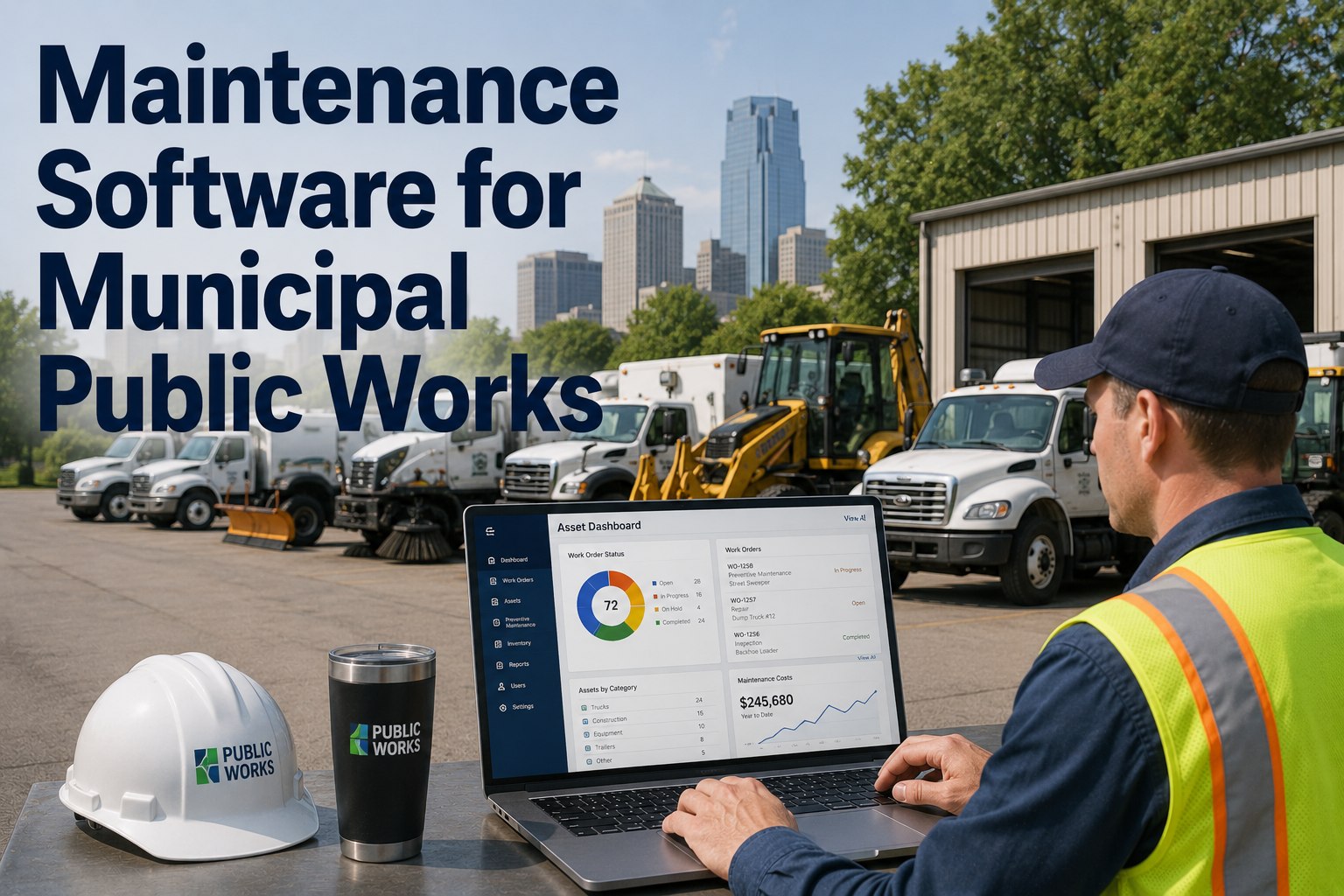
Public works maintenance software is the digital backbone that lets municipal teams manage roads, water systems, fleet vehicles, buildings, and parks from a single coordinated platform — replacing clipboard-driven work orders and siloed spreadsheets with centralized, auditable workflows. For cities and counties juggling aging infrastructure against flat or shrinking budgets, a modern government CMMS like OxMaint routes 311 service requests automatically, schedules preventive maintenance, and tracks every asset from streetlights to sewer lift stations so directors can prove compliance and do more with the crews they already have. The right municipal maintenance software pays for itself within months by cutting overtime, eliminating redundant part purchases, and preventing catastrophic failures before they happen. Ready to see it on your assets? Start Free Trial or read on for the complete evaluation guide.
One platform for streets, water, fleet, buildings & parks
OxMaint gives public works directors a shared CMMS architecture that connects 311 requests to work orders, preventive schedules, parts inventory, and audit-ready reporting — across every department, from small towns to large city portfolios.
The real cost of spreadsheet maintenance for city operations
A 15-person public works department managing 2,000+ assets on paper logs and Excel spreadsheets typically loses 8–12 hours per week searching for records, duplicating data entry, and chasing down work order statuses. That is over $25,000 in annual staff time spent on administrative friction — not fieldwork.
- Citizen 311 calls logged on paper slips — lost, duplicated, or forgotten
- Preventive maintenance skipped when crews are busy, then forgotten entirely
- Fleet service intervals tracked in one spreadsheet, road repairs in another
- Parts room runs out of critical filters mid-season; emergency orders cost 2–3x retail
- Audit preparation takes 40+ hours of digging through file cabinets each year
- No visibility into which assets are draining the budget through repeat failures
- 311 requests auto-generate work orders routed to the correct crew in real time
- Automated PM schedules fire 7/14/30 days ahead — never skipped or forgotten
- Streets, water, fleet, parks, and buildings on one shared asset registry
- Parts inventory hits reorder points automatically; seasonal spikes planned in advance
- Every work order, part, and labor hour timestamped and exportable in one click for audits
- Failure-cost dashboards flag the 20% of assets consuming 80% of the repair budget
What public works management software must do for your city
Not every municipal CMMS is built for the complexity of public works. Here are the five capability areas that separate a purpose-built platform from a generic work-order tool.
311 & Citizen Request Integration
Connect 311 call center or web portal requests directly into the CMMS. Pothole reports, streetlight outages, and water leak complaints auto-generate work orders tagged to the nearest crew — with GPS coordinates, photos, and priority levels. Citizens get status updates without your staff making follow-up calls.
Multi-Department Asset Registry
A single asset hierarchy spanning roads, bridges, water mains, sewer lines, traffic signals, park irrigation, fleet units, and buildings. Each asset carries its own maintenance history, warranty data, condition rating, and life-cycle cost — giving directors a true enterprise asset management view.
Automated Preventive Maintenance
Schedule recurring PMs by calendar interval, meter reading (odometer/hours), or condition trigger. Road crack-sealing every 24 months, hydrant flushing every spring, vehicle oil changes every 5,000 miles — OxMaint fires work orders automatically and reassigns them if the primary crew is at capacity.
Spare-Parts & Inventory Control
Track parts across multiple storerooms — the fleet shop, the water yard, the streets barn. Reorder points trigger purchase requests before stock hits zero. Seasonal demand forecasting means you have salt, cold-patch, and chlorine tablets staged before the first freeze or the first drought.
Audit-Ready Reporting & Compliance
Generate GASB 34, FMCSA DOT inspection, and MS4 stormwater compliance reports in minutes, not days. Every work order carries a full audit trail — who, what, when, parts used, labor hours, and outcome — so you walk into any council meeting or state audit with confidence.
Mobile-First Field Work Orders
Crews receive and close work orders on phones or tablets — with photos, signatures, parts used, and time stamped — even offline in remote locations or basements with no signal. No more driving back to the yard to drop off paper slips or type up notes.
How cities roll out public works CMMS in 30–60 days
A mid-sized city (population 25,000–75,000) can migrate from spreadsheets and paper to a fully operational municipal CMMS in under eight weeks. Here is the typical rollout timeline.
Asset Data Migration & Hierarchy Build
Import existing asset inventories from spreadsheets, GIS layers, and legacy systems. OxMaint structures assets into departments, locations, and parent-child hierarchies — roads by segment, fleet by unit number, buildings by room. Most cities complete this in 40–60 hours of staff time with OxMaint onboarding support.
PM Schedules & Work Order Templates
Define recurring preventive maintenance tasks for every asset category: street sweeping routes, vehicle service intervals, hydrant inspections, mowing cycles, HVAC filter changes. OxMaint pre-loads industry-standard task templates so teams start from 80% complete, not a blank page.
311 Integration & Mobile Field Rollout
Connect citizen request channels — 311 phone systems, web forms, or SeeClickFix — to the CMMS work-order engine. Deploy the mobile app to field crews, run a two-week parallel period where paper and digital coexist, then cut over. Most crews adapt within 4–5 shifts.
Dashboards, KPIs & Go-Live Optimization
Configure director and supervisor dashboards: backlog aging, PM compliance %, mean time to repair, overtime by department, and asset failure-cost rankings. Hold a 90-minute review with department heads to confirm the data matches reality — then you are fully live and audit-ready.
What municipal maintenance software saves a typical public works department
For a department managing 2,000 assets with 15 field staff and a $1.8M annual maintenance budget, switching to OxMaint typically delivers measurable savings within the first quarter. Here is the breakdown.
A 15-person department cutting 6 OT hours/week, eliminating 12 emergency part orders/year, preventing 3 major asset failures, and saving 35 audit hours saves roughly $54,000–$72,000 annually — against a software cost of $6,000–$12,000/year.
| Savings Category | Before OxMaint (Annual) | With OxMaint (Annual) | Net Savings |
|---|---|---|---|
| Reactive overtime labor | $42,000 | $18,000 | $24,000 |
| Emergency / expedited parts orders | $15,500 | $4,200 | $11,300 |
| Avoided catastrophic asset failures | $28,000 | $7,000 | $21,000 |
| Audit prep & compliance reporting labor | $8,400 | $1,200 | $7,200 |
| Fuel & tire waste from deferred fleet PMs | $6,000 | $2,500 | $3,500 |
| Total Annual Impact | $99,900 | $32,900 | $67,000 |
OxMaint capabilities mapped to public works outcomes
OxMaint is an AI-powered CMMS and EAM platform built to handle the full complexity of municipal operations. Here is how four core capabilities translate into measurable results for your department.
Machine-learning models analyze vibration, temperature, hour-meter, and failure-history data to flag pumps, motors, and vehicle components likely to fail in the next 14–30 days — before they become emergency breakdowns.
Citizen requests flow into the CMMS, auto-categorize by type and priority, and route to the nearest qualified crew with GPS context and SLA timers — eliminating manual dispatch and phone tag.
Streets, water, wastewater, parks, fleet, and facilities share one asset database with full life-cycle cost tracking, condition ratings, and maintenance history — giving directors a single source of truth for capital planning.
Field crews complete, photograph, and sign off on work orders from phones or rugged tablets — even in sewers, basements, or remote pump stations with zero connectivity. Data syncs the moment signal returns.
A 45,000-resident city cuts overtime 38% in one fiscal year
Riverside's public works director inherited a department running on paper work orders, three separate Excel trackers (fleet, streets, water), and a whiteboard in the parts room. The crew was logging 22+ overtime hours per week on reactive calls — mostly after-hours water main breaks and traffic signal failures that preventive maintenance could have caught early. Audit preparation for the state DOT and EPA took two staff members nearly 50 hours each spring.
After deploying OxMaint over a six-week implementation, the department automated 340 recurring PM tasks, connected the city's 311 web portal directly to work-order routing, and gave every crew a mobile app with offline capability. Within the first fiscal year, overtime dropped 38% (saving $19,800), emergency parts orders fell from 31 to 9, and the spring audit took under 4 hours to compile. The director now presents a live KPI dashboard at every city council meeting — and the council approved the next year's software budget unanimously.
See OxMaint on your city's assets
Book a 30-minute demo and we will load a sample of your asset data, show you 311-to-work-order routing live, and map your PM schedules — before you spend a dollar.
Public works maintenance software: what cities ask before buying
What is the best CMMS for municipal public works departments?
The best public works CMMS is one that unifies asset management, work orders, preventive maintenance, 311 integration, and parts inventory in a single platform — purpose-built for government operations rather than a generic industrial tool retrofitted for cities. OxMaint is designed for municipal multi-department complexity, supports offline mobile field use, and generates GASB 34 and FMCSA compliance reports out of the box. You can evaluate it on your own assets with a Start Free Trial or a guided demo.
How much does municipal maintenance software cost?
Most cloud-based municipal CMMS platforms price per user per month, ranging from $35 to $90 per active user depending on features and contract length. A 15-person public works department typically invests $6,000–$12,000 annually — against $50,000–$70,000 in measurable savings from reduced overtime, fewer emergency repairs, and eliminated audit-prep labor. OxMaint offers transparent tiered pricing with no implementation surprise fees.
How long does it take to implement public works software?
A mid-sized city (25,000–75,000 residents) can fully implement a municipal CMMS in 4–8 weeks. The timeline depends on asset data cleanliness, number of departments going live simultaneously, and 311 integration complexity. OxMaint provides a structured onboarding with pre-loaded industry PM templates and a dedicated implementation specialist so most departments are operational within 30–45 days.
Can public works software integrate with our existing 311 system?
Yes. Modern government CMMS platforms like OxMaint support API integrations with common 311 and citizen-request systems, including SeeClickFix, QAlert, and custom web portals. Citizen complaints auto-generate categorized, prioritized work orders routed to the correct crew — with status updates fed back to the citizen channel. You can see this workflow live by booking a demo with our municipal solutions team.
Does public works maintenance software work offline for field crews?
OxMaint's mobile app is built for field conditions — sewers, basements, remote pump stations, and areas with poor cell coverage. Crews can receive, view, update, photograph, and close work orders offline; the app queues all changes and syncs automatically the moment connectivity returns. This eliminates the common problem of crews driving back to the yard to drop off paperwork or re-enter data from field notes.
Stop managing public works on paper and spreadsheets
Join the cities using OxMaint to cut overtime 30–40%, automate preventive maintenance, and walk into every audit with confidence. Your first 14 days are free — no credit card required.
Free 14-day trial · No credit card