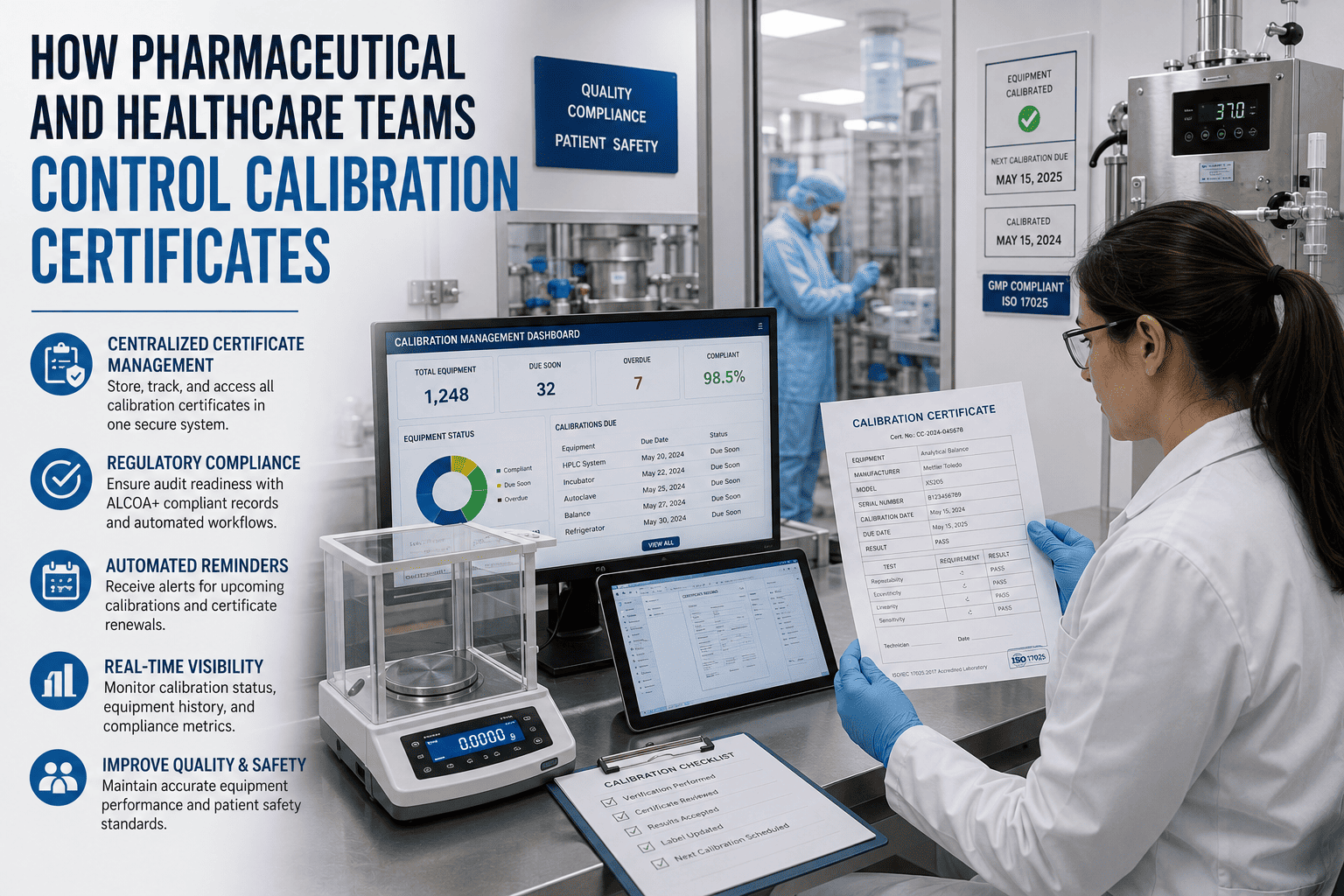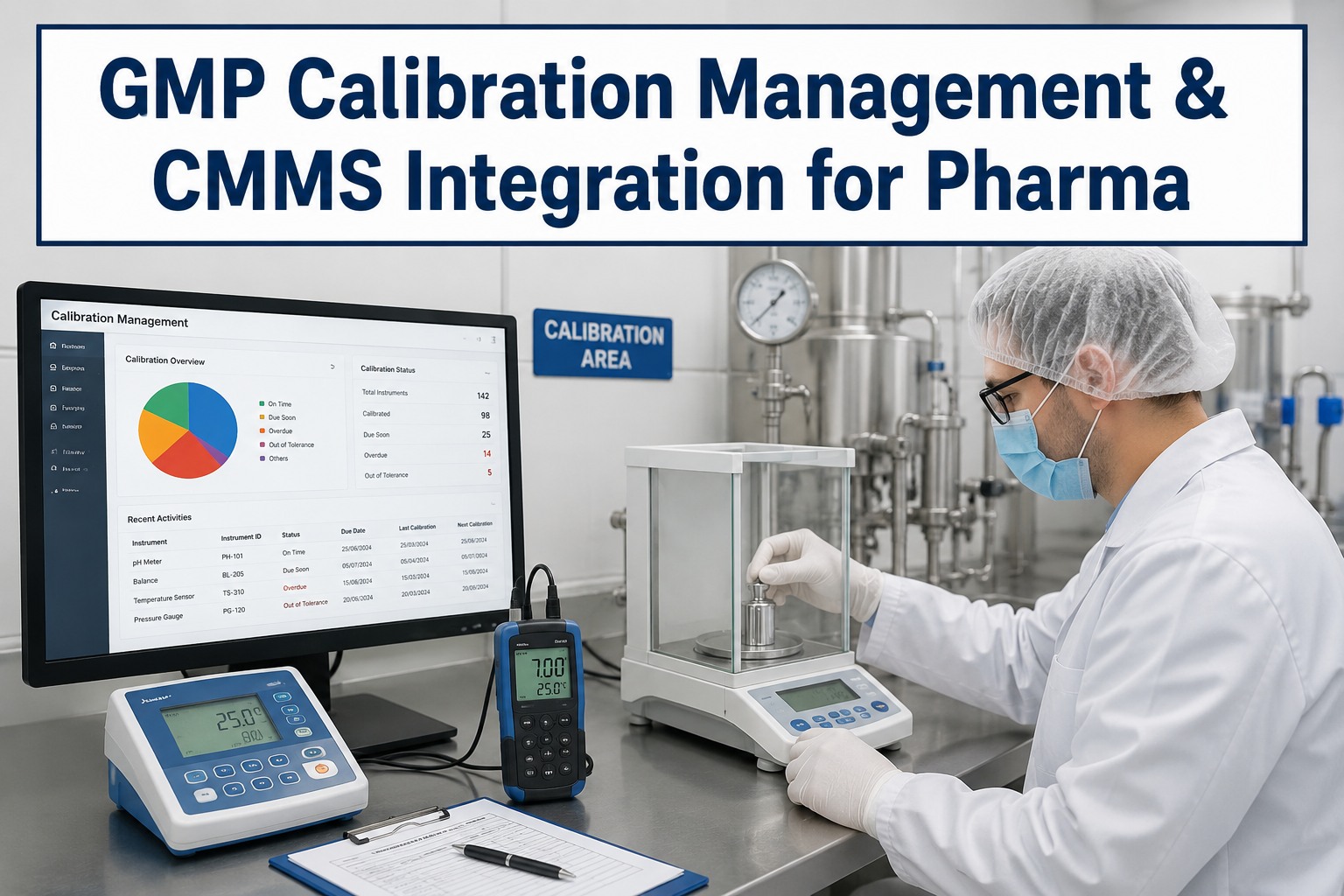
A pharmaceutical plant runs on measurements — and every measurement is only as trustworthy as the instrument taking it. A pH meter drifting 0.2 units out of tolerance during a fermentation batch is not a maintenance event, it is a data integrity investigation touching every batch made on that instrument since the last successful calibration. That is the reality behind FDA 21 CFR Part 211.68(a), EU GMP Annex 15, USP General Chapter 1058, and every warning letter the FDA has issued in the last decade about equipment qualification. Pharma calibration cannot run on paper stickers, spreadsheets, and a technician's memory of when the balance last passed. It has to run inside a validated CMMS that classifies every instrument by risk, drives calibration intervals off criticality and drift history, handles out-of-tolerance events with a formal impact assessment workflow, and holds ALCOA+ electronic records that survive an FDA audit. Oxmaint is the calibration management software built for pharmaceutical plants — integrated CMMS, GMP-ready, 21 CFR Part 11 compliant. Start a free Oxmaint trial to run GMP calibration on the CMMS, or book a demo to see calibration management and CMMS integration for pharma.
Pharma · Calibration · GMP CMMS Integration
GMP Calibration Management & CMMS Integration for Pharma — The 2026 Guide
USP 1058 instrument classification, criticality-based intervals, out-of-tolerance investigation, and ALCOA+ electronic records — the full pharma calibration workflow on one CMMS.
-
3 Groups
USP 1058 instrument classification tiers — A, B, and C by complexity
-
9 Attributes
ALCOA+ data integrity requirements every calibration record must satisfy
-
Every OOT
out-of-tolerance triggers a formal impact assessment on prior batches
-
21 CFR 11
electronic records and signatures compliance — non-negotiable for calibration records
Why Pharma Calibration Is Different
The Regulatory Density That Sets Pharma Calibration Apart
Every industry calibrates instruments. Pharma calibration is different because every reading is subject to a stack of overlapping regulations — FDA cGMP, EU GMP, USP monograph chapters, ISO standards, and data integrity guidance. A single missed calibration on a critical instrument does not just create a maintenance backlog. It creates a documentation gap that puts every batch tested on that instrument into an FDA-investigable state.
-
01
Overlapping Regulations
21 CFR Part 211.68(a), 21 CFR Part 11, EU GMP Annex 11 and Annex 15, USP 1058, USP 41, ISO/IEC 17025. Every calibration event must satisfy all of them simultaneously.
-
02
Batch Traceability Impact
An out-of-tolerance instrument does not just fail a PM — it triggers an impact assessment on every batch tested since the last passing calibration. Investigation, deviation, potentially recall.
-
03
Data Integrity Under ALCOA+
FDA and EMA have made data integrity a top inspection priority. Every calibration record must be Attributable, Legible, Contemporaneous, Original, Accurate — and Complete, Consistent, Enduring, Available.
-
04
Warning Letter Exposure
FDA warning letters routinely cite inadequate calibration programs — missing records, undefined intervals, no OOT investigation, no impact assessment. Every gap is a 483 finding waiting to happen.
USP 1058 Classification
The Three Instrument Groups That Drive the Whole Calibration Program
USP General Chapter 1058 classifies every pharmaceutical analytical instrument into one of three groups — A, B, or C — based on complexity and the degree of qualification required. This classification is the foundation of the entire calibration program. Group A instruments need visual verification only. Group C instrument systems need the full IQ/OQ/PQ lifecycle. Oxmaint holds the classification against every instrument record and inherits the appropriate calibration template automatically.
Basic Apparatus
Simple apparatus with no measurement capability or with basic user-configurable settings. Fitness-for-purpose confirmed by visual observation and calibrated standards.
Examples: magnetic stirrers, vortex mixers, hot plates, nitrogen evaporators, centrifuges (no reporting)
Requirement: Basic visual verification
Standard Instruments
Standard instruments providing measured values against physical measurement standards. Require calibration against traceable reference standards on defined intervals.
Examples: balances, pH meters, thermometers, titrators, pipettes, ovens, refrigerators, autoclaves
Requirement: Calibration + performance verification
Complex Instrument Systems
Complex computerized instrument systems requiring the full 4Q qualification lifecycle — Design, Installation, Operational, and Performance Qualification.
Examples: HPLC, GC-MS, dissolution testers, NIR spectrometers, particle size analyzers, LC-MS/MS
Requirement: Full DQ/IQ/OQ/PQ lifecycle
The Calibration Lifecycle
Six Stages Every GMP Calibration Program Must Run
A GMP-compliant calibration program is not a maintenance task — it is a lifecycle. Six stages, in order, every one documented, every one linked to the next inside the CMMS. Oxmaint runs the full sequence as gated workflow, so an instrument cannot ship a calibration record without the classification, interval, and impact review stages actually completing.
-
01
Instrument Identification
Every measurement instrument entered into the CMMS with unique ID, location, department, criticality, and the drug products it supports.
-
02
USP 1058 Classification
Assigned to Group A, B, or C. Classification drives the qualification lifecycle template and the calibration program scope.
-
03
Interval Assignment
Criticality, historical drift, and usage frequency drive the interval. Documented rationale for every interval assignment.
-
04
Calibration Execution
Performed against traceable standards. As-found and as-left readings recorded. Technician credential, standards used, environmental conditions captured.
-
05
Record & Approval
Electronic record with 21 CFR Part 11 signature. Approved by QA. Instrument sticker or system status updated. Result trended against instrument history.
-
06
Review & Interval Adjustment
Periodic review of drift data. Intervals shortened for drifting instruments, extended for stable ones. Justified change history preserved.
Interval Assignment Framework
Three Factors That Set Every Calibration Interval
A calibration interval is not a manufacturer's recommendation — it is a documented, justified assignment based on three factors specific to the instrument in its actual pharmaceutical use. FDA inspectors and EU auditors expect the rationale for every interval to be documented and reviewed.
-
F1
Instrument Criticality
Direct product-impact instruments (final release testing, in-process controls) demand tighter intervals than indirect ones. Criticality tier stored in the instrument record.
-
F2
Historical Drift
The instrument's own drift history over prior calibration cycles. Stable instruments earn extended intervals with justified rationale. Drifting instruments get shortened intervals.
-
F3
Usage Frequency & Environment
A pH meter used 100 times a day cannot share the interval of one used weekly. Environmental exposure (temperature, humidity, chemistry) shortens intervals further.
The OOT Investigation
An Out-of-Tolerance Reading Is a Data Integrity Event, Not a Maintenance Ticket
Every OOT triggers a formal impact assessment on every batch tested since the last successful calibration. If the impact assessment cannot rule out product risk, the batches enter deviation and potentially recall. This is the single most important calibration workflow in pharma — and the most common gap on paper-based systems.
The Out-of-Tolerance Workflow
The Four-Step Impact Assessment When an Instrument Fails
USP 1058 and cGMP expect a formal, documented investigation on every OOT event. Below is the working four-step workflow every pharmaceutical plant runs — from the initial failing reading through the impact assessment on affected batches. Oxmaint launches the workflow automatically when a calibration record posts an OOT result.
Quarantine the Instrument
Instrument tagged out of service immediately. No further batches tested. Deviation record opened. Original as-found reading preserved with technician signature.
Determine Look-Back Window
Identify every batch tested on this instrument since the last successful calibration. Pull data from LIMS or eBR. Establish the full population under investigation.
Impact Assessment
Quality Unit evaluates whether the drift magnitude could have altered any batch disposition decision. Scientific rationale documented. Deviation classification assigned.
CAPA & Return to Service
Corrective action on the instrument (repair, adjustment, replacement). Interval shortened for the next cycle. Batches released, rejected, or recalled per impact assessment.
ALCOA+ Data Integrity
The Nine Attributes Every Calibration Record Must Carry
FDA and EMA converged on ALCOA+ as the working definition of data integrity across all GMP records. The original five ALCOA attributes plus four extensions cover the full electronic record lifecycle. Every calibration record inside Oxmaint carries all nine — enforced by the software, not by procedure.
-
A
Attributable
Every entry linked to a specific user with 21 CFR Part 11 e-signature.
-
L
Legible
Readable, permanent, no ambiguity in units, format, or precision.
-
C
Contemporaneous
Recorded at the time the activity happens. Not reconstructed later.
-
O
Original
First-record capture preserved. No transcription intermediaries.
-
A
Accurate
Correct as recorded. No unresolved discrepancies from the raw data.
-
C
Complete
Full record — as-found, as-left, standards, environment, all fields.
-
C
Consistent
Chronological order, uniform format across the instrument population.
-
E
Enduring
Preserved for the required retention period without degradation.
-
A
Available
Accessible to inspectors on request. Retrievable during retention.
Where Manual Calibration Breaks
Four Gaps FDA Inspectors Find Almost Every Time
-
01
Interval With No Documented Rationale
Sticker says annually. Nobody can produce the risk assessment or drift study that justifies "annually" for this specific instrument. Automatic 483 finding.
-
02
OOT Handled as Maintenance Ticket
Failed calibration corrected with an adjustment. No impact assessment on batches tested since last passing calibration. No deviation record. This is the single most common warning letter cause.
-
03
Records Cannot Be Retrieved
Paper calibration sheets in a binder somewhere. Some are missing. Some are illegible. Some are undated. ALCOA+ violation on multiple attributes.
-
04
No 21 CFR Part 11 Signature
Electronic records without validated electronic signature, without audit trail, without user attribution. Data integrity finding on inspection.
Built for GMP
How Oxmaint Runs Pharma Calibration Inside the CMMS
-
Instrument Registry
Every Instrument as a Classified CMMS Asset
USP 1058 Group A, B, or C stored with the instrument record. Location, department, criticality, and product linkage held on the same asset. The calibration template inherits from the classification.
-
Justified Intervals
Interval Assignment With Documented Rationale
Criticality, drift history, and usage combine to set the interval — with the rationale attached to the instrument record. Every change tracked with justification and QA approval.
-
OOT Workflow
Automatic Impact Assessment on Every OOT
The moment a calibration record posts out of tolerance, Oxmaint launches the four-step workflow — quarantine, look-back window, impact assessment, CAPA. Deviation record created automatically.
-
21 CFR Part 11
Validated Electronic Records and Signatures
Every calibration entry attributable to a specific user with e-signature. Full audit trail. Record retention. ALCOA+ enforced by the software, not by procedure.
-
Drift Trending
Historical Drift Data on Every Instrument
As-found readings trended across every prior cycle. Drifting instruments flagged for interval reduction. Stable instruments justify extension. Data-driven, not sticker-driven.
-
Audit Package
FDA-Ready Export on Demand
Every calibration record, every OOT investigation, every interval justification, every ALCOA+ attribute — pulled in one export for FDA, EMA, or notified body inspection.
Measured Outcomes
What Pharma Plants Gain With Calibration Running on Oxmaint
-
Zero
Uninvestigated OOT Events
Automatic four-step workflow on every out-of-tolerance result. No OOT event slips through as a maintenance adjustment.
-
100%
ALCOA+ Compliance
Every calibration record carries all nine attributes. Enforced by the software architecture, not by SOP adherence.
-
Minutes
FDA Audit Prep Time
The full calibration history exports in one action. What used to take a week of file hunting is a single export.
-
Data-Driven
Interval Optimization
Drift-history-based intervals reduce over-calibration on stable instruments and tighten focus on drifting ones. Real risk reduction.
Frequently Asked
GMP Calibration & Pharma CMMS Questions
What triggers an out-of-tolerance investigation?
Any as-found reading outside the instrument's acceptable tolerance during scheduled or unscheduled calibration. The investigation includes quarantine of the instrument, look-back to the previous passing calibration, and an impact assessment on every batch tested during that window. Oxmaint launches the four-step workflow automatically the moment an OOT result is posted. Sign up for Oxmaint to run automatic OOT workflows on every calibration event.
How are USP 1058 Groups A, B, and C assigned?
Group A covers basic apparatus (magnetic stirrers, vortex mixers, hot plates) with no measurement capability, verified by observation. Group B covers standard instruments (balances, pH meters, thermometers) requiring calibration against traceable standards. Group C covers complex computerized systems (HPLC, GC-MS, dissolution) requiring the full DQ/IQ/OQ/PQ qualification lifecycle. Classification stored against every instrument record.
Is Oxmaint 21 CFR Part 11 compliant?
Yes. Every calibration entry is attributable to a specific validated user with electronic signature. Complete audit trail on every change. Record retention against the pharmaceutical retention requirement. ALCOA+ attributes enforced at the software level. Validation documentation available for the customer's qualification package. Book a demo to see 21 CFR Part 11 records and signature workflow in Oxmaint.
How are calibration intervals justified?
Three factors — instrument criticality, historical drift data, and usage frequency and environment. Every interval assignment carries the documented rationale on the instrument record. Intervals shorten automatically if drift exceeds threshold across consecutive cycles, or extend with QA approval based on demonstrated stability. Data-driven, not sticker-driven. Sign up for Oxmaint to run drift-based interval assignment on every instrument.
Classify · Calibrate · Prove
Every FDA Warning Letter for Calibration Cited the Same Four Gaps
Missing records. Undefined intervals. No OOT investigation. No electronic signature. Every one preventable with a validated CMMS that classifies every instrument, drives intervals off data not stickers, launches the impact assessment automatically on every out-of-tolerance result, and holds ALCOA+ records the FDA can pull in minutes. Oxmaint is the calibration management software built for pharmaceutical GMP.