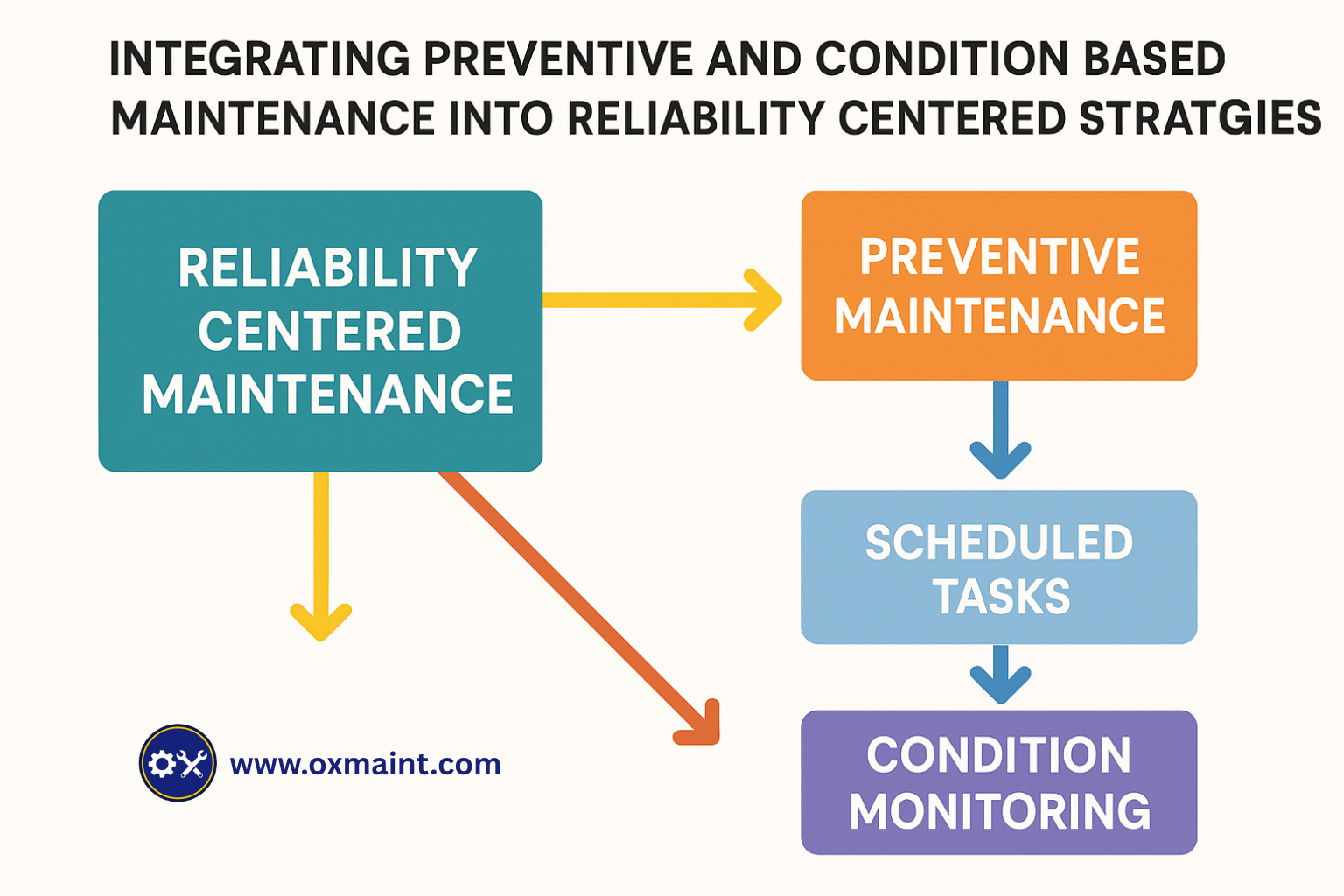
Reliability centered maintenance in utilities (T&D) is the systematic framework that transmission and distribution operators use to identify critical asset failure modes, select the most cost-effective maintenance strategy for each, and dramatically cut unplanned outages. For utilities (T&D) maintenance teams managing thousands of poles, miles of conductor, and hundreds of substations, an effective RCM program shifts resources from expensive reactive firefighting to controlled, predictive interventions. This roadmap walks through the exact steps to deploy a utilities (T&D) reliability program—from failure mode analysis to pilot project execution—and shows how modern CMMS technology makes the transition measurable. To see how OxMaint automates the entire workflow, you can Start Free Trial today.
Ready to stop fighting outages and start preventing them?
Utilities (T&D) maintenance teams that deploy a structured RCM program reduce unplanned downtime by up to 40% and cut emergency maintenance costs by 25% within the first year. Here is your step-by-step roadmap to build a proactive utilities (T&D) reliability program that actually works.
Why utilities (T&D) maintenance optimization can't wait
A typical regional utility managing 10,000+ T&D assets spends upwards of $4.5M annually on unplanned emergency repairs, overtime, and regulatory penalties. Reactive maintenance costs 3 to 5 times more than planned work, and a single transformer failure can leave thousands of customers without power for hours. The path to utilities (T&D) downtime reduction begins with shifting from a "fix-when-broken" culture to a structured reliability program.
How to implement RCM in utilities (T&D): A 6-month roadmap
Successful RCM implementation in utilities (T&D) does not happen overnight. It requires a phased rollout that builds buy-in, establishes data integrity, and proves ROI through a focused pilot project before scaling across the entire grid.
Asset Criticality Ranking
Map your full T&D asset hierarchy—from substation transformers to feeder lines—and rank assets by operational, financial, and regulatory impact. OxMaint's EAM module imports existing asset data to build this hierarchy in days, not months.
Failure Mode & Effects Analysis (FMEA)
Identify how each critical asset fails (e.g., oil degradation, bushing flashover, conductor sagging) and the operational consequence of that failure. Document failure modes directly in OxMaint's asset profiles to link them to future work orders.
Maintenance Strategy Selection
Assign the right strategy—run-to-failure, preventive (time-based), predictive (condition-based), or detective (hidden failure testing)—based on failure patterns and asset criticality. OxMaint automates PM triggers and condition-monitoring thresholds.
Utilities (T&D) RCM Pilot Project
Launch a 90-day pilot on a single substation or feeder line. Measure baseline metrics: unplanned downtime, MTBF, and maintenance labor hours. OxMaint's real-time dashboards provide instant visibility into pilot performance.
Data Review & Optimization
Analyze pilot data to validate your strategy choices. Are condition-based inspections catching faults early? Are time-based PMs too frequent? Refine maintenance intervals in OxMaint with a single click to optimize labor allocation.
Grid-Wide Rollout
Scale the proven RCM framework across all transmission and distribution circuits. OxMaint's mobile app ensures field technicians execute the new standardized work flows, capturing data offline in remote locations.
Choosing the right utilities (T&D) maintenance strategy per asset
Not every asset needs predictive maintenance. A core RCM principle is matching the maintenance strategy to the asset's failure pattern and criticality. Use the formula below to calculate the optimal intervention point for condition-based maintenance, and review the comparison table to align strategies with asset classes.
The P-F curve represents the time between a potential failure (P) becoming detectable and a functional failure (F) occurring. For a substation transformer where partial discharge is detectable 90 days before failure, inspect every 45 days. OxMaint automatically schedules condition-based inspections based on these intervals.
| Asset Class | Failure Pattern | Recommended Strategy | OxMaint Automation |
|---|---|---|---|
| Substation Transformers | Age-related, detectable | Predictive (Condition-based) | DGA & thermal sensor integration |
| Distribution Feeders | Random, environmental | Preventive (Time-based) | Automated vegetation & patrol cycles |
| Reclosers & Switches | Hidden failure | Detective (Functional testing) | Scheduled trip-test work orders |
| Pole-mounted Fuses | Random, low criticality | Run-to-Failure | Spare parts inventory min-max alerts |
How OxMaint powers your utilities (T&D) reliability program
Deploying RCM is impossible with spreadsheets and paper work orders. OxMaint's AI-powered CMMS and EAM platform digitizes the entire framework, turning your maintenance data into automated action.
Predictive Maintenance AI
Connect SCADA and IoT condition data to OxMaint. Our AI predicts transformer and switchgear failures weeks before they happen, cutting unplanned downtime by 30–50%.
Automated PM Scheduling
Eliminate missed maintenance cycles. OxMaint auto-generates work orders based on calendar time, runtime hours, or condition triggers—ensuring 100% PM compliance.
Mobile Field Execution
Technicians receive digital work orders on mobile devices, even offline in remote T&D corridors. Capture photos, update asset status, and close out jobs in real-time.
Regulatory Compliance Tracking
Automatically log every maintenance action for NERC and FERC audits. Generate compliance reports in one click, proving your utilities (T&D) maintenance best practices to regulators.
RCM benefits for utilities (T&D): A worked example
Consider a regional T&D cooperative managing 180 critical substation assets and spending $42,000 annually on reactive maintenance for just three problem feeders. By deploying an RCM pilot project using OxMaint, they transitioned 60% of reactive work to condition-based PMs within six months.
"We used to chase outages across our distribution network. After implementing RCM in OxMaint, we know which assets are degrading before they fail. Our unplanned downtime dropped by 38% in the first quarter."
See OxMaint on your assets — book a 30-min demo
Discover how OxMaint's CMMS streamlines your utilities (T&D) reliability program, from FMEA documentation to automated work order execution.
RCM in utilities (T&D): Your top questions answered
What is reliability centered maintenance in utilities (T&D)?
RCM in utilities (T&D) is a structured methodology used to identify the most effective maintenance strategy for each transmission and distribution asset based on its failure modes and operational consequences. Instead of applying uniform preventive maintenance to everything, RCM prioritizes critical assets and matches them to predictive, preventive, or run-to-failure strategies. OxMaint's CMMS digitizes this framework, linking failure modes directly to automated work order triggers.
How long does it take to implement an RCM pilot project in a utility?
A focused RCM pilot project for a single substation or feeder typically takes 90 to 120 days. This includes asset criticality ranking, FMEA, strategy selection, and initial data collection. With OxMaint, utilities can accelerate this timeline by importing existing asset hierarchies and using pre-configured maintenance templates. You can Book a Demo to see a live pilot setup.
How does RCM reduce unplanned downtime in T&D networks?
RCM reduces unplanned downtime by shifting maintenance from reactive to predictive and preventive strategies for critical assets. By identifying potential failures early through condition monitoring and scheduled inspections, teams can intervene before an outage occurs. Utilities using OxMaint for RCM typically see a 30–50% reduction in unplanned downtime because the AI engine flags anomalies before they become functional failures.
What are the main challenges of RCM implementation in utilities (T&D)?
The biggest challenges are data silos, aging paper-based processes, and resistance to changing maintenance culture. Utilities often struggle to maintain asset hierarchies in spreadsheets, making FMEA difficult. OxMaint solves this by centralizing asset data, automating work order generation, and providing mobile tools that make adopting new maintenance workflows effortless for field technicians.
Can OxMaint integrate with existing SCADA and IoT sensors for T&D assets?
Yes. OxMaint is designed to ingest condition-monitoring data from SCADA systems, IoT sensors, and DGA monitors installed on substation transformers and feeders. This integration enables predictive maintenance algorithms to trigger work orders automatically when readings deviate from established thresholds, forming the backbone of a true utilities (T&D) asset reliability program.
Transform your T&D maintenance from reactive to reliable
Join the utilities using OxMaint to cut unplanned downtime, automate PMs, and build a data-driven reliability program across every asset.
Free 14-day trial · No credit card