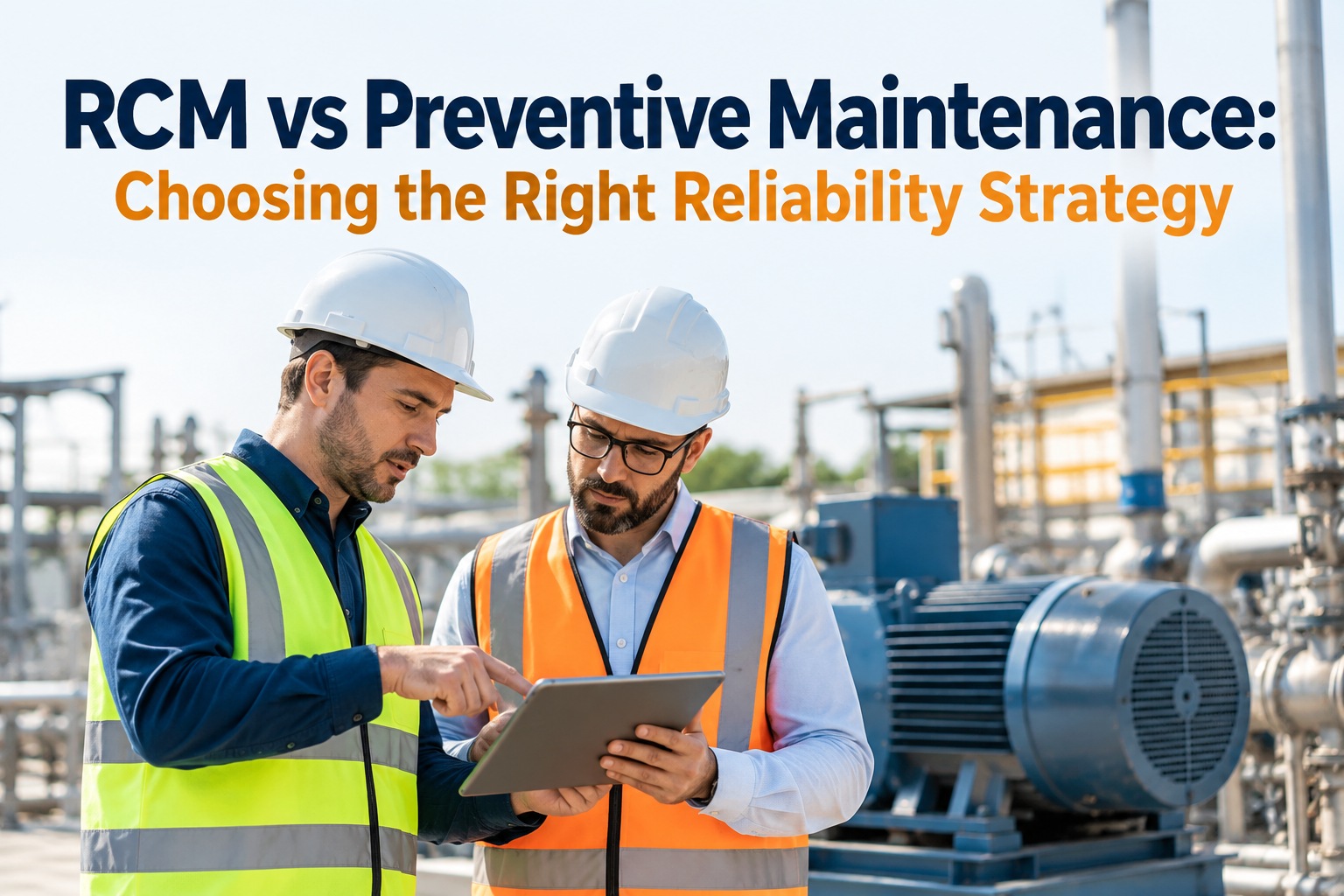
A boiler is the rare industrial asset where a maintenance miss isn't just expensive — it can be catastrophic. A tube weakened by scale and oxygen pitting can bulge, rupture, or explode under pressure; a safety relief valve left untested can fail exactly when it's the last line of defense; a low-water event from a failed cutoff can crack a furnace in seconds. That safety dimension is what makes Reliability-Centered Maintenance the right framework for boilers and steam systems: RCM doesn't maintain everything on a flat calendar, it identifies how each component actually fails, weighs the consequence — and for a boiler, the consequence can be a life — and assigns the one task that controls it. Layered on top is a quieter economic drain: a single failed steam trap can bleed 400–600 kg of steam an hour, and across a plant those losses run past $800,000 a year. This guide walks the complete RCM strategy for boilers and steam systems: the failure modes and their feedwater root causes, the four task strategies, safety-weighted criticality ranking, and the live condition-monitoring overlay that keeps the analysis working. Book a live RCM demo against your own boiler and steam assets.
On a Boiler, RCM Is a Safety Discipline First
Tube rupture, low-water events, and failed relief valves make consequence-driven maintenance non-negotiable.
25%
Of boiler tube failures trace to corrosion from untreated feedwater
12%
Heat-transfer loss from just 1/16 inch of scale on tube surfaces
400–600
kg of steam per hour wasted by a single failed-open steam trap
$800K+
Annual steam loss from failed traps in a medium-sized plant
The Dominant Failure Modes · And Their Feedwater Roots
FMEA is the analytical engine of RCM — it answers how a boiler fails and what each failure stems from. For boilers and steam systems, most serious failures trace back to one place: feedwater quality. Get the water wrong and scale, pitting, and low-water events cascade from it.
Tube Failure (Corrosion & Overheating)
The catastrophic mode. Oxygen pitting and scale weaken tubes until they bulge, rupture, or explode. Corrosion alone drives about 25% of tube failures — and dissolved oxygen above 0.007 mg/L causes irreversible pitting.
Scale-Induced Overheating
The silent efficiency killer. Hardness deposits insulate the heat-transfer surface — just 1/16 inch of scale cuts efficiency up to 12% and drives the metal temperature up toward failure.
Low-Water Events
The fast-acting hazard. A failed low-water cutoff (LWCO), feedwater pump, or condensate return exposes hot surfaces to no water — cracking the furnace or worse in seconds.
Safety Valve & Burner Faults
The hidden failures. A relief valve that won't lift on overpressure and burner/flame-scanner faults are discovered only on demand — which is why deferred testing is so dangerous here.
Failure Modes to Detection · The FMEA Core
The value of the FMEA is the detectability column — knowing the early signature of each mode is what moves a boiler from run-to-failure to condition-based and, critically, keeps its safety devices proven. Each mode has a task that catches it.
Failure Mode
Root Cause / Signature
Best Detection Task
Tube corrosion / pitting
Dissolved oxygen in feedwater, low pH
Water chemistry + ultrasonic thickness
Scale / fouling
Hardness, high TDS, treatment lapse
Water testing + efficiency trending
Low-water event
LWCO or feedwater pump failure
LWCO function test (failure-finding)
Safety valve fails to lift
Deferred testing, seat corrosion
Scheduled valve test & calibration
Burner / combustion fault
Fouled sensors, worn electrodes, scanner drift
Combustion testing + sensor PM
Steam trap failure
Failed open (steam loss) or closed (water hammer)
Quarterly ultrasonic trap survey
See RCM Live on Your Boiler Plant in 30 Minutes
Working session with our reliability team — bring your boiler and steam asset list. We'll rank them by safety-weighted criticality, map failure modes to feedwater root causes and tasks, and show how OxMaint auto-generates PM, safety-device tests, and trap surveys.
The Four RCM Task Strategies · Where Each Mode Lands
RCM routes each failure mode to one of four maintenance strategies by failure pattern and consequence. For boilers, one strategy carries special weight: failure-finding, the scheduled testing of safety devices whose failure is otherwise hidden until an emergency.
On-Condition
Predictive / Condition-Based
For modes with a detectable P-F interval. Water chemistry, ultrasonic thickness testing, and efficiency trending catch corrosion, pitting, and scale before they threaten a tube.
Scheduled Restoration
Time / Usage-Based
Restore or replace on a fixed interval — refractory repair, gasket and seal renewal, burner-component replacement, and annual certified internal inspection.
Failure-Finding
Safety-Device Testing
The critical one for boilers. Scheduled tests of safety relief valves, low-water cutoffs, and flame scanners — hidden protective functions that must be proven before a real demand arrives.
Run-to-Failure
Deliberate Acceptance
A conscious choice reserved for genuinely low-consequence, non-safety components — never a pressure part or a protective device on a boiler.
Safety-Weighted Criticality Ranking
RCM analysis is time-intensive, so it's spent where consequences justify it. On a boiler, consequence isn't only production — it's safety, which pushes pressure parts and protective devices to the top of the ranking regardless of redundancy.
SAFETY-CRITICAL
Pressure Parts & Protective Devices
Tubes, drums, safety relief valves, low-water cutoffs, flame safeguards. Failure risks injury or catastrophic rupture — full RCM, condition monitoring, and non-negotiable safety-device testing.
PRODUCTION-CRITICAL
Feedwater, Burner & Main Steam
Feedwater pumps, burner management, main steam and condensate. Failure stops steam supply — targeted FMEA, condition-based tasks, and scheduled restoration on wear parts.
SUPPORTING
Non-Critical Auxiliaries
Low-consequence, non-safety auxiliaries with redundancy or a tolerable outage. Simple inspection or planned restoration — no exhaustive analysis needed.
The AI Overlay · Keeping the Analysis Alive
An RCM study is only valuable if something is actually watching the parameters it identified. The mode that ranked "detectable by water chemistry" only helps if that chemistry is being trended and a missed safety-valve test can't slip through. This is where a live CMMS overlay turns a static study into an operating discipline.
Sensors & Tests Watch the Modes
IoT feedwater chemistry, drum level, pressure, and stack-temperature sensors, plus scheduled safety-device tests, track exactly the parameters the FMEA flagged.
Thresholds Fire Work Orders
Dissolved oxygen above limit, a scale-driven efficiency drop, or a missed valve test auto-generates a work order tied to the specific mode — with parts and procedure staged.
Findings Feed Back
Closed-work-order findings and test results return to the failure and compliance history — keeping the RCM analysis live and the safety-device record audit-ready.
How OxMaint Runs RCM for Boilers & Steam Systems
OxMaint embeds RCM directly into execution — failure-mode libraries in the asset record, safety-weighted criticality scoring, condition-monitoring triggers, auto-generated work orders and safety-device tests at RCM-defined intervals, and audit-ready reliability reporting for ISO 55000 and internal programs.
FMEA
Live Failure-Mode Libraries
Boiler and steam failure modes with feedwater root causes loaded into each asset record, linked to work-order templates and condition triggers — not stranded in a spreadsheet.
Criticality
Safety-Weighted Scoring
Rank every asset by safety and production consequence, so pressure parts and protective devices rise to the top and PM strategy follows real risk.
Safety Tests
Failure-Finding Cadence
Safety relief valve, low-water cutoff, and flame-scanner tests auto-generate on cadence — no protective-device test missed at a shift change.
Condition
Water Chemistry & IoT Triggers
Feedwater chemistry, drum level, and stack-temperature data convert threshold breaches into prioritized work orders — the P-F window put to use.
Traps
Steam Trap Survey Tracking
Schedule quarterly ultrasonic trap surveys and track failure rates — turning a $800K steam-loss drain into a managed, trending program.
Reporting
Audit-Ready Compliance
Reliability dashboards plus ISO 55000-aligned and safety-inspection-ready records — proof every test and interval was met, on demand.
Maintain Boilers by Risk, Not by Calendar
Replace spreadsheet RCM with a live program that ranks safety-weighted criticality, maps failure modes to feedwater root causes, and never misses a safety-device test. See OxMaint on your own assets. Free forever plan available.
Frequently Asked Questions
Why is RCM especially important for boilers and steam systems?
Because the consequence of failure includes safety, not just cost. A boiler tube weakened by scale and oxygen pitting can bulge, rupture, or explode under pressure; a low-water event from a failed cutoff can crack a furnace in seconds; a safety relief valve that won't lift removes the last line of defense against overpressure. RCM is built for exactly this — it drives every maintenance task from a specific failure mode and its consequence, so safety-critical pressure parts and protective devices get full analysis and rigorous testing while low-consequence auxiliaries get a lighter touch. That consequence-weighting is what makes RCM the right framework for an asset where a maintenance miss can be catastrophic.
Book a demo to see it on your boilers.
What are the main boiler and steam system failure modes?
The dominant modes are tube failure from corrosion and overheating (oxygen pitting and scale weaken tubes until they rupture — corrosion drives roughly 25% of tube failures), scale-induced overheating (just 1/16 inch of scale cuts heat transfer up to 12%), low-water events from failed low-water cutoffs or feedwater pumps, safety relief valve failure from deferred testing, and burner or combustion-control faults from fouled sensors and worn electrodes. Steam traps add a major economic mode — failed open they waste live steam, failed closed they cause water hammer. Critically, most of the serious modes trace back to feedwater quality, which makes water treatment and testing the highest-return activities in any boiler program.
Why is feedwater quality the root of most boiler failures?
Because the water is in constant contact with the hottest, most highly stressed metal in the plant. Dissolved oxygen above roughly 0.007 mg/L causes pitting corrosion on tubes and the drum shell that is irreversible once initiated and worsens without treatment correction. Hardness and high total dissolved solids deposit as scale on heat-transfer surfaces, insulating them so the metal runs hotter and efficiency drops — and that overheating is itself a path to tube failure. So a huge share of boiler failure modes — corrosion, pitting, scale, overheating — all originate in water chemistry. That's why daily-to-weekly testing of pH, conductivity, dissolved oxygen, and hardness, plus correct chemical dosing and deaerator performance, is foundational to boiler reliability.
Sign up free to track water chemistry.
How does RCM handle boiler safety devices?
Through the failure-finding task strategy. Safety relief valves, low-water cutoffs, and flame safeguards perform hidden protective functions — you can't tell from normal operation whether they still work, because their job only becomes visible during an abnormal event. RCM addresses this with scheduled failure-finding tests that deliberately exercise the device to prove it will function on demand. For boilers this is the single most important task category, because a protective device that has silently failed offers no protection at the exact moment it's needed. A CMMS makes these tests non-negotiable by auto-generating them on cadence and keeping an audit-ready record that each one was performed and passed.
How does OxMaint support an RCM program for boilers?
OxMaint embeds RCM into execution: failure-mode libraries with feedwater root causes live in each asset record linked to work-order templates and condition triggers, safety-weighted criticality scoring pushes pressure parts and protective devices to the top, and IoT feedwater chemistry, drum-level, and stack-temperature data auto-convert threshold breaches into prioritized work orders. Safety relief valve, low-water cutoff, and flame-scanner tests auto-generate on a failure-finding cadence so none is missed; quarterly ultrasonic steam-trap surveys are scheduled and their failure rates trended; and closed-work-order findings feed a living failure and compliance history. It overlays SAP PM and IBM Maximo and delivers ISO 55000-aligned, safety-inspection-ready reporting. A free forever plan is available to trial the full workflow.