Reliability centered maintenance in automotive plants is the difference between an operation that reacts to breakdowns and one that engineers them out before they happen. Automotive plants face some of the most demanding asset reliability challenges in manufacturing — high-volume production lines where a single failed conveyor motor, robotic welder, or stamping press can halt output and cost $10,000–$50,000 per hour in lost throughput. This guide walks maintenance and reliability leaders through proven RCM practices for automotive plants: identifying top failure modes on critical assets, selecting the right maintenance strategy for each, and launching an RCM pilot that delivers measurable downtime reduction in weeks. OxMaint's AI-powered CMMS and EAM platform is built for teams putting RCM into practice, with asset hierarchies that mirror your plant, failure-mode libraries linked to work orders, and analytics that prove your program is working. Start Free Trial to see how OxMaint operationalizes RCM from day one.
What if 70% of your unplanned downtime was preventable?
Reliability-centered maintenance identifies the failure modes that actually cause production losses on automotive lines — and applies the right strategy to each asset. OxMaint turns RCM theory into a live, plant-wide reliability program that reduces unplanned downtime 30–50%, extends asset life, and lowers total maintenance cost.
MONTHS
Automotive plants that launch a structured RCM pilot on critical assets typically see full payback within one or two quarterly maintenance cycles.
How to apply the seven RCM questions to automotive plant assets
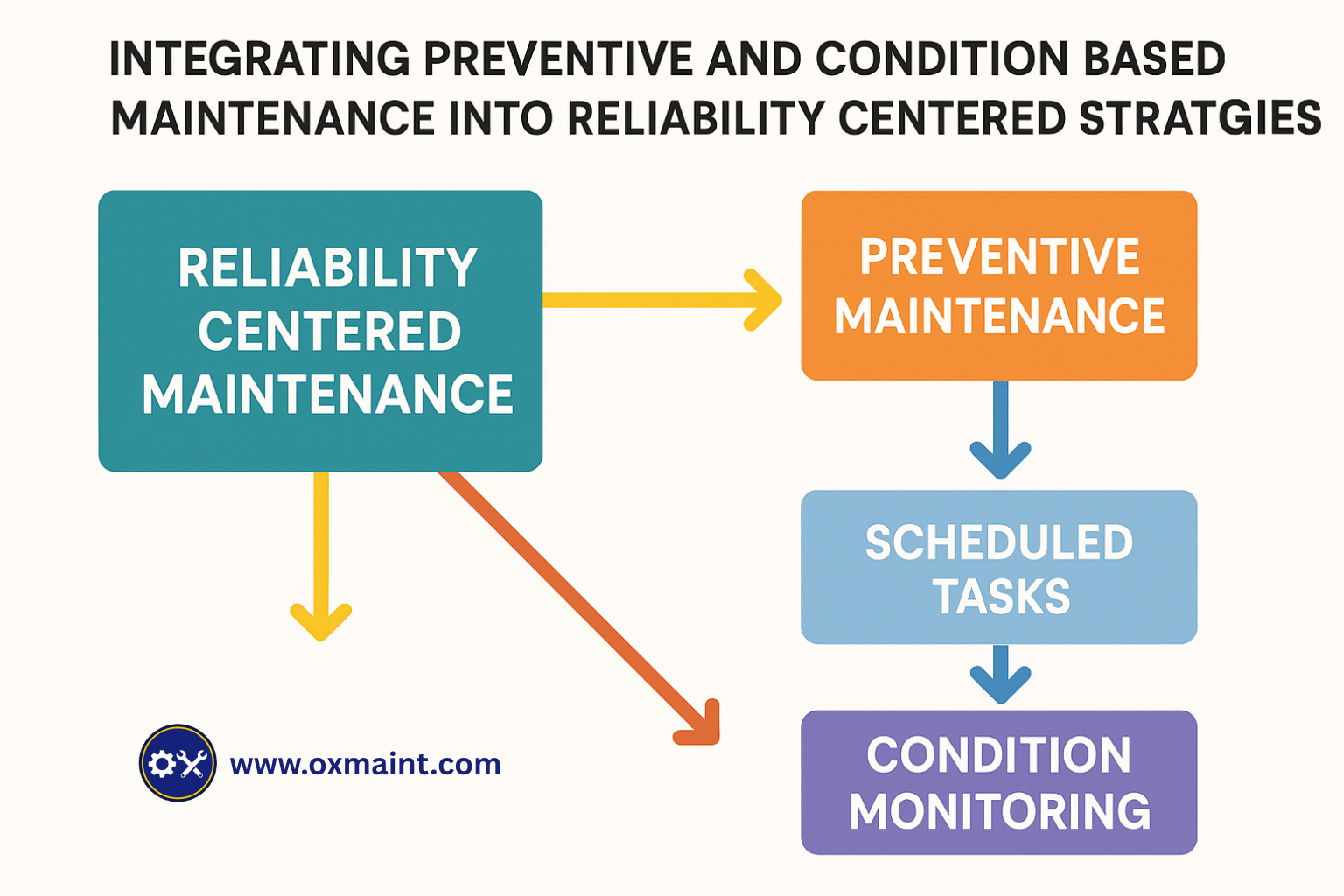
RCM in automotive plants starts with a disciplined seven-question analysis for each critical asset. The answers determine which maintenance strategy — run-to-failure, time-based PM, condition monitoring, or redesign — delivers the best balance of reliability, safety, and cost.
Define functions
What is the asset's primary and secondary functions in context of production? A stamping press's primary function is forming panels at 12 strokes/min; secondary functions include containment and safety interlocks.
Identify functional failures
How can the asset fail to perform each function? Distinguish total failure (press stops) from partial failure (stroke rate drops below spec, causing bottleneck).
Determine failure modes
What causes each functional failure? Link specific failure modes — bearing wear, hydraulic leak, sensor drift — to each functional failure at the component level.
Describe failure effects
What happens when each failure mode occurs? Document symptoms, production impact, safety risk, environmental consequence, and repair time required.
Classify consequences
Does the failure matter? Categorize as safety, environmental, operational, or non-operational. Safety and environmental consequences always take priority regardless of cost.
Select maintenance tasks
What proactive task is both technically feasible and worth doing? Choose condition-based, time-based, or failure-finding tasks — or decide no task adds value.
Default actions
If no proactive task applies, what is the default? Run-to-failure with redundancy, redesign, or procedural change. Document the rationale so decisions are auditable.
Choosing the right automotive plants maintenance strategy for each failure mode
Not every asset deserves a condition-monitoring sensor, and not every failure mode warrants a time-based PM. Automotive plants maintenance optimization depends on matching the strategy to the failure pattern, consequence, and cost of each mode. Use the decision matrix below to assign the right approach.
| Failure Pattern | Asset Example | Consequence | RCM Strategy | Typical Cost Impact |
|---|---|---|---|---|
| Age-related wear-out | Stamping press bearings | Line stoppage, $25K/hr | Time-based PM / replacement | 70% reduction in unplanned stops |
| Random failure, detectable | Robotic welder servo motor | Cell down, rework scrap | Condition monitoring (vibration) | 40–60% fewer catastrophic failures |
| Random failure, not detectable | Pneumatic valve on paint line | Quality defect, minor delay | Run-to-failure + spare on shelf | Lower total cost than over-maintaining |
| Safety or environmental | Press hydraulic accumulator | Injury risk, OSHA citation | Condition monitoring + redundancy | Zero-tolerance; regulatory compliance |
| Recurring design weakness | Conveyor chain tensioner | Repeated line stops, $8K/event | Redesign / modification | Eliminates failure mode permanently |
| Hidden failure (protection) | Safety interlock relay | Safety system unavailable | Failure-finding task (test) | Ensures protection availability 99%+ |
RCM pilot project in an automotive plant: a $42K problem solved
A mid-sized automotive stamping plant with 180 critical assets was spending $42,000 annually on emergency repairs for a single robotic welder cell that caused 14 unplanned stoppages per year. Here is how a structured RCM pilot on that cell delivered payback in under four months.
Asset criticality & FMEA
Ranked 180 assets by production impact. Selected the robotic welder cell as the RCM pilot — 14 unplanned stops/yr, $3K average repair cost, 6 hrs average downtime per event.
Instrument & baseline
Installed vibration and temperature sensors on the welder servo motors. Baselined failure modes in OxMaint's asset hierarchy — bearing wear, servo drift, cooling fan failure, torch tip degradation.
Assign maintenance tasks
Moved bearing wear to condition-based alerts; torch tip to runtime-based PM at 8,000 welds; cooling fan to time-based quarterly inspection. Three failure modes shifted from reactive to predictive.
Measure the impact
Unplanned stops dropped from 14 to 5 in the first quarter post-implementation. Emergency repair spend fell from $42K to $15K projected annually. Downtime reduced 64% on the pilot cell.
"The RCM pilot paid for itself in the first quarter. The key was having failure-mode data linked directly to work orders so technicians could see the history and the strategy behind every task."
— Maintenance Manager, Tier 1 Automotive Stamping PlantAutomotive plants downtime reduction: what RCM actually delivers
When reliability centered maintenance is implemented correctly — with the right software to sustain it — automotive plants see measurable improvements across the metrics that matter to operations and finance leadership.
Plants that shift critical assets from reactive to predictive maintenance typically cut unplanned stops by a third to half within 6–12 months.
Eliminating unnecessary PMs and catching failures early reduces both emergency repair spend and parts inventory carrying cost.
Operating assets within design limits and addressing degradation before damage propagates extends service life of presses, robots, and conveyors.
Less unplanned downtime and fewer quality defects from degraded equipment directly lift Overall Equipment Effectiveness on production lines.
How OxMaint operationalizes RCM for automotive plants
RCM analysis on paper does not reduce downtime — the strategy has to live in the daily maintenance workflow. OxMaint's AI-powered CMMS and EAM platform is built to bridge that gap, turning RCM decisions into automated triggers, linked work orders, and proof of results.
Asset hierarchy that mirrors your plant
Build multi-level asset structures — plant, line, cell, machine, component — so failure modes are linked to the exact component level where RCM analysis happens. Drill from line-level OEE down to a single bearing's vibration trend.
Outcome: Every work order carries full asset context — no more guessing which component failed.Failure-mode libraries linked to work orders
Define failure modes per asset class and require technicians to select mode, cause, and remedy on every completed work order. Over time, OxMaint builds a failure history that validates — or challenges — your RCM assumptions.
Outcome: Data-driven RCM reviews replace opinions with evidence from your own plant.PM triggers on runtime, cycles, or sensor data
Generate preventive maintenance automatically based on weld counts, press strokes, motor hours, or live IoT sensor thresholds. Condition-based alerts create work orders before failure occurs — the core of predictive RCM.
Outcome: Cut unplanned downtime 30–50% by catching degradation before it becomes failure.Analytics that prove your RCM program works
Track MTBF, MTTR, planned-vs-unplanned maintenance ratio, and downtime cost per asset — all updated in real time. Export board-ready reports that show the financial impact of your reliability program.
Outcome: Justify RCM expansion with hard numbers, not anecdotes.See OxMaint on your assets — book a 30-min demo
Watch how OxMaint maps your plant hierarchy, links failure modes to work orders, and triggers predictive maintenance automatically. Bring your toughest asset — we'll show you the RCM workflow live.
Frequently asked questions about RCM in automotive plants
What is reliability centered maintenance in automotive plants?
RCM in automotive plants is a structured methodology that identifies the failure modes most likely to cause production losses or safety risks on critical equipment, then assigns the most effective maintenance strategy to each — whether that is condition monitoring, time-based PM, run-to-failure, or redesign. The goal is to apply maintenance resources where they deliver the greatest reliability and cost benefit, rather than treating every asset identically.
How long does RCM implementation in automotive plants take?
A focused RCM pilot on 5–10 critical assets typically takes 8–12 weeks from analysis to measurable results. Full plant-wide rollout across hundreds of assets usually spans 12–18 months, phased by asset criticality. The fastest path is starting with your highest-impact equipment and using a CMMS like OxMaint to manage the workflow — book a demo to see the implementation roadmap.
Which assets should I include in an automotive plants RCM pilot project?
Start with assets that have the highest combination of production impact, failure frequency, and repair cost. In automotive plants, the best pilot candidates are typically robotic welder cells, stamping presses, paint booth fans and conveyors, and critical hydraulic systems. Rank assets by a criticality score weighing downtime cost, safety risk, and frequency of failure — then analyze the top 5–10 in depth.
What are the main RCM benefits for automotive plants?
The primary benefits are 30–50% reduction in unplanned downtime, 20–40% lower maintenance cost, 15–25% extended asset life, and 2–5% OEE improvement. RCM also improves safety by ensuring protective devices are tested, reduces spare-parts inventory by aligning stock to actual failure patterns, and creates an auditable maintenance record for compliance with ISO 55000 and IATF 16949 requirements.
Do I need special software to implement RCM in automotive plants?
While RCM analysis can start in spreadsheets, sustaining it requires a CMMS or EAM that links failure modes to work orders, triggers PMs based on condition data, and tracks reliability metrics over time. OxMaint is built specifically for this — you can start a free trial and begin building your asset hierarchy and failure-mode library on day one without a lengthy implementation project.
Stop reacting to failures. Start engineering them out.
OxMaint gives your maintenance and reliability team the tools to launch RCM, track results, and scale to a plant-wide reliability program — without spreadsheets, paper work orders, or disconnected systems.
Free 14-day trial · No credit card