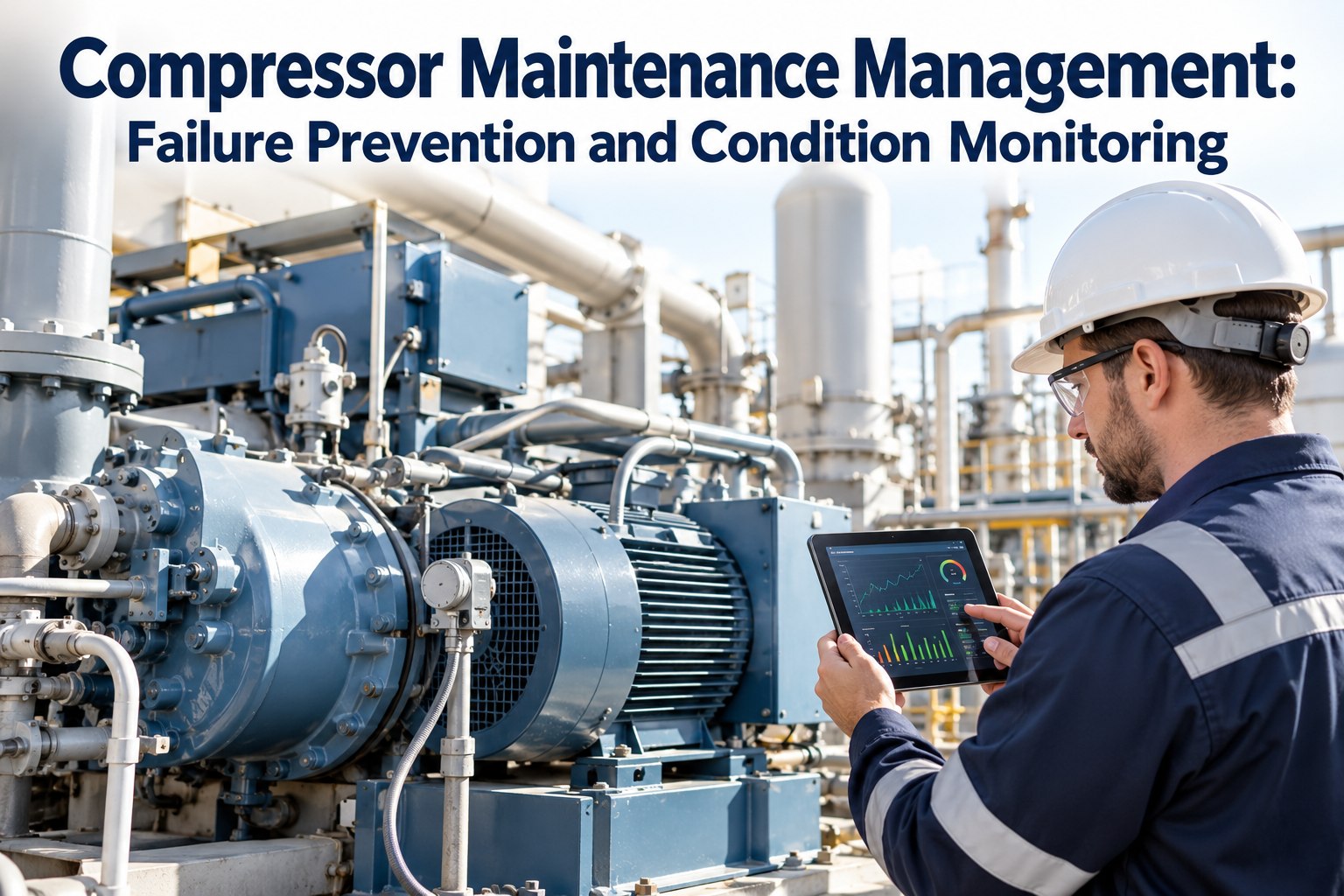
Reliability-centered maintenance in refining is the structured process of identifying how critical assets fail, what matters when they do, and which maintenance strategy — predictive, preventive, run-to-failure, or redesign — minimizes operational risk at the lowest cost. For refining operations, where a single unplanned compressor trip can halt throughput and trigger six-figure losses, RCM moves maintenance from a reactive cost center to an engineered reliability program. This guide walks through the seven classic RCM questions, failure-mode analysis, and strategy selection so your team can launch a refining RCM pilot project that cuts unplanned downtime in weeks. Ready to put it into practice? Start Free Trial with OxMaint and build your asset hierarchy today.
RCM REFINING GUIDE
Is your refining maintenance strategy engineered to prevent failures — or just reacting to them?
Top refining operations use RCM to identify critical failure modes and apply the right maintenance task before throughput drops. Move from reactive firefighting to a structured reliability program that protects availability and cuts total maintenance cost.
42%
of unplanned refining downtime is traceable to equipment failure modes that a structured RCM analysis would have identified and mitigated.
THE 7 RCM QUESTIONS
How to Build a Refining Reliability Program Using the Seven RCM Questions
A refining reliability program built on RCM principles answers seven sequential questions for every critical asset. This structured analysis reveals exactly which failure modes threaten production and which maintenance tasks actually mitigate them.
What are the functions and associated performance standards of the asset in its present operating context?
Define what the pump, compressor, or heat exchanger must do — flow rate, pressure, temperature — and at what performance level. A 60% capacity pump that should run at 100% is already failing by RCM standards.
In what ways can it fail to fulfill those functions?
List functional failures. A distillation column may fail to maintain temperature, fail to reach pressure, or fail entirely. Each failure mode demands a different mitigation path.
What causes each functional failure (failure modes)?
Identify the specific physical, chemical, or human causes — bearing wear, seal degradation, catalyst fouling, tube corrosion. OxMaint stores these in a failure-mode library linked directly to work orders.
What happens when each failure occurs (failure effects)?
Document the operational impact: production loss, safety hazard, environmental spill, secondary damage to downstream assets. This step quantifies the cost of inaction.
How much does each failure matter (failure consequences)?
Classify consequences as safety, operational, environmental, or non-operational. Failures with safety or environmental consequences demand proactive tasks regardless of cost.
What can be done to predict or prevent each failure (proactive tasks)?
Assign condition-based monitoring (vibration analysis, oil sampling), time-based PMs, or predictive maintenance. If no proactive task is technically feasible or cost-effective, the default is run-to-failure.
What must be done if a suitable proactive task cannot be found?
When no maintenance task reduces risk to an acceptable level, the answer is redesign, modification, or procedural change. RCM forces these decisions into the open with data — not guesswork.
STRATEGY SELECTION
Choosing the Best Refining Maintenance Strategy for Each Failure Mode
Not every asset deserves a predictive maintenance investment. RCM in refining matches each failure mode to the most cost-effective strategy using the P-F interval — the time between when a failure becomes detectable and when it causes functional loss.
| Strategy | Best Application in Refining | Typical P-F Interval | Relative Cost | Example Failure Mode |
|---|---|---|---|---|
| Condition-Based / Predictive | Critical rotating equipment with detectable warning signs | Weeks to months | Medium | Bearing wear on a charge pump detected via vibration |
| Time-Based PM | Age-related wear with predictable failure pattern | Fixed interval | Low-Medium | Lube oil replacement every 4,000 run-hours |
| Run-to-Failure (RTF) | Non-critical, redundant, or low-cost assets | N/A | Lowest | Instrument air filter drier with backup |
| Redesign / Modification | Recurring failures with no feasible proactive task | N/A | High (one-time) | Upgrading metallurgy on a corrosion-prone heat exchanger |
LAUNCH SEQUENCE
How to Implement an RCM Pilot Project in a Refining Plant
A refining RCM pilot project should target your top 5–10 critical assets — typically those representing 60–80% of unplanned downtime. Following a phased timeline delivers measurable results in 8–12 weeks and builds the business case for plant-wide scaling.
Asset Selection & Criticality Ranking
Rank assets by production impact, safety risk, and historical downtime. Select a pilot group — such as a FCCU wet gas compressor, primary crude charge pumps, and a key distillation column overhead system — and map their functional hierarchies in OxMaint.
FMEA & Strategy Assignment
Conduct Failure Mode and Effects Analysis on the pilot group. Document failure modes, effects, and consequences. Assign each failure mode a strategy: predictive, preventive, run-to-failure, or redesign. Load these into OxMaint as triggers and task templates.
Execute, Measure & Validate
Activate PMs and condition-based tasks. Track mean time between failures (MTBF), unplanned downtime hours, and maintenance cost per asset. Compare against the pre-pilot baseline to validate ROI and prepare the scale-out plan.
WORKED EXAMPLE
A 180-Asset Refining Unit Spending $42K/Year on Reactive Repairs
A mid-size refining unit ran 180 assets with a largely reactive maintenance approach, spending $42,000 annually on emergency labor and parts for just three recurring failure modes. After a 10-week RCM pilot targeting their top 5 critical assets, the team identified two bearing-failure modes addressable via vibration monitoring and one seal-degradation mode addressable via a condition-based PM. Post-implementation, unplanned downtime on those assets dropped 31%, and emergency repair spend fell to $26,000 — a payback period of under 4 months on the OxMaint subscription and sensor investment combined.
PLATFORM CAPABILITIES
How OxMaint Powers Your Refining Reliability Program
OxMaint is an AI-powered CMMS and EAM platform engineered for maintenance and reliability teams putting RCM into practice. From asset hierarchy to failure-mode-linked work orders, every capability maps directly to refining downtime reduction and maintenance optimization.
Asset Hierarchies That Mirror Your Plant
Build exact plant structures — from unit down to component level. Tag criticality, assign failure-mode libraries, and roll up downtime metrics automatically so RCM analysis always reflects real operating context.
Failure-Mode Libraries Linked to Work Orders
Every completed work order captures failure code, cause, and remedy. Over time, OxMaint builds a data-driven failure history that sharpens your RCM analysis and predicts which assets are trending toward failure.
PM Triggers Based on Runtime or Sensor Data
Schedule preventive maintenance on calendar time, run-hours, or condition thresholds. When a vibration sensor breaches an alert limit, OxMaint auto-generates a work order — closing the loop between detection and action.
Analytics That Prove RCM ROI
Track MTBF, MTTR, OEE, and unplanned downtime trends by asset, unit, or plant. OxMaint reports give leadership the proof points to scale RCM from a pilot project to a plant-wide reliability program.
See OxMaint on Your Refining Assets — Book a 30-Min Demo
Discover how OxMaint's AI-powered CMMS maps failure modes to work orders and cuts unplanned downtime. Walk through a live asset hierarchy, PM triggers, and RCM reporting tailored to your refining operation.
FREQUENTLY ASKED QUESTIONS
Refining RCM and Maintenance Optimization FAQs
What is reliability-centered maintenance in refining?
Reliability-centered maintenance in refining is a structured methodology that identifies how critical assets fail, the consequences of those failures, and the most cost-effective maintenance strategy to mitigate them — whether predictive, preventive, run-to-failure, or redesign. It shifts refining maintenance from reactive repair to engineered reliability, protecting throughput and safety.
How long does it take to implement an RCM pilot in a refining plant?
A focused RCM pilot project on 5–10 critical assets typically takes 8–12 weeks from asset selection through measurable results. Month one covers criticality ranking and hierarchy mapping, month two focuses on FMEA and strategy assignment, and month three executes tasks and validates downtime reduction. You can Book a Demo to see how OxMaint accelerates each phase.
What are the main RCM benefits for refining operations?
The primary RCM benefits in refining include 25–40% reduction in unplanned downtime, extended asset life, lower total maintenance cost, improved safety and environmental compliance, and a data-driven basis for capital allocation. By matching strategy to failure consequence, plants stop over-maintaining non-critical assets and focus spend where it prevents production loss.
How is RCM different from preventive maintenance in refining?
Preventive maintenance applies time-based tasks on a fixed schedule regardless of asset condition, while RCM is a decision framework that determines whether PM, predictive monitoring, run-to-failure, or redesign is the right response for each specific failure mode. RCM uses failure consequence and P-F intervals to allocate maintenance spend where it delivers the highest risk reduction.
Which refining assets should I prioritize for an RCM pilot project?
Prioritize assets with the highest combination of production impact, safety/environmental risk, and historical unplanned downtime — typically critical rotating equipment like FCCU wet gas compressors, crude charge pumps, distillation column overhead systems, and hydrogen make-up compressors. These assets usually represent 60–80% of downtime losses, making them the highest-ROI targets for RCM analysis. Start Free Trial to rank your assets by criticality in OxMaint.
Stop Reacting to Failures — Start Engineering Them Out
Launch your refining reliability program with OxMaint. Build asset hierarchies, link failure modes to work orders, and prove downtime reduction in weeks — not years.
Free 14-day trial · No credit card