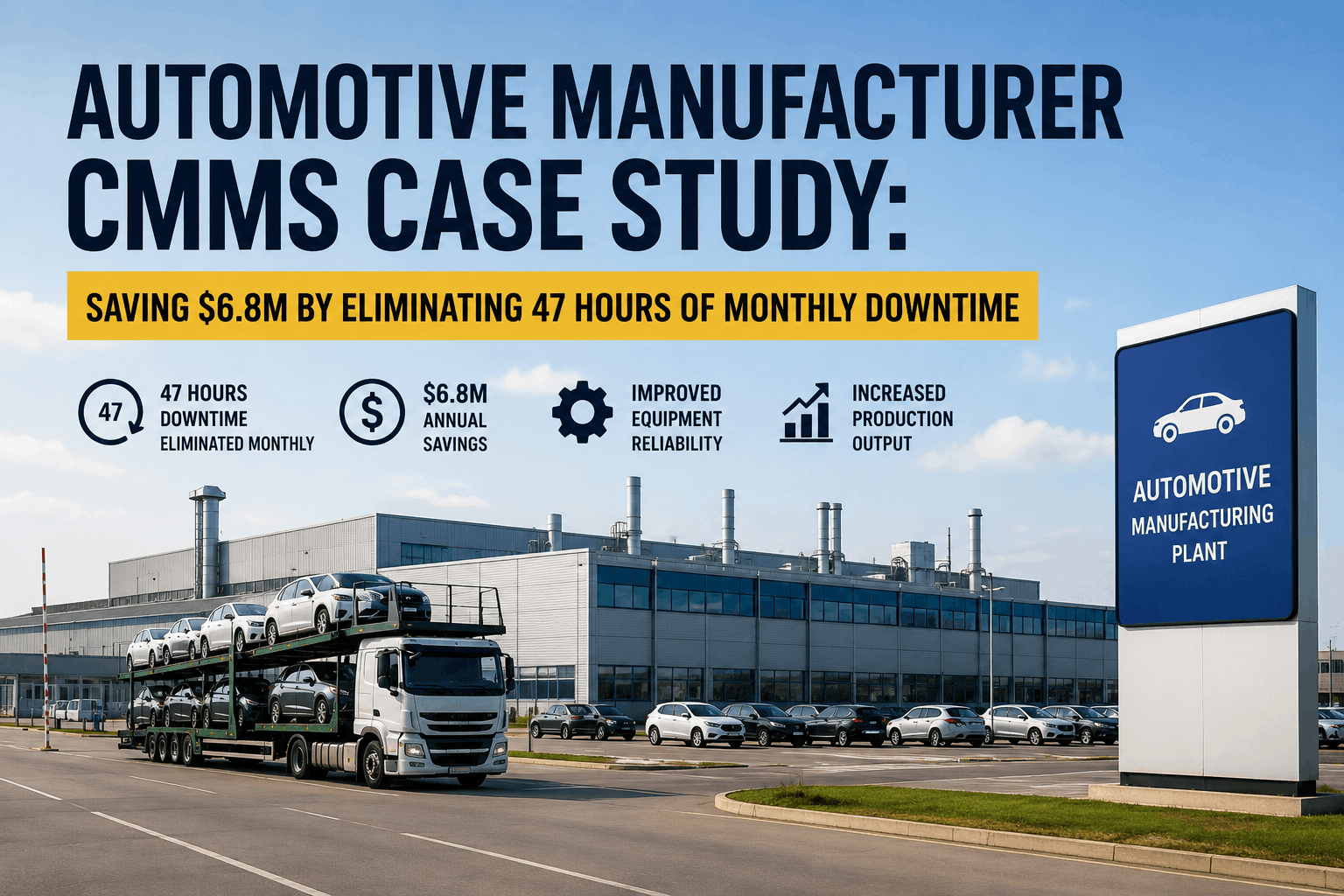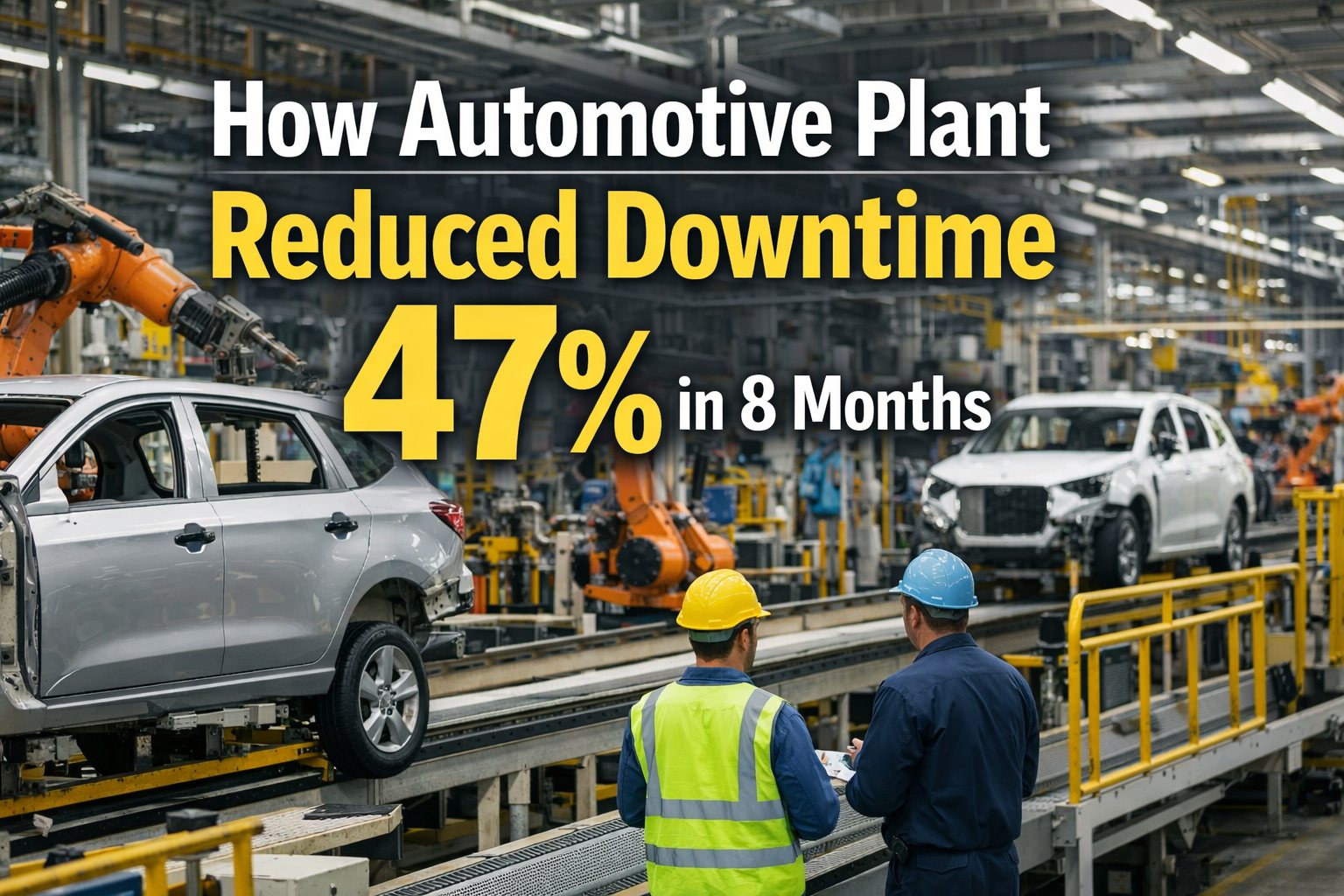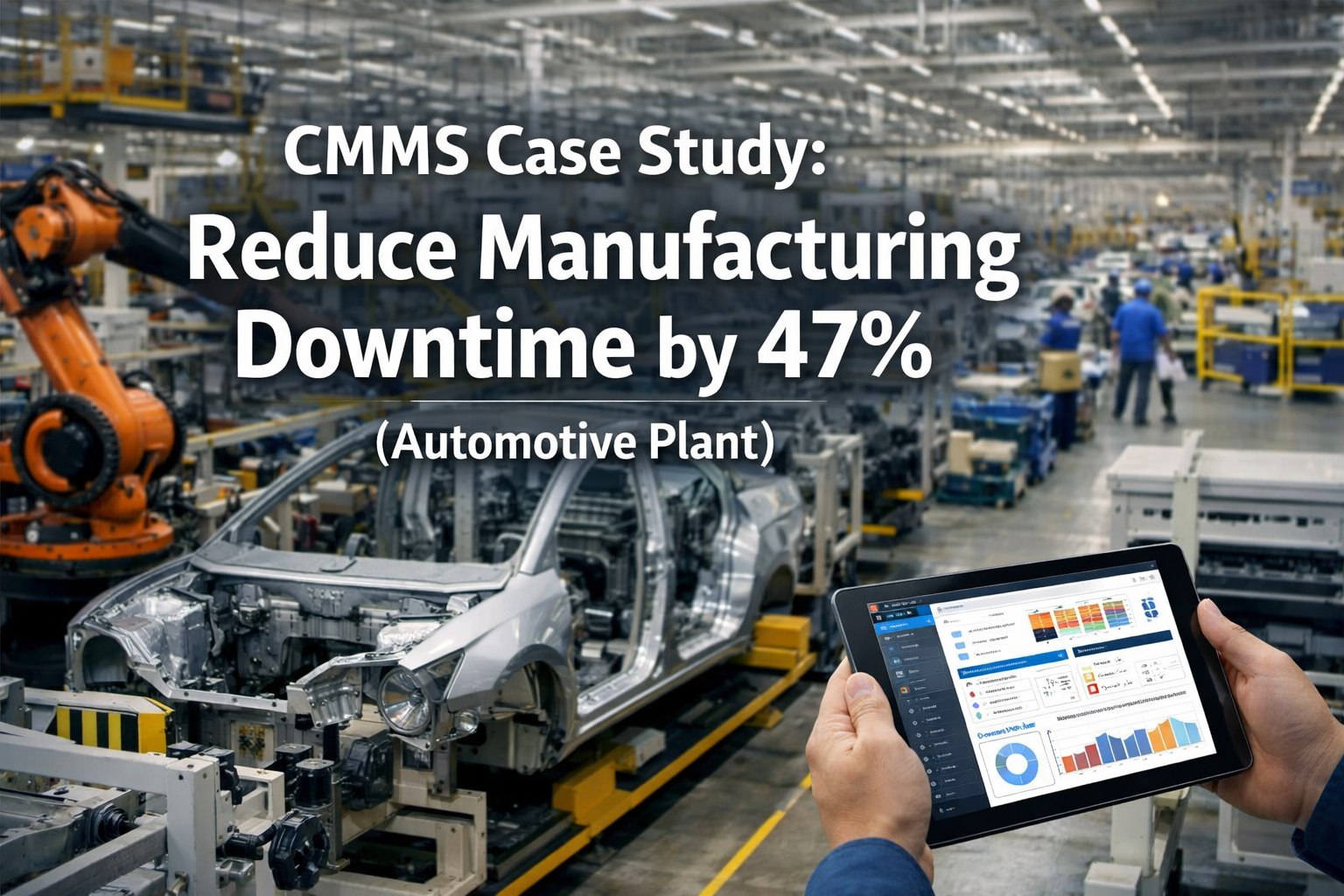
In automotive manufacturing, every minute of unplanned downtime burns through revenue at an alarming rate—with industry averages exceeding $260,000 per hour and high-volume auto plants losing up to $2.3 million per hour. This case study examines how Precision Auto Components (PAC), a Tier-1 automotive parts manufacturer operating 45 production lines across a 380,000 sq. ft. facility, slashed unplanned downtime by 47% and saved $680,000 annually using OXMaint CMMS—transforming a reactive, firefighting maintenance culture into a predictive, data-driven operation that now runs at 91% OEE.
PAC's turnaround from chronic breakdowns and missed shipments to industry-leading uptime proves that mid-market manufacturers don't need enterprise-scale budgets to achieve world-class maintenance performance—they need the right system and the discipline to use it.
Struggling With Unplanned Downtime?
See how OXMaint can cut your downtime in half. Get a personalized walkthrough with real automotive use cases—no commitment required.
The Problem: Chronic Breakdowns Crippling Production
PAC supplies brake assemblies, suspension components, and drivetrain parts to three major OEMs. With 45 active production lines running CNC machining centers, stamping presses, robotic welding cells, and automated assembly stations, even a single unplanned stoppage cascades across the supply chain—triggering OEM penalties, expedited freight costs, and lost contract confidence.
Before OXMaint, PAC's 22-person maintenance team operated almost entirely in reactive mode: fixing machines after they failed, relying on paper logs and tribal knowledge, and constantly scrambling for spare parts that may or may not be in stock.
Additional Operational Gaps
- No Asset Visibility: 1,200+ critical assets with no centralized maintenance history or condition tracking
- Spare Parts Chaos: 34% stockout rate on critical spares, turning 2-hour repairs into 2-day shutdowns
- OEM Penalty Exposure: $320,000 in late-delivery penalties over the previous 12 months
- OEE Below Target: Plant-wide OEE at 72% versus the automotive industry benchmark of 85%
- MTTR Bloat: Mean time to repair averaged 4.6 hours due to poor diagnostics and parts availability
The Solution: OXMaint CMMS Implementation
PAC selected OXMaint for its mobile-first architecture, automotive-ready PM templates, and rapid deployment timeline. The implementation was designed as a 10-week phased rollout aligned with PAC's production calendar to minimize disruption.
Weeks 1–2: Discovery & Asset Audit
Complete physical audit of 1,200+ assets across all 45 lines. Criticality ranking assigned to every machine. Failure history reconstructed from paper logs and technician interviews.
Weeks 3–4: System Configuration
PM schedules built for all critical assets aligned with OEM specs and IATF 16949 requirements. Spare parts inventory digitized with min/max thresholds and auto-reorder triggers.
Weeks 5–7: Pilot & Training
Deployed across 12 highest-downtime lines first. All 22 technicians trained on mobile work orders, inspection checklists, and photo documentation. Shift supervisors trained on dashboards.
Weeks 8–10: Full Rollout
Expanded to all 45 lines. KPI dashboards live on plant floor monitors. Weekly maintenance review meetings established using OXMaint analytics.
Core OXMaint Capabilities Deployed
The Results: 47% Downtime Reduction in 12 Months
Within the first 90 days, PAC saw measurable improvements. By month 12, the transformation was unmistakable—the plant had fundamentally shifted from a reactive operation to a proactive, data-driven maintenance culture.
Before vs. After: Full Performance Comparison
| Metric | Before OXMaint | After OXMaint | Change |
|---|---|---|---|
| Unplanned Downtime | 142 hrs/month | 75 hrs/month | -47% |
| Reactive Work Orders | 83% | 31% | -63% |
| PM Compliance | 29% | 94% | +224% |
| Mean Time to Repair | 4.6 hours | 1.7 hours | -62% |
| OEE (Plant-Wide) | 72% | 91% | +26% |
| Spare Parts Stockouts | 34% | 6% | -82% |
| OEM Late-Delivery Penalties | $320,000/yr | $41,000/yr | -87% |
| Asset Documentation | 18% | 100% | Complete |
The 47% downtime reduction alone translated to 67 additional production hours per month—equivalent to recovering nearly two full production days that were previously lost to breakdowns. Start your free trial and see results in 30 days
Where the $680K in Savings Came From
The financial impact extended far beyond reduced repair costs. Here is exactly how each dollar of savings was generated.
ROI Summary
How the Shift Happened: Reactive to Proactive
The numbers tell only half the story. The real transformation was cultural—PAC's maintenance team went from dreading the next breakdown to anticipating and preventing it. Here are the operational shifts that drove the results.
Technicians waited for machines to fail, then scrambled for parts and procedures—often relying on memory or calling senior techs at home.
OXMaint auto-generates PM work orders with step-by-step procedures, required parts pre-kitted, and photo documentation from previous repairs.
Spare parts inventory managed by memory and sticky notes. Critical parts discovered missing only when a machine was already down.
Digitized inventory with auto-reorder triggers. Parts linked directly to assets and PM tasks. Stockout rate dropped from 34% to 6%.
Plant manager reviewed maintenance through monthly spreadsheets—always looking at lagging data about problems that already happened.
Live OXMaint dashboards on plant floor screens showing real-time MTTR, PM compliance, and downtime trends. Weekly data-driven review meetings.
Key Takeaways for Manufacturing Leaders
PAC's results are not unique to large operations. OXMaint's modular architecture means manufacturers running 5 lines or 50 lines can deploy the same proven workflows with the same impact. Book a demo to see how it applies to your plant
Your Downtime Problem Has a Solution
Every month you wait costs production hours you cannot recover. See how OXMaint delivers measurable results for automotive and manufacturing plants—in a 30-minute walkthrough tailored to your operation.