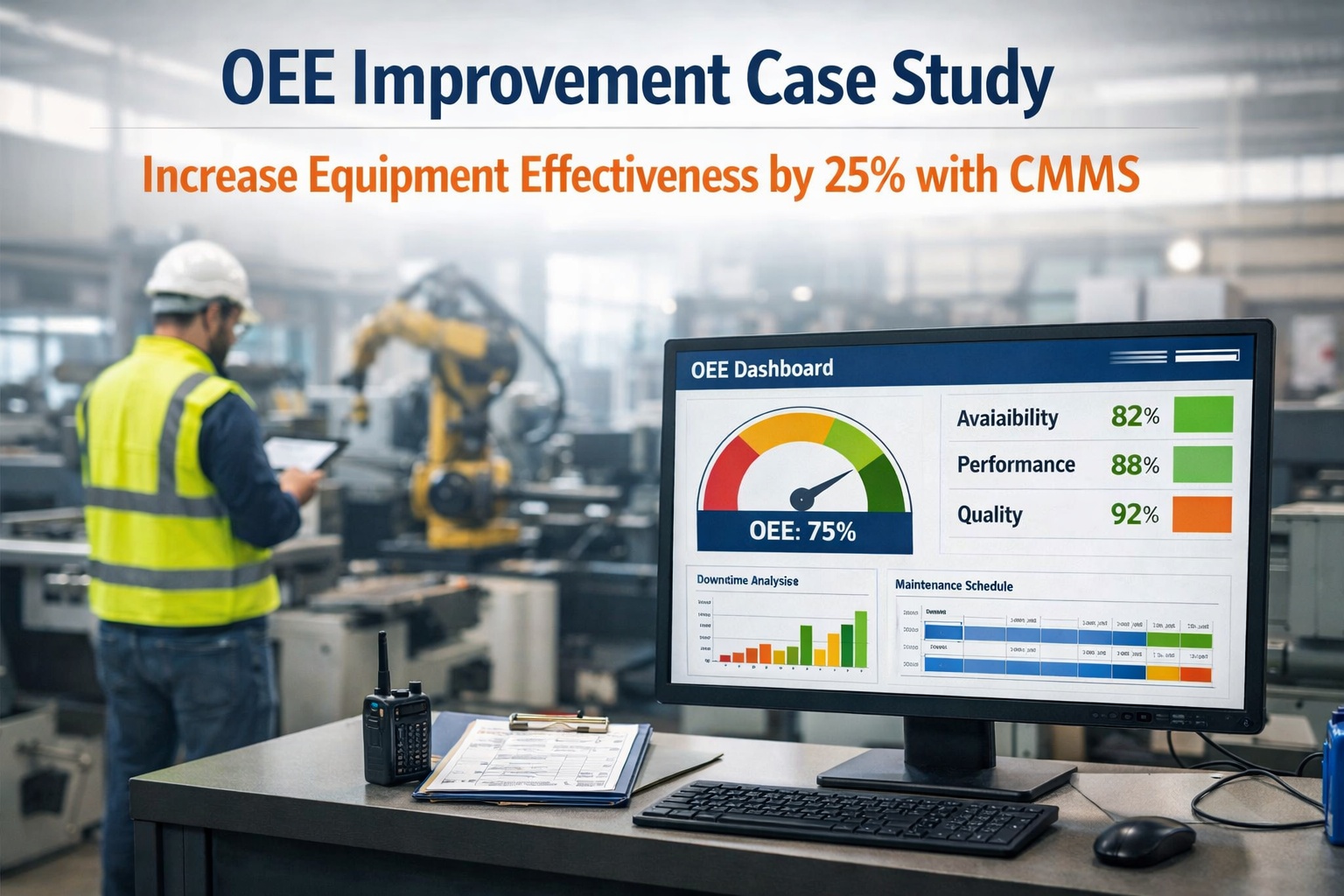
Overall Equipment Effectiveness (OEE) is the single most revealing number in manufacturing — and for Meridian Industrial Components, that number was painfully honest. Stuck at a 58% OEE score for three consecutive years despite multiple improvement initiatives, leadership faced a choice: spend $2.4M on new equipment to chase capacity, or fix the invisible losses already hiding inside their current machines. This case study documents how Meridian chose the second path, deployed OXMaint CMMS with real-time OEE dashboards, and increased plant-wide OEE by 25 percentage points — from 58% to 83% — in just 11 months, without a single dollar of capital expenditure.
For any manufacturer still running on spreadsheets and gut instinct, Meridian's journey is proof that hidden capacity is real, measurable, and recoverable — if you have a system that can see it.
What's Your Real OEE Right Now?
Most plants operate 15–25 OEE points below their actual potential — and they cannot see it. See exactly how OXMaint surfaces hidden capacity in your operation.
The Company: Meridian Industrial Components
Meridian is a mid-market manufacturer of precision-machined hydraulic valves, actuators, and fluid-power components serving construction, agriculture, and aerospace OEMs. The plant runs 14 CNC machining cells, 6 assembly lines, 4 pressure-testing stations, and 3 coating lines — all producing to tight tolerance specs across three shifts.
Despite a skilled workforce and well-maintained machines, quarterly capacity planning meetings always ended the same way: "we need more equipment." But the real problem wasn't capacity. It was visibility.
Understanding the Problem: A 58% OEE Meant 42% Hidden Waste
The world-class OEE benchmark is 85% — built from 90% Availability, 95% Performance, and 99.9% Quality. At 58%, Meridian was producing at just over half of its theoretical capacity. Here is how that broke down.
The Six Big Losses Driving the Gap
Every OEE point lost falls into one of six categories first defined by Total Productive Maintenance. At Meridian, a root-cause audit revealed exactly where the 42% was hiding.
Why Previous Improvement Efforts Had Failed
- Lagging Data, Not Leading Indicators: OEE was calculated monthly in spreadsheets — by the time losses were visible, the month was already lost
- Micro-Stops Invisible: Pauses under 5 minutes went unlogged on manual systems, yet consumed more production time than major breakdowns
- Maintenance Disconnected From Production: Maintenance KPIs (MTTR, PM compliance) and production KPIs (OEE, throughput) lived in separate systems with no cross-visibility
- No Root Cause Accountability: When a line went down, nobody tracked why — the same failure modes kept recurring quarter after quarter
- Improvement Was a Project, Not a Habit: Kaizen events produced gains that faded within 3 months because there was no system reinforcing the new behavior
The OXMaint Approach: Three Layers of OEE Recovery
Meridian's CMMS-led OEE program was built around a simple principle articulated by their maintenance director: "You cannot improve what you cannot see, and you cannot sustain what you cannot automate." The platform was deployed in three layered capabilities, each targeting a specific loss category.
Live OEE displays mounted on every production line showing Availability, Performance, and Quality broken out by asset, shift, and product — updated every 30 seconds. For the first time, operators and supervisors saw losses as they happened.
Condition-based triggers tied to runtime hours, cycle counts, vibration patterns, and historical failure signatures. When any parameter trended toward known failure modes, OXMaint automatically generated a work order before the machine stopped producing.
PM schedules aligned with production calendars to eliminate the forced-choice between running machines and maintaining them. Planned downtime moved to changeover windows and shift handovers, reducing lost production time to near zero.
The 11-Month Transformation Curve
OEE improvement does not happen overnight — but it does happen in predictable waves. Meridian tracked plant-wide OEE weekly from day one of deployment. Here is the actual climb.
Results: 25-Point OEE Jump Without Capex
Full Performance Dashboard
| Metric | Baseline | Month 11 | Improvement |
|---|---|---|---|
| Overall OEE | 58% | 83% | +25 points |
| Unplanned Downtime | 186 hrs/mo | 62 hrs/mo | -67% |
| Mean Time Between Failures | 112 hrs | 384 hrs | +243% |
| Mean Time To Repair | 5.8 hrs | 2.1 hrs | -64% |
| PM Compliance | 42% | 96% | +129% |
| Scrap & Rework Rate | 4.0% | 2.0% | -50% |
| Effective Production Capacity | Baseline | +43% | Equivalent to 6 new cells |
| Capital Expenditure | $2.4M planned | $0 spent | Deferred indefinitely |
The 25-point OEE jump unlocked the equivalent of six additional CNC cells of effective capacity — without adding a single new machine, square foot, or operator. Start your free trial and begin measuring real OEE
The Financial Impact
OEE is ultimately a proxy for financial performance. Meridian's 25-point gain translated into revenue, cost, and capital outcomes that reshaped the plant's P&L.
Investment & ROI
What Made It Work: The 4 Critical Success Factors
The Takeaway for Every Manufacturing Leader
The average unoptimized factory runs at 60% OEE. The world-class benchmark is 85%. That 25-point gap is not a mystery — it is a measurement problem. Meridian didn't buy smarter machines; they bought a system that finally told the truth about the machines they already owned. In 11 months, hidden capacity became visible capacity, visible capacity became recovered capacity, and recovered capacity became revenue.
Every plant has this same hidden capacity sitting inside it right now. The only question is whether you are measuring it — or missing it. Schedule a walkthrough to see your potential
Unlock the Hidden Capacity in Your Plant
A 30-minute walkthrough will show you exactly how OXMaint surfaces the OEE losses you cannot currently see — with real examples from plants like yours.