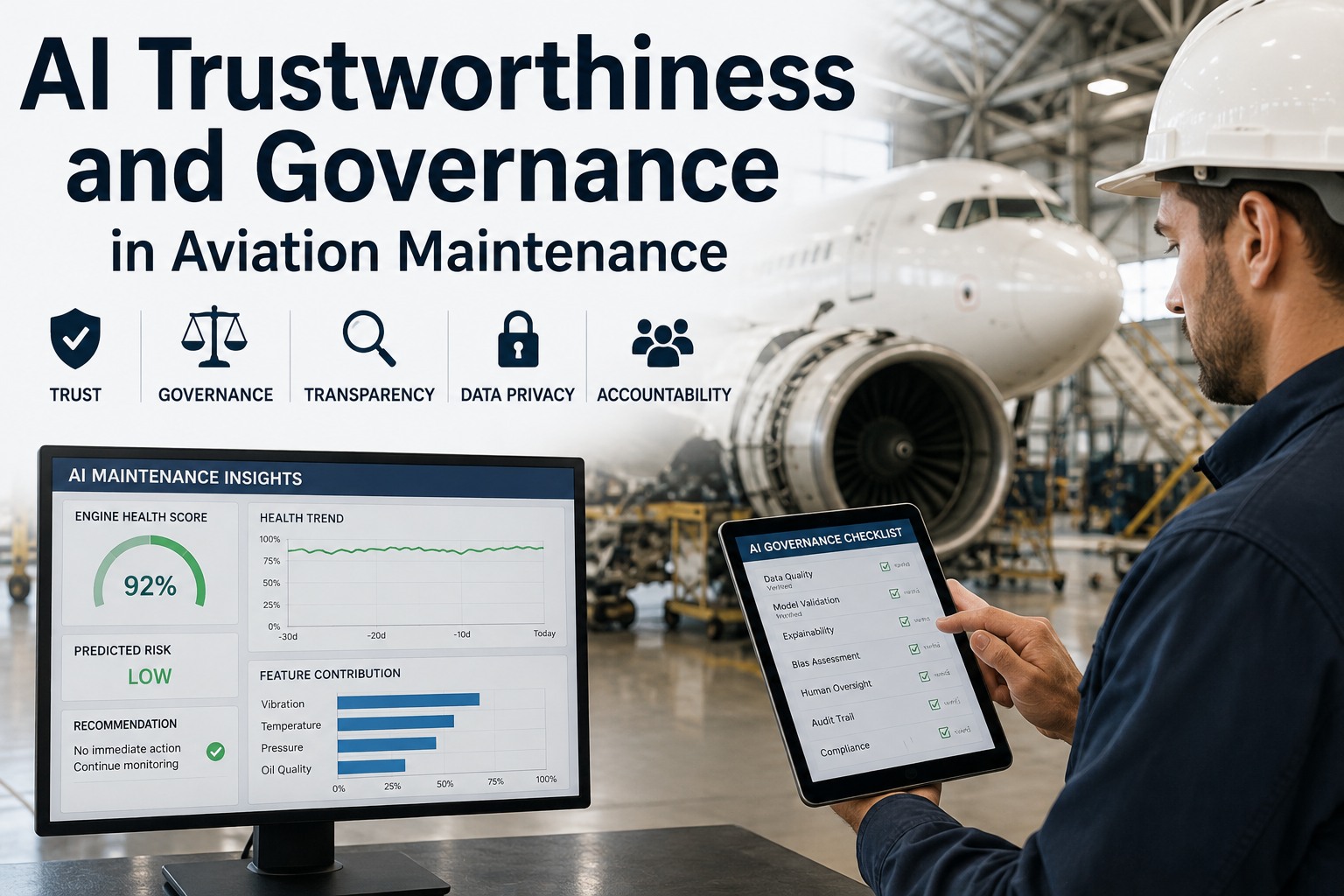
AI trustworthiness and governance in aviation maintenance is the discipline of ensuring that machine-learning systems used in MRO and airworthiness decisions remain accurate, explainable, accountable, and firmly under human authority — because an AI that maximizes throughput can quietly sideline the human judgment that keeps aircraft safe. As predictive maintenance, computer-vision inspections, and AI-assisted work-order triage spread across hangars and line stations, regulators, SMS managers, and certifying technicians all need defensible reasons to trust every AI output. This guide breaks down the five pillars of trustworthy aviation AI — model validation, human override tracking, explainability, bias monitoring, and SMS alignment — and shows how to operationalize them before auditors or investigators ask. If you want AI that strengthens safety-critical decisions instead of replacing them, Start Free Trial with OxMaint and see governed AI maintenance in action.
Who is accountable when the AI gets it wrong?
If your AI flags a component as serviceable and it fails in flight, "the model said so" is not a defense. Trustworthy AI in aviation maintenance means every recommendation is validated, explainable, and overridable — with a documented human in the loop. Here is the governance framework that makes that possible.
Why AI trustworthiness in aviation maintenance is a safety issue, not an IT issue
A single uncontained engine failure can cost $5M–$50M in damages, liability, and grounded fleet time — and aviation regulators are increasingly asking how AI contributed to the maintenance decision chain. Unlike e-commerce or logistics AI, aviation maintenance AI operates inside a Safety Management System (SMS) where every action must be justified, recorded, and auditable under frameworks like ICAO Annex 19, FAA Part 121/135 SMS rules, and EASA's AI Roadmap.
Throughput bias is real
AI optimized purely for turnaround time or cost will learn to defer borderline findings. Without governance, the model drifts toward "dispatch now, inspect later" — the exact failure mode SMS exists to prevent.
Regulators are catching up fast
EASA's AI Roadmap 2.0 and FAA guidance on machine learning expect documented assurance cases for AI in safety-related functions. "We trust the vendor" will not survive an audit in 2025 and beyond.
Technicians must stay the authority
Certifying staff sign for airworthiness. If AI recommendations quietly become the de facto decision, you have automation bias — the human stamps what the machine suggests without independent judgment.
The 5 pillars of AI governance in aviation maintenance
Governance is not a one-time model check — it is a continuous loop. These five pillars map directly to SMS principles (hazard identification, risk assessment, assurance, promotion) and give safety managers a concrete structure for AI oversight.
Model validation before deployment
Every AI model must be validated against held-out historical data and, ideally, a shadow-mode trial of 60–90 days where it runs alongside human decisions without influencing them. Target: sensitivity above 95% for safety-critical fault detection, with false-negative rates documented per failure mode. A model that misses 1 in 20 crack indications is not deployable, no matter how fast it is.
Human override tracking
Log every instance where a technician accepts, modifies, or rejects an AI recommendation — with reason codes. Override rates are a health metric: 0% overrides suggests blind trust (automation bias); 40%+ suggests the model is not fit for the task. Healthy governed systems typically see 5–15% overrides with documented rationale.
Explainability for every output
A technician must be able to answer "why does the AI think this bearing will fail?" in plain language: which sensor trends, which historical patterns, which thresholds were crossed. Black-box scores without contributing factors fail both the SMS assurance function and the human-factors requirement that certifying staff make informed decisions.
Bias and drift monitoring
Models trained on one fleet, climate, or utilization profile degrade on another. Monitor performance quarterly per aircraft type, station, and component population. If prediction accuracy drops more than 5 percentage points on any segment — or the model systematically under-flags older airframes — trigger revalidation before continued use.
SMS and regulatory alignment
Treat AI as a change to the maintenance system: run it through your Management of Change process, add AI-specific hazards to the hazard register, and define accountability in writing — who owns the model, who approves updates, who can suspend it. This is the paper trail EASA, FAA, and your QA auditors will ask for first.
What trustworthy AI aviation maintenance looks like in practice
The difference between governed and ungoverned AI is not the algorithm — it is the operating discipline around it. Here is the side-by-side that auditors and safety managers care about.
| Governance Dimension | Ungoverned AI | Trustworthy, Governed AI |
|---|---|---|
| Deployment | Vendor model switched on; no local validation | 60–90 day shadow-mode validation on your fleet data before go-live |
| Human authority | AI output treated as the decision; rubber-stamp signoffs | AI advises; certifying staff decide; every override logged with reason codes |
| Explainability | "Risk score: 87" with no contributing factors | "Vibration +38% vs. baseline, matching 3 prior bearing failures on this fleet" |
| Monitoring | Set-and-forget; accuracy silently degrades | Quarterly drift and bias reports per fleet, station, and component type |
| Accountability | "The AI said so" — no named owner | Named model owner, documented MOC, AI hazards in the SMS register |
| Audit readiness | Days of scrambling to reconstruct decisions | Every AI-influenced work order traceable in under 5 minutes |
A regional MRO learns the cost of ungoverned AI the hard way
Consider a composite scenario drawn from common industry patterns: a 40-aircraft regional MRO deploys an AI tool to prioritize its work-order backlog, tuned to maximize hangar throughput.
Without governance
- AI deprioritizes "low-confidence" NDT re-checks to clear the queue faster
- Override tracking absent — technicians accept 97% of AI rankings blindly
- A deferred crack indication resurfaces as an in-service finding 4 months later
- Result: 1 aircraft grounded 9 days, $310K in AOG costs, and a regulator finding that the AI process had no documented human oversight
With the 5-pillar framework
- Model validated in shadow mode for 90 days; safety-critical deferrals hard-blocked
- Override dashboard shows 11% technician overrides — healthy scrutiny, all logged
- Every AI priority score shows its top 3 contributing factors on the work order
- Result: 22% faster backlog clearance, zero deferred safety findings, and a clean SMS audit with full AI traceability
The lesson: governance did not slow the AI down — it made the speed defensible. The governed deployment captured the efficiency gains while keeping certifying staff, and the SMS, in command.
How OxMaint builds AI governance into every maintenance workflow
OxMaint is an AI-powered CMMS + EAM platform designed so that AI assists — never replaces — your certifying staff. Governance is not a bolt-on; it is how the platform works out of the box.
Explainable predictive maintenance
Every AI failure prediction ships with contributing factors — sensor trends, historical matches, threshold breaches — so technicians see the "why," not just a score. Outcome: informed human decisions and up to 30–50% less unplanned downtime without blind trust.
Full audit trail on every work order
AI recommendations, technician accept/reject actions, and override reasons are logged automatically against each asset and work order. Outcome: reconstruct any AI-influenced decision in under 5 minutes during an SMS or regulatory audit.
Human-in-the-loop work order triage
AI prioritizes your backlog by risk and criticality, but safety-critical categories require explicit human sign-off before deferral. Outcome: throughput gains of 20%+ with hard guardrails that keep airworthiness decisions with certifying staff.
Asset-level analytics for drift and bias checks
Segment prediction performance by fleet, station, and component type from one dashboard, so your quarterly governance reviews take hours, not weeks. Outcome: catch model drift before it catches you — with documented evidence for your assurance case.
Book a 30-minute demo — we will walk your safety team through governed AI, live
Bring your toughest governance questions. We will show you explainable predictions, override tracking, and audit-ready trails on real maintenance workflows.
AI trustworthiness and governance in aviation maintenance: FAQs
What is AI trustworthiness in aviation maintenance?
It is the property that an AI system's outputs are accurate, explainable, unbiased, and accountable enough to support safety-critical maintenance decisions. In practice it means validated models, visible reasoning, logged human overrides, and a named owner — not just a high accuracy percentage on a vendor slide.
How do regulators view AI in aircraft maintenance today?
EASA's AI Roadmap and FAA machine-learning guidance treat AI in safety-related functions as requiring a documented assurance case, human oversight, and change control. Expect auditors to ask who approved the model, how it was validated on your fleet, and how technicians can override it.
What is a healthy human override rate for maintenance AI?
Typically 5–15% with documented reason codes. A 0% override rate usually signals automation bias — technicians rubber-stamping AI output — while rates above 40% suggest the model is not fit for the task. OxMaint logs every override automatically; Book a Demo to see the override dashboard.
How does AI governance fit into an existing SMS?
Treat AI deployment as a Management of Change: add AI-specific hazards (automation bias, model drift, data bias) to your hazard register, define accountabilities in writing, and fold model performance reviews into your safety assurance cycle. Governance becomes an SMS input, not a separate IT process.
Can a small MRO implement AI governance without a data science team?
Yes — the key is choosing platforms with governance built in: explainable outputs, automatic audit trails, and per-fleet analytics. With OxMaint, a safety manager can run validation reviews and override monitoring from dashboards, with no coding or ML expertise required.
Deploy AI your technicians, auditors, and regulators can trust
OxMaint gives you predictive maintenance with explainability, human-in-the-loop control, and audit-ready traceability — so AI speeds up your hangar without ever outranking your certifying staff.
Free 14-day trial · No credit card · Set up in days, not months