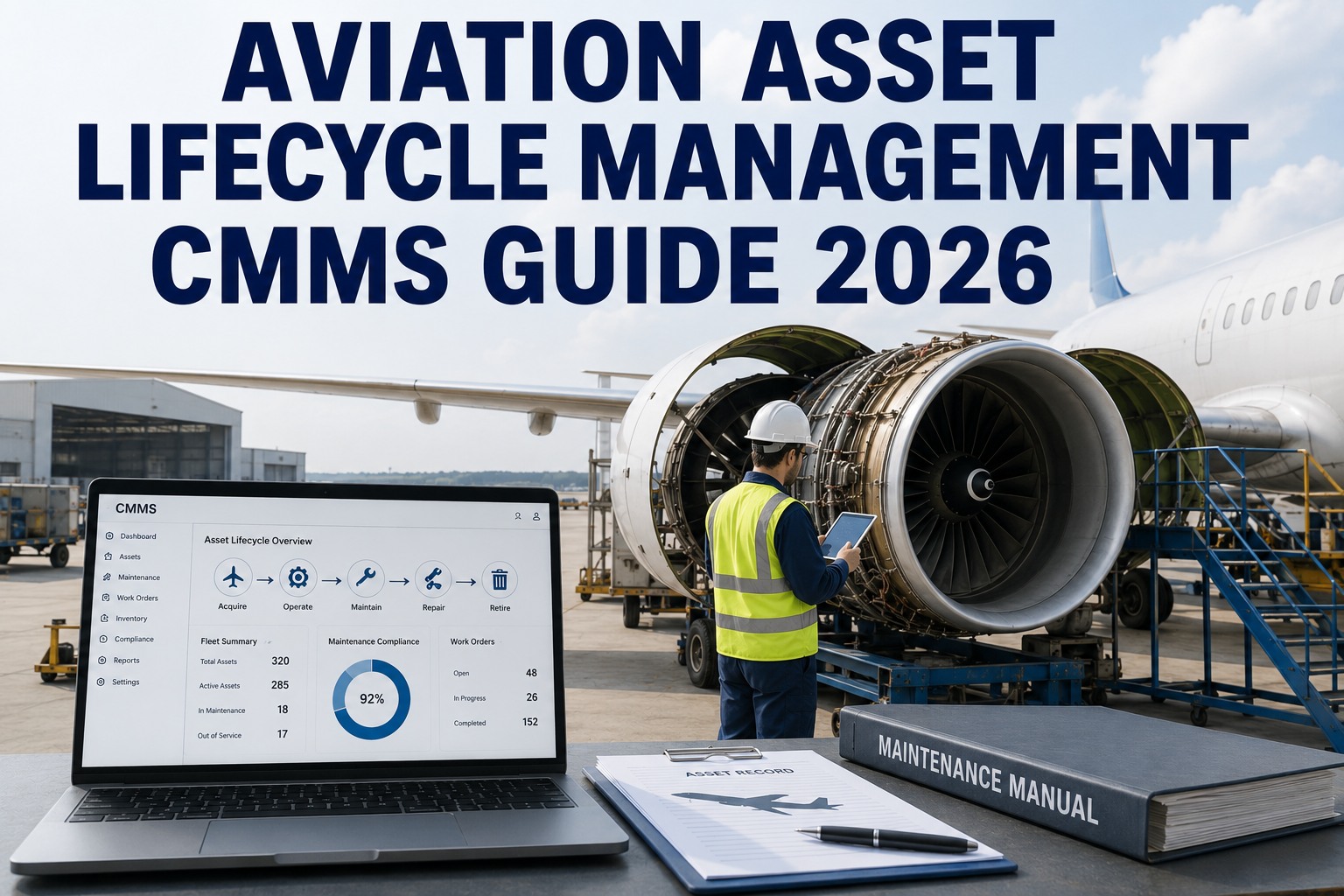
Maintenance costs consume 15–18% of every airline's total operating expenses. A single Aircraft-on-Ground event bleeds $10,000–$150,000 per hour. The global aviation asset management market hit $213.77 billion in 2025 and is accelerating toward $319 billion by 2030—because the industry has learned, painfully, that managing aircraft, airport infrastructure, and ground equipment with spreadsheets and paper isn't sustainable. With 46% of the world's commercial fleet now leased, a 17,000-aircraft delivery backlog stretching over a decade, and the FAA projecting 30% maintenance cost reductions through data analytics alone, the organizations that connect their operations, assets, and compliance into one system aren't just more efficient—they're the only ones keeping pace. This is the operational playbook for aviation professionals ready to stop reacting and start managing.
The numbers driving operational decisions for airlines, airports, and MROs this year
$213.7B
Aviation Asset Mgmt Market
Growing at 8.39% CAGR → $319B by 2030
15–18%
Airline OpEx on Maintenance
The largest controllable cost for every carrier
46%
Global Fleet Now Leased
Up from 40% in 2019—lifecycle records are contractually mandatory
17,000+
Aircraft Delivery Backlog
Over a decade of deliveries—existing fleets must last longer
33%
Operators Still on Spreadsheets
Small-fleet operators managing compliance with manual tools
30%
Projected Cost Reduction
FAA estimate through advanced data analytics by 2033
These numbers converge on one truth: aviation organizations that connect asset tracking, maintenance execution, and compliance documentation in a single digital platform outperform those that don't—in cost control, in audit outcomes, and in operational reliability. Teams ready to make that connection can sign up for centralized aviation asset and maintenance management built for the scale and complexity of modern aviation operations.
The Asset Lifecycle: Where Millions Are Won or Lost
Every aviation asset—a $150 million aircraft, a $30 million engine, a $2 million boarding bridge, a runway lighting array—passes through a lifecycle where the quality of data at each stage determines total cost of ownership. Organizations managing these stages with disconnected tools lose visibility at the transitions, and that's where the most expensive mistakes accumulate: deferred maintenance that compounds into major failures, compliance gaps that surface mid-audit, and replacement decisions driven by intuition instead of evidence.
Aviation Asset Lifecycle: 5 Stages of Value Management
CMMS data reveals failure patterns and true lifecycle costs for evidence-based decisions
Retire
Decommissioning, salvage value capture, records archival, parts reclamation
CMMS provides complete history that protects asset value at lease return or sale
With 46% of the global fleet now leased, incomplete lifecycle records don't just create operational risk—they trigger lease-return penalty clauses that cost millions. Accurate digital records from commissioning through retirement are no longer best practice; they're a contractual requirement. Aviation teams building this discipline today can book a demo to see lifecycle asset tracking in action across aircraft, airport infrastructure, and ground support equipment.
Airport & Facility Operations: The 24/7 Maintenance Challenge
Aviation asset management extends far beyond aircraft. Airports are among the most complex facilities on earth—environments that never pause, where runways, terminals, boarding bridges, baggage systems, lighting arrays, and ground support equipment must all perform simultaneously. The FAA targets 93% of NPIAS runway pavements in excellent, good, or fair condition. Poor terminal maintenance causes cascading delays across airline schedules. Yet airport facility management often runs on the same fragmented, reactive systems that the airline sector has been scrambling to replace.
Airport Operations: Two Worlds, One Maintenance System
Airside
Runways & Taxiways
Pavement inspections, crack repairs, FOD management, marking maintenance
Airfield Lighting
Center-line, threshold, guard, and taxi lights—bulb replacement, wiring, controls
Nav Aids & Weather Systems
ILS, VASI, windsock, and AWOS equipment calibration and servicing
Ground Support Equipment
Baggage tractors, fuel trucks, de-icers, pushback tugs—certification and PM
Terminal
HVAC & MEP Systems
Climate control, air handling, plumbing, fire suppression across terminals
Every asset category has its own inspection cadence, compliance requirements, and failure consequences. One CMMS manages them all.
When a boarding bridge fails during peak operations, the gate goes offline and flights cascade. When runway lighting maintenance gets deferred, FAA Part 139 certification is at risk. These aren't theoretical problems—they're the daily reality of airport facility management. The solution is the same one that airlines and MROs are adopting: centralized digital tracking that ensures no inspection is missed and no finding goes unresolved. Airport operations teams navigating this complexity can sign up for multi-asset airport maintenance management that tracks airside and terminal operations from one platform.
Work Order to Resolution: The Workflow That Drives Reliability
Operational reliability in aviation isn't built by heroic technicians making emergency repairs. It's built by consistent, repeatable work order workflows where every maintenance action is requested, prioritized, assigned, executed, documented, and verified—every time, for every asset. The organizations with the highest uptime and fewest audit findings have one thing in common: their work order process is a closed loop with no gaps for things to fall through.
The Aviation Work Order Lifecycle
From request to verified resolution—every step tracked and time-stamped
01
Request or Trigger
Inspection finding, PM schedule, sensor alert, or staff report initiates the work order
02
Prioritize & Assign
Criticality assessment, technician assignment based on skills and availability, parts staged
03
Execute & Document
Technician completes work, logs labor hours, parts used, conditions found, and actions taken
04
Review & Close
Supervisor verifies completion, confirms resolution quality, closes work order with full audit trail
Without a CMMS
Requests lost in email. No priority system. Work completed but undocumented. Findings unlinked to resolutions. Auditors find gaps the team thought were closed.
With a CMMS
Every request logged, prioritized, assigned, executed, and verified in one system. Complete chain from trigger to resolution. Instant audit-ready history for any asset.
This closed-loop workflow is what separates organizations that pass audits consistently from those that scramble before every inspection. When an FAA inspector asks to see the maintenance history for Runway 27L's center-line lighting over the past 18 months, the answer should take seconds, not hours. Teams that need that level of operational readiness can book a demo to see aviation work order workflows in action across multiple asset types and locations.
Stop Losing Revenue to Preventable Failures
See how aviation teams use OXmaint to automate PM schedules, close work order loops, build compliance-ready audit trails, and manage every asset from acquisition through retirement.
Matching Maintenance Strategy to Asset Criticality
Not every aviation asset needs predictive analytics. But every aviation asset needs structured tracking. The smartest organizations match their maintenance strategy to each asset's criticality, failure consequence, and data availability—applying the right level of sophistication where it generates the most return, while ensuring even low-criticality assets have basic preventive coverage.
Maintenance Strategy Selection Guide
Strategy
Approach
Best For
CMMS Requirement
Reactive
Fix when broken
Non-critical, low-cost terminal fixtures
Asset registry + failure logging
Preventive
Time or cycle-based PM
Lighting, HVAC, GSE, boarding bridges
Automated scheduling + work orders
Condition-Based
Monitor, maintain when indicated
Engines, APUs, conveyors, critical MEP
Sensor integration + threshold alerts
Predictive
AI forecasts failures before they occur
High-value fleet assets, landing gear, engines
Historical data + analytics platform
Every strategy beyond reactive depends on structured data capture. You can't predict what you haven't tracked.
The critical path: predictive maintenance requires historical failure data that only exists if you've been capturing it consistently in a digital system. Organizations that start with a CMMS and build disciplined preventive programs today are the ones that will have the data foundation for AI-driven optimization tomorrow. Aviation teams ready to build that foundation can start a free trial to digitize work orders and asset tracking and begin generating the structured records that advanced strategies require.
Expert Perspective: Operational Discipline Wins Over Advanced Technology
After twenty years in aviation MRO and airport operations, I can tell you the organizations with the fewest audit findings and the lowest AOG rates aren't the ones with the flashiest technology. They're the ones where every asset has a complete, searchable maintenance history. Where every inspection finding links to a corrective work order, and every work order links to a verified resolution. The real competitive advantage in 2026 isn't AI—it's operational discipline amplified by a CMMS that makes consistency automatic. AI becomes powerful later, but only if you've been capturing clean, structured data from day one.
Every aviation asset—aircraft, engine, GSE, terminal system—should have a single digital record from acquisition through retirement
68% of U.S. enterprises increased CMMS budgets in 2025—organizations not investing now are falling behind an industry-wide shift
Compliance isn't a pre-audit scramble—it's a continuous state that only automated, connected documentation makes sustainable
Your Aviation Operations Action Plan
Aviation operations and asset management in 2026 come down to connected data. When asset records, work order histories, inspection findings, compliance documentation, and PM schedules live in one system, every decision gets faster and every risk gets visible earlier. When they're scattered across spreadsheets, paper logs, and email threads, every decision carries hidden risk—and that risk compounds with every AOG event, failed audit, and deferred maintenance item your current tools fail to catch. The aircraft backlog means existing fleets must last longer. Workforce shortages mean fewer people must manage more. Expanding SMS mandates mean more documentation, not less. The organizations thriving under these pressures are the ones that invested in the digital foundation first. That foundation is available today.
Build Your Connected Aviation Operations Foundation
Join aviation teams using OXmaint to manage assets across their full lifecycle, automate work orders and inspections, and build the compliance-ready documentation that keeps operations moving and regulators satisfied.
What is aviation asset management and why does it matter in 2026?
Aviation asset management is the systematic oversight of aviation assets—aircraft, engines, airport infrastructure, ground support equipment, and components—across their full lifecycle from acquisition through retirement. It matters critically in 2026 because the market has grown to $213.77 billion driven by several converging factors: a 17,000+ aircraft delivery backlog meaning existing fleets must operate longer, 46% of the global commercial fleet now being leased (requiring comprehensive lifecycle documentation for contractual compliance), and the FAA projecting 30% maintenance cost reductions through data analytics. Effective asset management connects procurement, operations, maintenance, compliance, and retirement decisions through a centralized digital platform rather than managing them in disconnected spreadsheets and paper systems.
How does a CMMS improve aviation maintenance operations?
A CMMS improves aviation maintenance operations across four areas. For work order management, it creates a closed-loop process from request through verified resolution—eliminating lost requests, undocumented work, and orphaned findings. For preventive maintenance, it automates scheduling based on time, cycles, or calendar intervals so inspections and servicing happen regardless of staff availability. For compliance, it builds searchable audit trails linking every inspection to its findings, every finding to its corrective action, and every action to its verified resolution. For asset tracking, it maintains a complete digital record from commissioning through retirement that protects asset value during lease returns and regulatory audits. Organizations using CMMS report 25–40% maintenance efficiency improvements and significant reductions in unplanned downtime.
What assets need tracking in airport operations management?
Airport operations management requires tracking two broad categories. Airside assets include runways, taxiways, and apron pavements (inspection, crack repair, marking maintenance), airfield lighting systems (center-line, threshold, guard, and taxi lights), navigational aids and weather equipment, and ground support equipment like baggage tractors, fuel trucks, and de-icing units. Terminal assets include HVAC and mechanical/electrical/plumbing systems, boarding bridges and jet bridges, baggage handling conveyors and sortation systems, elevators, escalators, and moving walkways, fire suppression and emergency systems, and security screening equipment. Each category has distinct inspection schedules, compliance requirements, and failure consequences—making centralized CMMS tracking essential for complete coverage without gaps.
Which maintenance strategy should aviation organizations use for different assets?
Aviation organizations should match strategy to asset criticality. Reactive maintenance (run to failure) is appropriate only for non-critical, low-cost items where failure has zero safety or operational impact. Preventive maintenance (time or cycle-based scheduling) should cover the majority of aviation assets—airfield lighting, HVAC systems, GSE, boarding bridges, and terminal equipment. Condition-based maintenance works best for critical equipment with measurable degradation indicators, such as engines, APUs, conveyor systems, and major MEP equipment. Predictive maintenance using AI and historical data delivers the highest ROI on high-value fleet assets like engines, landing gear, and critical infrastructure. The key principle: every strategy beyond reactive requires structured digital data capture through a CMMS. You can't predict failures without historical records to learn from.
What compliance requirements affect aviation operations and asset management in 2026?
Aviation operations face converging compliance requirements in 2026. The FAA's expanded SMS final rule now requires Safety Management Systems for Part 121, Part 135, Part 91.147, and Part 21 operators with documented safety policies, hazard identification, and risk management programs. ICAO's Annex 19 Amendment 2 becomes applicable November 2026 with broadened safety management standards. EASA mandated SMS for Part 21 and Part 145 organizations starting March 2025. For airports specifically, FAA Part 139 certification demands documented self-inspection programs, maintenance records, and emergency plans. EU RefuelEU SAF mandates and emissions trading compliance add sustainability documentation. Managing these requirements manually is increasingly impractical—CMMS platforms create the automated, continuous documentation trail these regulations demand.