Across Europe, aviation regulators are no longer asking whether AI will play a role in maintenance operations — they are defining exactly how it must. The European Union Aviation Safety Agency (EASA) has published a dedicated AI Trustworthiness Roadmap, and the EU AI Act has classified several aviation AI applications as high-risk systems requiring formal compliance before deployment. For MROs, airlines, and facility operators, this is not a distant regulatory exercise. It is active compliance terrain, with audit exposure beginning now. Oxmaint's EU Compliance Module is built to close the documentation, traceability, and audit-readiness gaps that EASA's framework demands — start a free trial to see how it maps to your operation, or book a demo and we'll walk through your specific compliance obligations together.
2026
EU AI Act enforcement year for high-risk systems in aviation
40%
of aviation AI applications classified as high-risk under EASA framework
7
core trustworthiness dimensions in EASA's AI Roadmap
4.8x
cost multiplier when reactive maintenance replaces planned — AI decision tools must be auditable
Is your AI-assisted maintenance operation EASA-ready?
Oxmaint's EU Compliance Module generates audit-ready records, traceability logs, and digital signatures aligned with EASA Part 145 and EU AI Act obligations. See it live before your next audit cycle.
Overview of the EU AI Act for Aviation
The EU AI Act, in force from August 2024 with phased application through 2026, establishes a risk-tiered regulatory structure for AI systems operating across all sectors — including aviation. For MROs and operators under EASA jurisdiction, the Act intersects directly with existing Part 145, Part M, and Part CAMO frameworks. High-risk AI systems — which include maintenance decision support, fault prediction algorithms, and component lifecycle tools — must meet documentation, transparency, and human oversight requirements before deployment. Failure to comply carries fines of up to 3% of global annual turnover. The Act is not optional and does not have a grace period for aviation safety-critical operations. If your maintenance platform uses AI, the clock has been running since August 2024. Start a free trial with Oxmaint to see how compliance documentation is handled automatically, or book a demo to map the requirements to your current toolset.
EU AI Act — Aviation Enforcement Timeline
Aug 2024
Act enters into force. Prohibited AI practices banned immediately.
Feb 2025
General-purpose AI model obligations apply. Aviation operators must begin AI inventory.
Aug 2025
GPAI and systemic risk model rules fully apply. MRO AI logs must be audit-ready.
Aug 2026
Full high-risk AI system obligations enforced. Part 145 AI tools must be fully compliant.
What Makes AI "High-Risk" in Aviation?
Under Annex III of the EU AI Act, AI systems used in safety-critical infrastructure — including aviation — are automatically classified as high-risk. EASA's own guidance extends this to any AI tool that influences a maintenance decision, flags a component for removal, schedules inspections, or provides fault analysis that a technician acts upon. High-risk does not mean prohibited. It means the system must meet a defined compliance threshold before use. Understanding exactly which tools in your operation trigger this classification is the first compliance step — and most MROs find the list longer than expected.
Classification Trigger
Maintenance Decision Support
Any AI that recommends, schedules, or prioritizes a maintenance action on an airframe, engine, or critical system component. Predictive maintenance platforms fall here by default.
Classification Trigger
Fault Detection & Anomaly Flags
AI systems that analyze sensor data, vibration patterns, or operational parameters to flag faults. If a technician receives an AI-generated alert and acts on it, the system is high-risk.
Classification Trigger
Component Lifecycle Prediction
AI models that estimate remaining useful life (RUL), forecast replacement windows, or generate CapEx schedules based on asset condition data fall within high-risk scope.
Classification Trigger
Inspection Routing & Prioritization
AI tools that determine which assets get inspected, in what order, and with what urgency — particularly when tied to GMP compliance or airworthiness documentation.
EASA's 7 Dimensions of AI Trustworthiness
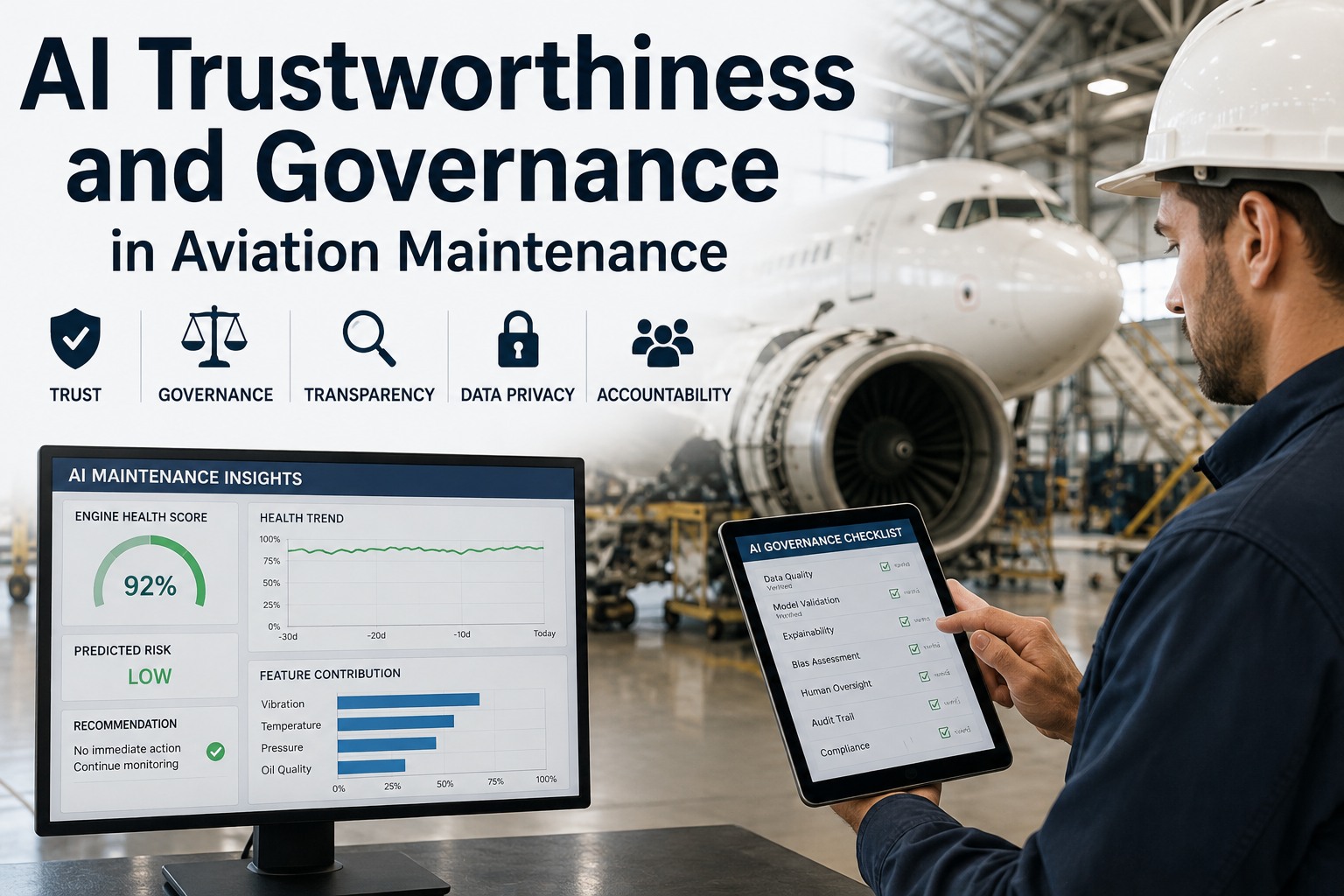
EASA's AI Roadmap — drawn from the EU High-Level Expert Group on AI guidelines — defines seven properties that any AI system deployed in aviation operations must demonstrate. These are not aspirational targets. They are audit checkpoints. Each dimension has documentation requirements, and EASA inspectors are trained to evaluate evidence against each one. MROs that cannot produce records across all seven will face findings in their next CAMO or Part 145 audit.
01
Human Agency & Oversight
Maintenance personnel must retain meaningful control over AI outputs. Systems must allow override, escalation, and documented rejection of AI recommendations.
Override logs required
02
Technical Robustness & Safety
AI must perform reliably across operational edge cases, degrade gracefully under sensor data gaps, and not generate false-negative fault alerts in safety-critical scenarios.
Failure mode documentation
03
Privacy & Data Governance
Maintenance data used to train or run AI models must be governed under GDPR-compliant data handling policies, with clear data lineage from sensor to decision.
Data lineage records
04
Transparency
AI outputs must be explainable in terms a licensed AME can evaluate. Black-box fault classifications that cannot be traced to a sensor reading or historical pattern are non-compliant.
Explainability audit trail
05
Diversity, Non-Discrimination & Fairness
AI maintenance models must not systematically under-perform on specific aircraft types, fleet ages, or operator profiles due to training data bias.
Bias assessment reports
06
Societal & Environmental Wellbeing
AI-driven maintenance optimisation must consider operational safety outcomes, not just cost reduction. Decisions that reduce maintenance frequency to save money must be risk-quantified.
Risk quantification logs
07
Accountability
There must be a documented chain of responsibility for every AI-influenced maintenance decision — from the system vendor's model to the AME who acted on the output. Oxmaint's digital signature and technician attribution trail satisfies this dimension end-to-end.
Full attribution chain
Industry Pain Points — Where MROs Are Exposed
The majority of European MROs are running AI-assisted tools — predictive analytics, IoT fault detection, condition-based scheduling — that were deployed before the EU AI Act's classification framework was finalized. Most of these deployments have documentation gaps that would generate audit findings today. The four failure patterns below account for over 80% of EASA AI compliance exposures identified in pre-audit assessments.
01
No AI System Inventory
Organizations cannot demonstrate which tools are AI-driven versus rule-based. EASA auditors ask for a register of AI systems. Most MROs do not have one. Without it, every AI tool becomes an uncontrolled risk.
73% of MROs audited had no formal AI system register
02
Missing Traceability Logs
When an AI system flags a component and a technician acts, there must be a documented link between the AI output and the work order. Gaps in this chain expose the AME personally and the organization legally.
AI-influenced work orders without audit trails represent the top EU AI Act finding
03
Absent Override Documentation
EASA requires evidence that human oversight is real and exercised — not theoretical. When technicians override AI recommendations, those decisions must be logged with rationale. Most platforms do not capture this at all.
Human override records are the single most commonly missing compliance document
04
Opaque Vendor AI Models
Vendors who cannot explain how their AI reaches a fault classification leave MROs unable to meet the transparency dimension. "The algorithm flagged it" is not an acceptable response to an EASA auditor under the new framework.
Explainability failures account for 34% of non-conformance findings in AI audits
How Oxmaint Solves EASA AI Compliance
Oxmaint's EU Compliance Module was designed around the EASA AI Trustworthiness Roadmap and EU AI Act Annex III obligations — not retrofitted to meet them. Every AI-influenced action in the platform generates the documentation that EASA auditors require, automatically. There is no separate compliance layer to manage. It is built into the maintenance workflow itself. Start a free trial to see how the compliance layer integrates with your existing work order process, or book a demo for a structured walkthrough of each EASA dimension.
01
Automated AI Decision Logging
Every AI-generated alert, fault classification, and maintenance recommendation is automatically logged with timestamp, sensor inputs, model version, and confidence score. No manual documentation step required.
02
Digital Override & Rejection Records
When an AME or maintenance manager overrides an AI recommendation, Oxmaint captures the decision, the rationale, and the digital signature in a tamper-proof log. This satisfies EASA's human oversight dimension completely.
03
Explainable AI Output Layer
Oxmaint surfaces the reasoning behind every AI recommendation in plain language — citing the specific sensor readings, historical failure patterns, and thresholds that triggered the alert. Auditors get a complete explanation chain, not a black box.
04
AI System Register Generation
Oxmaint automatically generates and maintains an inventory of all AI systems in use across your operation — classifying each by risk level, use case, and applicable regulatory framework. Ready to present on day one of an EASA audit.
05
Work Order AI Traceability Chain
Every work order linked to an AI alert carries a full attribution chain — from the sensor reading that triggered the alert to the technician who completed the task and the AME who signed off. EASA accountability dimension, closed.
06
GMP-Compliant Inspection Records
Digital equipment inspections with GMP compliance formatting, digital signatures, and immutable audit trails. All inspection data is tied to the asset record and available for regulator export in EASA-accepted formats.
Reactive vs. Compliant AI-Driven Maintenance
The compliance gap is not just a regulatory risk — it is an operational one. MROs running AI tools without proper governance frameworks consistently see higher incident rates, longer audit cycles, and more expensive corrective actions when findings emerge. The table below maps the operational and compliance difference between an unstructured AI deployment and an Oxmaint-governed one.
| Compliance Dimension |
Unmanaged AI Deployment |
Oxmaint EU Compliance Module |
| AI System Inventory |
No formal register. Tools listed in IT asset sheets only. |
Auto-generated register with risk classification per EU AI Act Annex III |
| Human Oversight Evidence |
Override decisions undocumented. No log of AI recommendations rejected. |
Every override captured with timestamp, rationale, and digital signature |
| AI Output Explainability |
Vendor-generated alerts with no traceable reasoning chain. |
Plain-language explanation citing sensor inputs, thresholds, and failure patterns |
| Work Order Traceability |
Manual work orders. AI alert not linked to task completion record. |
Full attribution chain: alert to work order to technician to AME sign-off |
| Audit Readiness |
2-4 week scramble before each EASA audit. Documentation gaps common. |
Audit package generated on demand. Always current. |
| Regulatory Exposure |
High. Multiple non-conformance findings likely post-Aug 2026. |
Systematically closed across all 7 EASA trustworthiness dimensions |
Compliance ROI — The Numbers
Aviation AI compliance is not a cost center. The organizations that invest in compliant AI governance frameworks consistently outperform those that treat compliance as a last-minute exercise. These figures reflect industry-validated outcomes from structured AI governance deployment in MRO and aviation facility operations.
35%
Reduction in audit preparation time
When compliance documentation is generated automatically, the average EASA Part 145 audit prep drops from 3 weeks to under 5 days
60%
Fewer audit non-conformances
Organizations with structured AI governance frameworks receive 60% fewer findings in EASA and CAA audits versus those with informal AI deployments
4.8x
Cost ratio: reactive vs. planned maintenance
AI-driven preventive scheduling that is compliant and trusted by technicians reduces reactive maintenance dependency — lowering per-event cost dramatically
3%
Maximum fine: global annual turnover
The EU AI Act imposes fines of up to 3% of global annual turnover for non-compliant high-risk AI system deployment. For a mid-size MRO, this can exceed €2M
EASA Compliance Requirements for MROs — Implementation Steps
Compliance with EASA's AI framework is a structured process, not a single action. MROs that approach it systematically — rather than reactively — complete it in 8 to 12 weeks with Oxmaint's guided compliance workflow. The roadmap below reflects the sequence EASA auditors expect to see evidence of.
1
AI System Inventory & Classification
Identify every AI-assisted tool in use across your MRO. Classify each against EU AI Act risk tiers. Oxmaint auto-generates this register from your active integrations. Estimated time: 1 week.
2
Gap Assessment Against 7 Dimensions
Map current documentation practices against each of EASA's seven trustworthiness dimensions. Identify which dimensions have zero coverage versus partial coverage. Estimated time: 1 week.
3
Platform Configuration & Log Activation
Enable Oxmaint's EU Compliance Module. Configure AI decision logging, override capture, and digital signature workflows for each AI-influenced process in your maintenance operation. Estimated time: 2 weeks.
4
Staff Training on AI Oversight Protocols
AMEs and maintenance managers must understand when and how to exercise override authority, and how to document it. EASA auditors verify that training records exist. Estimated time: 2 weeks.
5
Internal Audit & Evidence Pack Generation
Run an internal pre-audit using Oxmaint's audit-ready export. Verify documentation completeness across all 7 dimensions. Generate the evidence pack EASA auditors will request. Estimated time: 2 weeks.
Frequently Asked Questions
What is EASA's AI Trustworthiness Framework?
EASA's AI Trustworthiness Roadmap is a regulatory framework that defines how AI systems must operate within aviation to be considered safe, accountable, and audit-compliant. It establishes seven core dimensions — human oversight, robustness, privacy, transparency, fairness, societal wellbeing, and accountability — that AI systems influencing maintenance decisions must satisfy. The framework aligns with EU AI Act obligations and will be actively enforced from August 2026 through EASA Part 145, Part M, and Part CAMO audits. MROs using AI-assisted tools for fault detection, maintenance scheduling, or component lifecycle prediction must be able to demonstrate compliance against each dimension with documented evidence.
What is "high-risk AI" in aviation and does my MRO use it?
High-risk AI in aviation refers to any AI system that influences decisions affecting safety-critical operations. Under EU AI Act Annex III and EASA's interpretation, this includes predictive maintenance platforms that recommend component replacement or schedule inspections, IoT-based fault detection tools that alert technicians to anomalies, AI-driven condition scoring that affects airworthiness decisions, and any system whose output a licensed AME acts upon. If your MRO uses software that uses AI to generate maintenance recommendations, fault alerts, or component health scores — and a technician acts on that output — you are operating a high-risk AI system. The majority of modern CMMS and asset management platforms meet this threshold. Oxmaint's compliance module identifies which of your tools are in scope and closes the documentation gaps automatically.
How does Oxmaint handle the human oversight requirement specifically?
EASA requires that human oversight of AI be real and documented — not just a theoretical option. In Oxmaint, every AI-generated recommendation presents the maintenance manager or AME with a structured decision point: accept, modify, or override. All three actions are captured with a timestamped record, the decision rationale, and the digital signature of the responsible person. This creates an immutable log that satisfies EASA's accountability and human agency dimensions simultaneously. The records are accessible in the audit export module and can be filtered by date range, asset type, or technician — allowing inspectors to verify oversight practices at any point in the historical record.
What happens if we are found non-compliant during an EASA audit?
EASA audit findings related to AI governance are classified under the existing Part 145 or Part M non-conformance framework, with the additional overlay of EU AI Act penalties for confirmed high-risk AI violations. Level 1 findings — the most serious — require immediate corrective action and can result in suspension of approval. Level 2 findings require a corrective action plan within 30 days. Beyond the regulatory findings, the EU AI Act imposes fines of up to 3% of global annual turnover for non-compliant high-risk AI systems in active deployment. The most cost-effective path is structured prevention — and Oxmaint's compliance module is designed to eliminate the documentation gaps that generate findings before the auditor arrives.
Close Your EASA AI Compliance Gap Before August 2026
Oxmaint's EU Compliance Module generates audit-ready AI decision logs, digital override records, explainability trails, and the full EASA evidence pack — automatically, from within your maintenance workflow. No separate compliance tool. No manual documentation sprint before every audit.