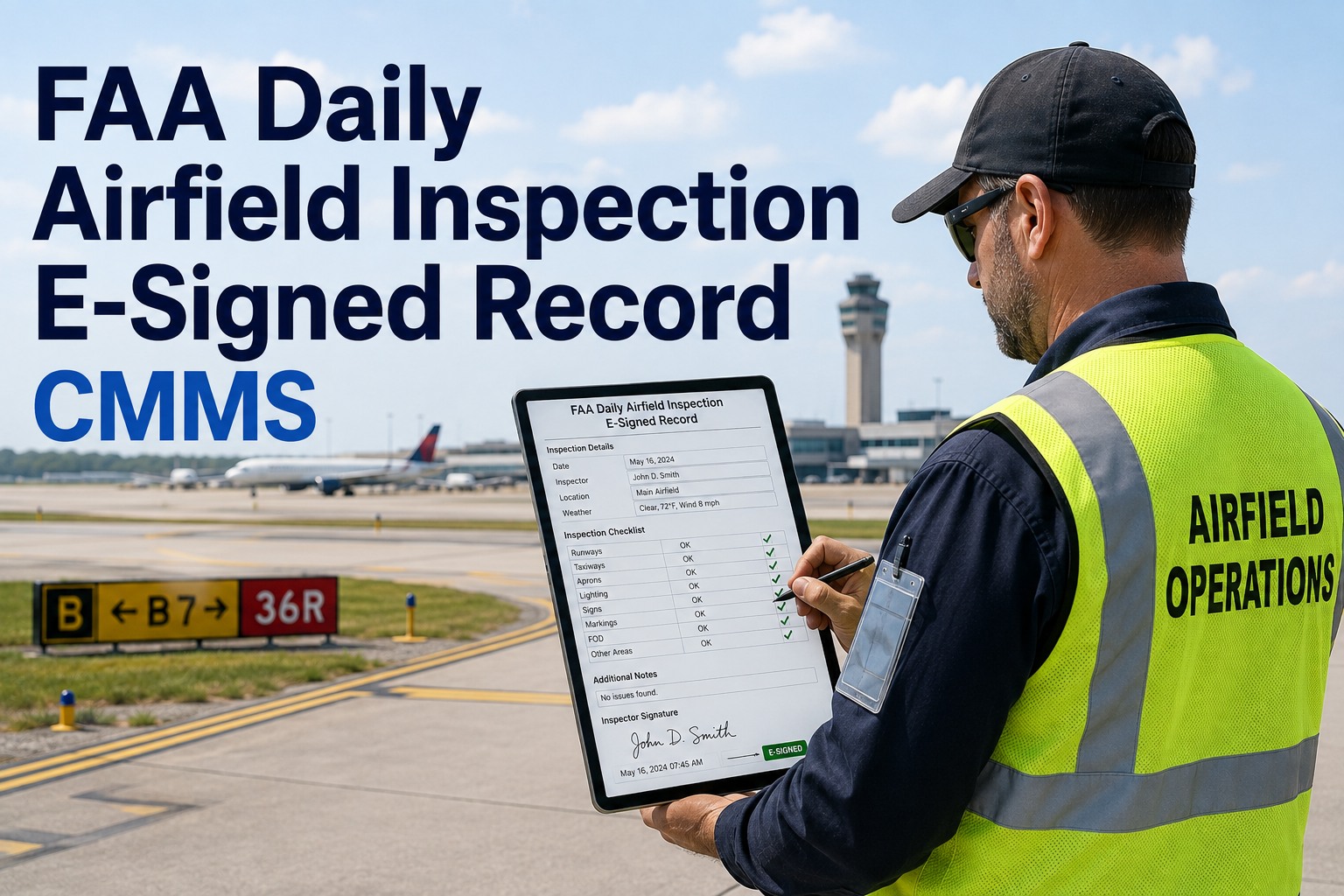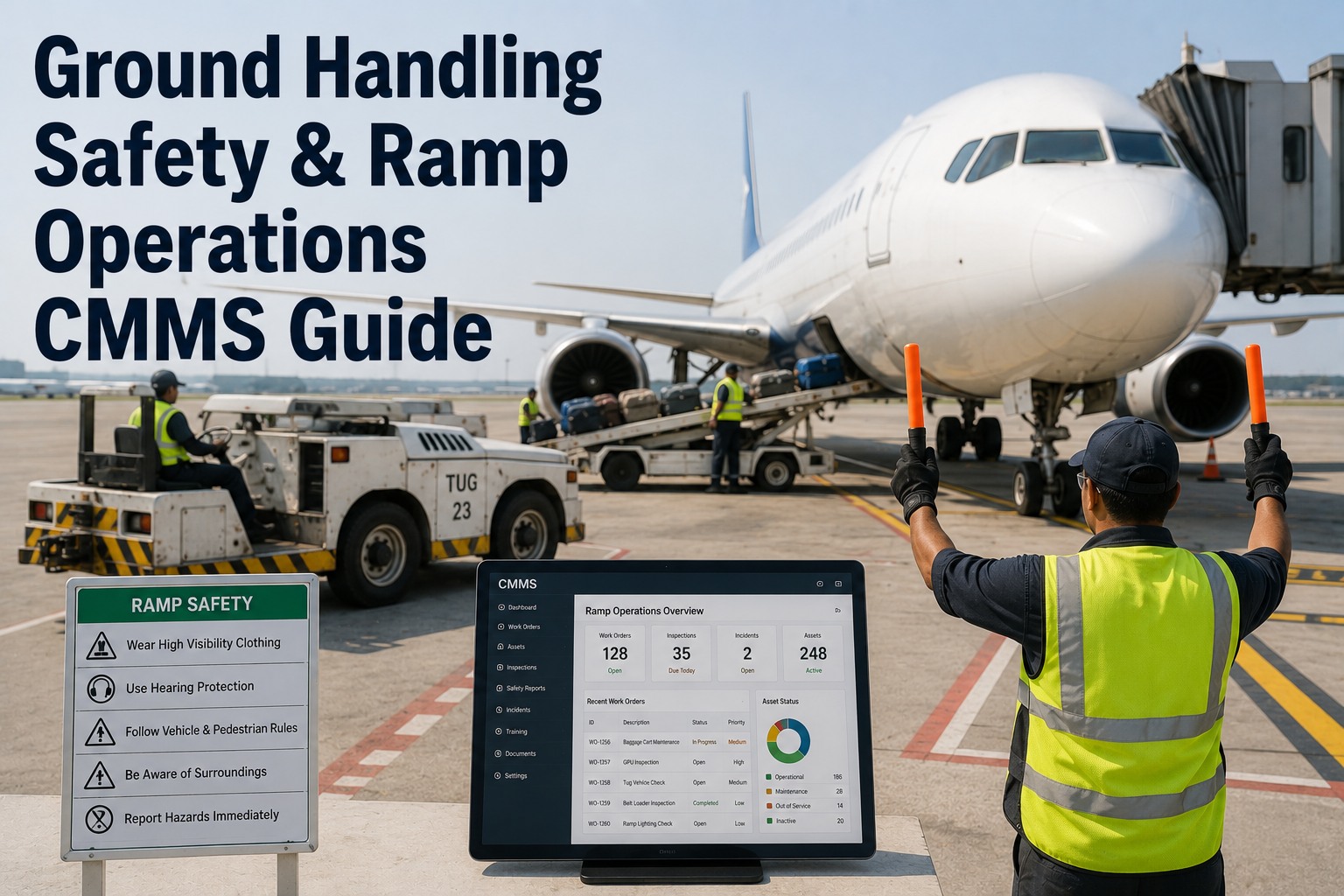
Aviation safety inspections are where compliance either lives on paper or lives on the ramp — and a paper-based program typically fails its next FAA Part 139 audit. This 2026 guide shows how a CMMS purpose-built for aviation turns daily airfield self-inspections, ARFF equipment readiness checks, and runway condition reporting into a closed-loop digital record. You will learn inspection route design, digital sign-off, discrepancy escalation logic, and how to build a safety inspection program that catches issues before regulators do. When you are ready to replace clipboard rounds with audit-ready data, Start Free Trial and deploy a digital inspection workspace in under 48 hours.
Is your airfield inspection program ready for the next Part 139 audit — or is it still living on clipboard sheets?
Over 60 percent of FAA Part 139 discrepancies cited in the last reporting cycle trace back to documentation gaps, not physical defects. A CMMS-based inspection program closes that gap with time-stamped digital sign-off, automated discrepancy routing, and FOD-free audit trails.
Four streams that define a Part 139-ready inspection program
A compliant airfield inspection program is not one checklist — it is four interlocking streams, each with its own frequency, sign-off authority, and escalation path.
Pavement, markings, lighting, signage, NAVAIDs, and FOD sweeps captured on a route-optimized mobile form before first departure and after last arrival.
Index-required vehicles, agent quantities (AFFF, dry chemical, PKP), PPE, and response-time drill logs verified against 14 CFR 139.319 minimums.
RCAM-based contaminant assessments, Mu friction readings, and NOTAM generation tied to the Field Condition form for FAA FDC submission.
Fuel quality checks, separator inspections, and wildlife hazard management plan logs aligned with AC 150/5200-33 and 14 CFR 139.327.
The tiered checklist architecture auditors look for
Build each stream as a three-tier checklist so a single failed item auto-escalates instead of sitting in a binder until the annual inspection.
- Runway / taxiway / apron pavement condition
- Edge lights, threshold lights, PAPI, REILs
- Signage retroreflectivity and orientation
- FOD sweep and wildlife observation log
- Marking visibility and condition
- ARFF vehicle startup and pump test
- Agent tank levels vs. index requirement
- Standby generator load bank status
- Fuel farm separator and sump sample
- Snow equipment readiness (in-season)
- Self-inspection program review (139.327)
- Movement area driver training records
- ARFF personnel training currency
- Wildlife hazard management plan review
- Emergency plan tabletop exercise log
What to inspect, how often, and which CFR it satisfies
A scannable matrix keeps operations, maintenance, and compliance teams aligned on cadence and regulatory authority.
| Inspection Item | Frequency | Regulatory Reference | Escalation Trigger |
|---|---|---|---|
| Movement area self-inspection | Daily, before first arrival | 14 CFR 139.327 | Any Tier 1 red flag |
| Runway friction (Mu) | Weekly / after major weather | AC 150/5320-12 | Mu below 40 |
| ARFF vehicle readiness | Daily check, weekly pump | 14 CFR 139.319 | Agent below index minimum |
| Fuel farm sump & separator | Weekly | AC 150/5230-4 | Water or contaminant detected |
| Wildlife hazard patrol | Daily, hourly in peak | AC 150/5200-33 | Hazardous species strike or near-miss |
| PAPI / REIL calibration | Quarterly | AC 150/5340-30 | Angle deviation > 0.1 degree |
| SMS internal audit | Annual | 14 CFR Part 5 / SMS | Any unresolved Level 2 finding |
From red flag to closed loop — without a single phone call
When an inspector flags a discrepancy, the CMMS should auto-route it through a four-level escalation in under five minutes.
Inspector taps "discrepancy," attaches photo, GPS-tag, severity tag.
CMMS spawns a work order, assigns technician, sets SLA timer.
System drafts NOTAM for Ops approval, alerts Airport Ops Manager.
Repair verified, digital sign-off, time-stamped record locked.
A mid-sized Part 139 airport running 4 daily self-inspections across 2 runways typically logs 1,200+ inspection records per month. On paper, 8–12 percent of discrepancies go unclosed before the next inspection cycle. On a CMMS, that figure drops below 1 percent.
What changes when the clipboard becomes a closed-loop system
The shift from paper to CMMS is not cosmetic — it compresses cycle time, raises closure rates, and produces an audit trail inspectors can defend in the room.
- ✕Discrepancy closure rate: 88–92 percent
- ✕Average time from flag to work order: 4–6 hours
- ✕Audit prep: 40+ staff hours per cycle
- ✕Lost or illegible forms: common
- ✕No real-time airfield status visibility
- ✓Discrepancy closure rate: 99+ percent
- ✓Average time from flag to work order: under 5 minutes
- ✓Audit prep: under 2 hours, export on demand
- ✓Every record GPS- and time-stamped
- ✓Live airfield status dashboard for Ops
What a CMMS delivers across a 12-month operating cycle
Aggregated benchmarks from small-hub to large-hub Part 139 airports that replaced clipboard inspections with a CMMS in 2024–2025.
Turn your next Part 139 audit into an export, not a fire drill.
Deploy a digital safety inspection workspace in under 48 hours — routes, checklists, escalation logic, and audit-ready records included.
Aviation safety inspection CMMS — answered
Does a CMMS replace the inspector, or just the clipboard?
The inspector remains the qualified authority — the CMMS replaces the paper, the manual transcription, and the phone-tree escalation. Inspectors still walk the route and apply judgment; the system captures GPS-tagged evidence, auto-generates work orders, and locks a time-stamped audit trail so nothing is lost between the ramp and the compliance office.
Can the system generate NOTAMs and FAA Field Condition reports?
Yes. When a runway condition discrepancy is flagged, the CMMS drafts a NOTAM using the inspector's RCAM inputs and routes it to Airport Operations for approval and submission. Field Condition forms are populated from the same record, eliminating duplicate data entry. You can see the full workflow when you Book a Demo.
How long does deployment take for a Part 139 airport?
A typical small-to-mid-hub airport is live in 48 to 72 hours. Route templates, checklists, ARFF index configurations, and user roles are pre-loaded from Part 139 standards, then customized to your ACM and SMS. Training for inspectors and ops staff usually completes in a single half-day session.
What happens if a device loses connectivity on the ramp?
The mobile inspection app runs fully offline. Inspectors capture photos, GPS tags, and discrepancy notes locally; the moment connectivity returns, records sync automatically with full time-stamp integrity preserved. No inspection is ever blocked by a dead signal zone at the far end of a runway.
How does the system prove compliance during an FAA inspection?
Every inspection record — daily self-inspection, ARFF check, runway condition report, and wildlife patrol — is stored with inspector identity, date, time, GPS coordinates, and attached media. Auditors receive a filtered export in minutes, not a binder. Most airports report cutting audit preparation from 40+ staff hours to under 2 hours. You can try the export workflow with a Start Free Trial.
Your next audit should take two hours, not two weeks.
Join the Part 139 airports that moved from clipboard to closed-loop in 2025 — and walked into their next FAA inspection with exports already in hand.
Free 14-day trial · No credit card