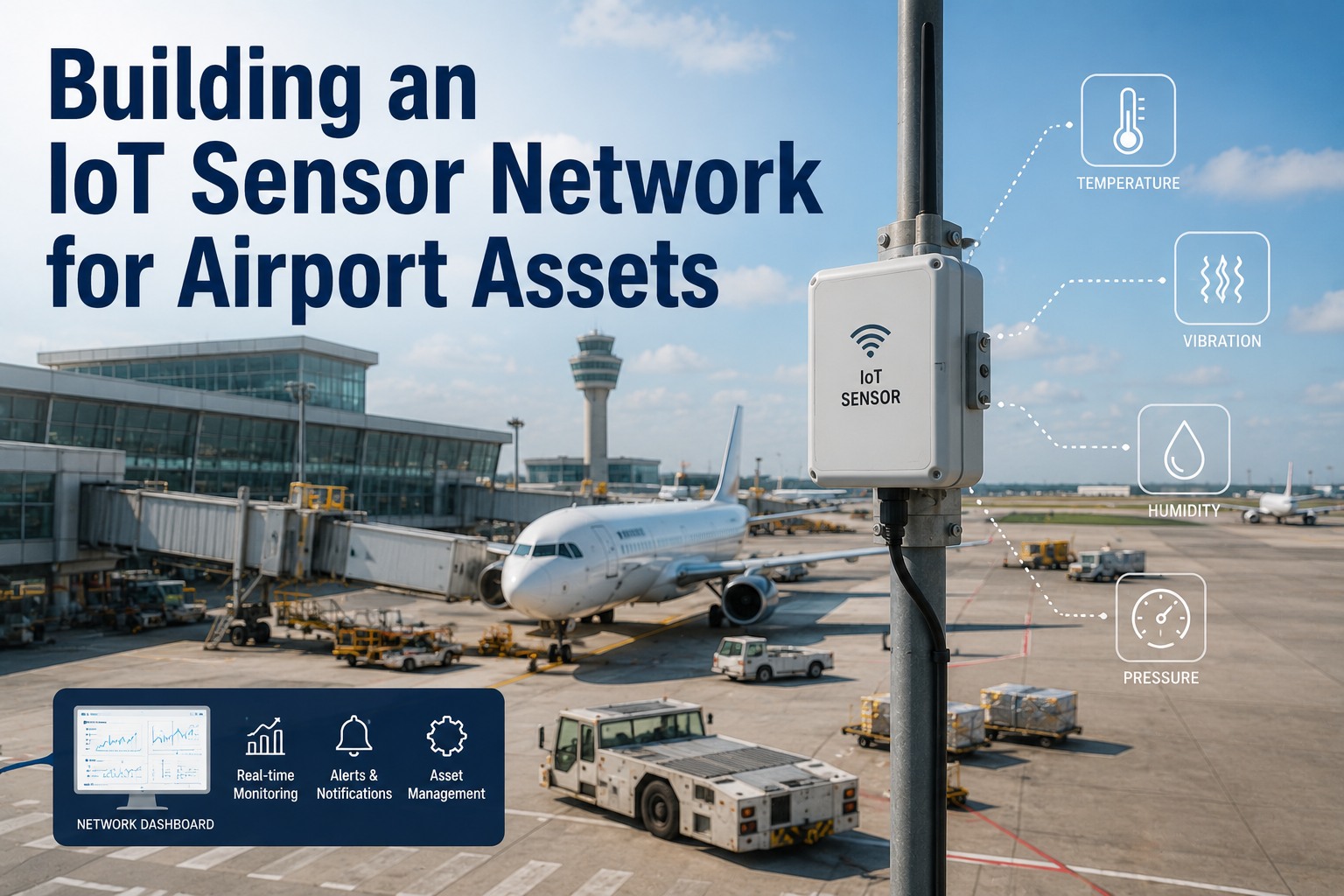
Deploying 100+ IoT sensors across terminals, runways, and parking structures should not take months of manual configuration. OXmaint's scalable IoT provisioning lets your IT team bulk-onboard devices, push consistent configurations, and start collecting maintenance data in days—not quarters. Book a demo to see how airports cut deployment time by 70%.
Why IoT Provisioning Is the Bottleneck Nobody Talks About
Airports are racing to deploy IoT—more than 45% are now implementing connected sensors for operations, maintenance, and passenger experience. But the biggest barrier is not buying the sensors. It is getting them online, configured correctly, and reporting data reliably across a facility that spans millions of square feet.
45%+
of airports now deploying IoT to improve operations and maintenance
$6.8B
projected airport IoT market by 2031, growing at 20% CAGR
72%
of IoT projects face delays due to provisioning and integration issues
Common Provisioning Failures at Airports
01
One-by-One Setup
A technician manually configures each sensor—entering WiFi credentials, server endpoints, and calibration values by hand. At 15 minutes per device, 200 sensors takes a full week.
02
Configuration Drift
Sensor 47 reports in Celsius while 48 reports in Fahrenheit. Polling intervals vary from 30 seconds to 5 minutes. Nobody notices until the dashboard shows impossible readings.
03
Security Gaps
Default passwords ship on 60% of devices. Without automated credential rotation at provisioning, each sensor is an entry point into the airport network.
04
No Lifecycle Visibility
Six months post-deployment, 12 sensors go offline. Nobody knows if they lost power, lost connectivity, or need firmware updates because there is no centralized device registry.
The 5-Phase IoT Deployment Framework for Airports
Whether you are deploying 50 vibration sensors on baggage belts or 500 environmental monitors across three terminals, the process follows the same five phases. OXmaint provides tooling for every phase—from planning spreadsheets to zero-touch onboarding.
Duration: 1-2 weeks
Map every asset requiring IoT monitoring (HVAC, escalators, lighting, baggage systems)
Survey network coverage across zones—WiFi, LoRaWAN, or cellular LTE/5G
Define sensor types, polling intervals, and data retention policies per asset class
Create a device registry template: Device ID, MAC, location, asset link, firmware version
Duration: 1 week
Build configuration profiles: one per device type with network, security, and reporting settings
Flash firmware in bulk using OXmaint's provisioning console or QR-code enrollment
Replace default credentials with certificate-based authentication (X.509 or token-based)
Stage devices in a test environment—verify data flow before field installation
Duration: 1-3 weeks (depending on scale)
Install sensors at mapped locations—scan QR code to auto-register in OXmaint device registry
Devices auto-connect using pre-staged credentials; zero manual network entry required
Run activation checks: confirm data reaching the dashboard within 60 seconds of power-on
Assign each device to its linked asset in OXmaint for automatic work order triggering
Duration: Ongoing (first 30 days critical)
Monitor device health dashboard: battery levels, signal strength, data freshness
Set alerts for offline devices, firmware mismatches, and anomalous readings
Tune polling intervals based on actual data needs—reduce battery drain on non-critical assets
Push OTA firmware updates in staged rollouts (10% canary, then full fleet)
Duration: Quarterly review cycle
Replicate proven configurations to new zones using profile cloning
Decommission end-of-life devices: revoke certificates, archive data, update asset registry
Evaluate next-generation sensors and connectivity upgrades (WiFi 6, private 5G)
Generate compliance reports showing full device lifecycle traceability
From planning to 500+ live sensors in under 6 weeks. OXmaint handles provisioning, monitoring, and lifecycle management in one platform.
Start Free
Manual vs. Automated Provisioning: The Scaling Gap
Manual device setup works for a pilot of 10 sensors. It collapses at scale. Here is how traditional provisioning compares to OXmaint's automated approach across the metrics that determine whether your IoT deployment succeeds or stalls.
Time per device
12-20 minutes
Under 30 seconds
100 devices deployed in
3-5 days
4-6 hours
Configuration consistency
Error-prone (human entry)
100% profile-driven
Security credential setup
Default passwords left on 60%+
Auto-rotated certificates
Firmware updates
Walk to each device
OTA staged rollouts
Offline device detection
Discovered weeks later
Real-time alerts in 60 seconds
70%
Reduction in deployment time with automated provisioning
35%
Less unplanned downtime with IoT-enabled predictive maintenance
30%
Energy savings from sensor-enabled smart building systems
Device Lifecycle at a Glance
Every IoT device in your airport passes through five lifecycle stages. OXmaint tracks each device from the moment it enters your inventory to the day it is decommissioned—giving your IT team complete visibility at every stage.
Procure
Receive, inventory, assign device IDs
Provision
Bulk flash, configure, authenticate
Operate
Live monitoring, alerts, data flow
Maintain
OTA updates, recalibration, repairs
Retire
Revoke certs, archive, decommission
What Gets Connected Across Your Airport
A modern airport IoT deployment spans three distinct zones, each with unique connectivity requirements, environmental conditions, and compliance obligations. OXmaint supports provisioning templates for every zone.
Terminal + Landside
HVAC temperature and humidity sensors
Escalator and elevator vibration monitors
Passenger flow and occupancy counters
Restroom usage and supply sensors
Smart lighting and energy meters
Airside + Runway
Runway and taxiway surface condition sensors
Jet bridge strain and position monitors
Ground power unit telemetry
Airfield lighting health monitors
Weather station and wind sensors
Infrastructure + Utilities
Electrical panel load monitors
Water pressure and flow meters
Backup generator health sensors
Fire suppression system monitors
Parking gate and barrier sensors
The Provisioning Checklist: 12 Steps to a Reliable Deployment
Use this checklist before, during, and after every IoT rollout at your airport. Each step maps directly to a feature inside OXmaint's device management console.
Before Deployment
1
Create a device registry with unique IDs, MAC addresses, and asset assignments
2
Define configuration profiles per device type (sensor type, polling rate, units, thresholds)
3
Verify network coverage at every planned installation point
4
Pre-stage firmware and security certificates on all devices
During Deployment
5
Scan QR code at install location to auto-register device in the correct zone
6
Confirm data flow within 60 seconds of power-on — flag any silent devices immediately
7
Validate sensor readings against a known baseline (calibration check)
8
Photograph installation for the maintenance record and compliance audit trail
After Deployment
9
Run a 48-hour burn-in test — monitor for dropouts, data gaps, or drift
10
Set up automated alerts for offline devices, low battery, and firmware mismatches
11
Schedule first OTA firmware update window (off-peak hours, staged rollout)
12
Generate deployment completion report with device count, coverage map, and health status
Market Momentum: Why Airports Are Investing Now
The airport IoT market is accelerating faster than almost any other infrastructure vertical. Airports that build scalable provisioning processes today will capture compounding returns as device density increases year over year.
$1.9B
2024
Airport IoT market value today
$6.8B
2031
Projected airport IoT market value
$25.9B
2030
IoT device management market globally
The IoT device management market is growing at 36.5% CAGR through 2030. Airports in Asia-Pacific are the fastest adopters, with China planning 216 new IoT-enabled airports by 2035. Sensor-enabled smart buildings cut energy costs by up to 30%, making the ROI case clear.
Real Results from Airport IoT Deployments
Airports and aviation organizations that have implemented structured IoT provisioning and management are seeing measurable improvements across maintenance costs, uptime, and operational efficiency.
KT
Kevin Torres
IT Infrastructure Director, Mid-Size U.S. Airport
We deployed 340 sensors across two terminals in 11 days using OXmaint's bulk provisioning. Previously, our team estimated 8 weeks for the same rollout. The zero-touch onboarding alone saved us hundreds of hours of manual configuration.
11 days
Total deployment time
SP
Sarah Patel
CMMS Systems Manager, Regional Airport Authority
Configuration drift was our biggest headache. After switching to profile-based provisioning, every sensor reports in the same units, same intervals, same format. Our data quality issues dropped to near zero.
MR
Marcus Reed
Chief Technology Officer, International Airport Group
The lifecycle dashboard changed everything. We now see battery levels, firmware versions, and connectivity status for all 800+ devices in one view. When a sensor goes offline, we know within a minute—not a month.
Frequently Asked Questions
What IoT protocols and connectivity types does OXmaint support?
OXmaint supports WiFi, LoRaWAN, cellular (LTE/5G), Bluetooth LE, and Zigbee devices. The platform is protocol-agnostic at the data layer—any sensor that can transmit via MQTT, HTTP, or CoAP can be onboarded.
Book a demo to discuss your specific hardware and network setup.
How does zero-touch provisioning work?
During the staging phase, each device is assigned a configuration profile and security certificate. When the device powers on in the field, it contacts OXmaint's provisioning server, authenticates automatically, downloads its configuration, and begins reporting data—no manual network entry or on-device setup required.
Can we integrate with our existing network management and CMMS tools?
Yes. OXmaint integrates with existing CMMS platforms, network management systems, and cloud IoT hubs (AWS IoT, Azure IoT) via REST APIs. Device data flows into your existing dashboards and triggers work orders in your current maintenance system.
Start a free trial to test integrations.
How do you handle firmware updates across hundreds of devices?
OXmaint supports over-the-air (OTA) updates with staged rollouts. You can push updates to a canary group (10% of devices), validate results, then roll out to the full fleet. Updates are scheduled during off-peak hours to avoid disrupting active monitoring.
What happens when a device reaches end of life?
OXmaint's lifecycle management includes automated decommissioning: security certificates are revoked, historical data is archived, the asset registry is updated, and a replacement device can be provisioned with the same configuration profile in minutes.
Deploy Hundreds of Sensors. Not Hundreds of Headaches.
OXmaint gives your IT team the provisioning, monitoring, and lifecycle tools to scale IoT across your entire airport—without drowning in manual configuration.