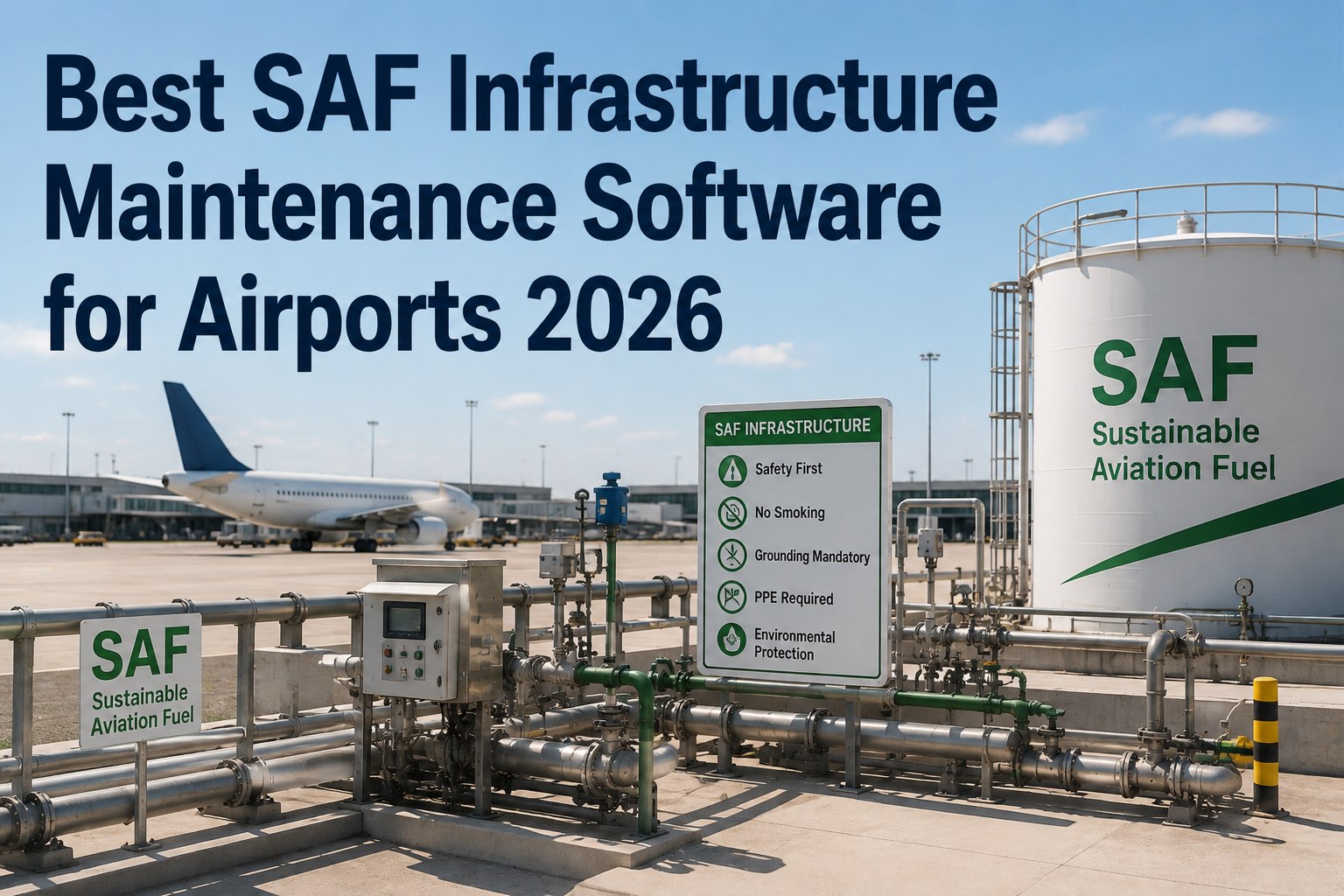
Sustainable aviation fuel is usually framed as a supply problem — not enough feedstock, refineries, or investment. But for the airport engineering team, SAF is something else entirely: a measurement-and-maintenance problem. However much SAF arrives, it still has to be blended with Jet A to spec, verified, documented, and released safely into one of the most tightly controlled fuel supply chains in the world — through the same tanks, seals, gaskets, hydrant lines, and quality labs that were never assessed for it. SAF is a "drop-in" fuel, but drop-in doesn't mean maintenance-free: hydrant systems require significant ongoing maintenance to prevent degradation, contamination, and leakage, and most airports haven't checked whether their fuel infrastructure can handle SAF blends without accelerated wear. This guide covers what SAF infrastructure maintenance software has to handle in 2026 — the blending-compliance workflow, the fuel-system assets under new stress, the quality-control chain, and how a CMMS ties environmental targets to real maintenance action. Book a free SAF-readiness assessment for your fuel infrastructure.
SAF Is a Measurement Story, Not Just a Supply Story
Drop-in fuel still has to be blended to spec, verified, documented, and released — through your existing systems.
50%
Maximum SAF blend with conventional Jet A approved under ASTM
D7566
ASTM spec governing synthesized-hydrocarbon jet fuel and blend limits
11
Certified production pathways — HEFA, FT, ATJ, SIP, PtL and more
2–70%
ReFuelEU mandate ramp — 2% by 2025 rising toward 70% by 2050
Why "Drop-In" Doesn't Mean Maintenance-Free
SAF's big advantage is that it works in existing aircraft and fuel systems. But existing systems now carry a fuel with different molecular composition running through them at rising blend ratios — and that changes the maintenance picture in three ways.
CHANGE 01
Blend Compliance Is Continuous
Neat SAF must be blended with Jet A within ASTM D7566 limits before it reaches an aircraft. Every batch has to be blended, verified, and documented — a recurring control point, not a one-time setup.
CHANGE 02
Seals & Materials Under New Stress
SAF's composition affects seal compatibility and material behavior. Tanks, gaskets, seals, and hydrant components need inspection against degradation most airports haven't yet assessed for SAF.
CHANGE 03
Documentation Is the Deliverable
Regulators and airlines increasingly demand proof. Every blend ratio, quality test, and release decision has to be captured as defensible evidence — the claim is only as good as the record.
The Fuel-System Assets SAF Puts Under Pressure
SAF flows through the same infrastructure as conventional jet fuel — which means the same assets now need inspection against a new set of risks. These are the components a SAF maintenance program has to track.
Fuel Farm Storage Tanks
Neat SAF, Jet A, and blended stock storage — with seals, linings, and coatings inspected for compatibility and water/contamination control.
Blending Systems
The ratio-control and injection equipment that brings SAF to an ASTM-compliant blend — the asset that decides whether every batch releases to spec.
Hydrant Lines & Pits
Underground hydrant piping, pit valves, and couplers carry high CAPEX and demand regular maintenance to prevent degradation, contamination, and leakage.
Filtration & Quality Systems
Filter-water separators, coalescers, and sampling points — the last line of contamination defense before fuel reaches the aircraft.
Quality-Control Lab & Sampling Chain
The lab equipment and sampling protocol that analyze, verify, and release each batch. SAF is analysed, blended, verified, documented, and released into the supply chain here — which makes calibrated instruments, controlled sampling points, and a documented chain of custody core maintenance assets, not back-office overhead.
Map Your SAF Fuel-System Assets in 30 Minutes
Working session with our aviation team — bring your fuel-farm and hydrant asset list. We'll map storage, blending, hydrant, filtration, and lab assets into a structured hierarchy and show how OxMaint runs inspection, PM, and sensor triggers across them.
The Blend-to-Release Quality Chain
SAF enters the world's most tightly controlled fuel supply chain through a defined sequence — and each step is a control point that has to be executed, verified, and documented. This is the chain a maintenance program has to keep running.
1
Receive & Segregate. Neat SAF arrives and is stored separately from Jet A until blending — with tank integrity and contamination checks logged on receipt.
2
Blend to Spec. SAF is blended with Jet A within ASTM D7566 limits — the ratio verified and recorded for the batch, not assumed.
3
Test & Verify. Lab sampling confirms the blend meets fuel-quality specifications — with results tied to the batch and the sampling point.
4
Document & Release. The batch releases to the hydrant system with a full record — blend ratio, test results, sign-off — as the compliance evidence airlines and regulators require.
Paper Fuel Log vs Digital SAF Program
Fuel-quality control has always run on documentation. SAF raises the stakes: more control points, tighter blend tolerances, and regulators asking for proof. Where a paper log records that a check happened, a digital program proves it — and links every environmental claim to the maintenance action behind it.
Paper Fuel Log
Blend ratios recorded by hand, hard to audit
Inspections scheduled by memory
Test results in separate lab paperwork
Contamination findings depend on follow-up
Environmental claims disconnected from action
Digital SAF Program
Blend and release records captured per batch
Auto-generated PM and inspection work orders
Test results linked to asset and batch
Findings become tracked work orders with deadlines
Every claim tied to the maintenance data behind it
How OxMaint Runs SAF Infrastructure Maintenance
OxMaint gives sustainability and engineering teams the execution layer — sensor integration for fuel-system and environmental data, PM and inspection programs that keep the infrastructure compliant, and reporting that closes the loop between operational action and environmental outcome.
Assets
Fuel-System Hierarchy
Storage, blending, hydrant, filtration, and lab assets modeled in a structured register — the foundation for SAF inspection and PM.
IoT
Sensor & Environmental Data
Sensor feeds on tanks, lines, and filtration convert into prioritized work orders — leaks and degradation caught before contamination spreads.
PM
Compliance Inspections
Seal, gasket, hydrant, and filtration inspections auto-generate on cadence — the SAF-compatibility checks most airports haven't yet built.
Capture
Blend & Test Records
Blend ratios, lab results, and release decisions captured on mobile with photo and e-sign — the documented chain regulators demand.
Escalate
Findings to Work Orders
A contamination flag or out-of-spec reading auto-generates a tracked corrective-action work order — nothing slips between finding and fix.
Report
Claim-to-Action Reporting
Reporting that ties every environmental claim to the maintenance data behind it — defensible evidence for airlines and regulators.
Turn Sustainability Into an Operational Advantage
Hit environmental targets through real operational change — and defend every claim with data. See how OxMaint runs SAF blending compliance, fuel-system inspections, and claim-to-action reporting. Free forever plan available.
Frequently Asked Questions
What is SAF infrastructure maintenance software?
It's a CMMS configured for the fuel-system assets and quality-control workflow that sustainable aviation fuel demands — storage tanks, blending systems, hydrant lines, filtration, and lab sampling. Beyond conventional fuel-farm maintenance, a SAF-ready platform tracks blend compliance to ASTM limits, inspects seals and materials for SAF compatibility, captures blend and test records per batch, and ties environmental claims to the maintenance action behind them. It's the execution layer that turns a sustainability target into documented operational reality.
Book a SAF-readiness assessment.
Can existing airport fuel infrastructure handle SAF?
Largely yes — SAF's key advantage is that it's a drop-in fuel that integrates into existing aircraft, storage, and hydrant systems. But "drop-in" isn't "no impact." SAF has a different molecular composition that affects seal compatibility and material behavior, and most airports haven't formally assessed whether their tanks, gaskets, seals, and hydrant components can handle rising blend ratios without accelerated degradation. Hydrant systems in particular already require significant regular maintenance to prevent contamination and leakage. The practical answer is that existing infrastructure can carry SAF, but only with an inspection and PM program built for the new stress.
What's the maximum SAF blend allowed, and why does it matter?
Under ASTM standards, SAF is currently approved for blending up to 50% with conventional Jet A, governed by ASTM D7566, which specifies fuel quality for synthesized-hydrocarbon jet fuel and the allowable percentage by production pathway. Neat SAF must always be blended with Jet A before use in aircraft — it's not used at 100%. This matters operationally because every batch has to be blended within spec, verified, and documented, making the blending system and quality lab recurring control points. Getting the ratio and the record right on every batch is the core discipline of SAF fuel handling.
Why is documentation so central to a SAF program?
Because SAF sits at the intersection of a tightly controlled fuel supply chain and increasingly strict sustainability mandates. Regulators and airlines demand proof that fuel was blended to spec and that emissions-reduction claims are real — and mandates like ReFuelEU ramp the required SAF share over the coming decades. Every blend ratio, quality test, contamination check, and release decision becomes evidence. A claim is only as strong as the record behind it, which is why capturing the blend-and-test chain digitally, tied to the specific asset and batch, is what makes a sustainability claim defensible.
Sign up free to build the evidence chain.
Does OxMaint support SAF and fuel-infrastructure maintenance?
Yes. OxMaint models SAF fuel-system assets — storage, blending, hydrant lines, filtration, and lab — in a structured hierarchy, integrates sensor data into prioritized work orders to catch leaks and degradation early, automates seal, gasket, and hydrant compliance inspections, captures blend ratios and lab results per batch with photo and e-signature, converts contamination or out-of-spec findings into tracked corrective actions, and reports every environmental claim against the maintenance data behind it. It gives sustainability and engineering teams one execution layer that survives leadership change and scales as SAF mandates rise. A free forever plan is available to trial the full workflow.