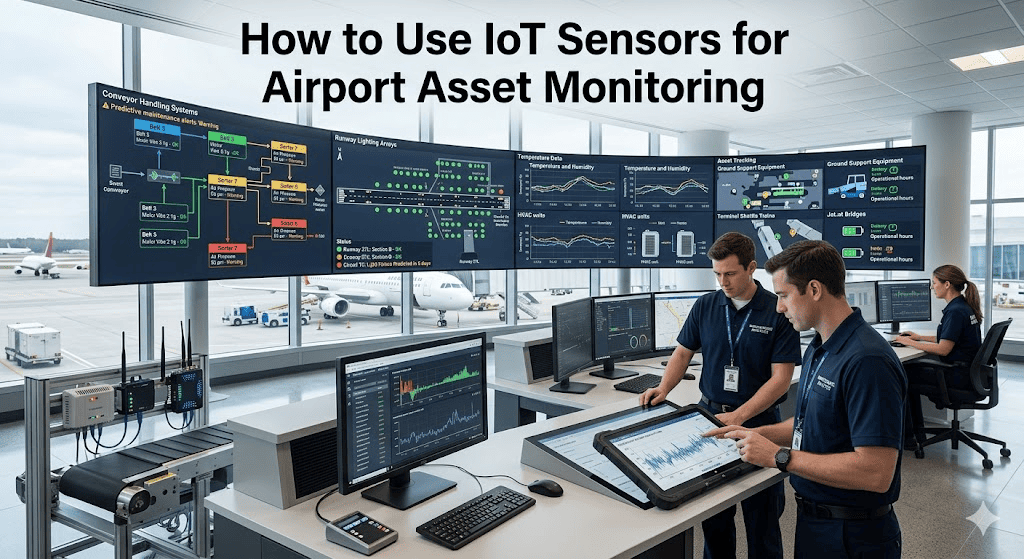
Airport IoT sensors transform boarding bridges, baggage handlers, HVAC plants and airfield lighting from siloed equipment into a live data layer that flags failures weeks before they strand passengers. An effective airport IoT monitoring network ties vibration, temperature, current and occupancy data into a single CMMS so reliability teams can shift from reactive fixes to predictive maintenance. This guide walks digital-transformation leads through sensor selection by asset class, secure network architecture, cybersecurity, CMMS integration and a scalable rollout from pilot to airport-wide deployment. See how OxMaint turns that sensor stream into automated work orders when you Start Free Trial or book a personalized demo today.
Airport IoT Implementation Guide
What if your boarding bridge warned you about a bearing failure 3 weeks before it seized?
A well-architected airport IoT sensor network catches mechanical and electrical faults in GSE, terminals and airfield equipment long before alarms fire — turning unplanned downtime into planned maintenance. Design the network right the first time.
Sensor Selection by Asset Class
Which airport equipment sensors fit each asset type?
Not every asset needs the same intelligence. Matching the right aviation IoT sensor to each equipment class is what separates a high-ROI airport sensor network from an expensive data firehose. Start with criticality, then choose the minimum viable sensor set.
Boarding Bridges & Apron GSE
Tri-axial vibration and motor-current sensors on drive motors, hydraulic pump pressure transducers, and position encoders on the telescopic tunnel. Target: detect bearing wear, misalignment and seal degradation before a bridge jams mid-boarding.
Baggage Handling Systems
Belt-speed tachometers, temperature thermocouples on conveyor motors, photoelectric sensors at junctions, and motor-current clamps on sortation diverters. The goal is predicting jams and motor burnout on a 24/7 system where a 1-hour stoppage can delay 12 flights.
HVAC & Terminal Plant
Differential pressure across AHU filters, supply and return temperature sensors, chiller kWh metering, and vibration on pump and fan bearings. Air quality (CO2) sensors tie back to terminal comfort and energy optimisation simultaneously.
Airfield Lighting & Power
Individual lamp-status monitors on approach and runway edge lights, CCR (constant current regulator) output sensors, and insulation-resistance monitoring on series circuits. A single failed edge light can trigger a NOTAM and reduce runway capacity in LVP.
Network Architecture
How to design an airport IoT network architecture that scales
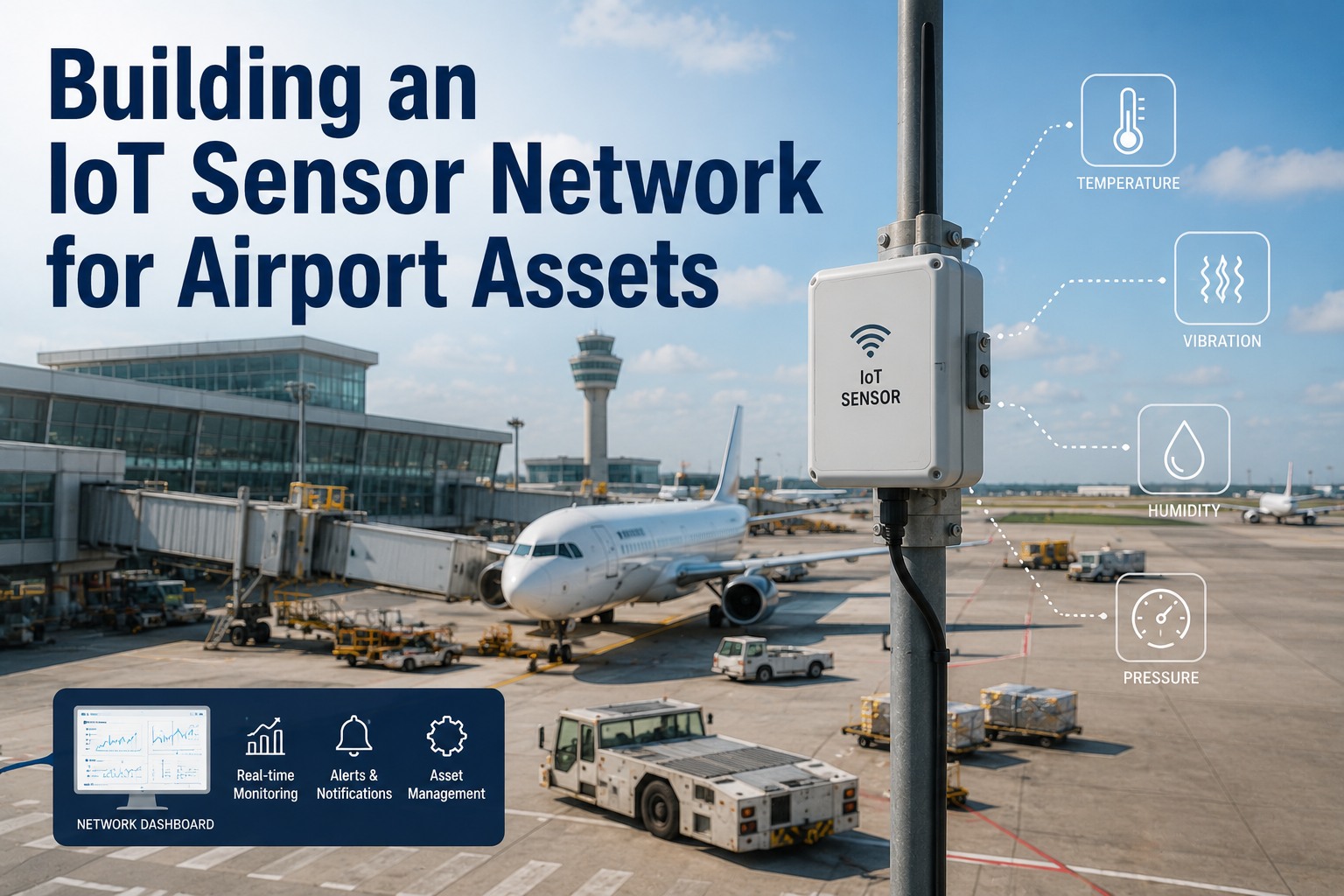
A smart airport sensor network lives or dies on its architecture. The most reliable deployments use a layered model — edge nodes at the asset, a local aggregation gateway, and a secure cloud or on-prem platform. This avoids swamping the airport's IT backbone while keeping latency under 500 ms for critical alerts.
Edge Sensing Layer
Battery-powered wireless sensor nodes (LoRaWAN, BLE Mesh, or Wi-Fi 6) mount directly on assets. On-node edge processing filters noise so only meaningful deviations are transmitted — extending battery life to 3–5 years and cutting bandwidth by up to 80%.
Aggregation & Gateway Layer
Ruggedised gateways in each concourse or airfield vault collect sensor data, apply protocol conversion (Modbus, BACnet, OPC UA to MQTT), and buffer locally during network outages. Dual-SIM 5G backhaul ensures no single point of failure.
Platform & CMMS Integration Layer
Data flows via encrypted MQTT or REST API into the maintenance platform — OxMaint — where AI models detect anomalies, trigger work orders, and update asset health scores in real time. This is where sensor data becomes maintenance action.
A 45-gate airport typically deploys 2,500–4,000 sensor nodes across GSE, terminal and airfield assets. Bandwidth at the gateway rarely exceeds 15 GB/month when edge filtering is correctly configured — less than a single security camera stream.
Deployment Timeline
From pilot to airport-wide IoT: a 6-month rollout plan
The biggest mistake airports make is trying to instrument everything at once. A phased airport IoT deployment — starting with the highest-criticality, highest-data-value assets — typically achieves ROI within 8 months and builds internal support for expansion.
Criticality Assessment & Asset Register
Audit every asset in OxMaint, rank by criticality and failure history. Identify the top 50–100 assets (usually boarding bridges, BHS motors and main chillers) that account for 70%+ of unplanned downtime cost.
Pilot Sensor Installation
Deploy 100–200 sensors on the prioritised pilot assets. Configure gateways, validate data quality, and set baseline operating profiles for 2–3 weeks before enabling any alerts.
CMMS Integration & Alert Tuning
Connect the sensor stream to OxMaint via API. Map anomaly thresholds to automated work-order generation. Tune alert sensitivity to minimise false positives — target a 90%+ actionable alert rate.
Predictive Model Training
OxMaint's AI engine now has 60+ days of baseline data. It begins flagging deviations — a bearing vibration trend rising 15% over two weeks, a chiller compressor drawing 8% excess current. Each alert auto-creates a corrective work order.
ROI Validation & Stakeholder Review
Measure downtime prevented, maintenance hours saved, and energy reductions. A typical pilot at a 30M-passenger airport documents $180K–$400K in avoided costs — the business case for airport-wide scale-up.
Airport-Wide Scale-Out
Roll out to remaining terminals, concourses, GSE fleet and airfield systems using the validated architecture and sensor templates. OxMaint handles the expanded asset count without additional infrastructure on the maintenance side.
Cybersecurity & Compliance
Securing airport IoT infrastructure against cyber threats
Airport IoT networks operate in a regulated, high-risk cyber environment. Every sensor node is a potential attack surface. Security cannot be an add-on — it must be designed into the architecture from day one, aligned with ACI and ICAO cyber-resilience guidance.
| Security Layer | Requirement | Why It Matters for Airports |
|---|---|---|
| Device Identity | X.509 certificates per node, mutual TLS | Prevents rogue devices from injecting false sensor data into the maintenance platform. |
| Network Segmentation | Dedicated VLAN, firewall-isolated from OT and IT | A compromised sensor cannot lateral-move into flight-info or security systems. |
| Data Encryption | AES-256 at rest, TLS 1.3 in transit | Protects asset health and location data from interception on shared airport infrastructure. |
| Access Control | Role-based access, SSO, MFA in OxMaint | Only authorised maintenance staff can acknowledge alerts or override thresholds. |
| Audit Logging | Immutable logs of all threshold changes and WO actions | Demonstrates compliance duringCAA / FAA / EASA maintenance audits. |
How OxMaint Helps
How OxMaint turns airport sensor data into maintenance action
An IoT sensor network without an intelligent CMMS is just a dashboard — it tells you something is wrong, but it does not fix it. OxMaint ingests the sensor stream and automatically converts anomalies into prioritised, tracked, compliant work orders. That is the bridge between data and downtime reduction.
AI-Driven Anomaly Detection
OxMaint's ML models learn each asset's normal operating profile from the sensor baseline and flag deviations — a 12% vibration increase on a boarding-bridge motor, a 6°C temperature rise on a BHS conveyor. Technicians get the alert with the likely failure mode and recommended fix attached.
Automated Work-Order Generation
When a sensor crosses a threshold, OxMaint auto-creates a work order, assigns it to the right technician based on skill and shift, reserves spare parts from inventory, and sends a mobile notification. No phone calls, no paper, no missed alerts in an inbox.
Asset Health Scorecard
Every instrumented asset gets a live health score (0–100) in the OxMaint dashboard, blending sensor trends, work-order history and inspection results. Reliability engineers see at a glance which boarding bridges, BHS lines or chillers are trending toward failure.
Compliance & Audit Readiness
Every sensor-triggered alert, work order, spare-part issue and completion sign-off is logged with timestamp and user. OxMaint generates audit-ready reports for CAA, FAA and EASA inspections in minutes — proving that predictive maintenance was performed, not just scheduled.
Real-World Impact
What an airport IoT deployment actually costs and saves
A mid-sized airport operating 45 gates, 120 GSE units and 8 baggage lines instrumented 2,800 sensor nodes. Here is what the numbers looked like after 12 months on OxMaint.
"We instrumented 40 boarding bridges and our main BHS lines with vibration and current sensors, then fed everything into OxMaint. In the first six months we caught 11 bearing failures before they became gate-out-of-service events. The system paid for itself before the pilot ended."
See OxMaint on your airport assets — book a 30-min demo
Walk through a live IoT-integrated CMMS dashboard, see automated work-order generation from sensor alerts, and get a custom rollout plan for your terminal and airfield assets.
Frequently Asked Questions
Airport IoT sensor network — your questions answered
How much does an airport IoT sensor network cost to deploy?
A typical mid-sized airport (30–45 gates) spends $35K–$60K on sensor hardware and gateways for a 2,000–3,000 node pilot, plus $15K–$25K for installation and integration. Most airports recover that within 8–12 months through avoided downtime — a single prevented boarding-bridge failure can save $8K–$15K in passenger disruption and repair costs. You can model your exact ROI by starting a Start Free Trial and entering your asset count.
Which wireless protocol is best for airport IoT sensors?
LoRaWAN is the leading choice for airfield and GSE sensors because it penetrates concrete terminal structures and offers 3–5 year battery life. Wi-Fi 6 is preferred for high-bandwidth indoor applications like video-based condition monitoring. Most airports run a hybrid: LoRaWAN for outdoor/airfield, BLE or Wi-Fi for terminal-internal assets. OxMaint integrates data from all protocols into a single asset health view.
How does airport IoT monitoring integrate with an existing CMMS?
Sensor gateways push data via MQTT or REST API to the CMMS, which evaluates thresholds and generates work orders automatically. OxMaint provides native API connectors and pre-built integration templates for common industrial protocols (Modbus, OPC UA, BACnet), so a typical integration takes 2–4 weeks rather than months. Book a Book a Demo session to see the integration workflow live.
Is airport IoT infrastructure secure enough for regulated aviation environments?
Yes — when designed correctly. The network must use device-level X.509 certificates, mutual TLS, network segmentation (separate VLAN from operational IT), AES-256 encryption and role-based access control. OxMaint adds immutable audit logging and SSO/MFA so every threshold change and work-order action is traceable for CAA, FAA and EASA compliance audits.
Can smart airport sensors predict failures on legacy equipment?
Absolutely. The majority of ROI comes from legacy assets — 15-year-old boarding bridges, original BHS motors and ageing chillers that have no built-in intelligence. Retrofitted vibration, temperature and current sensors feed OxMaint's AI models, which learn the baseline and detect degradation. In fact, legacy assets often show the fastest payback because their failure rates are highest.
Ready to make unplanned airport asset downtime a thing of the past?
Deploy OxMaint as the intelligent layer over your airport IoT sensor network. Automated work orders, AI-driven anomaly detection and full audit readiness — live in weeks, not months.
Free 14-day trial · No credit card