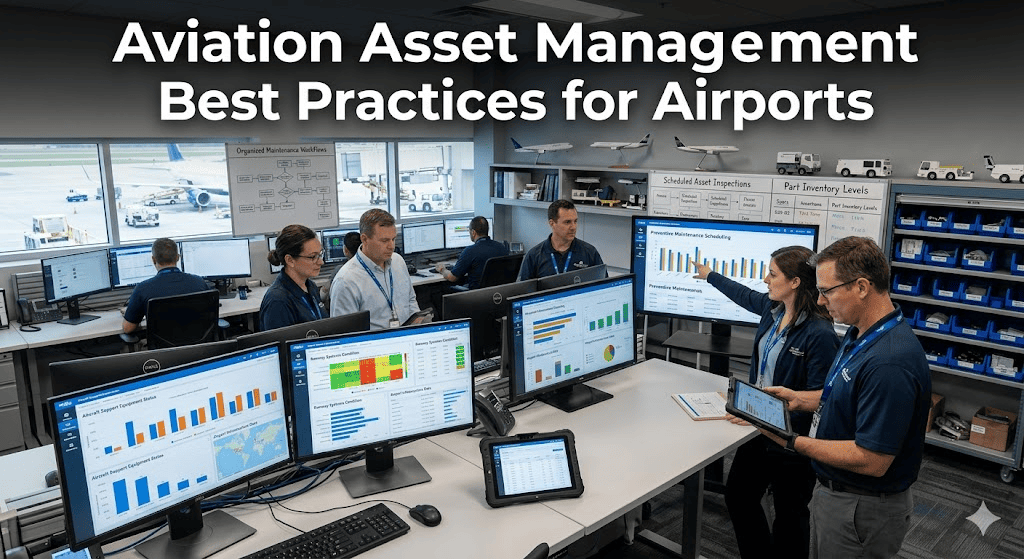
Aviation asset management is no longer a back-office overhead — it is a direct operational and financial lever for every airport. With global passenger traffic projected to reach 7.8 billion by 2036 and airports managing aging infrastructure under FAA Part 139, ICAO Annex 14, and EASA regulatory frameworks, a reactive approach to asset lifecycles costs 4.8× more per failure event than a planned maintenance model. Runway lighting systems, airfield ground lighting, jet bridges, baggage handling networks, and HVAC systems across terminal concourses all carry specific inspection intervals, lifecycle replacement windows, and documentation requirements that paper-based or spreadsheet-managed programs consistently fail to meet. Airports with CMMS-managed asset programs report 35% fewer unplanned failures and 28% lower total maintenance spend — and that gap widens every year reactive programs delay the transition. Start a free trial to centralize your aviation asset portfolio in Oxmaint, or book a demo and walk through your specific airport asset hierarchy with a product expert.
See Your Airport Asset ROI in 30 Minutes
See how much cost you can eliminate from reactive aviation maintenance across your terminal, airfield, and ground systems portfolio.
- Real-time asset visibility across every terminal system
- Predictive failure alerts before runway and gate equipment fails
- 5-10 year CapEx forecasting for infrastructure replacement cycles
What Is Aviation Asset Management?
Aviation asset management is the systematic approach to tracking, maintaining, and planning the full lifecycle of every physical asset an airport operates — from airfield pavement and runway lighting to jet bridges, baggage conveyors, HVAC systems, security screening equipment, and ground support vehicles. Unlike generic facilities management, aviation asset management operates under strict regulatory timelines (FAA Advisory Circulars, ICAO Annex 14, TSA security directives) where missed inspections carry civil penalties and operational license risk.
At its core, effective aviation asset management links three functions that most airports run in silos: maintenance scheduling, condition-based lifecycle tracking, and capital expenditure forecasting. When these functions are unified in a single system, airport operations teams gain predictive visibility into equipment health, replacement timelines, and budget requirements — rather than reacting to failures that were entirely foreseeable.
The FAA estimates that U.S. airports collectively spend over $26 billion annually on capital improvement programs — a significant portion of which is driven by deferred maintenance and untracked asset deterioration that could have been managed at a fraction of the cost with structured asset lifecycle programs. Book a demo to see how Oxmaint structures aviation asset hierarchies for multi-terminal airports.
Key Concepts in Aviation Asset Management
Asset Registry and Hierarchy
Every airport asset mapped from Portfolio down to Component level — terminal systems, airfield infrastructure, mechanical equipment, and vehicles — with condition scores, installation dates, and maintenance history in one searchable record.
Condition-Based Lifecycle Tracking
Assets are continuously scored on condition metrics rather than calendar age alone. Deterioration curves trigger maintenance interventions or replacement planning before failure — eliminating the surprise factor from end-of-life events.
Preventive Maintenance Scheduling
FAA-mandated inspection intervals, manufacturer PM requirements, and operational usage triggers built into automated work order schedules — so no inspection window is missed and every completion is documented with technician sign-off.
Regulatory Compliance Documentation
FAA Part 139 self-inspection records, OSHA equipment certifications, TSA maintenance directives, and ICAO Annex 14 surface condition reports all generated automatically from daily work order completions — no separate audit prep required.
Rolling CapEx Forecasting
5 to 10-year capital replacement models built from actual asset condition data and lifecycle curves — enabling airports to plan major infrastructure investments, apply for FAA AIP grants, and avoid emergency CapEx spikes from unexpected failures.
Mobile-First Multi-Site Operations
Airport maintenance technicians access, update, and close work orders from mobile devices on the airfield, in terminals, and in mechanical rooms — with offline capability for remote locations and real-time sync for supervisors monitoring from operations centers.
Aviation Asset Management Pain Points
Zero Asset Condition Visibility
Most airports manage 10,000 to 50,000 individual assets across terminals, airfields, and support areas — with no centralized condition scoring. Maintenance teams make replacement decisions based on age estimates or failure history rather than actual equipment health data, consistently under-investing until catastrophic failure forces emergency spend.
Missed Regulatory Inspection Windows
FAA Part 139 requires daily, weekly, and periodic self-inspections across 19 certification areas. Tracking these intervals in spreadsheets or paper logs creates inevitable gaps — and a single missed runway surface inspection or airfield lighting check can result in civil penalties exceeding $50,000 per violation day.
Disconnected CapEx Planning
Capital planning teams work from procurement records and asset age spreadsheets — disconnected from actual condition data held by maintenance. The result is CapEx budgets that miss high-risk assets due for replacement and fund low-priority renewals, while deferred maintenance accumulates into $5M to $20M emergency replacement programs.
Siloed Maintenance Records Across Departments
Terminal engineering, airfield operations, ground handling, and facilities teams typically manage maintenance records in separate systems — or no system at all. When an asset fails, there is no consolidated history of prior work orders, repair patterns, or component replacements, forcing technicians to troubleshoot from scratch every time.
These pain points compound over time — every year a reactive program continues, deferred maintenance backlog grows by 8-12% and the cost to close the gap increases exponentially. Airports that shift to structured asset management programs with CMMS recoup their implementation investment within 18 months on average — start a free trial to see how quickly Oxmaint builds that foundation for your airport.
How Oxmaint Solves Aviation Asset Management
Unified Aviation Asset Registry
Every airport asset — from runway edge lights to baggage carousel motors — catalogued in a hierarchical registry with condition scores, maintenance history, warranty status, and replacement cost. Multi-terminal, multi-concourse structures supported natively.
FAA-Aligned PM Scheduling
Preventive maintenance schedules built from FAA Advisory Circulars, manufacturer service intervals, and operational usage data. Work orders auto-generated and dispatched to mobile technicians — with completion documentation that satisfies Part 139 self-inspection requirements.
Investor-Grade CapEx Forecasting
Rolling 5-10 year capital replacement models generated from actual asset condition trajectories — not age estimates. Exportable for FAA Airport Improvement Program grant applications, bond financing, and board-level capital planning presentations.
Real-Time OEE and Uptime Dashboards
Portfolio-wide equipment availability, mean time between failures, and maintenance backlog metrics visible to operations directors in real time. Drill-down from airport-wide KPIs to individual asset performance in three clicks.
Reactive vs. Planned: Aviation Asset Management Comparison
| Management Area | Reactive Approach | Planned Approach with Oxmaint |
|---|---|---|
| Asset Condition Visibility | Unknown until failure; based on age estimates | Continuous condition scoring; deterioration curves updated after every inspection |
| Maintenance Scheduling | Event-driven; technicians dispatched after breakdown | Automated PM schedules based on FAA intervals and usage triggers |
| Regulatory Documentation | Paper logs; gaps discovered during audits | Auto-generated digital records satisfying Part 139 requirements |
| CapEx Planning | Budget based on age; emergency replacements frequent | Condition-driven 5-10yr models; no surprise capital events |
| Repair Cost per Event | 4.8x higher than planned maintenance interventions | Planned repairs 78% lower cost; parts pre-ordered, downtime minimized |
| Multi-Site Coordination | Each terminal or concourse managed independently | Portfolio-wide dashboard; cross-site benchmarking and resource sharing |
ROI and Results: What Airports Achieve
These outcomes are not outliers — they reflect the fundamental economics of shifting from failure response to failure prevention. The longer a reactive program runs, the deeper the deferred maintenance backlog and the more expensive the correction. Teams that move early see the steepest ROI — book a demo to build a custom ROI projection for your airport asset portfolio, or start a free trial and see measurable results within your first 30 days.
Frequently Asked Questions
What types of airport assets should be included in an aviation asset management program?
A comprehensive aviation asset management program should cover all asset categories that affect safety, operations, and regulatory compliance. This includes airfield assets (runway lighting, PAPI systems, signage, pavement surface markings), terminal systems (HVAC, elevators, escalators, baggage handling conveyors, jet bridges), security systems (CCTV, access control, screening equipment), utilities (electrical distribution, emergency generators, water systems), and ground support equipment (tow tractors, fuel trucks, baggage loaders). Assets outside this scope — retail fixtures, concession equipment — are generally lower priority unless they affect life safety systems. Start a free trial to build your complete aviation asset registry.
How does aviation asset management differ from standard facilities management?
Standard facilities management focuses on building systems and occupant comfort. Aviation asset management adds a layer of regulatory obligation — every maintenance activity on safety-critical airport infrastructure must be documented to specific standards (FAA Part 139, ICAO Annex 14, TSA maintenance directives) and retained for defined periods. Asset failures carry not just operational costs but civil penalty exposure. Aviation asset management also involves a higher density of assets operating under 24/7 demands, shift-based maintenance crews, and the need to coordinate maintenance windows around flight schedules and gate assignments.
How long does it take to implement a CMMS for airport asset management?
Most airports are fully operational in Oxmaint within 30 to 60 days. The fastest implementations start with the highest-priority regulatory assets (airfield lighting, jet bridges, baggage systems) and expand from there. There is no heavy IT infrastructure requirement — Oxmaint is cloud-based and mobile-first. Asset data can be imported from existing spreadsheets or procurement records. The most time-intensive step is typically walking down assets to confirm condition data — which many airports complete as a parallel activity during the first month of system operation.
Can Oxmaint support FAA Airport Improvement Program grant documentation?
Yes. Oxmaint generates condition assessments, asset inventory reports, and rolling CapEx models in exportable formats suitable for FAA AIP grant applications. The condition-based replacement planning data Oxmaint produces — tied to actual asset health scores rather than age estimates — strengthens grant applications by demonstrating a documented, data-driven basis for capital investment requests. Airports using structured CMMS data in AIP applications report higher approval rates and faster processing compared to applications based on general age-of-infrastructure estimates.
Stop Losing Millions to Reactive Airport Maintenance
Turn every airport asset into a predictable, trackable system with Oxmaint. Used by operations teams managing 10,000+ assets — live in days, not months, with no heavy implementation required.
- Real-time asset visibility across terminals, airfields, and ground systems
- Predictive failure alerts before safety-critical equipment fails
- 5-10 year CapEx forecasting for infrastructure replacement planning
Works across multi-site portfolios. No heavy implementation required. See measurable results in the first 30 days.