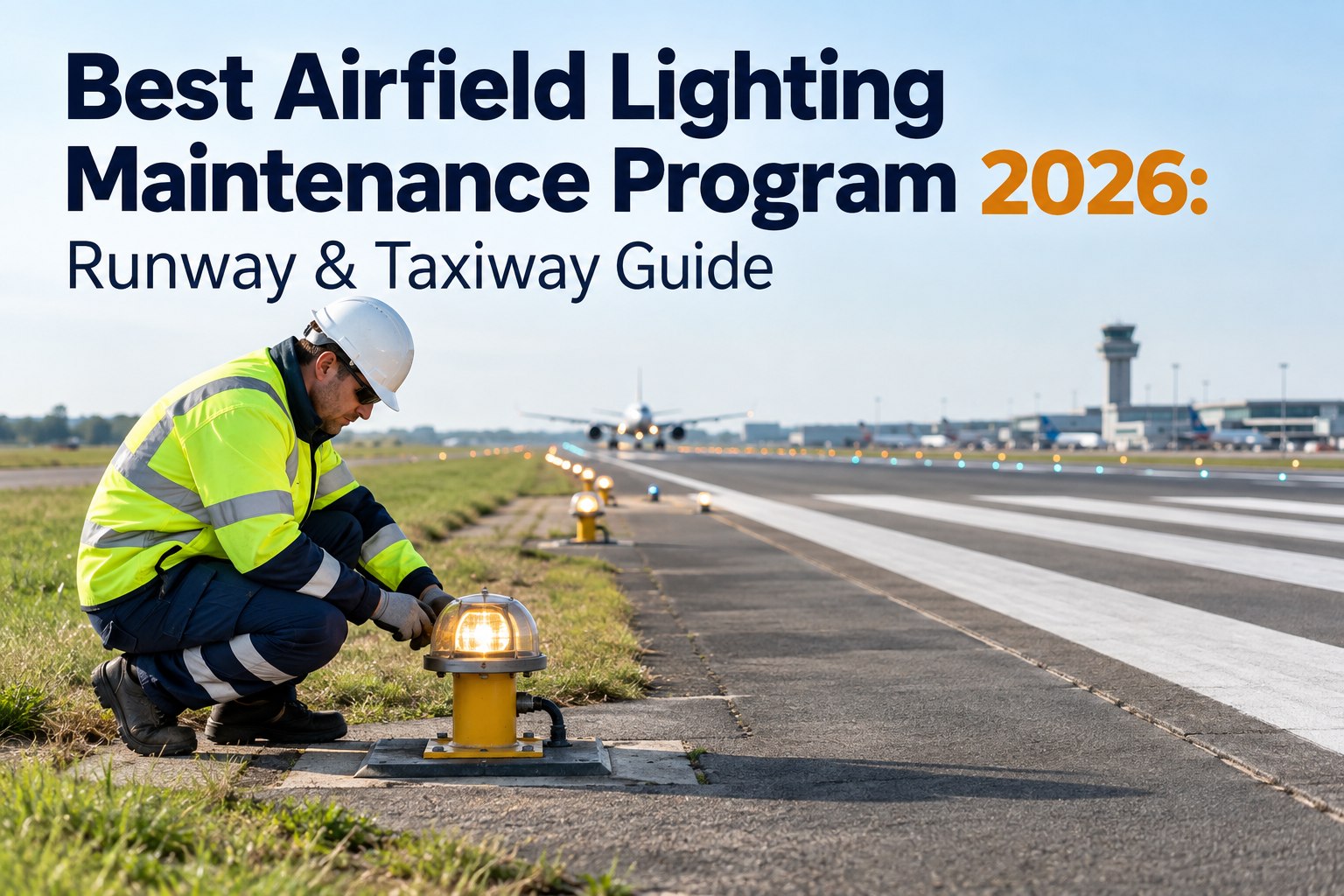
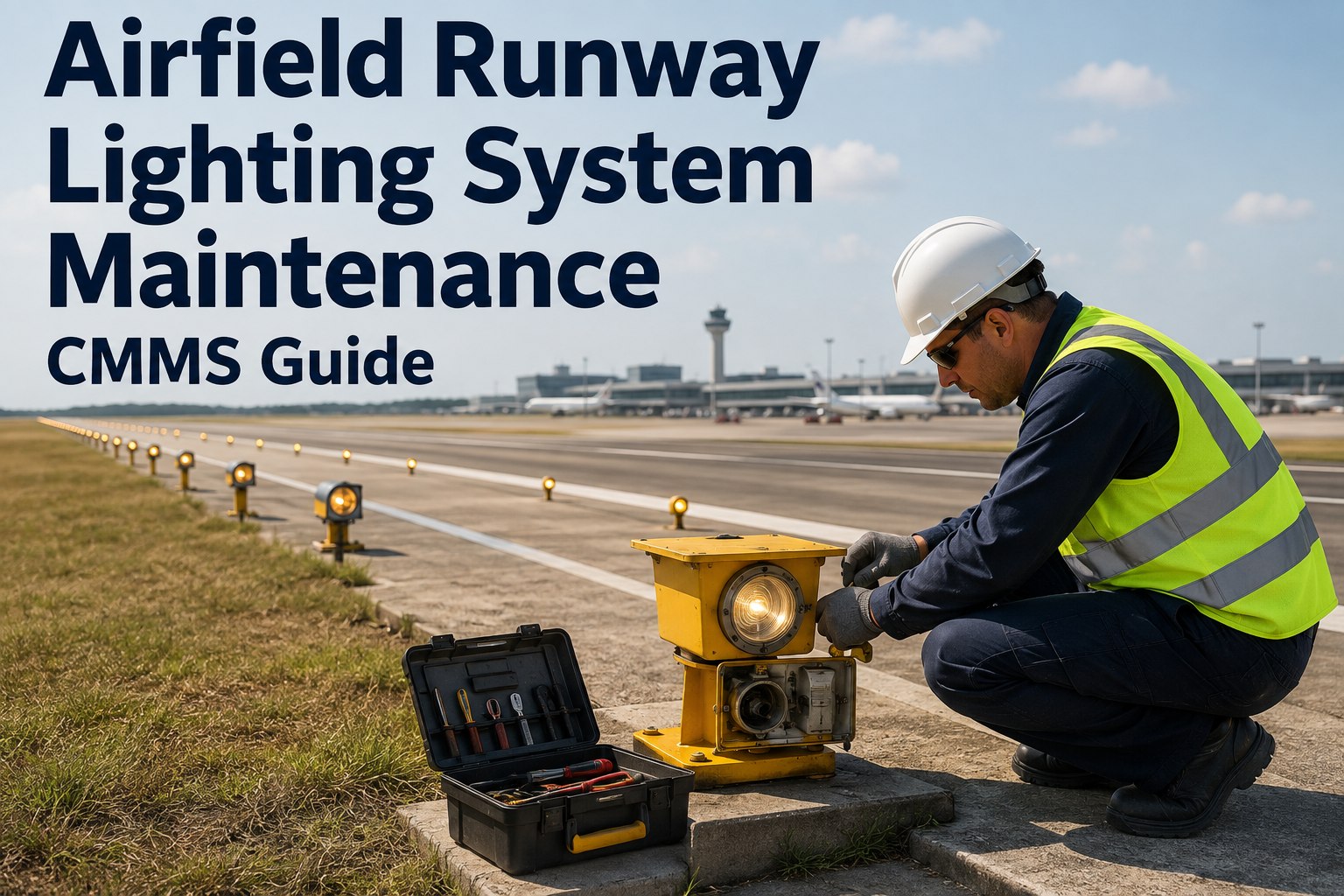
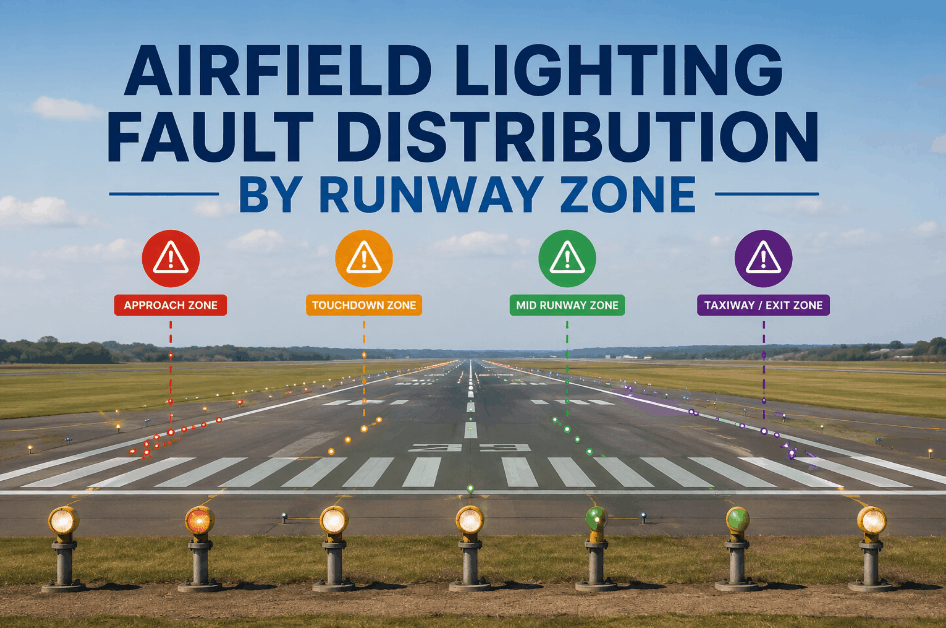
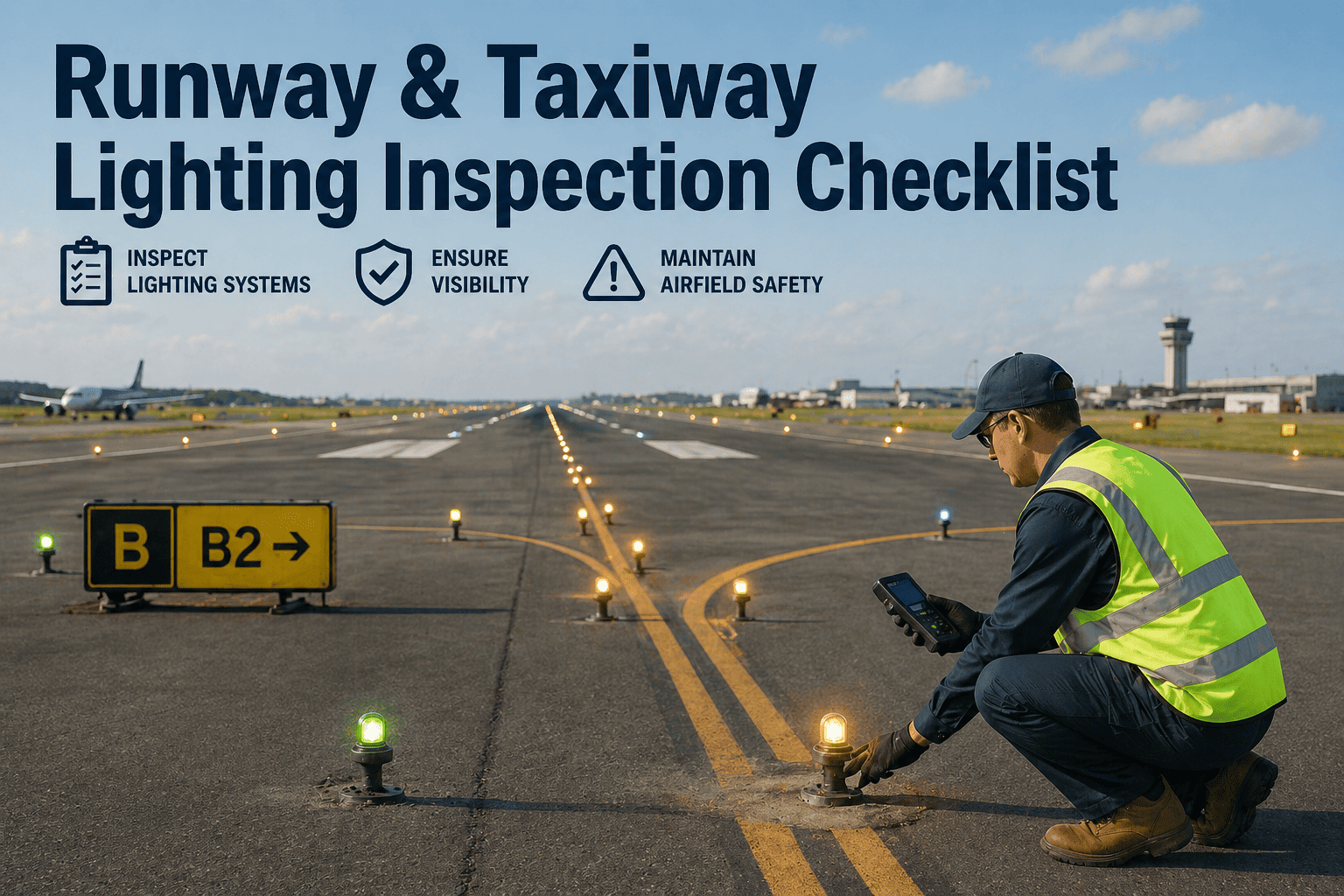
A single failed runway edge light is a maintenance task. A pattern of failed runway edge lights that disrupts pilot visual guidance continuity is an FAA compliance violation — one that can trigger NOTAMs, restrict instrument approach minimums, and in worst-case scenarios, contribute to runway incursion risk during low-visibility operations. Airport lighting systems are among the most maintenance-intensive infrastructure categories on any airfield: thousands of individual fixtures spanning runway edges, taxiway centerlines, approach light bars, PAPI units, threshold markers, guidance signs, and obstruction beacons — all operating on high-voltage series circuits that demand specialized electrical knowledge and rigorous safety protocols. FAA Advisory Circular 150/5340-26C establishes the preventive maintenance framework, including photometric testing requirements that must occur at least twice annually for precision approach runways. Yet at many Part 139 airports, airfield lighting maintenance is still tracked through paper logs, spreadsheet-based lamp replacement schedules, and manual NOTAM coordination — creating documentation gaps that compound over time until the next FAA certification inspection surfaces them. The airports achieving the highest fixture availability rates and lowest per-fixture maintenance costs are those managing their lighting infrastructure through a CMMS that treats every fixture, circuit, regulator, and control system as a tracked, scheduled, and condition-scored asset. Discover how OxMaint structures airfield lighting asset hierarchies — start a free trial to build your lighting maintenance program today.
How Visible Is Your Lighting Maintenance Program to FAA Inspectors?
Digitize fixture tracking, automate photometric testing schedules, and generate audit-ready NOTAM documentation with OxMaint's airfield maintenance platform.
The Complete Airport Lighting Ecosystem: What Maintenance Teams Actually Manage
Airport lighting is not a single system — it is a network of interdependent visual aid systems, each governed by distinct FAA specifications, maintenance tolerances, and operational criticality levels. Understanding the full scope of the lighting ecosystem is essential for structuring a maintenance program that addresses every asset class with the appropriate inspection frequency and documentation rigor.
Runway Edge Lights (HIRL/MIRL/LIRL)
White edge lights with yellow final 2,000 ft marking. Intensity settings from Step 1 to Step 5. FAA tolerance: unserviceable lights must not be adjacent or disrupt the lighting pattern. Below 70% photometric output requires immediate maintenance.
Approach Lighting Systems (ALSF/MALSR/SSALR)
Sequenced flasher configurations extending up to 2,400 ft from threshold. FAA standard: if 4+ adjacent bars or flashers are obscured, a NOTAM must be issued. Steady-burner lamps still incandescent at many airports pending LED certification.
PAPI / VASI Systems
Precision approach path indicators providing vertical guidance through red/white light transitions. Traditional halogen PAPIs consume 500W per housing; LED replacements use 85W with 50x longer lamp life. Alignment calibration is the most common maintenance driver.
Taxiway Lighting (Edge, Centerline, Lead-Off)
Blue edge lights, green centerline lights, alternating green-yellow lead-off lights at runway exits. In-pavement fixtures require frequent cleaning due to rubber deposits, fuel residue, and debris accumulation — especially in touchdown zones where aircraft wheel impact loosens mounting bolts.
Runway Guard Lights and Stop Bars
Elevated and in-pavement guard lights at runway holding positions flash yellow to alert pilots and vehicle operators. Stop bars illuminate red to prevent unauthorized runway entry. These systems interface with ATC and RWSL automation — maintenance failures create direct runway incursion risk.
Signs, Beacons, and Obstruction Lights
Illuminated guidance signs (internally lit at Class I, II, and IV airports per Part 139), rotating airport beacons, lighted wind cones, and obstruction marking. Detroit Metro converted 750 signs from incandescent to LED in a single program cycle — reducing re-lamping labor by over 80%.
The Hidden Complexity: Series Circuits, CCRs, and Why Airfield Lighting Is Different
Airfield lighting operates fundamentally differently from commercial building electrical systems — and this distinction is critical for understanding why specialized maintenance knowledge and tracking are required. Airport runway and taxiway lighting runs on series circuits powered by Constant Current Regulators (CCRs), not the parallel circuits used in standard facility electrical infrastructure. In a series circuit, every fixture is connected in sequence through isolation transformers — meaning a single fault can potentially affect an entire circuit of 50–100+ fixtures. Each CCR provides multiple brightness steps (typically 3 or 5) and must maintain precise current output regardless of load variation. Understanding this architecture is the foundation of effective airfield lighting maintenance — and a CMMS that can track circuit-level health alongside individual fixture condition provides a level of operational intelligence that paper-based programs simply cannot match. Ready to see circuit-level tracking in action? Book a demo to explore how OxMaint maps series circuit assets for airfield operations teams.
Constant Current Regulators
CCRs convert input voltage to constant current output across brightness steps. Maintenance includes thermal imaging, contact inspection, tap adjustment verification, and load balancing after LED conversions. A misadjusted CCR after LED retrofit can draw nearly identical input current as the original incandescent load — wasting the efficiency gains.
Isolation Transformers
Each fixture connects to the series circuit through an isolation transformer designed to keep the circuit operational when a lamp fails. Primary-to-secondary shorts in transformer windings create the most dangerous maintenance hazard — energized re-lamping with a shorted transformer can expose technicians to lethal voltage. Transformer testing is a non-negotiable PM task.
Lighting Vault Infrastructure
The central electrical vault houses CCRs, transfer switches, monitoring panels, and standby power connections. Vault maintenance includes environmental monitoring (temperature, humidity, ventilation), cable insulation testing, grounding system verification, and backup power transfer testing — all on documented schedules that FAA inspectors review during certification.
Control and Monitoring Systems (ALCMS)
Airfield Lighting Control and Monitoring Systems provide remote operation of CCRs and real-time circuit status. ALCMS maintenance covers software updates, sensor calibration, communication link verification, and alarm threshold configuration. 38% of airports with new LED installs now include centralized smart control systems integrated with predictive maintenance platforms.
Photometric Testing: The Maintenance Task Most Airports Underperform
Photometric testing — the measurement of individual fixture light output against FAA-specified minimum thresholds — is the single most important quality assurance activity in an airfield lighting maintenance program. FAA AC 150/5340-26C requires photometric testing of precision approach runway lighting at least twice annually, with additional testing before and after maintenance activities to verify effectiveness. Yet many airports treat photometric measurement as an annual checkbox rather than an ongoing condition monitoring discipline — creating compliance gaps and operational risk.
| Photometric Testing Parameter | FAA Standard | Maintenance Action Trigger |
|---|---|---|
| Fixture light output | Must meet minimum per AC 150/5345-46 | Below 70% of minimum requires immediate service |
| Precision approach runway fixtures | Photometric testing minimum twice annually | Pre- and post-maintenance verification required |
| Runway centerline lights (CAT II/III) | May require weekly checks per traffic density | Rubber deposits from touchdown zone are primary degradation cause |
| In-pavement fixture lens condition | Must maintain optical clarity | Pitting, crazing, or contamination below threshold requires replacement |
| Fixture alignment | Must provide accurate directional reference | Post-snowplow and post-construction verification required |
| Adjacent unserviceable fixture rule | Must not disrupt lighting pattern | Adjacent failures require priority repair to maintain pattern continuity |
A CMMS transforms photometric testing from a periodic compliance event into a continuous condition monitoring program. By tracking photometric measurements per fixture over time, maintenance teams can identify degradation curves, predict cleaning and re-lamping intervals based on actual performance data rather than fixed calendar schedules, and demonstrate to FAA inspectors a proactive, data-driven approach to fixture maintenance that goes beyond minimum compliance standards. Start building photometric testing records that satisfy FAA inspectors — start a free trial and configure your first airfield lighting PM schedule in minutes.
Incandescent vs. LED: The Airfield Lighting Transition Decision
The LED transition is no longer a question of "if" — it is a question of sequencing, budgeting, and managing the operational complexity of converting lighting systems while maintaining continuous airfield availability. Between 2019 and 2023, aviation authorities worldwide drove replacement of 1.9 million legacy fixtures, with 420,000 replacements occurring in 2023 alone. The economics are compelling, but the transition introduces its own maintenance considerations.
Critical transition rule: FAA guidance prohibits mixing LED and incandescent fixtures on the same runway or taxiway circuit — the entire circuit must be converted simultaneously to avoid visual inconsistencies that could affect pilot perception. This means LED conversion is a circuit-by-circuit capital project, not a gradual fixture-by-fixture replacement. A CMMS that maps fixtures to circuits and circuits to capital project timelines gives operations teams the planning visibility they need to sequence conversions without disrupting airfield availability.
How OxMaint Manages Airfield Lighting at Scale
Circuit-to-Fixture Hierarchy
Map every lighting circuit from vault CCR through series loop to individual fixtures, with each fixture tagged by type, location, lamp technology, installation date, and photometric history. Circuit-level dashboards show aggregate health while fixture-level records support individual service tracking.
Multi-Frequency PM Automation
Configure PM schedules that match FAA AC 150/5340-26C recommendations — daily visual rounds, weekly centerline checks for high-traffic runways, monthly CCR inspections, semi-annual photometric testing, and annual comprehensive overhauls. Every schedule auto-generates work orders with pre-built checklists.
NOTAM Integration Workflow
When lighting deficiencies meet NOTAM thresholds, OxMaint flags the condition and generates documentation that supports NOTAM issuance coordination with ATC. Digital audit trails show exactly when deficiencies were identified, reported, and resolved — closing the compliance loop that FAA inspectors evaluate.
Fixture Performance Trending
Track photometric readings, cleaning intervals, failure frequency, and repair costs per fixture over time. Identify circuits with accelerated degradation rates — pointing to environmental factors, installation issues, or equipment approaching end-of-life — before performance drops below FAA thresholds.
Lamp and Fixture Parts Management
Monitor replacement lamp inventory, fixture gasket kits, isolation transformer stock, and CCR spare parts with automatic reorder triggers. Track LED vs. incandescent inventory separately to support phased conversion programs without stockout risk on either technology.
LED Conversion Capital Planning
Use asset age, maintenance cost, and energy consumption data to build ROI models for circuit-by-circuit LED conversion sequencing. OxMaint's CapEx forecasting tools help airport finance teams prioritize conversions where maintenance cost savings and energy reduction justify the higher upfront fixture investment.
The ROI Case: What Lighting Maintenance Optimization Actually Delivers
The financial case for proactive lighting maintenance extends beyond energy savings. Every minute of unplanned runway closure for emergency lighting repair carries a direct operational cost — aircraft holding patterns, delayed departures, missed connections, and the regulatory burden of NOTAM management. A CMMS-driven maintenance program that prevents lighting deficiencies from reaching NOTAM-triggering thresholds delivers ROI through operational continuity, not just reduced lamp replacement costs. Build the business case for your lighting maintenance upgrade — book a demo to see OxMaint's cost analytics applied to your airfield lighting infrastructure.
Frequently Asked Questions
How often should airport runway lighting undergo photometric testing?
FAA AC 150/5340-26C recommends photometric testing for precision approach runway lighting at least twice annually, with frequency adjusted based on traffic density, pollution exposure, equipment reliability, and previous measurement results. Runway centerline lights on CAT II and CAT III runways may require weekly checks due to rubber deposit accumulation in the touchdown zone. Testing should occur both before and after maintenance activities to assess needs and verify effectiveness.
Can airports mix LED and incandescent lights on the same runway?
No. FAA guidance requires that an entire runway or taxiway circuit be converted to LED simultaneously — mixing technologies on the same circuit creates visual inconsistencies in color temperature, intensity, and light pattern that can affect pilot perception. This means LED conversion is planned and executed as a circuit-by-circuit capital project, which a CMMS helps manage by mapping fixtures to circuits and tracking conversion sequencing across the airfield.
What are the biggest maintenance challenges with in-pavement airfield lights?
In-pavement lights face unique degradation factors: rubber deposits from aircraft tires, lens pitting from debris impact, mounting bolt loosening from wheel loads, seal integrity compromise from freeze-thaw cycles, and contamination from fuel and de-icing fluid. These fixtures require more frequent cleaning than elevated lights, and the entire fixture unit is typically removed for shop refurbishing rather than field-serviced — making inventory management of replacement units a critical CMMS function.
What maintenance changes when an airport converts to LED lighting?
LED conversion dramatically reduces re-lamping labor — from 2x per year to once every 10+ years — but introduces new maintenance considerations. CCR tap settings must be adjusted for the lower LED load to avoid energy waste. Cold-climate airports may need defroster element maintenance since LEDs generate less heat than incandescent fixtures. Lens cleaning remains essential as LED performance is equally affected by contamination. And circuit-level monitoring becomes more important since LED failure modes differ from incandescent — LEDs may degrade gradually rather than fail suddenly.
Every Fixture Tracked. Every Circuit Monitored. Every Inspection Documented.
OxMaint gives airfield electricians and airport operations teams a single platform to manage thousands of lighting assets across runways, taxiways, and approach systems — with the compliance documentation that FAA Part 139 inspections demand.