Base maintenance events — C-checks, D-checks, and structural heavy checks — are the most capital-intensive, schedule-sensitive operations in aviation MRO. A single day of TAT overrun can cost an airline six figures in AOG penalties and slot displacement, while under-resourced work packages create airworthiness risk that no hangar manager can afford. Sign Up Free to bring your heavy-check planning, NRC tracking, and slot utilization into a single real-time platform built for base maintenance operations.
Heavy Check Planning Built for Hangar Managers
OxMaint gives base maintenance teams a C/D-check work-pack builder, NRC capture, parts pre-positioning, manhour tracking, and live TAT burndown — all in one platform designed for heavy maintenance hangars.
Why Base Maintenance Software Is a Critical Investment
Base maintenance planning is fundamentally different from line maintenance. Heavy checks involve thousands of task cards, multi-tier subcontractor coordination, regulatory documentation requirements, and dynamic scope that expands every time an access panel opens. Hangar managers running C-checks and D-checks on spreadsheets and paper work packages are operating at a structural disadvantage — one that compounds TAT risk with every untracked NRC and every mis-sequenced work order. Book a Demo to see how OxMaint's base maintenance platform eliminates the planning gaps that cause heavy check overruns. Purpose-built base maintenance software gives hangar teams the visibility and control to execute complex check events on time, on budget, and fully documented for regulatory compliance. Sign Up Free and configure your first heavy check work package in OxMaint within hours of onboarding.
Core Challenges in Heavy Maintenance Planning
Work Package Complexity
C-checks and D-checks require integrating AMM tasks, AD compliance, SB incorporation, and customer-requested modifications into a single executable work package — a process that breaks down when managed across disconnected documents and systems.
NRC Discovery and Scope Growth
Non-routine cards discovered during access and inspection routinely expand check scope by 20–35%. Without a digital NRC capture and routing workflow, findings pile up on the hangar floor while engineers wait for disposition — burning TAT hours that cannot be recovered.
Parts Pre-Positioning Failures
Heavy checks require hundreds of rotable and consumable parts staged before induction. Late parts — caused by poor pre-positioning visibility — are the single most common cause of critical path delays in base maintenance events.
Slot and Resource Conflicts
Hangar slot planning without real-time visibility into incoming check schedules, bay availability, and labor allocation creates cascading conflicts that force last-minute aircraft swaps, subcontractor overruns, and customer SLA penalties.
Manhour Tracking Gaps
Without live manhour consumption data, hangar managers can't detect labor burndown deviations until the check is already behind schedule. By the time the overrun is visible in weekly reports, recovery options are severely constrained.
Compliance Documentation Risk
Regulatory airworthiness documentation — task sign-offs, inspector stamps, AD compliance records — must be complete and traceable at check closure. Incomplete paper trails at delivery create re-work, delivery delays, and potential CAMO audit findings.
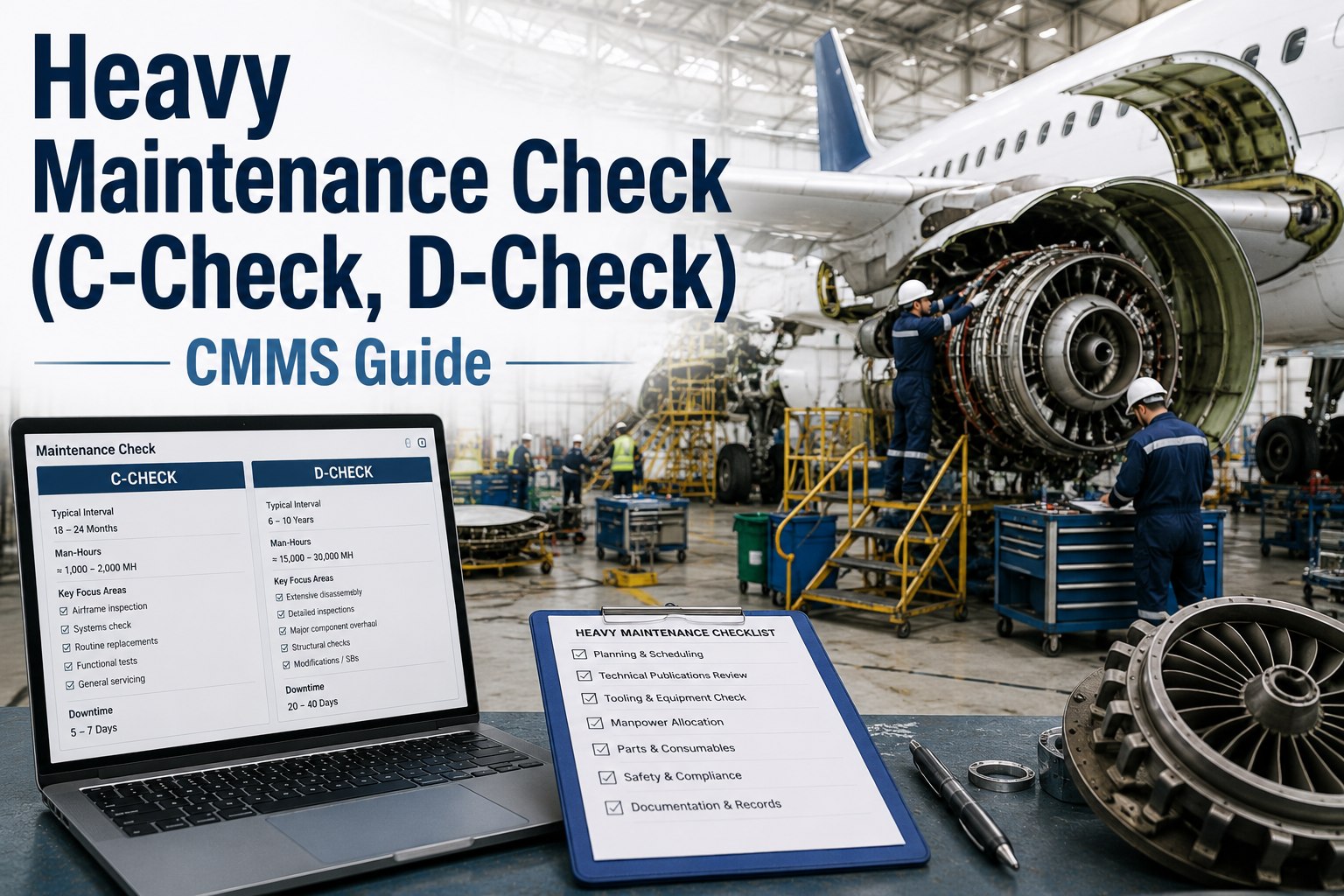
C-Check vs D-Check Planning: What Changes at Each Level
Understanding the planning differences between C-check and D-check events is essential for scoping base maintenance software requirements. Book a Demo to see how OxMaint handles both check levels within a unified work package and slot planning environment.
OxMaint Base Maintenance Software: Key Capabilities
C/D-Check Work Package Builder
Construct complete check work packages from AMM references, AD compliance requirements, SB inclusions, and operator requests — with task sequencing, dependency mapping, and zone allocation built in from day one.
Digital NRC Capture and Routing
Technicians raise NRCs at point of discovery via mobile interface. Each card is automatically routed for engineering disposition, parts request, and work scope integration — eliminating the paper backlog that stalls hangar operations.
Parts Pre-Positioning Module
Correlate work package task cards with parts demand, map procurement lead times against check induction dates, and generate pre-positioning action lists that ensure critical parts arrive before they hit the critical path.
Hangar Slot Planning Dashboard
Visualize all incoming checks across bay capacity, labor availability, and equipment requirements. Identify slot conflicts weeks ahead and resolve them before they translate into customer delivery failures and penalty exposure.
Manhour Tracking and TAT Burndown
Track manhour consumption against the planned budget in real time. Live TAT burndown charts alert hangar managers to deviation trends early enough to add shifts, reallocate trades, or escalate scope changes before overrun becomes inevitable.
Compliance Documentation and Billing
Consolidate task sign-offs, inspector records, and AD compliance documentation into a single audit-ready package at check closure — and generate billing reports tied to actual work order consumption for accurate customer invoicing.
See OxMaint Heavy Check Planning in Action
From work package build to NRC capture to TAT burndown — OxMaint gives your hangar team end-to-end visibility across every C-check and D-check event from induction to delivery.
Base Maintenance KPIs OxMaint Tracks Automatically
5 Ways OxMaint Reduces Heavy Check TAT and Cost
Eliminate Work Package Build Time with Structured Templates
OxMaint's work package builder pre-loads task card libraries, AD compliance matrices, and zone checklists for common aircraft types — reducing package build time from days to hours and ensuring no required task is omitted at induction.
Close NRCs 3x Faster with Mobile Discovery Workflows
When technicians capture findings digitally at the point of discovery — with photos, location data, and initial assessment — engineering disposition starts immediately rather than waiting for paper-based routing to complete its cycle.
Prevent Critical Path Delays with Pre-Positioning Visibility
Parts pre-positioning dashboards in OxMaint flag any required component without a confirmed procurement or staging status — giving supply chain teams a targeted action list weeks before the check induction date, not the day the task hits the floor.
Optimize Hangar Capacity with Forward Slot Planning
OxMaint's slot planning tools give hangar managers a 90-day visual of bay occupancy, induction schedules, and labor demand curves — enabling proactive capacity decisions that maximize throughput without overbooking the hangar floor. Book a Demo to walk through the slot planning module with an OxMaint solutions engineer.
Deliver Checks Audit-Ready with Automated Documentation
Task card completions, inspector sign-offs, and regulatory compliance records are captured throughout the check — not assembled at the end. At delivery, the complete airworthiness package is ready for CAMO review without last-minute documentation scrambles. Sign Up Free to configure your documentation workflows in OxMaint today.
Without vs With OxMaint: Base Maintenance Operations
- Work packages built manually across spreadsheets and Word documents
- NRCs tracked on paper forms, routed by hand, lost in shift handovers
- Parts status unknown until the task hits the hangar floor
- Slot conflicts discovered in weekly planning meetings, too late to resolve
- Manhour overruns visible only in post-check financial reports
- Structured work packages built from task libraries with full traceability
- NRCs raised, routed, and closed digitally with real-time status tracking
- Parts pre-positioning confirmed weeks before induction via automated alerts
- Slot conflicts flagged 30+ days ahead with bay utilization forecasting
- Live TAT burndown and manhour deviation alerts mid-check, not after
Frequently Asked Questions: Base Maintenance Software
What is base maintenance software?
Base maintenance software is a platform purpose-built for planning, executing, and documenting heavy maintenance checks — C-checks, D-checks, and structural events — in MRO hangars. It manages work packages, NRC capture, slot planning, parts pre-positioning, and compliance documentation in a single integrated system.
How does OxMaint's work package builder handle NRC scope growth?
OxMaint's digital NRC capture workflow lets technicians raise findings at point of discovery via mobile. Each NRC is automatically integrated into the work package, routed for engineering disposition, and tracked against TAT — preventing the backlog that causes critical path delays.
Can OxMaint support both C-check and D-check planning simultaneously?
Yes. OxMaint's slot planning and work package modules support multiple concurrent check events across hangar bays, with independent TAT burndown, manhour tracking, and NRC queues per aircraft — giving hangar managers full multi-check visibility from a single dashboard.
How does parts pre-positioning work in OxMaint?
OxMaint correlates work package task cards with required parts, maps procurement lead times, and generates pre-positioning action lists with target staging dates. Supply chain teams receive automated alerts for any parts at risk of arriving after the task hits the critical path.
Does OxMaint generate base maintenance billing reports?
Yes. OxMaint ties billing to actual work order consumption — materials, labor, NRC scope additions — enabling accurate customer invoicing at check delivery without manual reconciliation between planning and finance systems.
How quickly can a hangar team onboard to OxMaint for heavy check planning?
Most base maintenance teams configure their first work package template and hangar slot plan within the first week of OxMaint onboarding. OxMaint's implementation team provides structured onboarding tailored to heavy maintenance operations.
Build Your Next C-Check Work Package in OxMaint
Give your hangar team the work package builder, NRC workflows, slot planning tools, and live TAT burndown they need to deliver every heavy check on time, on budget, and fully documented from induction to delivery.