Engine shop managers running CFM56, V2500, GEnx, and PW1100 fleets face a precision problem that generic CMMS platforms were never built to solve. Every shop visit demands traceable workscope control from induction to release — and without purpose-built engine maintenance software, LLP cycle burn, EGT margin recovery, and build-spec configuration live in disconnected spreadsheets that break at the worst possible moment. Sign Up Free to see how OxMaint's engine shop module gives your team a single traceable record for every engine moving through your facility — workscope builder, borescope evidence capture, module tracking, and release documentation in one connected platform.
Engine MRO · Blog · 2026
Engine Maintenance Software for Shop Managers: Workscope, LLP Tracking & Engine Record Control
Purpose-built engine shop visit software for CFM, V2500, GE, and Pratt fleets — with LLP tracking, EGT margin monitoring, borescope evidence capture, and traceable engine records from induction to release.
100%Traceable engine record from induction to release — every task, part, and inspection logged
LLPLife-limited part cycle tracking per module, per engine, per fleet — no spreadsheet required
EGTMargin monitoring and workscope scope decisions supported by performance restoration data
OEMBuild-spec configuration for CFM56, V2500, GEnx, PW1100, and mixed-type fleets
2026 Engine Shop Visit Challenges — What Shop Managers Are Actually Dealing With
Engine shop visits are the highest-cost, highest-risk maintenance events in commercial aviation MRO. A single CFM56 or V2500 shop visit generates hundreds of work order tasks, dozens of LLP cycle status checks, borescope evidence packages, and a build-spec configuration file that must be traceable through every teardown and build stage. In 2026, engine shop managers report that workscope creep, LLP tracking gaps, and manual release documentation are the three largest contributors to unplanned cost exposure and TAT overrun. Book a Demo to see how OxMaint structures engine shop visit control from quote to release across all engine types in your fleet.
Engine Shop Visit Management — Common Failure Points by Stage
5 Engine Shop Visit Control Problems OxMaint Solves
Engine shop visit management fails at predictable points. The five problems below account for the majority of unplanned cost, TAT overrun, and airworthiness documentation exposure that engine shop managers report across CFM, V2500, GE, and Pratt programs. Book a Demo to walk through how OxMaint's engine shop module addresses each one with structured digital workflows.
01
Workscope Traceability from Quote to Release
Engine workscopes built from prior visit notes or memory introduce undocumented scope assumptions that surface mid-build. OxMaint's workscope builder creates a digital, task-level workscope at induction — linked to engine serial, module status, and LLP cycle data — so every scope decision is documented from the first day of the visit.
02
Life-Limited Parts Cycle Tracking Per Engine
LLP cycle errors are an airworthiness event, not a maintenance inconvenience. OxMaint tracks life-limited part cycles per part, per module, and per engine serial — with cycle status visible at induction so workscope decisions and part replacement logic are based on verified data, not recalculated spreadsheet fields.
03
Borescope Evidence Capture Linked to Task Record
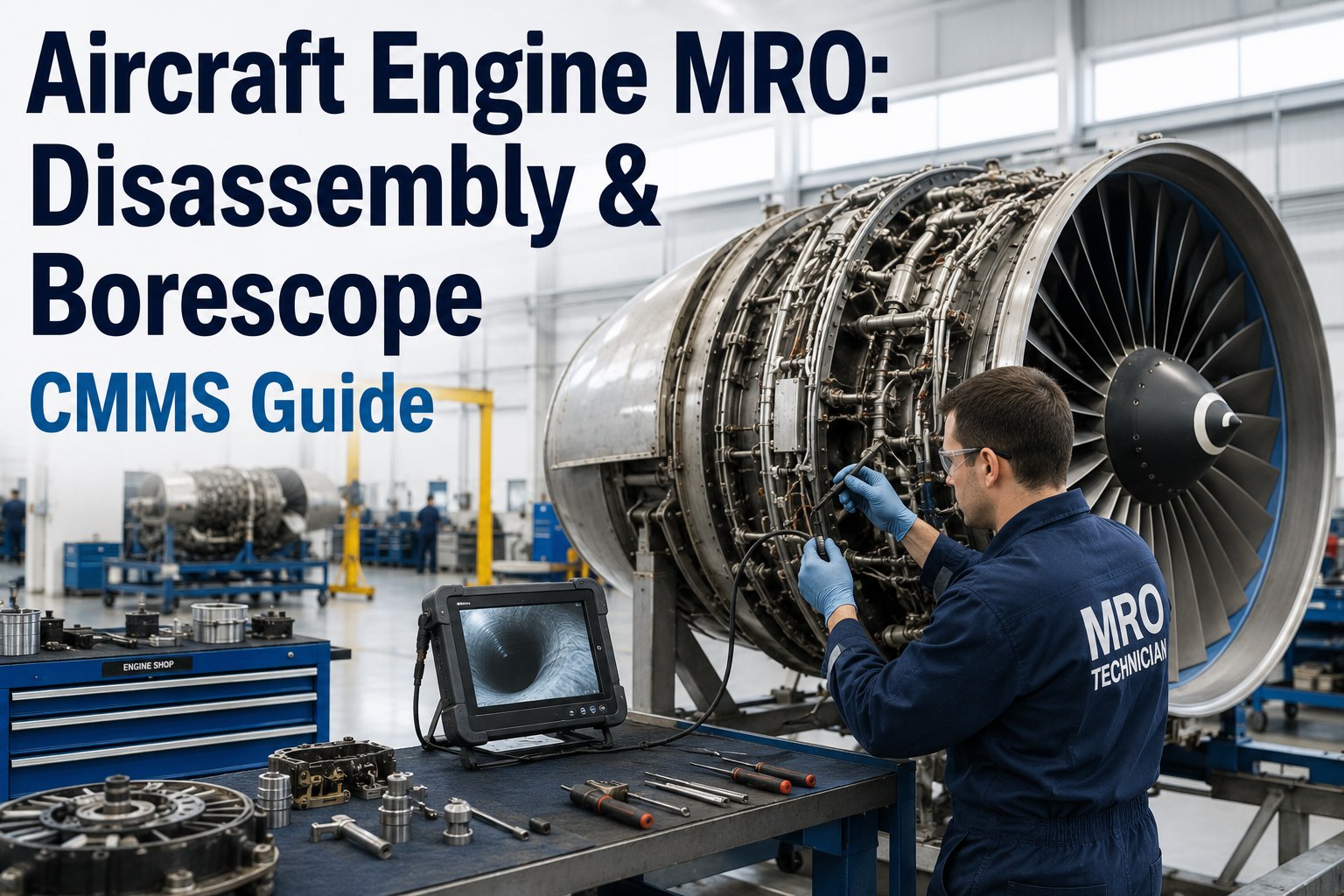
Borescope findings stored in shared drives or email threads cannot be linked to a specific task, stage, or engine serial at release time. OxMaint captures borescope images directly within the task record — timestamped, task-linked, and included in the release documentation package without manual compilation.
04
EGT Margin Monitoring and Workscope Optimization
EGT margin decisions drive the difference between a minimum-scope visit and a full performance restoration — a cost delta that can exceed $500,000 per engine on high-cycle narrowbody types. OxMaint connects EGT margin data to workscope scope decisions, giving shop managers a documented rationale for restoration scope at every visit.
05
Build-Spec Configuration and Release Documentation
Build-spec configuration errors found at release — or after return to service — generate non-conformance findings, airworthiness directives, and TAT penalties that dwarf the cost of the original shop visit. OxMaint maintains a version-controlled build-spec per engine with an approval chain, and auto-assembles the full traceable engine record at release.
Engine Type Coverage — CFM, V2500, GE, and Pratt Fleet Support
OxMaint's engine shop module is configured for the engine types that drive commercial MRO volume in 2026. Whether your shop handles CFM56 lease returns, V2500 performance restoration, GEnx workscope builds, or PW1100 inductions, OxMaint provides engine-type-specific task libraries, LLP limits, and build-spec templates that eliminate the manual setup work required to start each visit. Sign Up Free to connect your first engine type and run a workscope build against live LLP data.
CFM56 Series
CFM56-3 / -5B / -7B
Task library, LLP limits, module tracking, EGT margin data integration
Narrowbody workhorse — highest shop visit volume in most commercial MRO facilities
Full workscope builder with CFM56 module-level LLP cycle tracking and build-spec control
V2500 Series
V2500-A1 / -A5 / -D5
Performance restoration workscope, HPT/LPT tracking, borescope evidence capture
High-value performance restoration visits with complex module interaction dependencies
EGT margin decision support and traceable V2500 engine record from induction to release
GEnx / PW1100G
GEnx-1B / -2B · PW1100G-JM
Next-gen engine type support, LEAP compatibility roadmap, composite module handling
Widebody and next-gen narrowbody shop visits with higher complexity module builds
Build-spec configuration and LLP tracking for composite-intensive, digitally-monitored engine types
Where Engine Shop Visit Cost Escapes — and How OxMaint Contains It
Cost overrun on engine shop visits concentrates in four measurable categories. Each is traceable, preventable, and recoverable with structured workscope and documentation control.
Engine Shop Visit Cost Leakage — Source and Recovery Potential
Unplanned workscope expansion mid-build
Undocumented scope assumptions at induction cause late task additions
Highest TAT and cost impact — contained by workscope builder at induction
LLP cycle status rework at release
Cycle errors found at release trigger documentation rework and TAT delay
Eliminated by per-part LLP tracking verified at induction, not release
Borescope documentation gaps at airworthiness release
Missing or unlinked inspection evidence delays release sign-off
Resolved by task-linked evidence capture throughout the visit
Over-restoration from conservative EGT scope decisions
Without margin data, workscope defaults to maximum restoration scope
EGT margin integration targets restoration scope to actual performance gap
Total traceable cost exposure per engine visit:
Workscope · LLP · Borescope · EGT — all controlled in OxMaint
How OxMaint's Engine Shop Module Replaces Disconnected Visit Management
OxMaint was built for maintenance operations teams that cannot afford documentation gaps, cycle tracking errors, or workscope surprises on high-value engine assets. The engine shop module provides a single connected record for every engine moving through your facility — from induction workscope build to LLP cycle verification, borescope evidence package, build-spec approval, and release documentation. Sign Up Free and connect your first engine type to OxMaint's workscope builder and LLP tracking module today.
100%
Traceable workscope from induction task-1 to release sign-off
Every task, part, inspection, and scope decision linked to the engine serial record — no reconstruction at release.
Zero
LLP cycle status assumptions — verified data at every induction
OxMaint's per-part cycle tracking eliminates the spreadsheet recalculation risk that drives airworthiness exposure.
TAT
Reduction from documentation rework elimination at release
Release packages assembled from live task records — not compiled from email threads and shared drives the week before sign-off.
Multi
Engine type support — CFM, V2500, GEnx, PW1100 in one platform
Engine-type-specific workscope libraries and LLP limits eliminate manual setup for each new shop visit type in your facility.
Purpose-Built Engine Shop Visit Software — Workscope to Release, One Platform
OxMaint's engine shop module gives shop managers traceable workscope control, LLP cycle verification, borescope evidence capture, and auto-assembled release documentation for CFM, V2500, GEnx, and PW1100 fleets. Free to start.
Frequently Asked Questions
What engine types does OxMaint's engine maintenance software support?
OxMaint supports CFM56 (-3, -5B, -7B), V2500 (-A1, -A5, -D5), GEnx (-1B, -2B), and PW1100G-JM engine types with type-specific task libraries, LLP limits, and build-spec templates. Mixed-fleet facilities can manage all engine types from a single platform.
Sign Up Free to connect your first engine type.
How does OxMaint handle life-limited parts tracking for engine shop visits?
OxMaint tracks LLP cycles per part, per module, and per engine serial number. Cycle status is verified at induction — not recalculated from spreadsheets at release — eliminating the cycle burn errors that create airworthiness documentation exposure.
Can borescope inspection evidence be linked directly to engine work orders in OxMaint?
Yes. OxMaint captures borescope images within the task record — timestamped and engine-serial-linked — and automatically includes them in the release documentation package. No manual compilation or shared drive retrieval at release.
Book a Demo to see the evidence capture workflow.
Does OxMaint support EGT margin tracking and workscope optimization for performance restoration visits?
OxMaint connects EGT margin data to workscope scope decisions, providing a documented rationale for restoration scope at every visit. This prevents over-restoration on engines with acceptable margin and ensures minimum-scope decisions are traceable for airworthiness purposes.
How does OxMaint improve engine shop visit TAT and release documentation?
Because every task, inspection, part, and scope decision is recorded in the engine's live digital record throughout the visit, OxMaint auto-assembles the complete release documentation package at sign-off — eliminating the manual compilation rework that is the most common source of TAT overrun at release.
Book a Demo to walk through the release workflow.
Is OxMaint suitable for independent engine MRO shops as well as airline in-house engine facilities?
Yes. OxMaint is used by both independent engine MRO shops managing multi-customer, multi-engine-type workloads and airline in-house engine facilities managing their own fleet visit programs.
Sign Up Free to configure OxMaint for your facility type.
What is the difference between OxMaint and a generic CMMS for engine shop visit management?
Generic CMMS platforms manage work orders and PM schedules — they are not built for engine-serial-level LLP cycle tracking, borescope evidence capture linked to airworthiness tasks, or build-spec configuration control. OxMaint's engine shop module provides the precision-level traceability that engine shop visits require and generic platforms cannot deliver.
From Induction to Release — Every Engine Visit Traceable, Every LLP Verified, Every Record Complete
OxMaint's engine shop module replaces disconnected workscope spreadsheets, shared-drive borescope folders, and manual release compilation with a single traceable digital record for every CFM, V2500, GEnx, and PW1100 engine in your facility. Free to start. No hardware required.