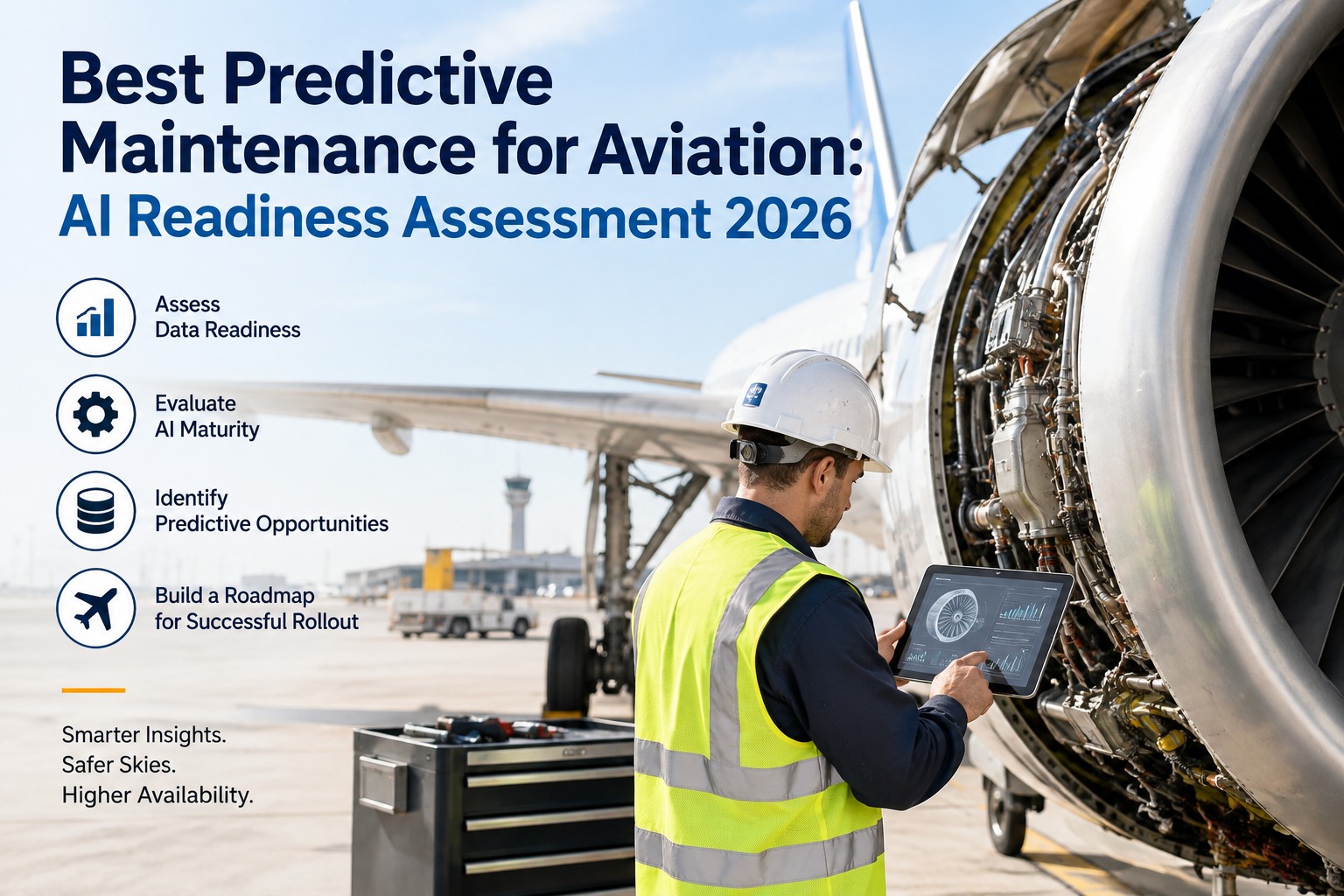
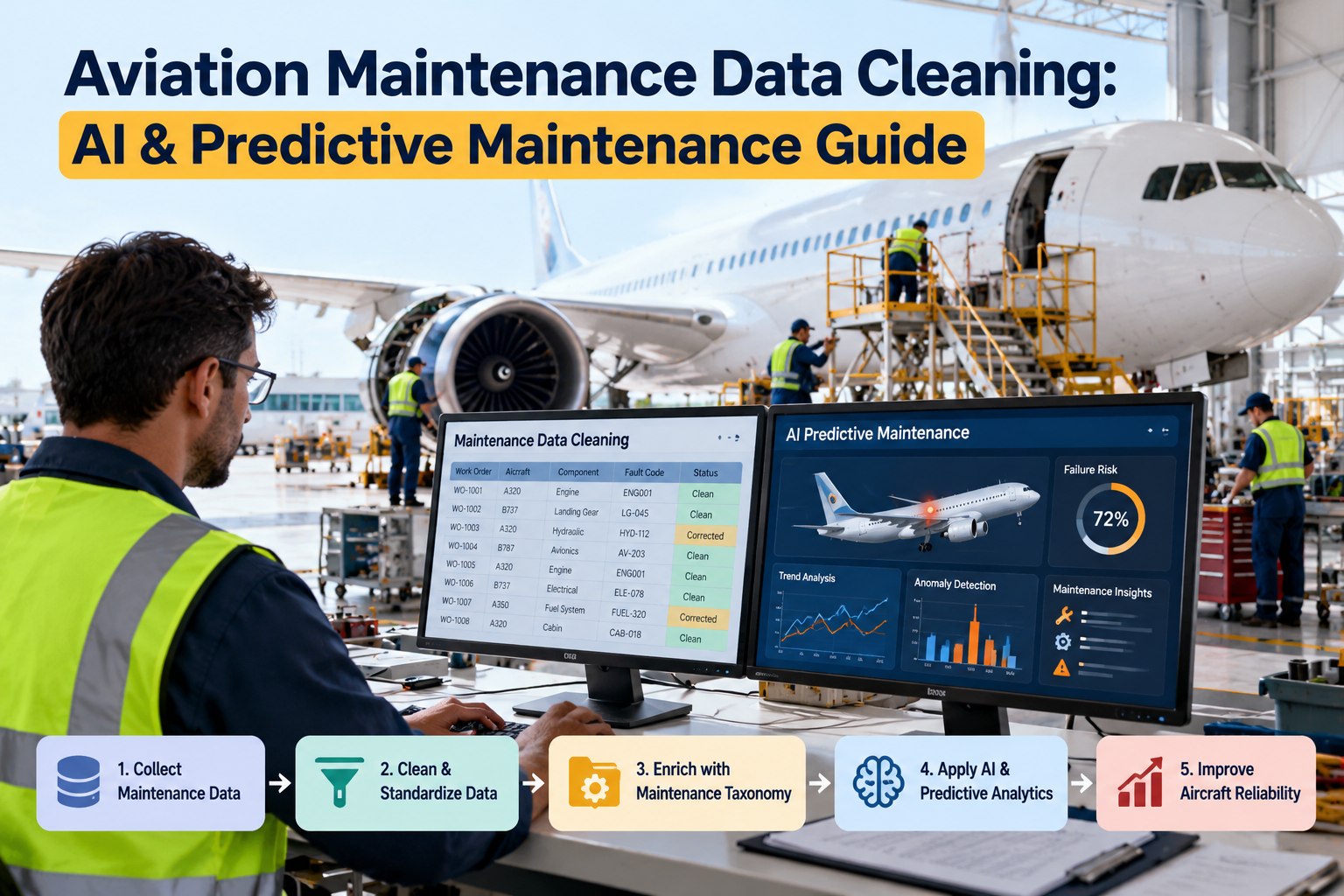
Most failed aviation predictive maintenance programs don't fail because the AI model was bad — they fail because nobody checked whether the plant's data could support a model in the first place. Sensors get purchased, a vendor gets engaged, a pilot launches on a handful of assets, and six months in, someone discovers the failure history is too thin to validate anything, or half the "sensor data" is actually manually transcribed readings with gaps nobody flagged. Readiness assessment isn't a formality before a predictive maintenance rollout — it's the difference between a program that produces a trustworthy first alert and one that quietly gets ignored after the third false positive. This guide walks through the five dimensions worth scoring honestly before committing budget.
Aviation Predictive Maintenance · AI Readiness Assessment · 2026
Score Your Readiness Before You Buy the Sensors
A predictive model trained on incomplete failure history or unvalidated sensor feeds doesn't fail loudly — it fails quietly, by being wrong often enough that technicians stop trusting it. OXMAINT AI starts with what's already in your CMMS: work order history, inspection records and asset data, scored against the five readiness dimensions that actually determine whether a predictive rollout is worth starting yet.
5 dimensions
sensor coverage, data quality, failure history, model validation, change management
Garbage in
a model trained on incomplete or inconsistent data won't outperform the data feeding it
Years, not months
meaningful failure-pattern training typically needs a multi-year history, not a single quarter
1 gate
a clear go/no-go checkpoint before committing budget to a pilot
The Five Readiness Dimensions
Score each one honestly, not optimistically — a low score here is cheaper to find now than after the pilot has already burned a quarter. Start free and see where your own asset data currently stands.
01
Sensor Coverage
"Do the assets we want to predict on actually have sensors reporting reliably?"
A predictive program can't run ahead of instrumentation — gaps in coverage become gaps in what the model can ever see.
02
Data Quality
"Is our asset hierarchy consistent, and is sensor data clean, timestamped and complete?"
Inconsistent asset IDs, missing timestamps and manual transcription gaps quietly poison every model trained on top of them.
03
Failure History
"Do we have enough documented failure events, with cause, to actually train a pattern on?"
A model needs real failure examples to learn from — not just healthy-state data with no labeled outcomes.
04
Model Validation
"How will we confirm a prediction is right before we act on it operationally?"
Without a defined validation process, the first wrong alert is also the first time anyone questions whether the model works at all.
05
Change Management
"Will technicians actually act on a predictive alert, or route around it like every other dashboard?"
The best model in the world does nothing if the alert doesn't reach someone who trusts it enough to open a work order.
Where Does Your Program Actually Sit?
Readiness isn't binary — it's a maturity ladder, and most programs are lower on it than they'd like to believe. Book a demo to see an honest assessment of where you sit today.
Ad Hoc
Failure data scattered across paper, spreadsheets and memory. No consistent asset hierarchy.
Tracked
Work orders and inspections logged digitally, but sensor data and failure history aren't yet linked together.
Structured
Clean asset hierarchy, sensor feeds flowing reliably, failure events labeled with cause — model-ready data.
Validated
A pilot model's predictions have been checked against real outcomes and shown to be reliable enough to act on.
Scaled
Predictive alerts routinely convert into trusted work orders across multiple asset classes, not just the pilot.
Your CMMS Data Is the Readiness Assessment
OXMAINT AI scores your existing work order history, inspection records and asset hierarchy against these five dimensions — so you know exactly where the gaps are before committing budget to sensors or a model, not after.
Red Flags That Mean You're Not Ready Yet
These are common signs a program should invest in data foundations before a predictive pilot, not after one stalls. Sign up free and start closing these gaps in your existing data.
⚠️
Asset IDs are inconsistent across systems — the same tail number or component recorded differently in different logs.
⚠️
Failure cause isn't recorded — work orders note "fixed" without documenting what actually failed and why.
⚠️
Sensor data has undocumented gaps — outages nobody flagged, silently treated as "normal" by anything trained on it.
⚠️
No plan to validate a prediction before acting on it operationally — the model's first real test is a live decision.
⚠️
Technicians weren't part of scoping — the people expected to trust and act on alerts weren't consulted before rollout.
⚠️
No baseline reactive cost to compare against — without one, it's impossible to tell if the program is actually working.
The Go / No-Go Gate
Before scoping a pilot, these should all be true — not aspirational, not "in progress." Book a demo to run this gate against your own program.
✓
Sensor coverage confirmed reliable on the specific assets targeted for the pilot.
✓
Asset hierarchy and identifiers consistent across every system feeding the model.
✓
Enough labeled failure history exists to give a model real patterns to learn from.
✓
A validation process is defined for checking predictions against real outcomes.
✓
Technicians who'll act on alerts have been part of scoping the pilot, not just informed of it.
Frequently Asked Questions
How much historical failure data do we actually need before starting a predictive pilot?
There's no universal number — it depends on how frequently the target failure mode occurs — but a model needs enough real, labeled failure examples to learn an actual pattern from, not just a handful of anecdotal cases. Multiple years of consistent history is generally more useful than a few recent, thin months.
Can we start a predictive maintenance program if our data isn't perfect yet?
Yes, but scope the pilot to match the readiness level honestly — starting on the asset class with the cleanest data and best sensor coverage, rather than the whole fleet at once, is generally more likely to produce a trustworthy first result.
What's the difference between condition monitoring and true predictive maintenance?
Condition monitoring reports current sensor readings and simple threshold alerts. Predictive maintenance uses historical failure patterns to forecast a future failure before it happens — which requires the labeled failure history and validation process that condition monitoring alone doesn't need.
Why does change management matter as much as the data or the model?
A technically sound prediction that technicians don't trust or act on produces no operational value — it just becomes another alert people learn to ignore. Readiness on the people and process side is as important as readiness on the data side.
Can OXMAINT AI help assess our readiness before we invest in sensors or an AI vendor?
Yes — OXMAINT AI existing work order history, inspection records and asset hierarchy data can be reviewed against these five readiness dimensions to identify specific gaps, before committing budget to sensor hardware or a predictive modeling engagement.
Know Where the Gaps Are Before You Spend the Budget.
Score sensor coverage, data quality, failure history, model validation and change management honestly — and scope your first predictive pilot on solid ground, not a hopeful guess.