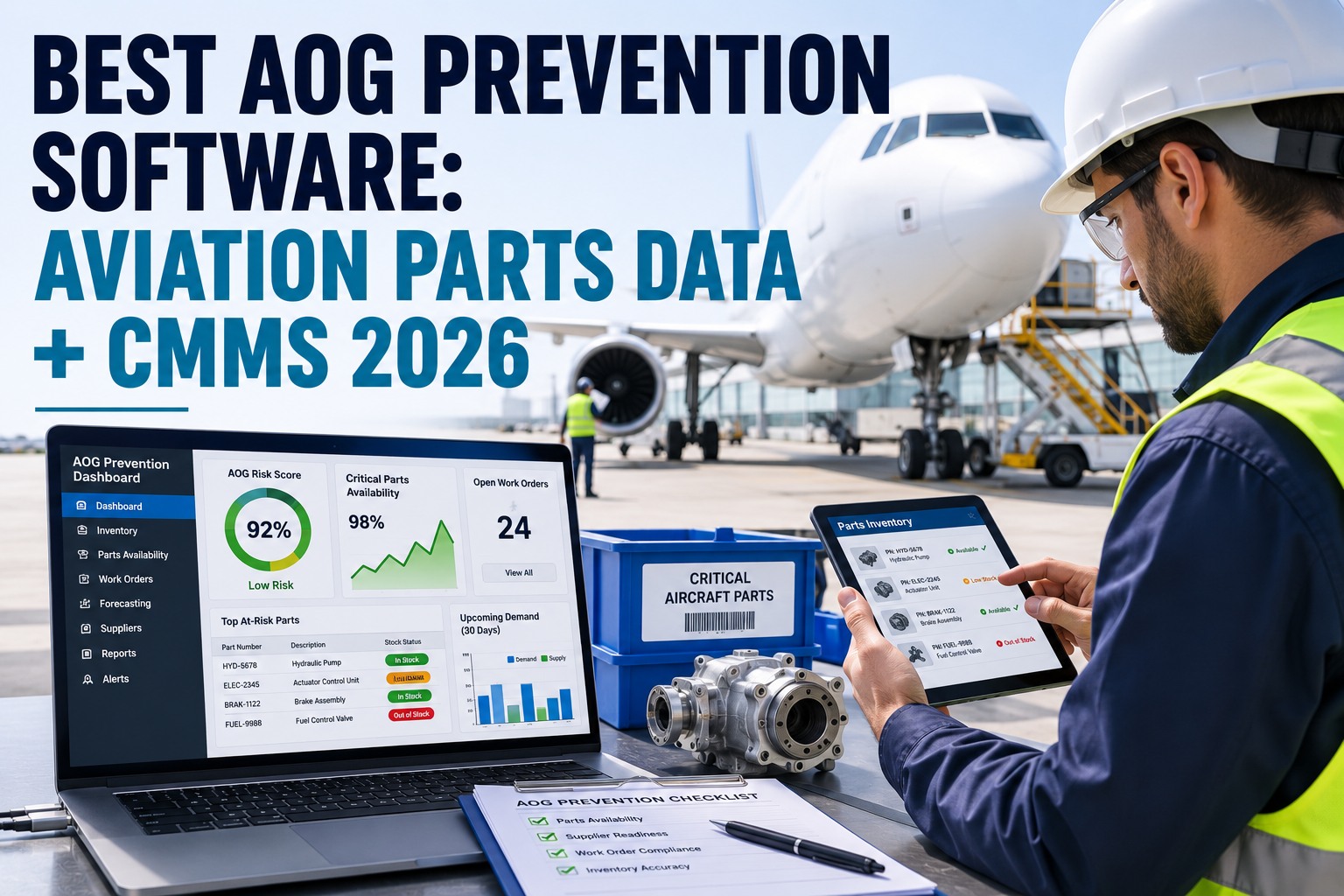
Most AOG events aren't bad luck — they're a data problem wearing a supply-chain costume. When an aircraft is grounded waiting on a part, the cost runs $10,000 to $150,000 an hour, yet 73% of AOG events involve parts that were entirely foreseeable from historical consumption. The part that grounds the jet is usually one somebody could have seen coming. This guide covers AOG prevention through parts data quality: why AOG happens, what good parts data looks like, the levers that prevent the scramble, and how a CMMS makes it repeatable. Book a free AOG-risk review.
Most AOG Events Are Foreseeable — And Preventable
The part that grounds the aircraft is usually one the data already flagged. AOG is a parts-data problem first.
$10–150K/hr
Cost of an aircraft grounded waiting on a part
73%
Of AOG events involve parts foreseeable from consumption history
4.8x
Cost premium of emergency AOG procurement vs planned
40%
Fewer parts-driven AOG events with integrated inventory + CMMS
The Inventory Trap · Why Carrying More Doesn't Work
The instinct is to solve AOG by stocking more of everything. But that just creates the opposite problem alongside the first — capital locked in dead stock while the critical part is still missing. This is the trap real parts data is built to escape.
Overstock
23–30%
of inventory value in slow-moving or obsolete stock
Capital sits permanently locked in parts that won't be consumed at current fleet composition — money that can't fund the parts you actually need.
Stockout
62%
of planners have low confidence in their reorder points
At the same time, the critical component runs short — because static min/max levels and category averages can't see individual-part demand.
The trap is that both happen at once: too much capital in parts that never move, and stockouts on the parts that ground aircraft. More inventory doesn't fix it — better parts data does, by stocking to real demand at the individual part-number level.
What Good Parts Data Actually Looks Like
AOG prevention rests on knowing each part as its own object — its category, its behavior, its lead time, its paperwork. Aviation parts fall into distinct classes, and each needs different data to be managed well.
Rotables
High-value serialized components tracked removal to repair to return-to-service — 60–70% of total inventory value. Untracked rotables are financial and compliance exposure at once.
Expendables & Consumables
Gaskets, seals, fasteners, filters consumed on installation. Need batch tracking, min/max levels, and usage-rate forecasting — cheap individually, AOG-causing in aggregate.
Shelf-Life Items
Adhesives, sealants, lubricants, rubber with expiry dates. Need automated alerts at 90, 30, and 7 days — an expired part is a stockout you already paid for.
Airworthiness Documentation
Every part needs traceability — 8130-3 tags, serialization, batch records — for FAA Part 145/121, EASA, and GCAA. Missing paperwork grounds a part as surely as a missing part.
Find Your Foreseeable AOG Risk in 30 Minutes
Working session with our aviation team — bring your parts and consumption data. We'll surface the foreseeable stockouts, flag capital trapped in dead stock, and show how OxMaint turns parts data into reorder triggers and pre-staged work orders.
The Prevention Levers
Turning parts data into AOG prevention comes down to four moves. Each attacks a different cause of the ground-time scramble, and together they shift procurement from reactive to planned.
01
Forecast Demand at the Part-Number Level
Model consumption from flight cycles, fleet age, and failure history per part — not category averages. Accurate forecasting cuts excess stock up to 25% while eliminating critical stockouts.
02
Set Reorder Points on Real Lead Times
Aerospace lead times run from days to 18+ months. Reorder points tied to actual supplier lead time prevent the scramble that forces emergency sourcing at 3–5x standard cost.
03
Pre-Position for Planned Maintenance
C-checks and heavy visits generate large, predictable parts demand. Tie parts to the maintenance schedule to pre-stage stock ahead of hangar entry — with a demand signal weeks out.
04
Track Metrics Leadership Can See
Fill rate, stockout frequency, excess-stock percentage, AOG emergency buys, inventory turnover — reported monthly. What doesn't get measured doesn't improve.
Reactive Part-Chasing vs Data-Driven Prevention
The whole shift AOG prevention delivers is from chasing parts after the aircraft is grounded to seeing the need before it becomes an emergency. The contrast shows up on every line of the operation.
Reactive Part-Chasing
Stockout discovered mid-maintenance
Emergency sourcing at 4–6x freight cost
Static min/max from category averages
Capital trapped in dead stock and short on criticals
Parts knowledge lives in one planner's head
Data-Driven Prevention
Need forecast weeks before the failure
Planned procurement at standard rates
Reorder points on real per-part demand
Stock matched to actual consumption
Parts data lives in the system, not tribal memory
How OxMaint Prevents Parts-Driven AOG
OxMaint is the operating system airports and MROs use for this program — asset hierarchies mapped to the real operation, PM and inspection automation, mobile execution, IoT integration, and reporting that turns parts data into decisions, from one dashboard on desktop or mobile.
Structure
Parts Tied to Assets
Every part linked to the asset and task it serves in an asset hierarchy mapped to the real operation — so demand traces to actual maintenance, not a guess.
Track
Rotables & Traceability
Serialized rotable tracking removal to return, batch records, and 8130-3 documentation — defensible audit trails for FAA Part 145/121, EASA, and GCAA.
Forecast
Consumption-Based Demand
Model usage from flight cycles, fleet age, and failure history to set stock at the part-number level — cutting both excess and stockout.
Reorder
Lead-Time-Aware Triggers
Automated reorder triggers on real supplier lead times, with max-stock rules and 90/30/7-day shelf-life alerts to stop overbuying and expiry loss.
Stage
Parts-Confirmed Work Orders
Confirm the right parts and certifications are at the station before a task starts — pre-positioning stock ahead of planned checks, mobile-first.
Report
Fill Rate & AOG Metrics
Track fill rate, stockout frequency, excess stock, and AOG buys for leadership monthly — with SAP and Maximo overlay across every base.
Give Maintenance an Operating System That Lasts
Prevent the foreseeable AOG, free the capital trapped in dead stock, and build a parts program that survives leadership changes and turnover. See how OxMaint turns parts data into fleet availability. Free forever plan available.
Frequently Asked Questions
What is AOG and what does it cost?
AOG — Aircraft on Ground — is when an aircraft can't fly until a maintenance issue is fixed, often because a part isn't available. It costs roughly $10,000 to $150,000 per hour in lost revenue, crew, passenger compensation, and slot penalties, and emergency procurement to resolve it runs about 4.8 times the planned cost.
Book a risk review.
How is AOG a parts-data problem?
Because 73% of AOG events involve parts that were foreseeable from historical consumption patterns. The part that grounds the aircraft is usually one whose demand the data already showed — so with accurate per-part consumption data and reorder points, most of these become planned buys instead of emergencies.
Doesn't holding more spare parts prevent AOG?
Not by itself. Carrying more creates the inventory trap — 23–30% of stock value sits in slow-moving or obsolete parts while critical components still run short. The fix is stocking to real demand at the part-number level, not stocking more of everything.
Start free.
How much can data-driven parts management reduce AOG?
Operations using integrated inventory and CMMS platforms cut parts-driven AOG events by an average of 40% within 12 months, while forecasting trims excess stock up to 25% and maintains high parts availability — cutting emergency-sourcing premiums at the same time.
How does OxMaint help prevent AOG?
It ties every part to the asset and task it serves, tracks rotables and 8130-3 traceability for compliance, forecasts demand from consumption history, sets lead-time-aware reorder triggers with shelf-life alerts, confirms parts are staged before a task starts, and reports fill rate and AOG metrics to leadership — with SAP and Maximo overlay. A free forever plan is available.