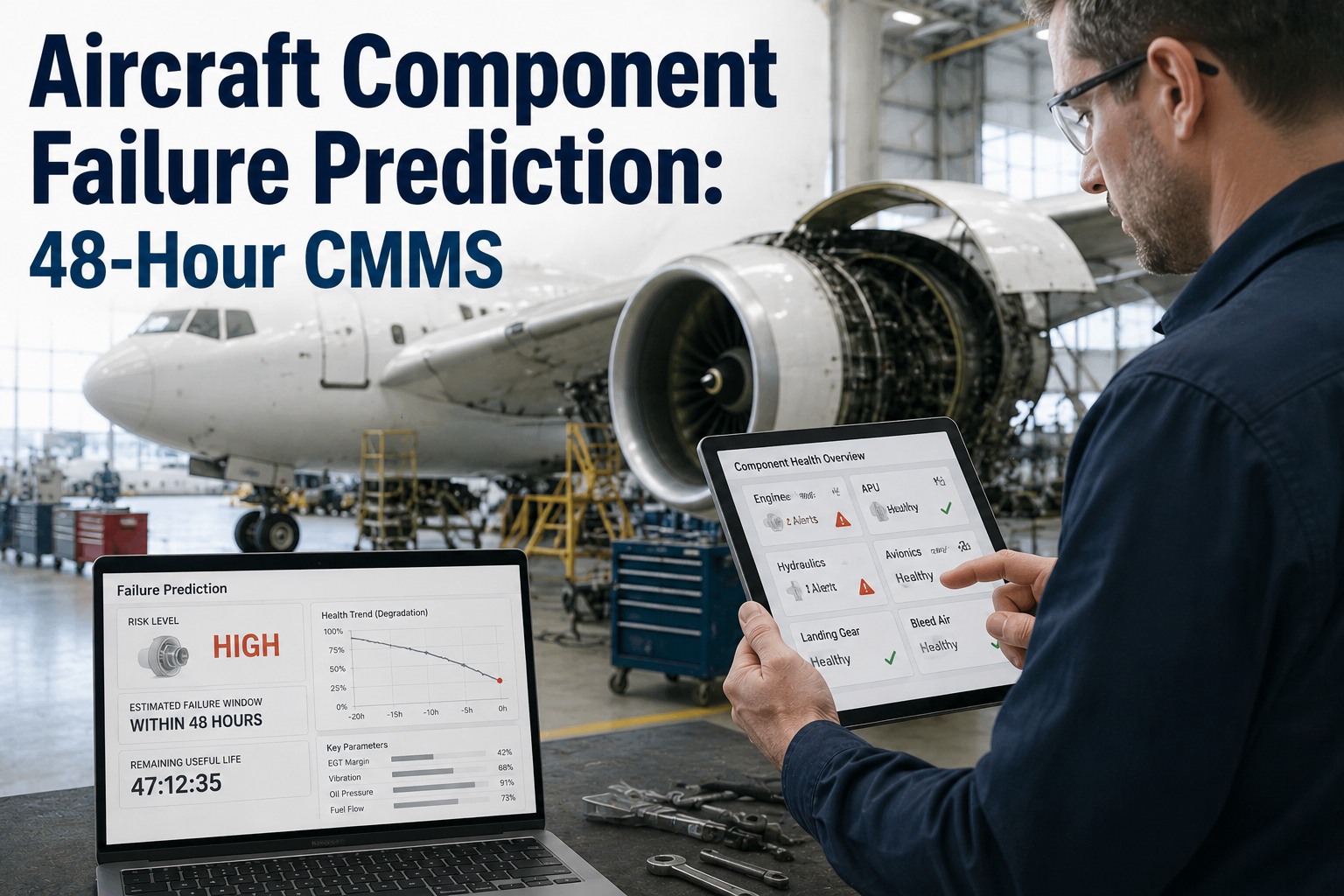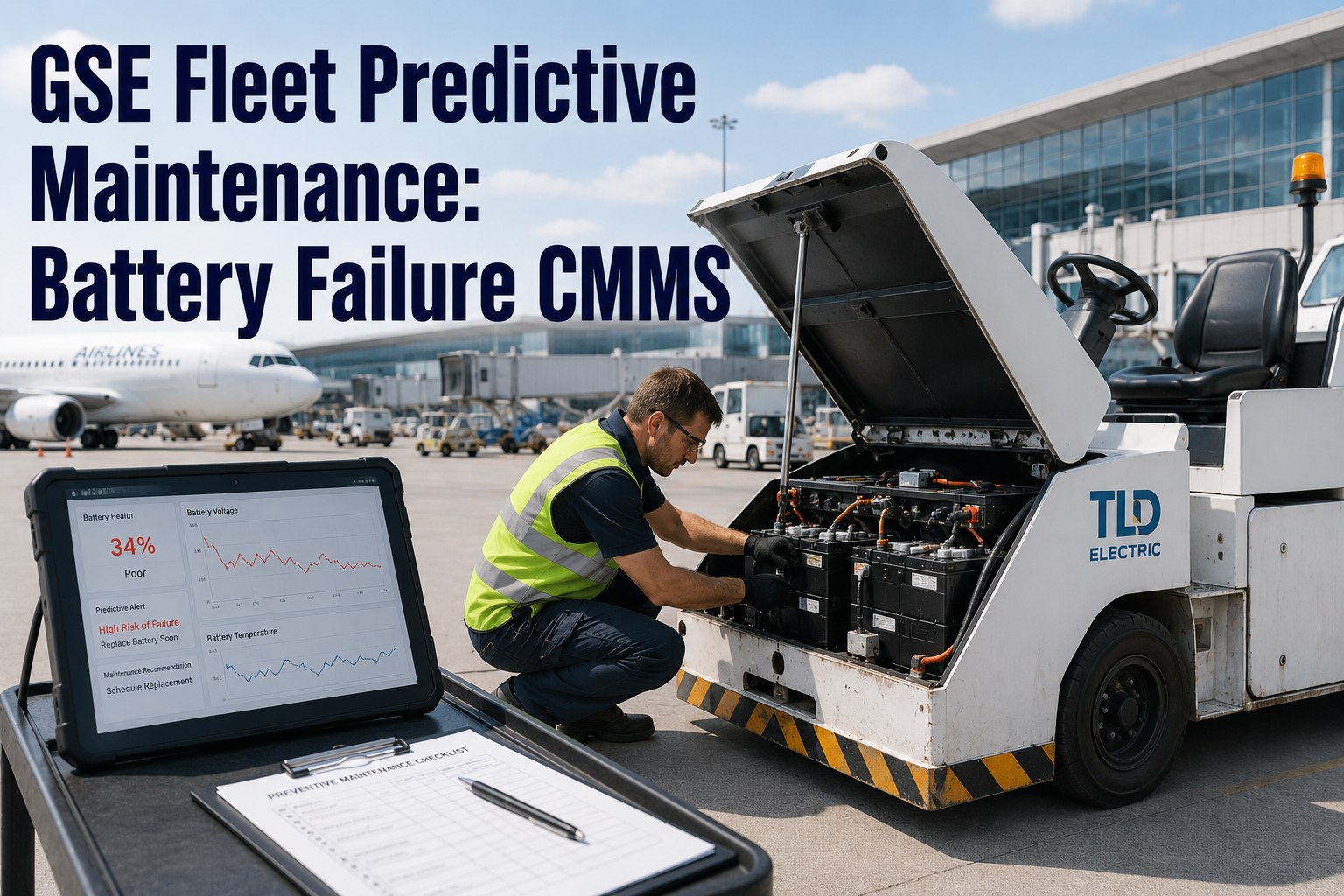
Ground support equipment fleets are increasingly battery-driven, and battery failures now account for a disproportionate share of ramp delays across major airports. This GSE fleet predictive maintenance guide for 2026 covers how a battery failure CMMS detects capacity decline early, predicts tug and belt loader breakdowns before they happen, and keeps electric GSE on the ramp instead of in the shop. You will find actionable guidance on charge-cycle tracking, hydraulic system condition monitoring, tire-pressure telematics, and GSE AI insights that reliability teams can deploy immediately. If you want to stop reacting to dead batteries and start predicting them, Start Free Trial or read on for the full framework.
GSE Predictive CMMS Guide 2026
What if you knew which GSE battery would fail next week?
A modern battery failure CMMS turns charge-cycle data, voltage curves and temperature telemetry into failure predictions — so ramp managers pull a tug or belt loader for a 20-minute cell swap before it ever causes a delay. OxMaint brings that predictive capability to every electric asset on your ramp.
Why Battery-Driven GSE Demands Predictive Maintenance
The Real Cost of Reactive GSE Battery Management
A mid-size airport operating 120 electric tugs, belt loaders and baggage tractors typically loses 8–12 ramp hours per week to unexpected battery failures — translating to roughly $180K–$260K in annual delay-related costs and lost gate-turn productivity.
The problem is not that battery failures are unpredictable — it is that most GSE fleets still rely on preventive maintenance calendars set at 90-day intervals, completely blind to how each individual pack is actually aging. Two identically purchased tugs can hit 80% capacity decline months apart depending on duty cycle, ambient temperature, depth of discharge and charger health. Without per-asset telemetry feeding into a CMMS, the first sign of trouble is a vehicle that will not hold charge on a cold morning — and by then the delay has already cascaded.
GSE Predictive Maintenance Data Streams
Five Telemetry Signals Your GSE Predictive CMMS Should Track
Effective GSE predictive maintenance draws on five core data streams. When these feed into a unified CMMS like OxMaint, AI models can flag individual assets for intervention days or weeks before failure.
Battery Capacity Decline Tracking
Log amp-hour throughput, end-of-charge voltage and pack impedance every cycle. When capacity trends below 85% of nameplate, the CMMS auto-generates a work order to inspect or replace cells — before the asset starves a turn.
Charge-Cycle & Charger Health
Each charge event is tagged to asset and charger ID. Repeated under-charges or abnormal finish curves point to failing charger modules or poor contacts — a leading indicator the battery itself will degrade prematurely.
Hydraulic System Condition Monitoring
Tug and belt loader hydraulics fail from contamination and seal wear. Trending pump cycle counts, filter delta-pressure and fluid temperature in the CMMS lets reliability teams schedule fluid changes and seal inspections based on condition, not calendar guesswork.
Tire Pressure & Wear Telematics
Under-inflated GSE tires cut belt-loader traction and shorten casing life by up to 25%. TPMS feeds live to the CMMS; sustained low-pressure alerts trigger fast-fill or replacement work orders automatically.
Motor & Controller Thermal Data
Electric traction motors and controllers that repeatedly exceed thermal thresholds are heading toward winding or IGBT failure. Logging temperature spikes against load profiles lets the AI flag degradation early.
Battery Failure Prediction Model
How CMMS Predicts GSE Battery Failure Before It Happens
Predictive battery health scoring combines three measurable indicators into a single risk score that the CMMS uses to prioritize work orders and replacements.
A 180-asset GSE fleet at a regional hub deployed OxMaint's battery predictive guide model across its electric tugs and belt loaders. Within 90 days, the CMMS flagged 14 packs with BHRS scores above 60 — nine of which had shown zero outward symptoms. By scheduling cell replacements during overnight lulls, the fleet cut battery-related ramp delays by 41% and avoided an estimated $94K in projected delay costs over the following quarter. Spare battery inventory was also optimized, freeing $28K in working capital previously tied up in buffer stock.
Implementation Timeline
Deploying GSE Predictive CMMS in 90 Days
A phased rollout gets predictive monitoring live on critical assets fast and avoids the data-overload trap that stalls many CMMS projects.
Asset & Telemetry Onboarding
Import the full GSE asset registry into OxMaint. Connect battery management systems and chargers via API or MQTT. Baseline capacity and impedance for every pack.
Threshold Tuning & Alert Setup
Calibrate BHRS thresholds to your operating conditions. Configure auto-generated work orders for capacity decline, charger faults and hydraulic pressure deviations. Train ramp techs on mobile work-order app.
AI Insights & Optimization
Activate GSE AI insights for failure prediction. Review the first wave of flagged assets, validate predictions against shop findings, and refine models. Begin weekly reliability review dashboards.
How OxMaint Helps
OxMaint Capabilities That Prevent GSE Battery Failures
OxMaint maps each predictive maintenance data stream to a concrete CMMS capability — so reliability teams move from symptom to scheduled work order without manual tracking.
Per-Asset Battery Health Scoring
OxMaint tracks charge-cycle count, end-of-charge voltage and capacity decline for every electric GSE unit. When a pack's health score crosses threshold, a work order generates automatically — cutting unplanned battery downtime 30–50%.
AI Failure Prediction Engine
Machine-learning models analyze impedance trends, thermal events and charger anomalies to predict failures 7–21 days in advance. Maintenance planners schedule interventions during low-traffic windows, protecting gate-turn performance.
Automated Preventive Work Orders
Trigger PMs on condition, not just calendar. Hydraulic filter changes, tire pressure top-ups and charger inspections fire when telemetry says they are needed — eliminating both over-maintenance and missed service.
Spare Battery & Parts Inventory
OxMaint links predicted replacements to spare-parts inventory in real time. When the AI flags a pack for swap, the system checks stock, reserves parts and notifies procurement — preventing shelf-outs on critical cell banks.
Reactive vs. Predictive GSE Maintenance
What Changes When You Move from Calendar PM to Predictive CMMS
| Metric | Calendar-Based PM | OxMaint Predictive CMMS |
|---|---|---|
| Battery failure detection | Discovered at shift start or mid-ramp | Flagged 7–21 days before failure |
| Unplanned ramp downtime | 8–12 hrs/week per 120 assets | Reduced 30–50% within first quarter |
| Spare battery inventory | 20–30% buffer stock held "just in case" | Right-sized to predicted replacements |
| Work-order generation | Manual, paper-based, often delayed | Auto-generated on threshold breach |
| Compliance & audit trail | Spreadsheet logs, gaps common | Full digital trail, ISO 55000-ready |
| Annual delay cost (120-asset fleet) | $180K–$260K | $65K–$110K after optimization |
See OxMaint Predict Battery Failures on Your GSE Fleet
Book a 30-minute demo and we will connect your asset list, walk through battery health scoring on real equipment, and show you exactly which assets would be flagged today.
Frequently Asked Questions
GSE Predictive Maintenance & Battery CMMS FAQs
What is GSE predictive maintenance and how does it differ from preventive maintenance?
GSE predictive maintenance uses real-time telemetry — battery voltage, impedance, temperature, hydraulic pressure — to determine each asset's actual condition and trigger service only when degradation is detected. Preventive maintenance follows fixed calendar intervals regardless of condition, which means healthy assets get over-serviced while failing ones slip through unnoticed. Predictive CMMS cuts unnecessary work orders and catches failures weeks earlier.
How does a CMMS detect battery capacity decline in electric GSE?
The CMMS logs amp-hour throughput and end-of-charge voltage on every cycle, then compares actual delivered capacity against nameplate rating. When capacity trends below 85% or internal impedance rises beyond a tuned threshold, the system auto-generates a work order. OxMaint combines these signals into a Battery Health Risk Score so planners see which packs need attention first.
Can predictive maintenance work for tugs and belt loaders, not just batteries?
Yes. The same CMMS framework extends to hydraulic pump cycle counts, filter delta-pressure, motor controller thermal events and tire-pressure telematics. OxMaint tracks all five data streams in one platform, giving reliability teams a unified view of every GSE asset's health. You can see it live on your equipment — Book a Demo to find out how.
How long does it take to implement a GSE predictive CMMS?
Most mid-size GSE fleets are live on OxMaint within 60–90 days. Month one covers asset onboarding and telemetry integration, month two tunes thresholds and trains ramp technicians on the mobile app, and month three activates AI failure prediction. Existing spreadsheets and paper work orders can be imported directly during onboarding.
What ROI can a GSE fleet expect from battery failure prediction?
Fleets typically cut battery-related ramp delays 30–50% within the first quarter and reduce spare battery inventory 15–20% by aligning stock to predicted replacements. For a 120-asset fleet spending $200K+ annually on delay costs, payback usually occurs within 4–6 months. You can validate the numbers on your own data with a free trial .
Stop Reacting to Battery Failures. Start Predicting Them.
Join the GSE reliability teams using OxMaint to keep electric tugs, belt loaders and baggage tractors on the ramp — and out of the shop.
Free 14-day trial · No credit card