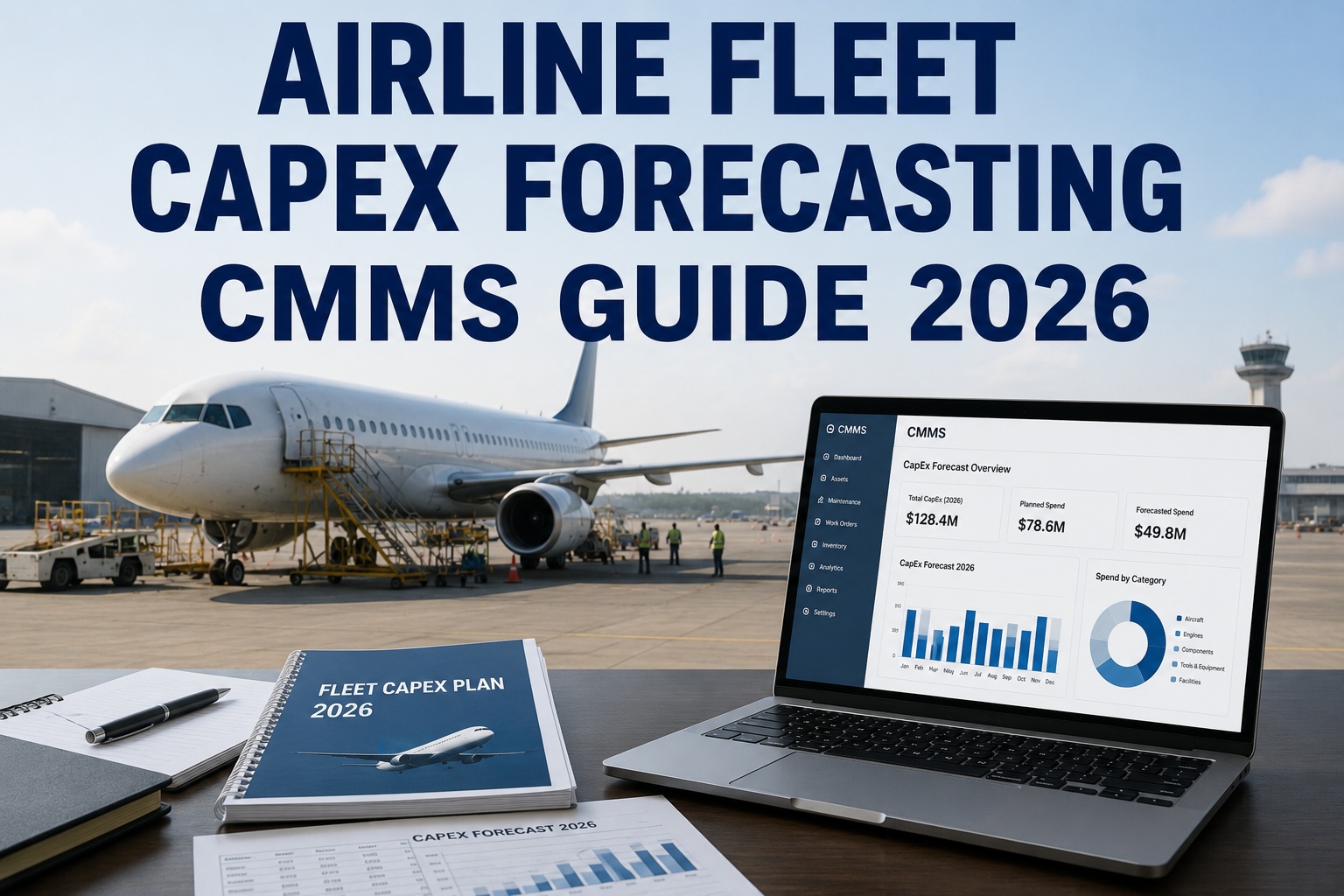
Airline fleet CapEx forecasting shapes the largest financial decisions a carrier makes — and when the maintenance data feeding those forecasts is fragmented across spreadsheets, PDF task cards and legacy MRO systems, the result is millions in mistimed capital spending. This 2026 guide to airline fleet CapEx forecasting in aviation CMMS walks through heavy check timing, engine shop visit forecasts, LLP replacement planning and terminal-value modeling so finance and reliability leadership can build multi-year capital plans they can defend. OxMaint's AI-powered CMMS and EAM platform unifies the work-order history, asset-utilization and reliability KPI data that underpin credible forecasts, then rolls it into dashboards the C-suite can trust. Start your Start Free Trial today or book a demo to see it on your fleet data.
CapEx Forecasting Guide 2026
Is your fleet capital plan built on maintenance data you can trust?
A single mistimed heavy check or engine shop visit can shift a $200M fleet renewal decision by 18 months. OxMaint turns work-order history, utilization logs and reliability KPIs into multi-year CapEx forecasts finance leadership defends with confidence.
The Forecasting Gap
Why airline fleet CapEx forecasts fail — and what changes in 2026
Fleet capital planning CMMS adoption is accelerating because airlines lose 8–12% of annual capital budget accuracy to maintenance records that live in disconnected systems.
Fragmented Maintenance Data
Heavy check intervals stored in one MRO system, utilization data in another and LLP tracking in spreadsheets — creating blind spots that mis-time $5–15M airframe events.
Reactive Replacement Cycles
Without predictive analytics on MTBUR and failure trends, engines enter the shop 90–120 days early or late — distorting the capital expenditure timeline by a full fiscal quarter.
No Reliability KPI Roll-up
When finance can't see MTBF, dispatch reliability and AOG cost roll-ups alongside asset age, terminal-value models skew and fleet renewal decisions slip.
CapEx Forecasting Formula
The aviation capital planning formula finance teams defend
A defensible CMMS capital forecasting model rolls five data streams into one number. Each stream must trace back to a timestamped work-order record.
CMMS work-order history pinpoints aircraft hitting C-check and D-check thresholds within 12 months, giving procurement 90-day lead time to secure bay slots.
Trended EGT margin, oil consumption and vibration data forecast shop visits 14–18 months out, locking in spare-engine leasing before peak summer demand.
Cycle-count tracking on life-limited parts flags $80K–$340K replacements per engine, giving finance a parts-capital line item accurate within 5%.
Dispatch reliability and MTBF curves feed residual-value models that determine whether to retire, sell or extend a fleet — directly driving the renewal CapEx envelope.
Worked Scenario
From spreadsheet chaos to a 5-year CapEx forecast — a 50-aircraft fleet example
A mid-size narrowbody operator tracked heavy checks and LLP cycles across 14 Excel workbooks. Three unforecasted engine shop visits cost $24M and pushed fleet renewal analysis off-cycle.
| Forecast Dimension | Before OxMaint (Spreadsheets) | With OxMaint CMMS | Capital Impact |
|---|---|---|---|
| Heavy Check Timing | C-check dates ±45 days uncertain; bay slots booked late at 15% premium | Work-order history + utilization auto-flag due dates 12 months ahead | $2.1M saved on slot premiums |
| Engine Shop Visits | 3 unforecasted visits in 12 months; $8M unplanned spend | Predictive trend on EGT, oil and vibration forecasts visits 14–18 months out | $6.4M reallocated to planned cycle |
| LLP Replacement | Cycle counts updated quarterly; $1.2M surprise parts orders | Real-time cycle tracking + auto PO triggers at 80% life remaining | $900K inventory carrying cost cut |
| Terminal-Value Modeling | Residual values from broker estimates; 12% variance year-over-year | Dispatch reliability + MTBF trend feed ISO 55000-aligned residual model | Forecast variance narrowed to 4% |
| Reliability KPI Roll-up | MTBF compiled manually each quarter; 6-week lag to finance | Live dashboards roll MTBF, AOG hours and dispatch reliability to the CFO | 6-week lag eliminated |
How OxMaint Helps
How OxMaint powers CMMS capital planning aviation teams trust
OxMaint's AI-powered CMMS and EAM platform connects every work order, asset-hour and spare-parts transaction to the capital forecast — so finance and reliability leadership work from the same verified data set.
Predictive Heavy Check & Shop Visit Forecasting
AI models trend EGT margins, vibration, oil consumption and flight-hour data to forecast engine shop visits and heavy check timing 12–18 months ahead — cutting unplanned CapEx variance by 30–50%.
Outcome: $4–8M annual CapEx variance eliminated per 50-aircraft fleetReal-Time LLP Cycle & Asset-Hour Tracking
Automatic cycle accumulation and threshold alerts on life-limited parts eliminate quarterly spreadsheet reconciliation, keeping the parts-capital line item accurate within 5% at any moment.
Outcome: 900K+ inventory carrying cost recovered annuallyReliability KPI Roll-Up Dashboards
MTBF, MTBUR, dispatch reliability and AOG cost roll up live to executive dashboards aligned to ISO 55000 — giving finance the same data reliability engineers see, with zero reporting lag.
Outcome: 6-week reporting lag to finance eliminatedTerminal-Value & Residual Modeling Engine
Trended reliability and utilization data feed residual-value models that determine retire, sell or extend decisions — narrowing forecast variance from 12% to under 4% on aging fleet blocks.
Outcome: Renewal CapEx envelope defended to the board with audit-grade dataSee your fleet's 5-year CapEx forecast built on data you can audit
Book a 30-minute demo and we'll load your aircraft utilization, work-order history and LLP cycle data into OxMaint — then show you the heavy-check and shop-visit forecast your finance team can defend.
Frequently Asked Questions
Airline fleet CapEx forecasting CMMS — your questions answered
What is airline fleet CapEx forecasting in a CMMS?
Airline fleet CapEx forecasting in a CMMS uses maintenance work-order history, asset-utilization data and reliability KPIs to project multi-year capital expenditure on heavy checks, engine shop visits and LLP replacements. A platform like OxMaint replaces disconnected spreadsheets with a single auditable data source that finance leadership can trust — see it on your data with a Book a Demo.
How does a CMMS improve aviation capital planning accuracy?
A CMMS improves aviation capital planning by timestamping every maintenance event, tracking real-time asset hours and cycles, and trending reliability indicators like MTBF and dispatch reliability. This cuts forecast variance from 10–12% with spreadsheets to under 5%, because every dollar in the capital plan traces back to a verified work-order record rather than a manual estimate.
When should an airline start fleet replacement planning for 2026?
Airlines should begin 2026 fleet replacement planning 18–24 months ahead, because engine shop-visit lead times alone run 14–18 months and heavy-check bay slots sell out 12 months in advance. Starting early with a CMMS-backed forecast lets procurement secure slots at standard rates and gives finance time to model terminal-value scenarios before the fiscal cycle locks.
What data does OxMaint need to build a fleet CapEx forecast?
OxMaint needs three core data streams: historical work-order records (at least 24 months), current asset hours and flight cycles per tail number, and reliability KPI baselines like MTBF and AOG hours. Our onboarding team imports this from your existing MRO system or spreadsheets — you can start with a Start Free Trial and connect data incrementally.
How long does it take to deploy OxMaint for CapEx forecasting?
Most mid-size carriers are live on OxMaint's core CMMS and capital-forecasting dashboards within 4–6 weeks. The timeline depends on data quality in your source systems — if work-order history is clean, we can produce a first-pass multi-year CapEx forecast within the first 14 days of the trial period.
Ready When You Are
Stop defending CapEx plans built on spreadsheets
Join the airlines and MROs using OxMaint to forecast heavy checks, engine shop visits and fleet renewal with audit-grade maintenance data. Book a demo and see your 5-year capital plan in one dashboard.
Free 14-day trial · No credit card