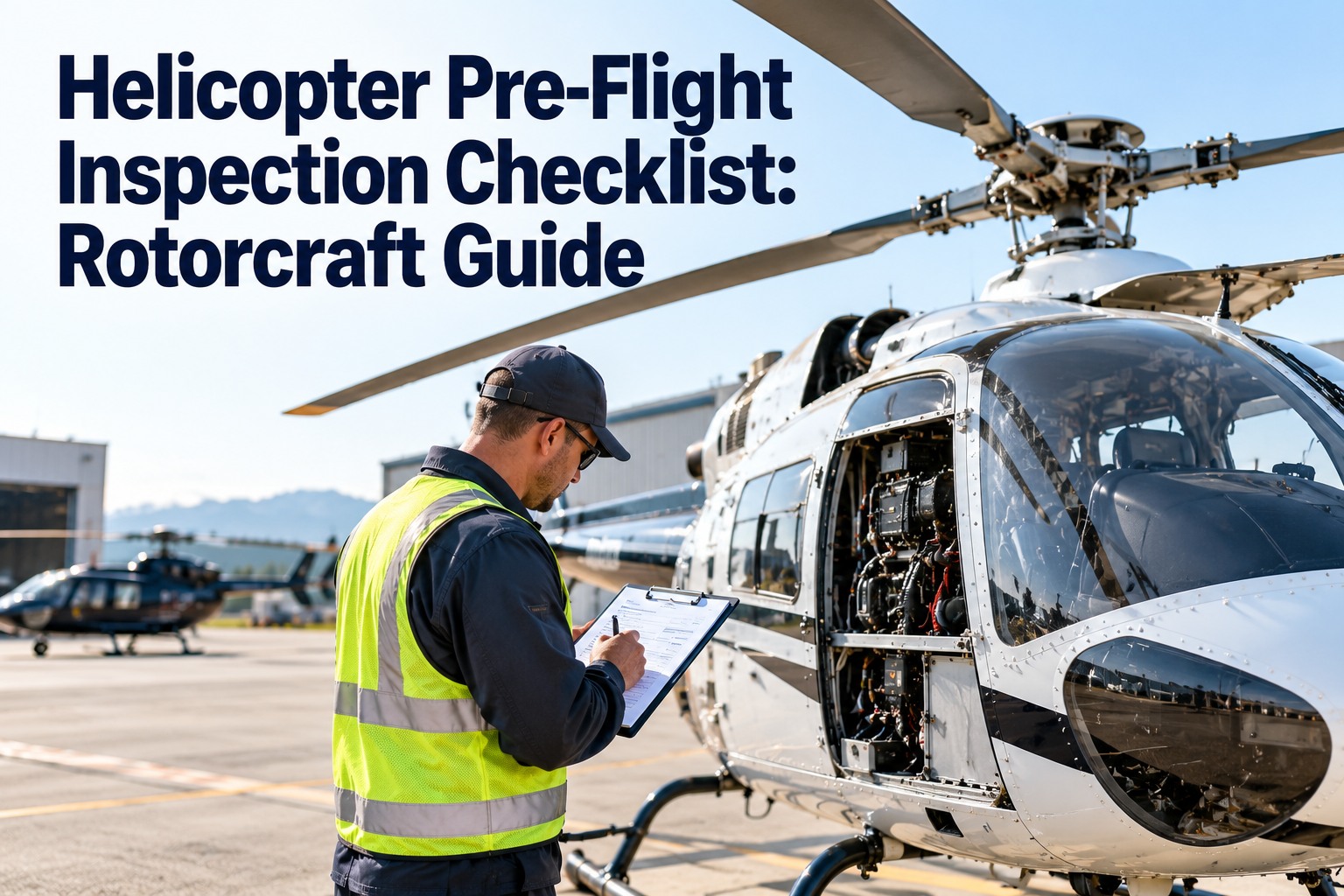
A helicopter pre-flight is the pilot's last chance to catch something before the skids leave the ground — a nicked rotor blade, a weeping hydraulic servo, a loose pitch link, a fuel cap not seated. Rotorcraft are unforgiving of the item you skipped, and a paper walk-around card that never makes it back to maintenance loses the squawk the moment it's noted. This guide is a complete, system-by-system pre-flight inspection checklist for helicopters, and it shows how OXMAINT AI, the AI-powered aviation CMMS, turns every walk-around finding into a tracked squawk and work order.
Aviation · Rotorcraft · Pre-Flight Inspection Checklist · 2026
Helicopter Pre-Flight Inspection Checklist: Rotorcraft Guide
A rotor nick caught on the walk-around is a maintenance item; the same nick missed is an in-flight emergency. OXMAINT AI, the AI-powered CMMS and maintenance management software, runs the pre-flight as a digital checklist: work the walk-around system by system, log any defect as a squawk on the spot, raise the work order, and keep the signed record and component life-limits tracked against the tail number.
1Walk-Around
→
2Log Squawk
→
3Work Order
→
4Signed Record
8 SYSTEMS · WALK-AROUND
✓Cabin & cockpit
✓Main rotor system
✓Mast & transmission
✓Engine & powerplant
✓Hydraulics & controls
✓Tail boom & tail rotor
6
critical systems that drive rotorcraft airworthiness
3–6×
tail-rotor RPM relative to the main rotor
Part 43/91
FAA maintenance & airworthiness framework
TBO
hard life limits on hubs, swashplates, TR gearbox
How to Use This Checklist
Work the walk-around in a consistent direction — most pilots start at the cabin, move to the nose and rotor mast, then around the tail boom and back — so no panel is ever skipped. Tick each item, and the moment anything is outside limits, it becomes a squawk, not a mental note. Always defer to the aircraft's approved rotorcraft flight manual and maintenance manual; this is a general rotorcraft guide, not a substitute for type-specific procedures. Book a demo to run a digital pre-flight in OXMAINT AI.
✓Serviceable — within limits, continue
!Squawk — log the defect, assess against the manual
✗No-go — grounding item until cleared by maintenance
ACabin & Cockpit
Documents aboard — airworthiness, registration, flight manual, weight & balance
Master & ignition switches off; controls free, friction set
Collective, cyclic and pedals full travel, no binding
Seats, belts and harnesses secure; doors and latches sound
Caution / advisory panel — test lights, no latched warnings
Circuit breakers in; instruments read zero / as expected
BMain Rotor System
Blades — leading edge, skin, tip caps: no nicks, cracks, delamination or debonding
Hub and grips — security, no cracks or corrosion
Pitch-change links and horns secure; hardware and cotter pins present
Swashplate and scissors — condition, no excess play, boots intact
Droop stops and dampers condition; no fluid weeping
Main rotor retaining nut and witness marks as set
CMast & Transmission
Mast and swashplate support — no cracks, security of mounts
Transmission oil level in sight gauge; no leaks at seals or lines
Chip detectors and cooling fan / blower condition
Drive belts or input coupling — tension and condition as applicable
Cowlings and inspection panels secure after check
DEngine & Powerplant
Engine oil level and filler cap secure; no leaks on deck or lines
Air intake and filter clear of debris, FOD and obstruction
Exhaust and stacks — security, no cracks or excessive deposits
Belts, hoses and wiring — no chafe, fraying or heat damage
Compartment clear of rags, tools and loose articles
EHydraulics & Flight Controls
Hydraulic reservoir level; no leaks at pump, servos or lines
Servo actuators and bellcranks — security, no seepage
Control rods, bearings and rod ends — no play, hardware safetied
Control continuity confirmed through full range of travel
Trim and governor linkages condition as applicable
FFuel System
Quantity confirmed sufficient for flight plus reserve
Sump drained — fuel clear, correct grade, no water or sediment
Caps and vents secure; no leaks or staining around tank
Fuel lines and shutoff valve condition and security
GTail Boom & Tail Rotor
Tail boom skin and attach points — no cracks, dents or loose rivets
Tail rotor blades — no nicks, cracks or erosion; tip condition
Tail rotor hub, pitch-change and control cables / rod security
Tail rotor gearbox oil level; no leaks; chip detector condition
Drive shaft, hangers and couplings along the boom secure
Horizontal / vertical stabilizers and guard condition
HGear, Fuselage, Lights & Emergency
Skids or wheels — alignment, security, wear; ground handling gear removed
Fuselage and windows — no damage; antennas and static wicks intact
Position, anti-collision and landing lights operative
Pitot / static ports clear and covers removed
Fire extinguisher, first-aid and survival gear aboard and in date
Covers, tie-downs and blade tie removed before start
The Squawk You Note on Paper Is the Squawk You Lose.
A defect found on the walk-around only matters if it reaches maintenance. Logged in OXMAINT AI on the spot, a squawk becomes a work order against the tail number, routed to a mechanic, with the pre-flight record signed and retained — so nothing falls off the card between the ramp and the hangar.
The Life-Limited Parts a Pre-Flight Can’t See
A walk-around catches the visible; it can't see that a rotor hub is approaching its time between overhaul. Critical rotorcraft components carry hard manufacturer life limits, and flying past one is an airworthiness violation no visual check will reveal. OXMAINT AI tracks each against hours flown. Start free and track life-limited parts in OXMAINT AI.
Overhaul intervals on major dynamic components commonly fall in the range of roughly 1,200–2,400 hours depending on type and part — always set by the manufacturer for the specific aircraft. The pre-flight keeps the machine safe today; life-limit tracking keeps it legal and safe over its service life.
From Walk-Around to Work Order
A digital pre-flight only earns its keep if a finding flows straight into maintenance. OXMAINT AI carries the walk-around from the ramp to a tracked, documented repair without a paper hand-off. Book a demo to walk the full loop in OXMAINT AI.
01
Digital walk-around
The pilot or mechanic works the checklist on a mobile device, ticking each item against the tail number.
→
02
Squawk logged
Any out-of-limits item is captured as a squawk with a photo and note, the moment it's found.
→
03
Work order raised
The squawk becomes a work order routed to maintenance, with grounding items flagged no-go.
→
04
Signed & retained
The completed pre-flight is signed and kept against the aircraft, with life-limits tracked alongside.
Why Run Pre-Flight in OXMAINT AI
Paper walk-around cards lose squawks, hide trends and can't track a life limit. Built into the CMMS, the pre-flight ties every finding to the aircraft and the maintenance behind it. Start free and connect pre-flight to maintenance in OXMAINT AI.
◉
Mobile Digital Checklist
The full walk-around on a phone or tablet, tied to the tail number, with required items enforced before sign-off.
◉
Instant Squawk Capture
A defect logged with photo and note converts straight into a work order — no finding lost between ramp and hangar.
◉
Life-Limit Tracking
Hubs, swashplates and tail-rotor gearboxes tracked against TBO by hours flown, with alerts before the limit.
◉
Serial-Number Traceability
Components tracked by serial number across aircraft transfers, so history follows the part.
◉
Regulatory-Ready Records
Signed pre-flight and maintenance records retained and exportable to support Part 43, 91 and 135 obligations.
◉
Fleet-Wide Visibility
Open squawks and due inspections across every aircraft in one view — what paper logbooks cannot give.
“
Our walk-arounds were solid, but the squawks lived on clipboard cards — a pilot would note a weeping servo, and if the card didn't make it to the board, maintenance never saw it until the next scheduled check. Running pre-flight digitally closed that gap: the finding is a work order against that tail number before the pilot walks away, and the hub and gearbox hours are tracked so nothing creeps past a limit. The ramp and the hangar finally see the same aircraft.
Director of Maintenance · Rotorcraft Operator
Frequently Asked Questions
What are the main systems on a helicopter pre-flight?
Eight areas: cabin and cockpit, main rotor system, mast and transmission, engine and powerplant, hydraulics and flight controls, fuel, tail boom and tail rotor, and landing gear with fuselage, lights and emergency equipment. Each carries its own specific check points.
Book a demo to run it digitally in OXMAINT AI.
What should I check on the main and tail rotor?
On the main rotor: blades for nicks, cracks and delamination, plus hub, grips, pitch links, swashplate, droop stops and the retaining nut. On the tail rotor: blades, hub, pitch-change, the gearbox oil and chip detector, and the drive shaft and hangers along the boom.
Does a pre-flight replace scheduled maintenance?
No. A pre-flight catches what's visible on the day; it can't see a component approaching its time between overhaul. Hard life limits on hubs, swashplates and the tail-rotor gearbox are tracked by hours flown, separately from the walk-around.
Which FAA rules apply to helicopter maintenance?
14 CFR Part 43 covers maintenance standards and authorization, Part 91 sets the owner/operator airworthiness responsibility, and Part 135 adds requirements for commercial operations. Always follow the aircraft's approved flight and maintenance manuals for type-specific procedures.
How does a CMMS improve the pre-flight?
It turns the walk-around into a mobile checklist tied to the tail number, captures any defect as a squawk that becomes a work order on the spot, tracks component life limits by hours, and retains a signed, exportable record — closing the gap between the ramp and maintenance.
Start free and digitize your pre-flight in OXMAINT AI.
Make Every Pre-Flight Count — and Keep It.
Run your rotorcraft pre-flight on the OXMAINT AI maintenance management software — the full system-by-system walk-around as a mobile checklist, instant squawk-to-work-order capture, TBO and life-limit tracking by hours flown, and signed records retained against every tail number. Catch it on the ramp, fix it in the hangar, prove it on paper.