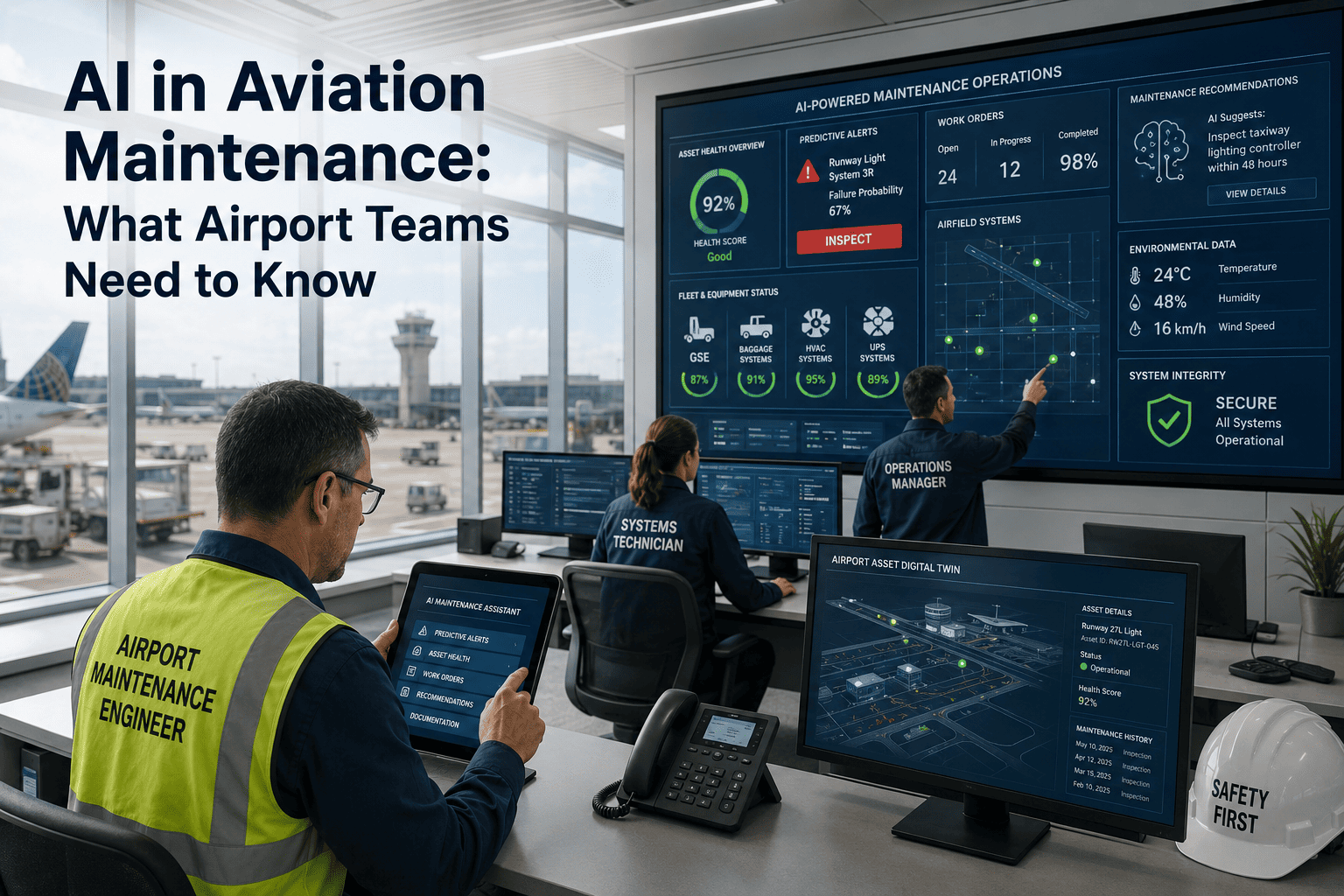
AI in Aviation Maintenance: What Airport Teams Need to Know
By Lewis Abbott on May 9, 2026
Artificial intelligence is no longer a future concept in aviation maintenance — it is operational reality at the world's leading airports and MRO operations. AI models trained on years of failure data now predict bleed valve degradation, baggage motor wear, and chiller compressor failure with 80 to 92% precision. The global aviation analytics market crossed USD 4.5B in 2024 and is forecast to triple by 2030. For airport maintenance teams, the question is no longer whether to adopt AI — it is how to deploy it without disrupting current operations or burning budget on tools that do not integrate with the CMMS already in place. This guide cuts through the noise: what AI actually does in aviation maintenance, where it delivers measurable value, and how to deploy it pragmatically. Start a free trial to put AI on your own asset register, or book a demo for a tailored aviation walkthrough.
global aviation analytics market in 2024 — forecast to triple by 2030 (industry analyst consensus)
92%
peak precision achievable by mature AI failure-prediction models on critical aircraft and airport assets
35%
average reduction in unscheduled maintenance events at AI-equipped operators (IATA MRO benchmarks)
5x
return on investment within 24 months for AI-driven aviation maintenance programs at scale
What Does AI Actually Do in Aviation Maintenance?
In aviation maintenance, AI does four things — and only those four are worth investing in seriously. First, anomaly detection: identifying when an asset is behaving differently from its own history or its fleet peers. Second, failure prediction: estimating remaining useful life so planners can intervene before disruption. Third, work order optimization: matching the right technician, parts, and slot to each job to maximize throughput. Fourth, decision support: surfacing the right asset, document, or procedure to a technician in the field at the moment they need it.
Everything else marketed as "AI in aviation maintenance" is usually either basic automation rebranded, or research-stage capability not yet deployable at production airports. Knowing the difference matters when budgets, integration debt, and operational risk are all at stake. Start a free trial and see which of the four AI capabilities deliver value on your asset base first.
The 6 Production-Ready AI Capabilities for Airport Teams
01
Anomaly Detection
ML models compare each asset's live telemetry to its baseline and to peer assets — flagging deviations days or weeks before any threshold-based alarm would trigger.
02
Remaining Useful Life
Survival models estimate days, hours, or flight cycles to expected failure for each component — converting binary "OK / not OK" into a planning window.
03
Auto-Routing & Scheduling
Optimization engines match work orders to technicians by skill, location, parts availability, and SLA — replacing manual supervisor coordination.
04
Predictive Spare Parts
Demand forecasting from historical work orders and predictive flags right-sizes parts inventory — cutting carrying cost without raising stockout risk.
05
Computer Vision Inspection
Image models detect runway surface defects, baggage belt damage, and corrosion on jet bridges from drone or fixed-camera imagery — augmenting human inspectors.
06
Knowledge Retrieval
Natural language interfaces surface relevant procedures, schematics, and historical fixes to field technicians — reducing diagnostic time on complex assets.
The biggest mistake airport teams make with AI is starting with the most exciting capability instead of the highest-ROI one. Anomaly detection on critical assets is almost always the right first step.
Where AI Pays Off Fastest in Airport Operations
AI delivers the biggest measurable returns where three conditions overlap: high failure cost, predictable degradation, and rich sensor data. The eight asset categories below score highest on all three for most airports. Book a demo to see your top ROI candidates ranked.
High
Baggage Handling Motors
Vibration and current data predict bearing wear and gearbox degradation — preventing the most common terminal disruption event.
High
HVAC Chillers & AHUs
Compressor amperage, refrigerant pressure, and temperature trends flag failure 2 to 6 weeks ahead — preventing summer cooling outages.
High
Jet Bridge Hydraulics
Pressure and cycle data identify failing pumps and worn cylinders — preventing gate closures that cascade across the schedule.
Medium
Runway Lighting Circuits
Current draw monitoring on series circuits identifies failing fixtures and isolation transformers before night-ops compliance breaches.
High
Aircraft APUs & Bleed Air
Vibration and EGT trending detects bearing and seal degradation 30–90 cycles before failure — preventing AOG events.
Medium
Escalators & Walkways
Drive motor vibration and step chain wear data prevent peak-hour passenger flow disruptions.
High
Generators & UPS
Battery voltage curves and load test deviations predict failure under emergency conditions — protecting Tier 1 backup power.
Medium
De-Icing Pad Systems
Pump pressure, fluid level, and heater current trending prevents winter operational shutdowns at northern airports.
Score your asset register for AI ROI in 30 days
Oxmaint's onboarding accelerator ranks every aircraft and airport asset by predictive value — so you start with the highest-impact wins.
Standalone AI tools generate insights that never reach the technician executing the work. Without a CMMS connection, predictions sit in dashboards and produce no operational change.
Data Silos Block Training
When sensor data lives in BMS, ACARS, and SCADA silos and never reaches a unified asset hierarchy, models cannot train on the cross-system patterns where most real failures originate.
Pilots That Never Scale
A successful AI pilot on one asset class often fails to scale because the underlying CMMS cannot ingest, contextualize, and act on predictions across the rest of the airport portfolio.
Technician Trust Gap
If AI flags an asset as failing and the technician has no way to see why, they ignore the alert. Explainability and full asset context are non-negotiable for field adoption.
Over-Spending on Custom Models
Custom-built ML on every asset class is expensive and slow. Most airports get 80% of the value from pre-trained models embedded in the CMMS at a fraction of the cost.
No Feedback Loop
Without closed work orders feeding back into the model, prediction accuracy stagnates. AI gets dumber over time when its outputs are not validated against ground truth.
How Oxmaint Operationalizes AI for Airport Teams
Oxmaint embeds AI directly inside the CMMS workflow — so predictions become work orders, work orders become outcomes, and outcomes feed back into the model. This is what differentiates a deployed AI program from a stalled one. Start a free trial to see the closed-loop AI workflow on your own assets.
Embedded Anomaly Detection
Pre-trained models for common asset classes — baggage motors, chillers, jet bridges, generators — work out of the box on your live sensor data.
Unified Data Hierarchy
BMS, SCADA, ACARS, and IoT gateway data flows into a single Portfolio > Site > System > Asset hierarchy — the foundation every model needs.
Predictions to Work Orders
Every AI flag generates a work order with parts, skills, and estimated downtime — pushed to the right technician with the underlying signal explained.
Mobile-First Field Support
Technicians see why an asset was flagged — which sensor, which trend, which peer comparison — before they touch the equipment.
Continuous Model Tuning
Closed work orders feed back into the model — sharpening prediction accuracy and cutting false positives by 40 to 60% by year two.
Compliance & Auditability
Every AI-driven work order timestamped, signed, and stored against the asset — defensible evidence for FAA, EASA, CAA, and ICAO audits.
A working AI program is not measured by the sophistication of the model — it is measured by the number of failures it prevents per quarter.
Standalone AI Tools vs. Oxmaint Embedded AI
Operational Dimension
Standalone AI Analytics Tool
Oxmaint Embedded AI
Prediction-to-action lag
Hours to days — manual transcription to CMMS
Seconds — auto-generated work order
Asset context for technician
Limited; lives in a separate dashboard
Full history, schematics, prior failures attached
Data integration burden
Custom pipelines for every data source
Native connectors for BMS, SCADA, ACARS, IoT
Feedback loop accuracy
Often manual or absent — model accuracy plateaus
Closed work orders auto-feed model training
Time to first value
6–12 months custom build
14–30 days with pre-trained asset models
Cost profile
High custom dev + integration cost
Subscription embedded in CMMS — no extra integration
Compliance audit trail
Separate from work orders — reconstruction needed
Single trail tying AI flag, work order, sign-off
The Documented ROI of AI in Aviation Maintenance
Aviation operators with mature AI programs report consistent, measurable returns within 24 months — and the gains compound as model accuracy improves. Book a demo to see how these numbers map to your fleet and airport.
35%
reduction in unscheduled maintenance events at AI-equipped operators within 24 months
25%
cut in spare parts inventory carrying cost from AI-driven demand forecasting
92%
peak prediction precision achievable on critical asset classes by mature programs
5x
return on AI investment within 24 months of integrated CMMS deployment
Frequently Asked Questions
Do airport teams need data scientists to deploy AI maintenance?
No. With pre-trained models embedded in the CMMS, airport teams deploy AI through configuration rather than coding. Pre-built models for common asset classes — baggage motors, chillers, jet bridges, generators — work out of the box on standard sensor data. Custom data science is only required for non-standard assets, and even then is typically a small fraction of the program scope.
How does AI handle false positives without burning technician trust?
Mature AI programs explain every prediction — which sensor, which trend, which peer comparison drove the flag. Technicians see the underlying evidence before deciding whether to act. Continuous model tuning from closed work orders cuts false positives by 40 to 60% by year two, and tolerable false-positive thresholds can be set per asset class to balance precision and recall.
Can AI work on airport assets that lack modern sensors?
Yes — to a point. AI requires data to learn from, but that data does not have to come from new sensors. Existing BMS readings, work order history, runtime hours, and even paper inspection logs (digitized via mobile capture) all provide signal. For older assets without telemetry, low-cost retrofit IoT gateways add the missing inputs without replacing the asset itself.
How long before AI maintenance shows measurable airport ROI?
Most airport teams see the first prevented failure within 60 to 120 days of go-live — typically a baggage motor, chiller, or jet bridge issue caught before terminal impact. That single avoided event usually covers the annual platform investment. Steady-state ROI of 3 to 5x is reached by the end of year two as model accuracy improves and reactive callouts decline.
Deploy Aviation-Grade AI on Every Critical Airport Asset
Used by operations teams managing 10,000+ assets. Pre-trained models live in 14–30 days. Limited onboarding slots available this quarter — secure yours now.
Embedded anomaly detection with explainable predictions
Predictions auto-generate work orders for field execution
Continuous model tuning from closed work order outcomes