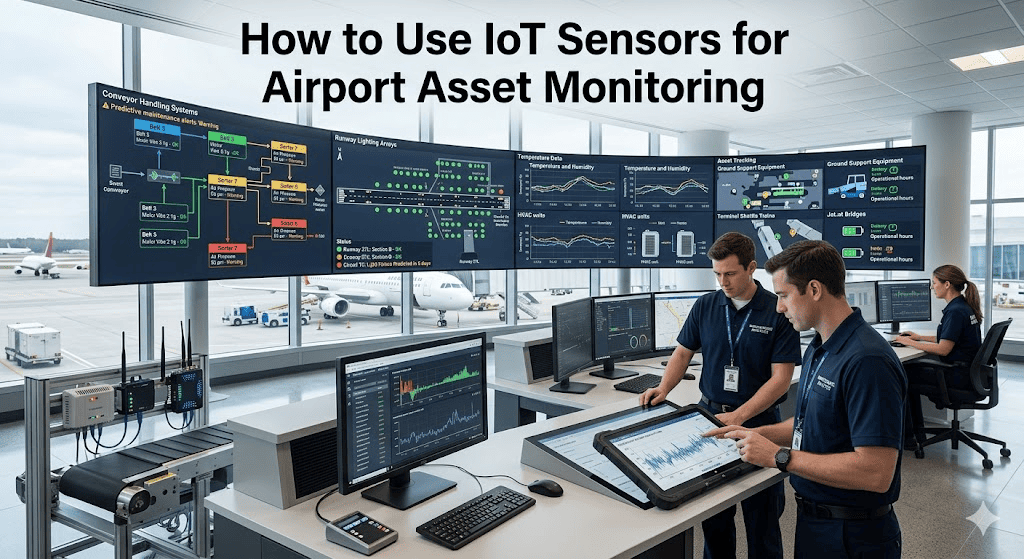
Airport maintenance teams face an impossible challenge—managing thousands of critical assets across terminals, runways, and support systems while operating in the dark. Without real-time visibility into equipment health, you're trapped in reactive mode, responding to failures instead of preventing them. The aviation IoT market is projected to reach $81 billion by 2034, driven by airports achieving 40% cost reductions through sensor-enabled predictive maintenance. Start your free IoT-CMMS trial and transform your maintenance operations with real-time infrastructure monitoring.
COMPLETE INTEGRATION GUIDE
IoT Sensors for Airport Maintenance
From Reactive Repairs to Predictive Excellence
$81B
Aviation IoT Market by 2034
40%
Cost Reduction Achievable
50%
Less Machine Downtime
What Are IoT Sensors in Airport Maintenance?
IoT (Internet of Things) sensors are intelligent devices that continuously monitor equipment conditions—temperature, vibration, pressure, humidity, and more—and transmit this data wirelessly to your maintenance management system. Unlike traditional monitoring that requires manual inspections, IoT sensors provide 24/7 automated surveillance of your entire infrastructure, from HVAC systems and escalators to runway lighting and baggage conveyors.
When IoT sensors detect anomalies—a motor running hot, unusual vibration patterns, pressure fluctuations—they automatically alert your CMMS and can trigger work orders before equipment fails. This shift from reactive to predictive maintenance is why leading airports are investing heavily in sensor technology.
Why Airport Maintenance Needs IoT Sensors
Modern airports operate 24/7 with zero tolerance for equipment failures. A single conveyor breakdown can cascade into flight delays affecting thousands of passengers. Traditional maintenance approaches simply cannot keep pace with these demands.
Blind Spots in Equipment Health
50% of maintenance work is unplanned or rescheduled because teams lack real-time visibility into equipment conditions. You only discover problems when something breaks.
Continuous Condition Monitoring
IoT sensors track equipment health parameters in real-time, detecting anomalies weeks before failures occur. Your CMMS receives instant alerts when thresholds are exceeded.
Manual Inspection Limitations
Technicians can only inspect a fraction of your assets daily. Critical early warning signs go unnoticed between scheduled rounds, especially in remote or hard-to-access locations.
Automated 24/7 Surveillance
Sensors monitor every asset continuously—even in basements, mechanical rooms, and airside locations—providing complete infrastructure visibility without additional staff.
Ready to Eliminate Equipment Blind Spots?
See how OxMaint's IoT-integrated CMMS delivers real-time equipment visibility across your entire airport.
Types of IoT Sensors for Airport Infrastructure
Different airport systems require different monitoring approaches. Here's a comprehensive breakdown of sensor types and their applications across your facility.
T°
Temperature Sensors
Monitor HVAC systems, electrical panels, motors, and refrigeration units. Detect overheating before it causes failures or fire hazards.
HVAC Systems
Motor Bearings
Electrical Rooms
Cold Storage
~
Vibration Sensors
Identify imbalances, misalignments, and bearing wear in rotating equipment. Detect problems weeks before catastrophic failure.
Baggage Conveyors
Escalators
Jet Bridges
Pumps
P
Pressure Sensors
Monitor hydraulic systems, pneumatic controls, and fluid systems. Alert on leaks, blockages, or system degradation.
Hydraulic Systems
Fire Suppression
Fuel Lines
HVAC Ducts
H
Humidity Sensors
Protect sensitive equipment from moisture damage. Essential for server rooms, electrical infrastructure, and climate-controlled areas.
Data Centers
Control Rooms
Archive Storage
Terminals
A
Current/Power Sensors
Track electrical consumption patterns to identify inefficiencies and detect motor degradation before failure.
Runway Lighting
Terminal Power
Motor Systems
Substations
◊
Acoustic/Ultrasonic Sensors
Detect air leaks, electrical arcing, and mechanical noise anomalies that indicate developing problems.
Compressed Air
Electrical Panels
Steam Systems
Bearings
IoT Connectivity Protocols Explained
Choosing the right connectivity protocol is crucial for reliable sensor communication across your airport's diverse environments—from terminal interiors to remote airside locations.
RECOMMENDED FOR AIRPORTS
LoRaWAN
Long Range Wide Area Network
15 km
Range
10+ yrs
Battery Life
10,000+
Devices/Gateway
Excellent building penetration
Low power consumption
Unlicensed spectrum (no fees)
Ideal for remote airside locations
Best for: Distributed airport infrastructure, outdoor equipment, remote locations
Wi-Fi
Wireless Local Area Network
100 m
Range
Wired
Power
High
Bandwidth
High data throughput
Uses existing infrastructure
Real-time data streaming
Best for: Terminal areas, data-intensive sensors, video monitoring
Cellular (4G/5G)
NB-IoT / LTE-M
Wide
Coverage
5+ yrs
Battery
Med
Bandwidth
Carrier-managed infrastructure
No gateway deployment
Mobile asset tracking
Best for: Mobile assets, GSE tracking, off-site facilities
Bluetooth/BLE
Bluetooth Low Energy
100 m
Range
2-5 yrs
Battery
Low
Cost
Very low cost sensors
Easy smartphone integration
Indoor positioning
Best for: Asset tags, proximity sensing, tool tracking
IoT-CMMS Integration Architecture
Understanding how sensor data flows from equipment to actionable maintenance decisions is essential for successful implementation.
Gateway Layer
IoT Gateway
Protocol Translation
Data Aggregation
Edge Processing
Secure Transmission
Action Layer
Mobile Alerts
Work Orders
Dashboards
Reports
What Happens When Sensor Detects Anomaly
1
Sensor detects temperature spike on baggage conveyor motor
2
Data transmitted to gateway, analyzed against thresholds
3
CMMS generates work order with priority and asset history
4
Technician receives mobile alert, repairs before failure
See IoT-CMMS Integration in Action
Watch how OxMaint automatically converts sensor alerts into prioritized work orders.
Airport Asset Categories for IoT Monitoring
HVAC & Climate Control
Temp, Humidity, Pressure
Escalators & Elevators
Vibration, Current, Position
Baggage Handling
Vibration, Temp, Speed
Automatic Doors
Current, Cycle Count
Runway Lighting Systems
Current, Voltage, Light
Jet Bridges / Airbridges
Vibration, Hydraulic, Position
Ground Support Equipment
GPS, Fuel, Engine Health
Navigation Aids
Power, Signal, Temp
Electrical Substations
Temp, Current, Humidity
Backup Generators
Fuel, Temp, Vibration
Water/Sewage Pumps
Vibration, Flow, Pressure
Fuel Farm Equipment
Level, Pressure, Leak
Fire Suppression
Pressure, Smoke, Temp
Access Control Systems
Status, Tamper, Power
CCTV Infrastructure
Status, Temp, Network
Emergency Lighting
Battery, Lamp Status
Proven Benefits of IoT-Enabled Maintenance
Maintenance Cost Reduction
Predictive maintenance powered by IoT sensors prevents emergency repairs and optimizes resource allocation.
McKinsey Research
Downtime Reduction
Real-time monitoring catches failures before they happen, keeping critical systems operational.
McKinsey Research
Failures Prevented
Comprehensive sensor networks detect 75-85% of potential catastrophic equipment failures before they occur.
Industry Analysis
Productivity Increase
Automated alerts and work order generation free technicians to focus on actual repairs instead of inspections.
Aberdeen Group
Implementation Roadmap
1
Assessment & Planning
Weeks 1-2
Identify high-value assets for monitoring
Evaluate connectivity requirements
Define threshold parameters
Plan gateway placement
2
Pilot Deployment
Weeks 3-6
Deploy sensors on 5-10 critical assets
Configure CMMS integration
Set alert thresholds and workflows
Validate data accuracy
3
Expansion & Optimization
Weeks 7-12
Scale to additional asset categories
Refine alert thresholds based on data
Train maintenance teams
Develop predictive models
4
Full-Scale Operations
Ongoing
Complete infrastructure coverage
Enable AI-driven analytics
Continuous optimization
Measure and report ROI
Frequently Asked Questions
What's the typical ROI timeline for IoT sensor deployment?
Most airports achieve positive ROI within 12-24 months. IoT sensor deployments typically cost $2,000-8,000 per critical asset but prevent failures that could cost $50,000-500,000. The first savings often appear within months as emergency repairs decrease and maintenance becomes more efficient.
How do IoT sensors integrate with our existing CMMS?
Modern IoT platforms provide APIs and pre-built integrations for leading CMMS systems like OxMaint. Integration typically takes 2-6 weeks and enables automated work order generation when sensors detect anomalous conditions, seamlessly fitting into existing maintenance workflows.
Which connectivity protocol is best for airport environments?
LoRaWAN is typically the best choice for distributed airport infrastructure due to its long range (up to 15km), excellent building penetration, low power consumption (10+ year battery life), and ability to support thousands of devices per gateway. Wi-Fi works well for terminal areas with high data requirements.
How secure is IoT sensor data transmission?
Enterprise IoT solutions employ multiple security layers including AES-128/256 encryption, mutual authentication between devices and networks, secure key management, and network segmentation. Aviation-grade solutions comply with cybersecurity standards and can integrate with zero-trust security architectures.
Can sensors work in harsh airside environments?
Yes. Industrial-grade IoT sensors are designed for demanding environments with IP67/IP68 ratings for water and dust resistance, wide operating temperature ranges (-40°C to +85°C), vibration resistance, and ruggedized enclosures. They're specifically engineered for outdoor and industrial applications.
What maintenance do the sensors themselves require?
IoT sensors are designed for minimal maintenance. Battery-powered sensors (LoRaWAN, BLE) typically last 5-10 years before battery replacement. Wired sensors require virtually no maintenance beyond periodic calibration verification. Your CMMS can track sensor health and alert when attention is needed.
Transform Your Maintenance with IoT Intelligence
Join forward-thinking airports achieving 40% cost reductions and near-zero unplanned downtime with sensor-enabled CMMS.