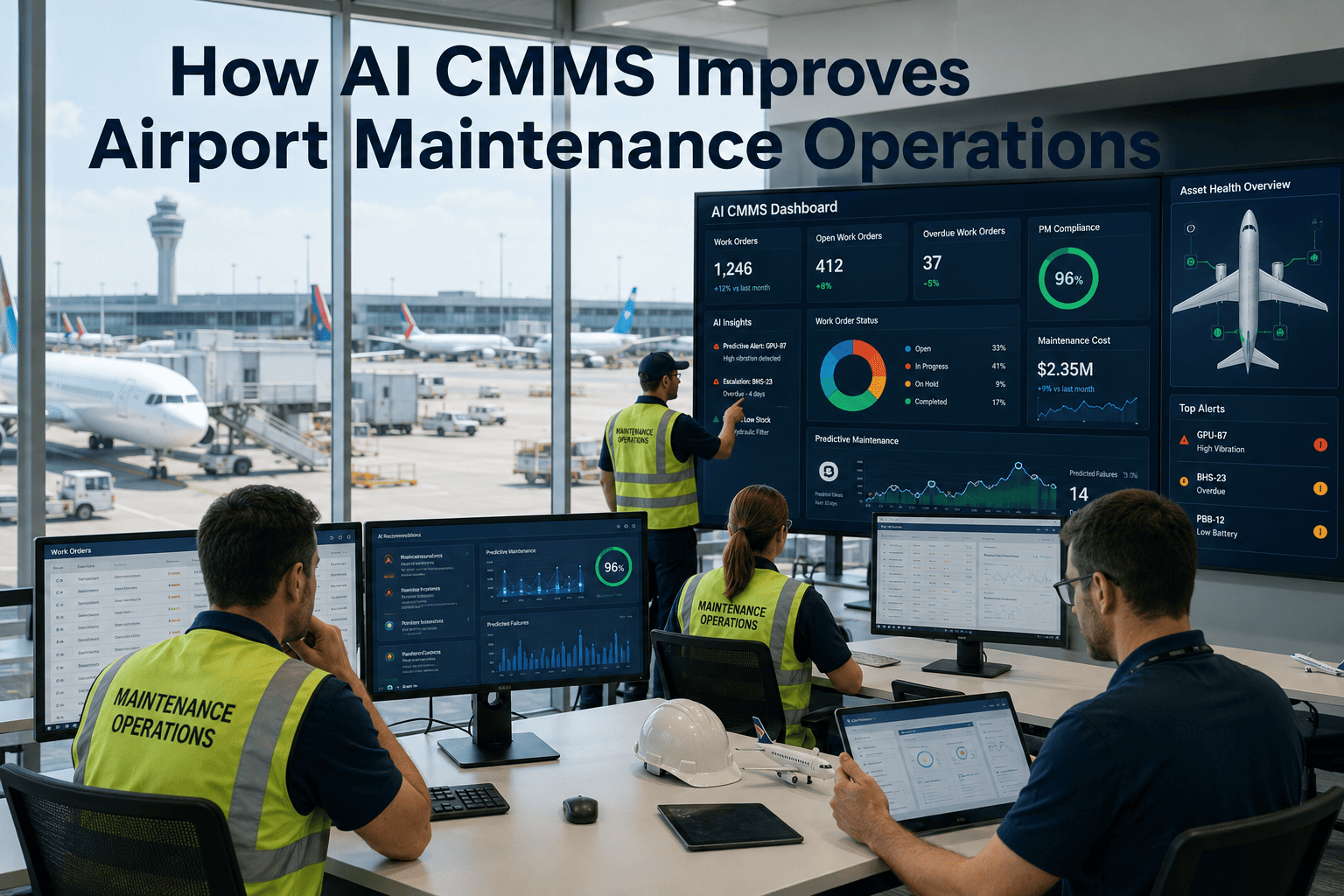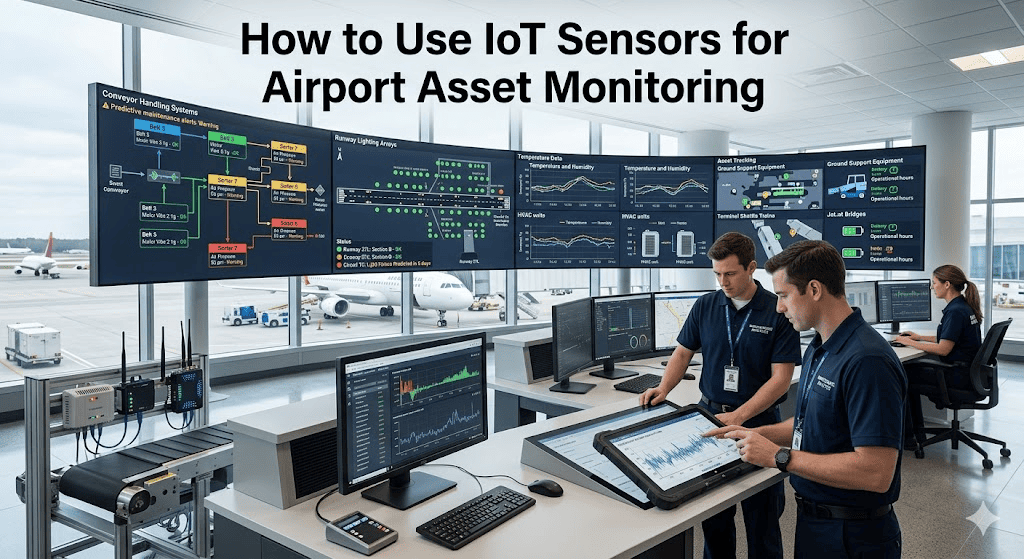
Modern airports operate fifty thousand or more individual assets — baggage handling conveyors cycling fifteen thousand bags per hour, HVAC plants conditioning hundreds of thousands of square feet, jet bridges performing three hundred docking operations per week, runway lighting systems where a single failed approach light can close a runway, and ground support equipment fleets exposed to twenty-four-hour duty cycles. Calendar-based preventive maintenance cannot keep pace with this asset population and reactive maintenance is too expensive to sustain. The operational answer that mature airports are now adopting at scale is IoT-sensor-driven asset monitoring — continuous vibration, temperature, current, pressure, and condition data streamed from critical equipment into a CMMS that turns the signal into a work order before the asset fails. This guide shows airport operations directors, facility managers, and engineering leads at airports across the USA, UK, Canada, UAE, Germany, and Australia exactly which sensors to deploy on which assets, how the data converts to maintenance action, and what ROI to expect. start a free trial to configure IoT-driven monitoring in Oxmaint from day one, or book a demo to see your airport assets mapped to sensor categories live.
See Failures 30–90 Days Before They Happen
Identify the exact assets in your terminal, baggage hall, and airfield that are degrading right now — and turn that intelligence into scheduled, low-impact maintenance instead of peak-hour emergencies.
Works across multi-site airport portfolios — live in days, not months.
What IoT Asset Monitoring Actually Means at an Airport
IoT sensor-driven asset monitoring at an airport is the continuous capture of condition data — vibration, temperature, current draw, pressure, flow, humidity — from critical equipment and the automated conversion of that data into maintenance action through an integrated CMMS. Unlike traditional condition monitoring, which depends on a technician walking the asset on a schedule, IoT monitoring runs twenty-four hours a day, captures degradation signals weeks before they would be detectable by human inspection, and triggers work orders without supervisor intervention.
The architecture is straightforward — sensors mount externally to existing equipment, transmit wirelessly over LoRaWAN, Wi-Fi mesh, or cellular, and feed a CMMS that applies pattern recognition and threshold logic to the data. No rip-and-replace, no equipment modification, no specialist staff required to interpret the readings. start a free trial to deploy your first sensor-driven monitoring on critical airport assets.
The Six Sensor Categories Every Airport Should Deploy
Vibration & Accelerometer
Bearing wear, imbalance, misalignment in rotating equipment. Critical for baggage conveyor drives, HVAC compressors, escalator motors. 95–98% accuracy on bearing fault detection.
Temperature & Thermal
Motor overheating, electrical panel hot spots, refrigeration drift, HVAC chiller condition. Detects developing faults weeks before insulation breakdown or component failure.
Motor Current Analysis
Current signature changes reveal mechanical load, gearbox wear, belt tracking drift, and electrical degradation — without invasive sensor placement.
Pressure & Hydraulic
Jet bridge hydraulic systems, baggage system pneumatics, fuel hydrant networks. Catches seal degradation and circuit faults before bridges become unservicable.
Flow & Energy
HVAC water flow, compressed air consumption, cold storage temperature stability — early signals of energy drift and developing inefficiency.
Electrical & Power Quality
CCR output, transformer health, UPS condition, runway lighting circuit insulation. Predictive insulation resistance trending replaces reactive circuit failures.
Modern industrial IoT sensors cost as little as $0.10–$0.80 per unit — comprehensive airport monitoring is now economically viable for any facility size.
The Pain Points IoT Asset Monitoring Eliminates
Reactive Mode on Critical Assets
Around 50 percent of airport maintenance work is unplanned or rescheduled because teams lack real-time visibility into equipment health — failures are discovered when something breaks, never before.
Manual Rounds Miss the Critical Window
Technicians can only inspect a fraction of assets daily. Vibration trends that signal a bearing failure 30 days out go undetected because the next manual round is two weeks away.
Cascading Failures from One Asset
A single baggage conveyor motor failure during peak hours cascades into dozens of delayed departures, mishandled bag claims, and emergency overtime — when 72 hours of advance warning would have prevented every cost.
Calendar PM Either Over- or Under-Services
Healthy equipment serviced too often, degrading equipment serviced too rarely — calendar maintenance is calibrated to the average asset, not the actual one. Both errors cost real money.
No Defensible Data for CapEx Requests
Replacement budget requests rely on age and anecdote — not condition data. Finance pushes back, and the highest-risk assets remain in service until they fail in front of passengers.
No Trending Across Asset Population
Same fault recurring on the same equipment family across multiple terminals — invisible without sensor data and fleet-wide pattern analytics. Recurring root causes go unaddressed for years.
Airports moving from calendar-based to sensor-driven asset monitoring routinely cut unplanned downtime by 30–50 percent and total maintenance cost by 18–25 percent — start a free trial to see how, or book a demo to model your asset portfolio.
How Oxmaint Converts IoT Sensor Data Into Maintenance Action
Open Sensor Protocol Support
OPC UA, MQTT, BACnet, and REST API ingest from any major sensor manufacturer — no rip-and-replace of existing instrumentation. Sensors you already have start contributing to predictive maintenance on day one.
Anomaly Detection & Threshold Alerts
Machine learning models learn each asset's healthy operating signature and flag deviations — rising vibration on a conveyor motor, unusual current draw on an HVAC compressor, thermal drift on an electrical panel.
Automated Work Order Generation
When a sensor signal crosses a defined threshold, Oxmaint generates a work order automatically — with asset details, predicted failure mode, recommended action, and estimated time to failure — routed to the correct technician.
Asset Health Score Dashboard
Live color-coded health view of every monitored asset — baggage conveyors, HVAC plants, jet bridges, escalators, runway lighting CCRs. Operations leaders see at a glance which assets need attention and which are healthy.
Degradation Trend Analytics
Vibration, temperature, current, and pressure trends per asset over weeks and months — remaining useful life projections give finance the data to approve targeted replacement capex rather than blanket refurbishment.
Multi-Terminal Sensor Visibility
Sensor data from every terminal, concourse, and airside zone in one unified view — common fault patterns across the asset population surface fleet-wide rather than as isolated terminal-level events.
Used by operations teams managing 10,000+ airport assets — see measurable results in the first 30 days.
Calendar Maintenance vs IoT Sensor-Driven Maintenance
| Maintenance Dimension | Calendar-Based PM | IoT Sensor-Driven PM |
|---|---|---|
| Failure detection horizon | After the failure occurs | 30–90 days before failure for most fault modes |
| Inspection coverage | Fraction of assets per day, by technician availability | 24/7 continuous monitoring on every instrumented asset |
| Maintenance scheduling | Calendar-driven, ignores actual asset condition | Condition-driven, scheduled during low-traffic windows |
| Healthy asset over-servicing | Significant — assets serviced regardless of need | Eliminated — service triggered by condition only |
| Degrading asset under-servicing | Common — degradation invisible between rounds | Eliminated — degradation flagged in real time |
| CapEx justification | Age, anecdote, and recent failure history | Condition score, RUL projection, sensor data trend |
| Peak-hour failure exposure | High — no advance warning of imminent failure | Near-eliminated — advance warning enables off-peak scheduling |
| Cost outcome | High emergency cost, over-servicing waste, cascading delays | 18–25% lower maintenance cost, 30–50% less downtime |
Measured ROI From IoT Asset Monitoring
Frequently Asked Questions
Which airport assets benefit most from IoT-driven monitoring?
The highest-impact airport assets for IoT-driven monitoring share three characteristics — they are operationally critical, expensive to repair on emergency call-out, and generate detectable degradation signatures before failure. The standard priority list is baggage handling conveyors and carousels (motor and gearbox issues are detectable 3–4 weeks ahead of failure), HVAC chillers and air handling units (compressor and filter monitoring prevents terminal comfort failures), escalators and elevators (drive and mechanism monitoring prevents passenger-facing breakdowns), jet bridges (hydraulic and electrical monitoring keeps gates operational), and airfield lighting systems including CCRs and transformers. Starting with the equipment whose failures cause the most operational disruption delivers the fastest measurable ROI — typically within the first 90 days.
Do I need to replace existing equipment to deploy IoT monitoring?
No — and this is one of the most common misconceptions about airport IoT deployments. Modern industrial IoT sensors mount externally to existing equipment housings and require no modification to the machinery itself. Older HVAC units, conveyor systems, jet bridge mechanisms, and motors can all be monitored with surface-mounted vibration, temperature, and current sensors — no digital interfaces required on the host equipment. Sensors communicate wirelessly over LoRaWAN (up to 15 km range with 5–10 year battery life), Wi-Fi mesh, or cellular, so most airports need only two to four gateways for full coverage. Existing instrumentation that already exists — typically 30–50 percent of what a comprehensive programme requires — is integrated through OPC UA, MQTT, or REST API rather than replaced.
How accurate are IoT-based failure predictions for airport equipment?
Modern IoT-based predictive systems achieve 85–98 percent accuracy for well-defined failure modes — bearing wear, motor degradation, belt tracking, hydraulic seal loss, electrical insulation breakdown. Vibration sensors are particularly accurate at 95–98 percent on rotating equipment fault detection. Temperature and motor current analysis typically achieve 88–95 percent accuracy. Accuracy improves continuously as the predictive models learn each specific airport's operational patterns and equipment behaviour. Advance warning is typically 30–90 days for slow-developing faults and 7–14 days for faster degradation patterns — enough time to schedule maintenance during overnight or low-traffic windows rather than respond to a peak-hour failure.
How does Oxmaint handle IoT data across multiple airport sites?
Oxmaint's multi-site portfolio architecture is designed for airport groups and authorities operating multiple facilities. Sensor data from every terminal, concourse, and airside zone at every airport feeds into a unified portfolio view, with site-level dashboards available for individual operations teams. Common failure patterns across the asset population — a recurring HVAC compressor fault on a specific equipment family, for example, or a baggage motor bearing issue appearing at multiple terminals — surface as fleet-wide trends rather than isolated incidents. Corporate engineering teams can act on the pattern with one fleet-wide programme rather than five terminal-level fixes. Each site retains its own PM schedules, technician roster, and compliance documentation while the engineering intelligence is shared across the portfolio.
Stop Reacting to Asset Failures — Start Preventing Them
Airport operations directors across the USA, UK, Canada, UAE, Germany, and Australia use Oxmaint to convert IoT sensor data from baggage handling, HVAC, jet bridges, escalators, runway lighting, and ground support equipment into real-time failure predictions and automated maintenance workflows — without replacing existing infrastructure.
- Real-time asset health visibility across every monitored system
- Predictive failure alerts 30–90 days in advance
- Automated work order generation tied to sensor anomalies