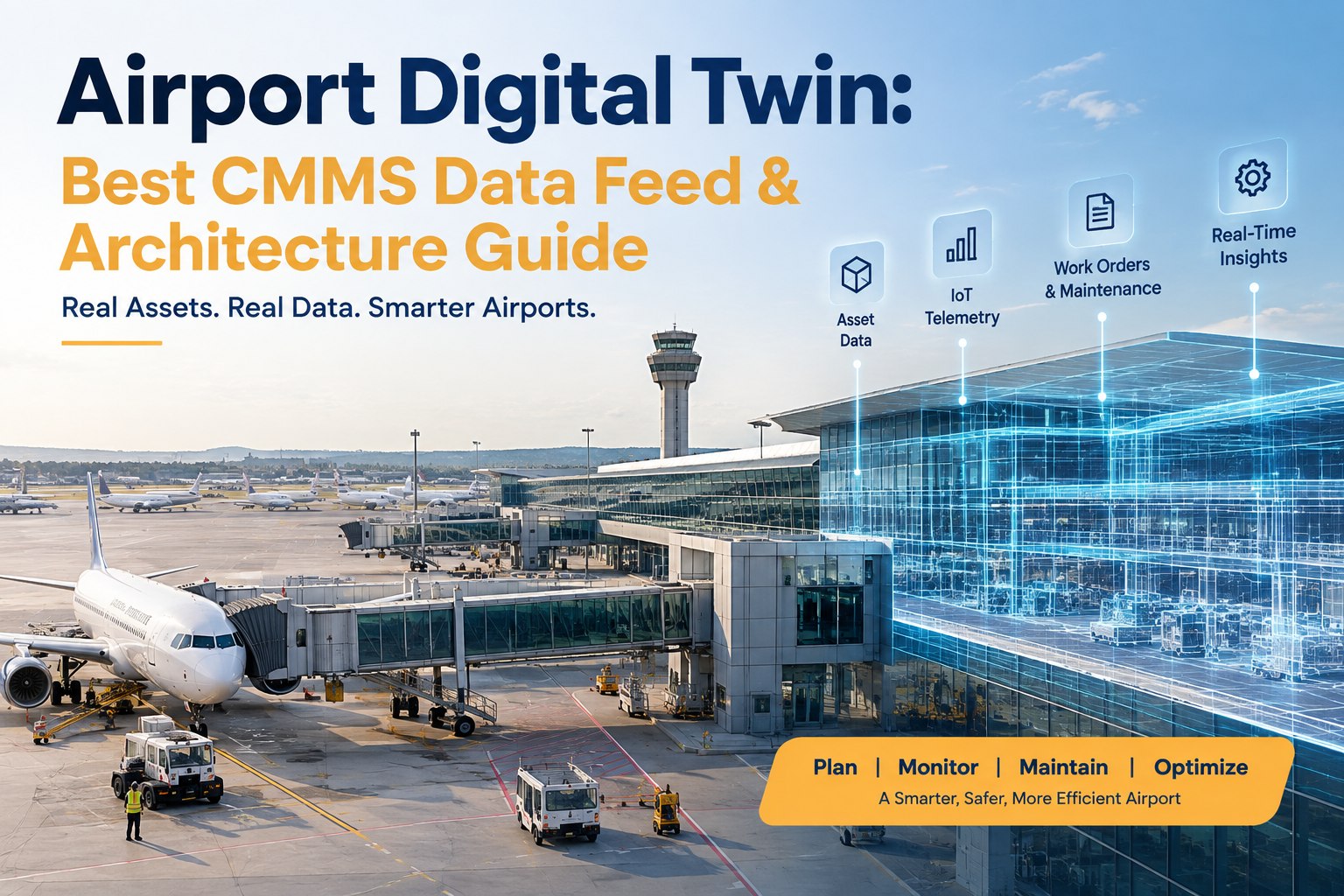
Your airport has 156 operational assets spread across terminals, utilities, and ground ops. Right now, the data about those assets lives in five different systems, three spreadsheets, and someone's memory. When Terminal C's power system needs an upgrade, your team discovers the maintenance record is six months stale. When a boarding bridge fails at Gate 22 during morning rush, nobody knows its last service date without digging through paper files. Real-time digital twin synchronization eliminates this blindness by creating a living virtual replica of every airport asset, continuously updated through IoT data streams. Schedule a demo to see how OXmaint keeps your digital twin in perfect sync with your physical infrastructure.
The Digital Twin Opportunity in Aviation
Airports are among the most complex infrastructure environments on earth, with thousands of interdependent systems operating around the clock. Digital twin technology is transforming how these systems are monitored, maintained, and optimized. The growth trajectory is unmistakable, and the airports investing now are building operational advantages that compound over time.
$1.32B
Airport Digital Twin Market (2024)
→
28.7%
CAGR Growth Through 2033
→
$12.17B
Projected Market Value by 2033
Dataintelo Airport Digital Twin Market Report, 2025
Why Most Airport Digital Models Fail
Having a 3D model of your airport is not the same as having a digital twin. The difference is synchronization. Most airports that attempt digital twins end up with expensive static models that drift further from reality every day. Here are the four reasons that gap widens.
Technicians complete work orders on paper. Data enters the system days or weeks later, if at all. By the time the model reflects reality, reality has changed again. The twin becomes a historical record, not a live mirror.
BMS data lives in one platform. CMMS records in another. GIS maps in a third. Energy data in a fourth. No single system sees the full picture. Your digital twin is only as good as the narrowest data pipe feeding it.
Without sensors streaming live telemetry, your twin has no heartbeat. It cannot tell you if the HVAC in Terminal B is degrading, if a pump is drawing abnormal current, or if a transformer is running hot right now.
A static model cannot trigger actions. When a sensor detects anomalous vibration in an escalator motor, nothing happens automatically. The insight exists in data but never becomes a work order, an alert, or a decision.
80% of airports still run primarily reactive maintenance programs. OXmaint's synchronized digital twin shifts your operation from reactive to predictive with live IoT data streams and automated triggers.
Start Free
How Real-Time Synchronization Works
A synchronized digital twin is not a dashboard bolted onto existing systems. It is an intelligent platform that ingests data from the physical world continuously, processes it through AI models, and feeds actionable insights back to operators in real time. OXmaint's architecture makes this happen through three tightly integrated layers.
OXmaint Digital Twin Synchronization Architecture
Physical Layer
Your Airport Infrastructure
Vibration Sensors
Temperature Monitors
Energy Meters
SCADA / BACnet
BMS Feeds
Air Quality Systems
Continuous IoT Data Streams via MQTT, REST APIs, Edge Computing
Digital Twin Layer
OXmaint Platform
BIM / IFC Models
GIS Mapping
Asset Registry
3D Spatial Models
Historical Records
Lifecycle Models
AI Processing, Anomaly Detection, Predictive Algorithms
Action Layer
Automated Outcomes
Auto Work Orders
Predictive Alerts
Outage Planning
Incident Response
Analytics Dashboards
Scenario Simulation
Inside the OXmaint Digital Twin Monitor
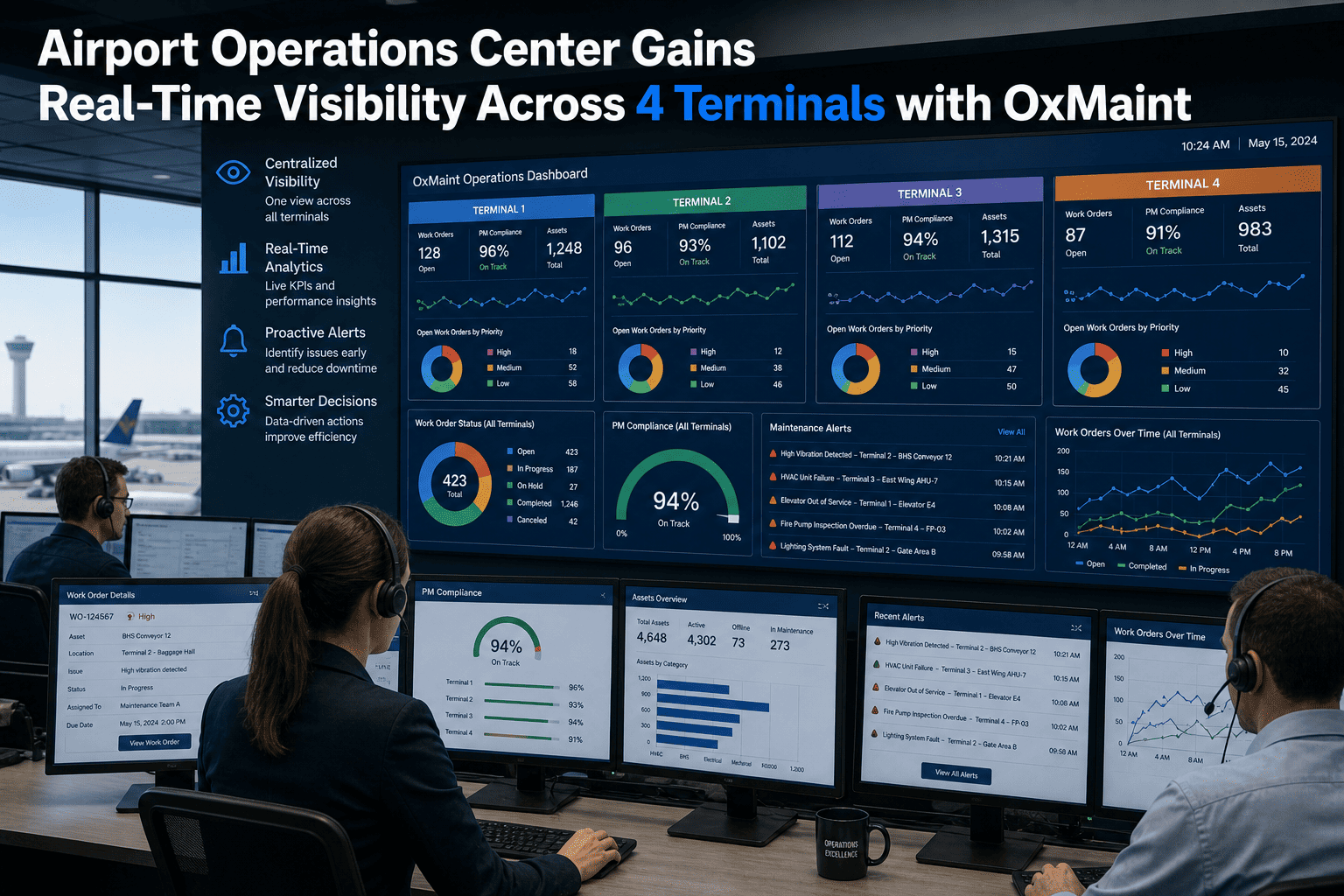
OXmaint's Digital Twin Monitor is your real-time operational command center. It unifies system health, maintenance status, and asset distribution into a single interface that gives you complete situational awareness across your entire airport at a glance.
System Health
Operational snapshot
Operational Assets156 / 156
System Uptime100.00%
Critical Issues10
Alerts138
Maintenance Status
Live maintenance pulse
Scheduled100
In Progress0
Overdue10
Next Interval30h
Asset Distribution
Zone coverage
Terminals0
Utilities156
Ground Ops0
Parking0
Overview
Assets
Outage Planning
Incidents
Analytics
Asset ID
Name
Status
Last Service
Next Service
ASSET58584302
Runway Lighting and Ground Radar
Active
2025-07-08
2025-10-08
ASSET04749570
Pump PMP-00030
Active
2025-12-23
2026-03-31
ASSET58561610
Passenger Boarding Bridge Systems
Active
2025-09-15
2026-01-15
ASSET77940575
Moving Walkway MW-00067
Active
2025-12-23
2026-03-31
ASSET25774729
LV Panel PANEL-LV-00024
Active
2025-12-23
2026-03-31
See Your Airport in Real Time
Book a demo and we'll show you how OXmaint's Digital Twin Monitor transforms disconnected infrastructure data into a living, synchronized operational picture.
Five Synchronization Capabilities That Change Everything
When your digital twin stays synchronized with physical reality in real time, it stops being a visualization tool and becomes an operational intelligence engine. These five capabilities are what separate a live twin from a dead model.
01
Live Asset Health
Every Asset Has a Pulse
IoT sensors stream vibration, temperature, current draw, and runtime data from every critical asset. The digital twin processes this telemetry in real time and displays system health as a live operational snapshot. When a pump starts drawing 15% more current than baseline, the twin flags it before the pump fails.
02
Predictive Maintenance Triggers
Fix It Before It Breaks
The platform builds lifecycle degradation curves for each asset class. When sensor data indicates an asset is approaching a failure threshold, OXmaint automatically generates a work order, assigns a technician, and reserves parts. No human intervention needed between detection and action.
03
Outage Planning
Simulate Before You Shut Down
Before taking Terminal C's power system offline for an upgrade, simulate the impact. The digital twin models which systems are affected, identifies backup circuits, and calculates the optimal maintenance window. Planned outages stay planned instead of becoming emergencies.
04
Incident Detection
Know It Happened Before Anyone Calls
When an air handling unit trips offline, the twin detects the state change in seconds. It correlates the failure with downstream impacts, identifies affected zones, and alerts the right response team with the asset's full history, location, and recommended action.
05
Performance Analytics
Turn Data Into Decisions
Synchronized data enables trend analysis across asset classes, zones, and time periods. Compare energy consumption across terminals. Identify which equipment types fail most. Benchmark maintenance KPIs against targets. Every data point feeds smarter capital and operational planning.
Before and After: The Synchronization Difference
The difference between an airport running disconnected systems and one running a synchronized digital twin shows up in every maintenance call, every outage, and every capital decision.
Escalator Motor Failure at 7 AM
Without Synchronization
Passenger reports escalator stopped. Facilities gets the call at 7:22 AM. Technician dispatched at 7:45. Arrives, diagnoses motor failure. Parts search takes 90 minutes. Repair complete at 11:30 AM. 4+ hours of downtime during peak passenger flow.
With OXmaint Digital Twin
Twin detects abnormal vibration pattern 3 weeks before failure. Predictive alert triggers PM work order. Motor serviced during overnight maintenance window. Escalator never stops. Zero passenger impact. Zero emergency cost.
Terminal Power System Upgrade Planning
Without Synchronization
Engineering team reviews 3-year-old drawings. Asset data pulled from CMMS is incomplete. Backup circuit capacity is unknown. Outage window estimated at 6 hours. Actual outage runs 11 hours due to unforeseen dependencies. 14 gates affected.
With OXmaint Digital Twin
Digital twin models all circuit dependencies in real time. Simulation confirms backup capacity for non-critical loads. Outage planned for 6 hours during off-peak, executed in 5.5 hours. Zero gate disruptions. Full documentation auto-updated.
Annual Capital Budget Planning
Without Synchronization
Department heads submit wish lists. No data on actual asset condition or remaining useful life. Budget allocated politically. Three HVAC units replaced that had 5+ years of life left. Two critical pumps that needed replacement were missed.
With OXmaint Digital Twin
Lifecycle degradation data shows exactly which assets need replacement within 12 months. Capital ranked by criticality and condition score. Budget directed to highest-impact replacements first. $2.1M in deferred spend on healthy assets.
What Gets Synchronized: Asset Categories
Every airport asset type generates different data and requires different synchronization priorities. OXmaint's digital twin maps the right sensors to the right assets, ensuring every category gets the monitoring depth it needs.
Temperature
Air Flow
Filter Pressure
Energy Draw
Terminal comfort and air quality depend on HVAC performance. Synchronized monitoring detects filter degradation, refrigerant leaks, and compressor stress weeks before failures impact passenger zones.
Voltage
Load Factor
Transformer Temp
Circuit Status
Power failures cascade. A tripped transformer can black out gates, baggage systems, and security checkpoints simultaneously. The twin maps every circuit dependency and monitors load in real time.
Vibration
Motor Current
Trip Count
Door Cycles
Elevators, escalators, and moving walkways are passenger-facing assets where downtime is immediately visible. Vibration and motor current analysis predicts bearing failures and drive belt wear before stoppage.
Flow Rate
Pressure
Pump Runtime
Leak Detection
Water distribution networks span miles across airport campuses. Acoustic sensors and flow anomaly detection identify leaks underground before they surface, preventing runway damage and costly emergency repairs.
Light Intensity
Radar Status
Pavement Sensors
ILS Health
Airfield systems are safety-critical with zero tolerance for failure. The digital twin provides continuous monitoring of runway lighting, ground radar, ILS equipment, and pavement condition sensors to ensure operational readiness.
Hydraulics
Alignment
Drive Motor
HVAC Precond.
Boarding bridge failures directly delay departures. Hydraulic pressure monitoring, alignment sensor tracking, and motor health analysis ensure bridges operate reliably during every aircraft turnaround.
The Business Impact: Synchronization by the Numbers
Real-time digital twin synchronization delivers measurable returns across maintenance costs, asset availability, operational efficiency, and capital planning accuracy.
30%
Reduction in unplanned downtime with predictive maintenance powered by digital twin synchronization
15%
Reduction in annual maintenance expenditures achieved through synchronized predictive analytics
96%+
Infrastructure availability target achievable with continuous IoT-driven condition monitoring
44%
Of airports now using digital twins for operational management, up from single digits five years ago
Scheduled Outage Management
The digital twin does not just monitor live operations. It gives your planning team a simulation environment for scheduling maintenance windows and planned downtime with full awareness of dependencies and downstream impacts.
Upcoming Scheduled Outages
2026-02-15
Terminal C power system upgrade
Estimated 6h • Backup active • Non-critical circuits
2026-02-22
HVAC full system inspection
Estimated 8h • Off-peak • All terminals
2026-03-01
Water distribution network testing
Estimated 4h • Manual bypass enabled
2026-03-10
Baggage handling system belt replacement
Estimated 5h • Terminal A • Overnight window
Frequently Asked Questions
What does "real-time synchronization" actually mean for a digital twin?
It means your virtual model updates continuously as physical conditions change. When a sensor detects a temperature shift, a pump changes state, or a maintenance task is completed, the digital twin reflects that change within seconds. This is fundamentally different from periodic batch updates or manual data entry. OXmaint achieves this through persistent IoT connections using MQTT, SCADA integration, and REST API feeds that stream data to the platform without interruption.
How does OXmaint integrate with our existing BMS, CMMS, and GIS systems?
OXmaint does not replace your existing systems. It unifies them. The platform connects to BMS through BACnet and Modbus protocols, imports BIM models via IFC format, integrates with CMMS through REST APIs, and overlays GIS data for spatial context. Every data source becomes a building block for your synchronized twin. Most airports complete initial system integration within 2-3 weeks.
Book a consultation to plan your integration.
Do we need to install IoT sensors on every asset?
No. OXmaint's phased approach starts with your most critical assets, typically HVAC, electrical distribution, and vertical transport systems. Many airports already have BMS sensors and SCADA systems in place that can feed data directly into the twin. The platform also accepts manual inspection data for lower-priority assets. You start seeing value from day one and expand sensor coverage over time based on ROI.
How quickly can we deploy a synchronized digital twin?
OXmaint follows a three-phase deployment. Phase 1 (weeks 1-3) establishes the asset registry, connects existing data sources, and delivers real-time monitoring. Phase 2 (weeks 4-8) activates predictive models, alert thresholds, and anomaly detection. Phase 3 (months 3-6) enables full simulation, scenario planning, and lifecycle forecasting. Most airports are running with live, synchronized data within the first month.
Schedule a demo to see the deployment roadmap.
What makes OXmaint different from other digital twin platforms?
Most digital twin platforms focus on visualization. OXmaint focuses on operational action. The platform does not just show you a 3D model of your airport. It automatically generates work orders from sensor anomalies, plans outages with dependency awareness, tracks asset lifecycle degradation, and delivers predictive maintenance triggers that prevent failures. It is a maintenance intelligence platform with a digital twin interface, not the other way around.
Start your free trial to experience the difference.
Your Airport Deserves a Living Digital Twin
Real-time asset synchronization, predictive maintenance, outage simulation, and complete operational visibility for every piece of infrastructure across your campus. See what a synchronized digital twin looks like.