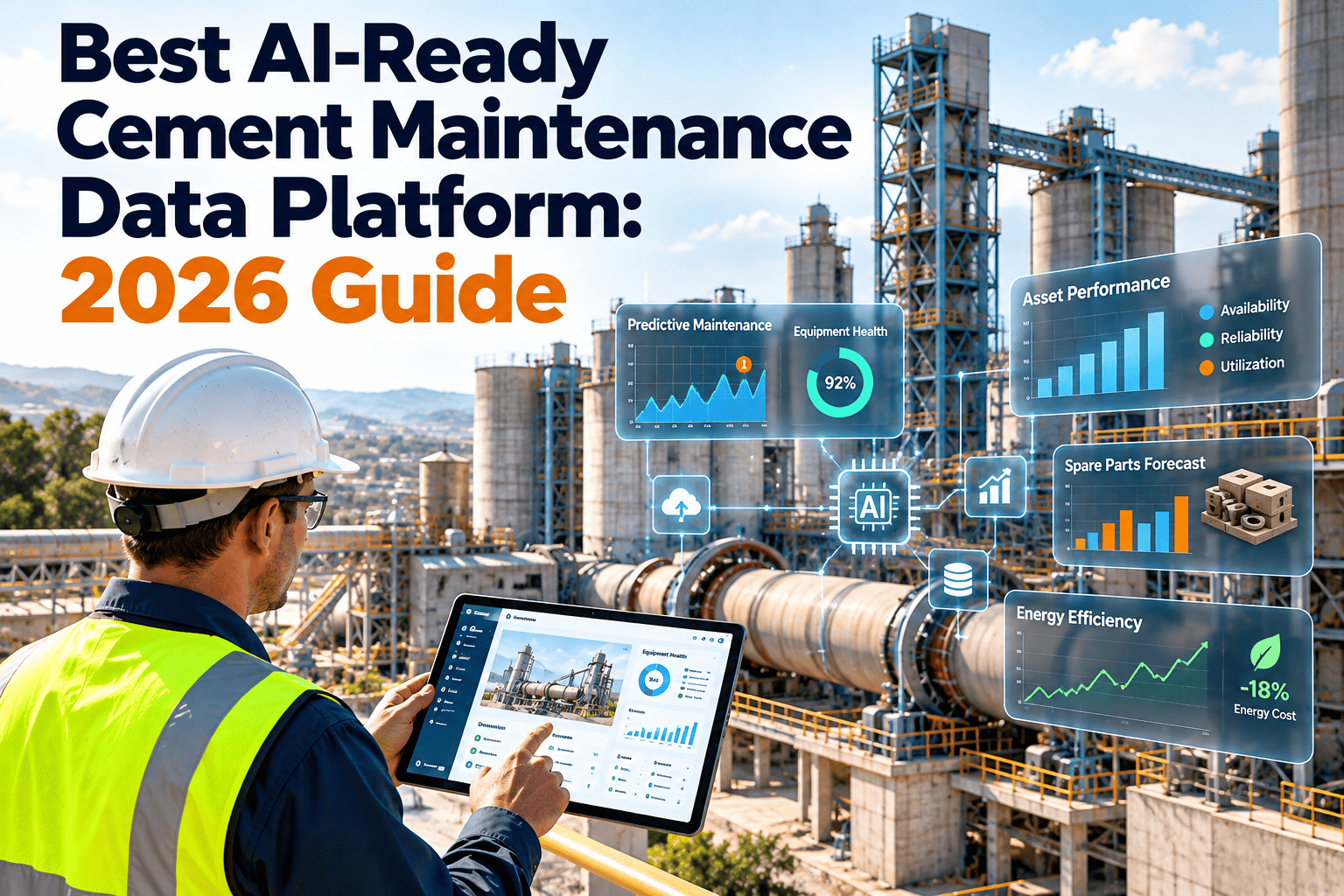
Choosing a data platform for cement maintenance in 2026 means looking beyond a long feature list. An AI-ready platform is one that gives clean, connected and trustworthy data to whatever analytics a plant chooses to use, from simple trend alerts to machine learning models. Without that foundation, even a strong model produces weak results. This guide compares the main platform types, sets out evaluation criteria and shows where a maintenance system fits. If you want to test the maintenance data layer first, you can try Oxmaint with your own asset list.
Best AI-Ready Cement Maintenance Data Platform: 2026 Guide
Compare the platform types a cement plant can use for AI-driven maintenance, and learn which capabilities decide whether predictions can be trusted and acted on.
Action layer: work orders, inspections, scheduling, spares
Analytics layer: condition models, trends, reporting
Context layer: asset hierarchy, failure codes, event history
Connectivity layer: historian, SCADA, sensors, quality data
What AI-ready actually means for a cement plant
AI-ready is not a product label. It describes the condition of the data and the workflow around it. Four tests are worth applying to any platform.
1
Connected
Process, condition and maintenance data can be joined by asset and time, without manual exports.
2
Contextualised
Each signal is tied to a known asset, component and operating mode, not just a raw tag name.
3
Labelled
Failures, repairs and findings are recorded with consistent codes so models can learn from them.
4
Actionable
A prediction can create a work order, reserve parts and be followed through to a result.
Platform types compared
Most cement plants end up with a combination. The comparison below describes categories rather than individual vendors, because the right choice depends on existing systems and skills.
| Platform type | Strength | Typical gap | Best used for |
|---|---|---|---|
| CMMS or EAM | Work orders, assets, spares, inspections, compliance records | Limited raw signal processing unless integrated | Maintenance record, execution and labelled history |
| Process historian and SCADA | High-frequency process and sensor data with long retention | Little maintenance context or work management | Storing and trending process signals |
| Condition monitoring systems | Specialist vibration, thermography and oil analysis | Often limited to one technique or one asset class | Diagnosis of rotating equipment |
| Industrial data lake or cloud analytics | Flexible storage and model development | Needs data engineering skills and governance | Custom analytics across many plants |
| OEM or vendor analytics | Deep knowledge of one machine family | Silos across suppliers and limited asset coverage | Specific high-value equipment |
| Quality and lab systems | Product and process quality results | Weak link to equipment health | Connecting quality drift with equipment condition |
Evaluation criteria and suggested weights
Weights should reflect your priorities. The values below are an example starting point that plants can adjust.
See how maintenance data becomes AI-ready
Walk through asset hierarchies, failure codes and work order flows with your own equipment list.
Capabilities that matter most in 2026
Open connectivity
Look for support for common industrial interfaces such as OPC UA and MQTT, along with APIs and file import. Plants rarely replace their control systems, so a platform must work alongside them.
Asset hierarchy that matches the plant
A cement plant tree should reach from the kiln or mill down to drives, bearings and instruments. Without that structure, signals cannot be tied to the components that fail.
Consistent failure and cause coding
This is the most overlooked capability. Models learn from labelled failures, and labels come from disciplined work order closure.
Closed-loop actions
Insight is worth little unless it creates a task, a part reservation and a recorded outcome. Check the number of manual steps between alert and work order.
Mobile and offline-friendly use
Large plants have areas with weak connectivity. Technicians must be able to capture inspections and close work wherever they are.
Security and access control
Review role-based access, audit trails, data residency and how the platform handles operational technology networks.
Where each platform type fits in a combined architecture
Sources
Sensors, PLCs, SCADA, lab and ERP data
Storage and processing
Historian, data lake or monitoring system
Models and rules
Plant analytics team, vendor tools or built-in alerts
Maintenance system
Work orders, assets, spares, inspections, outcomes
The maintenance system closes the loop. It receives the alert, schedules the work and returns a labelled outcome so analytics can improve.
Questions to ask every vendor
- Which data sources can you connect to without custom coding, and what is the typical integration effort?
- How do you represent asset hierarchies, and can we import ours?
- Can predictions or alerts create work orders automatically, and who approves them?
- How do you handle model monitoring and retraining, and who is responsible?
- What happens to our data if we leave, and can we export it in open formats?
- What are the security controls for operational technology environments?
- Can you share references from heavy industry with similar conditions?
Red flags during evaluation
AI promised without data discussion
If a vendor skips data quality, labelling and integration, the model will struggle.
No path to work execution
Dashboards that stop at insight leave the plant with extra screens and no change in outcomes.
Locked data formats
Closed storage makes switching and combining tools expensive.
One-size-fits-all models
Cement equipment has specific failure modes. Generic models need local tuning.
A readiness checklist before you buy
- Equipment list with consistent naming and criticality rankings is available.
- Key sensors and monitoring points are identified for kilns, mills, fans and gearboxes.
- Failure codes are defined and used on work orders.
- At least one year of work order history is accessible, even if imperfect.
- Owners are named for data quality, models and maintenance response.
- A pilot scope is chosen with clear success measures.
Where Oxmaint fits
Oxmaint is a maintenance management platform. In an AI-ready architecture it covers the action and context layers.
Asset management for plant hierarchies and component history.
Preventive and corrective workflows to turn findings and alerts into tracked work.
Inspections captured on mobile devices with consistent checklists.
Inventory and spares linked to work orders and critical equipment.
Reporting and dashboards for reliability, backlog and outcomes.
Plants should confirm current integration options and analytics scope during a demo, since requirements vary.
Why data quality outweighs model sophistication
Plants often compare algorithms when the real difference lies in data. A modest model with clean asset context and good failure labels usually beats an advanced model fed with mislabelled tags and incomplete history.
- Inconsistent tag names make it hard to compare similar machines across lines.
- Missing replacement dates make it impossible to separate wear from maintenance resets.
- Free-text work order descriptions hide failure patterns that coded fields would reveal.
- Gaps in sensor history reduce the amount of usable training data.
Trends shaping cement maintenance data in 2026
Interoperability standards
OPC UA and MQTT remain common routes for moving plant data into analytics and maintenance tools.
Edge processing
Some analysis moves closer to the machine, which can reduce bandwidth needs and improve response time.
Assistive AI for technicians
Search and summary tools help crews find procedures, past repairs and asset history faster, but they depend on good records.
Energy and emissions focus
Cement is energy intensive, so equipment efficiency data increasingly sits beside reliability data.
Cybersecurity expectations
Connecting operational data to cloud tools raises questions about segmentation, access and monitoring.
Treat these as areas to ask vendors about rather than fixed requirements. Confirm current capabilities directly during evaluation.
Cement-specific use cases to test during a pilot
- Kiln drive and support roller condition tied to inspection findings and planned alignment work.
- Raw and cement mill health, including motor load, vibration and wear part replacement history.
- ID fan and cooler fan monitoring linked to dust control and process draught.
- Gearbox condition combining vibration, oil results and repair history.
- Critical spare readiness tied to condition findings and supplier lead times.
- Shutdown planning using job history, parts readiness and past outage overruns.
A 90-day pilot plan
Days 1 to 30
Select one asset group. Clean the asset list, define failure codes and connect available data sources.
Days 31 to 60
Run inspections and work orders in the system. Compare alerts or trends with technician findings.
Days 61 to 90
Review outcomes, measure response time and decide whether to expand, adjust or stop.
Define success measures in advance, such as alert-to-work-order time, share of work orders with failure codes, or reduction in work waiting for parts.
Total cost of ownership considerations
- Licensing model: per user, per asset or per site, and how costs change as coverage grows.
- Integration effort: connectors, custom interfaces and ongoing maintenance of them.
- Data engineering and analytics skills required to operate the platform.
- Training time for technicians, planners and supervisors.
- Exit costs, including data export and the effort of rebuilding workflows elsewhere.
Scorecard template for comparing shortlisted options
Score each option from one to five against your weighted criteria, and record the evidence behind each score.
| Criterion | What to look for | Evidence to request |
|---|---|---|
| Integration | Standard connectors, open APIs, import tools | Live demonstration using your own data sample |
| Asset context | Multi-level hierarchy, component tracking, failure codes | Import of your equipment list |
| Workflow | Alert to work order to closure with minimal manual steps | Walk-through of a full cycle |
| Usability | Mobile inspections, simple closure, offline tolerance | Trial with technicians on the floor |
| Security | Access roles, audit trail, network design | Security documentation and review |
| Cost and support | Transparent pricing, onboarding, response times | Written proposal and references |
Who should be in the selection team
- Maintenance and reliability leaders, who own the workflow and the outcomes.
- Planners and technicians, who will use the system every day and spot practical problems quickly.
- Process and automation engineers, who understand data sources and network constraints.
- IT and operational technology security staff, who assess access and architecture.
- Procurement and finance, who review total cost and contract terms.
Build, buy or combine
Every plant eventually asks whether to build analytics in house, buy a packaged solution or combine both. The answer depends on skills, scale and appetite for ongoing support.
Build in house
- Maximum flexibility and local knowledge.
- Requires data engineers, modellers and long-term support.
- Works best across several plants with a central team.
Buy a packaged solution
- Faster start and vendor-supported updates.
- May fit some equipment better than others.
- Check data export rights and integration depth.
Combine
- Use a maintenance system for records and execution.
- Use specialist tools for condition analysis.
- Agree clear data contracts between the systems.
Mistakes to avoid when selecting a platform
- Buying for a demonstration scenario instead of the plant's real equipment, data quality and staff skills.
- Starting analytics before work order discipline is in place, which leaves models without usable labels.
- Ignoring the technician experience, so data capture falls back to paper and memory.
- Choosing a platform that cannot share data with the systems already in the plant.
- Skipping a pilot, so problems appear only after a full contract is signed.
- Measuring success by number of dashboards rather than by reduced downtime, faster response and better planning.
Data ownership, portability and governance
Maintenance and condition data will outlive any single platform. Settle the rules early, before integration work begins.
- Confirm in writing that the plant owns its asset, work order and sensor data, including derived records.
- Check that data can be exported in open, documented formats without extra fees.
- Define who can change asset hierarchies, failure codes and criticality rankings, and how changes are approved.
- Agree retention periods for sensor data, inspection photos and work history, in line with company and regulatory requirements.
- Decide how data is shared between plants in a group, and who is responsible for quality at each site.
Signs your plant is ready to scale beyond the pilot
- Technicians close work orders with failure codes without being chased.
- Alerts from the pilot assets lead to inspections and recorded findings.
- Planners use the system to schedule work and check parts availability.
- Reports are trusted by supervisors and reviewed in regular meetings.
- Integration with plant data sources runs reliably without manual repair.
- Clear owners exist for data quality, security and model review.
Final guidance for cement maintenance leaders
The best AI-ready platform is the combination that gives your plant connected data, clear asset context, labelled failures and a dependable path from insight to completed work. Start with the maintenance record, prove value on one asset group, and expand only when the data and the habits are ready. Compare vendors on evidence from your own equipment, not on presentations alone, and revisit the decision each year as technology and plant needs change.
Frequently asked questions
Do we need a data lake to use AI in maintenance?
Not always. Many plants start with a historian and a maintenance system and add storage later.
Is a CMMS enough for predictive maintenance?
It supplies the work record and execution. Prediction also needs condition data and models.
What should we pilot first?
Pick one critical asset group, such as a kiln drive or fan, with good data and clear downtime cost.
How long does setup take?
It depends on data quality. Book a demo to scope your plant.
Can we start with our own asset list?
Yes, you can sign up and load equipment records.
Build the maintenance data foundation first
Clean assets, coded failures and tracked work orders make every later AI investment more useful.